AI Strategy Series | Article 18 of 20
Building the Intelligent Enterprise
Summary
Artificial intelligence is dramatically reducing the time and cost required to collect information, identify patterns, and generate recommendations. However, faster analysis does not automatically produce faster organizational learning or stronger competitive performance.
In Article 18 of the AI Strategy Series, Victor M. Font Jr. examines why enterprise learning speed is becoming a critical source of sustainable competitive advantage.
The article distinguishes data collection, analysis, knowledge creation, organizational learning, and adaptive capability. It introduces the six-stage Enterprise Learning Cycle: Observe, Interpret, Decide, Implement, Validate, and Institutionalize. Together, these stages describe how organizations convert operational evidence into authorized changes and repeatable improvements.
The Enterprise Learning Velocity model measures the elapsed time required to complete this cycle, exposing organizational bottlenecks that faster AI processing alone cannot eliminate.
An illustrative financial comparison demonstrates the economic consequences. Two organizations face identical operational exposure of $30,000 per week. One requires eight weeks to implement a validated correction, accumulating $240,000 in exposure. The other completes the correction in two weeks, limiting exposure to $60,000—a $180,000 difference attributable to faster organizational response.
The article also explains why model learning and enterprise learning are fundamentally different. Improving an algorithm does not necessarily improve business processes, decision authority, workforce capabilities, or economic outcomes.
Executives are encouraged to establish measurable learning cycles, preserve decision evidence, eliminate unnecessary authorization delays, validate operational improvements, and institutionalize successful practices.
The central strategic conclusion is that competitive advantage will increasingly belong to organizations capable of turning experience into improved enterprise performance faster than their competitors.
Two enterprises deploy the same artificial intelligence platform.
Both have access to comparable models, similar computing resources, and sophisticated analytical capabilities.
Both identify opportunities to improve customer service, optimize operations, and automate repetitive decisions.
Six months later, their results are dramatically different.
The first organization has implemented dozens of AI applications. Its adoption dashboard shows impressive growth. Employees report productivity improvements, and management regularly announces new use cases.
Yet the organization continues to experience the same operational problems.
Customer complaints recur.
Automated decisions require repeated correction.
Departments independently discover problems that other departments have already encountered.
Lessons from unsuccessful implementations remain buried in project reports.
The second organization has deployed fewer AI applications.
But every significant AI-enabled decision produces information about its assumptions, execution, and results.
Unexpected outcomes trigger structured reviews.
Operational failures become inputs to process improvement.
Successful interventions are incorporated into reusable capabilities.
Governance controls evolve as new risks emerge.
The organization becomes progressively better at using AI.
Which enterprise possesses the stronger competitive advantage?
The answer is not necessarily the one deploying more technology.
It may be the one learning faster.
As artificial intelligence becomes increasingly accessible, the ability to learn from decisions and outcomes may become one of the most consequential sources of sustainable competitive advantage.
This is a fundamental shift in enterprise strategy.
Historically, organizations invested heavily in acquiring information, developing expertise, and producing analysis.
AI is reducing the cost of many of those activities.
But the ability to convert experience into improved organizational performance remains difficult to reproduce.
That capability depends on more than technology.
It requires enterprise architecture, information governance, operational feedback, accountable decision-making, and leadership willing to change established practices when evidence demands it.
The intelligent enterprise must become a learning enterprise.
And learning must become an engineered capability rather than an accidental byproduct of experience.
Intelligence Is Becoming Abundant. Learning Is Not.
In Article 16, When AI Makes Intelligence Cheap, What Becomes Valuable?, we examined how competitive advantage shifts when sophisticated analytical capabilities become widely available.
In Article 17, Your Proprietary Data Is Not Automatically an AI Moat, we established that possessing unique information does not automatically create sustainable differentiation.
The next question follows naturally.
If intelligence is increasingly accessible and proprietary data is not sufficient, what enables one organization to consistently outperform another?
One answer is the speed at which the organization converts experience into improved capability.
Consider a company implementing AI-assisted procurement.
The system evaluates supplier performance, recommends purchasing decisions, and identifies potential cost reductions.
During its first month, the system produces several recommendations that appear financially attractive but create operational difficulties.
Some suppliers cannot meet revised delivery schedules.
Certain purchasing decisions increase inventory volatility.
A few recommendations conflict with contractual obligations.
An organization focused primarily on deployment metrics may classify these incidents as implementation issues.
It corrects the immediate problems and continues operating.
A learning organization asks more consequential questions.
Why did the recommendations fail?
Which assumptions were incorrect?
What information was missing?
Were decision boundaries appropriately defined?
Could the failures have been detected before execution?
What changes would prevent recurrence?
How should the lessons influence other AI-enabled procurement processes?
The distinction is significant.
The first organization fixes incidents.
The second improves the system that produces decisions.
Learning occurs when operational experience changes future organizational behavior.
Merely collecting information about what happened is not enough.
The Difference Between Data, Knowledge, and Organizational Learning
Enterprises frequently use the terms data, knowledge, and learning interchangeably.
They represent different capabilities.
Data describes observations, events, measurements, and records.
Knowledge provides an interpretation of those observations.
Organizational learning occurs when that knowledge changes how the enterprise makes decisions, allocates resources, executes processes, or governs activities.
An AI system may collect millions of operational events without improving organizational performance.
A knowledge management platform may contain thousands of lessons learned that nobody applies.
An analytics dashboard may accurately identify recurring failures without triggering corrective action.
These systems produce information.
They do not necessarily produce learning.
The Enterprise Learning Distinction
| Capability | Primary Function | Evidence of Success |
|---|---|---|
| Data collection | Capture operational observations and events | Reliable, relevant records |
| Analysis | Identify patterns, relationships, and anomalies | Validated findings |
| Knowledge creation | Explain what findings mean | Supported conclusions and reusable insights |
| Organizational learning | Change decisions, processes, controls, or behavior | Demonstrable improvements in future performance |
| Adaptive capability | Sustain improvement as conditions change | Faster, more effective responses to new circumstances |
This distinction matters because AI can accelerate data collection, analysis, and knowledge production without automatically creating organizational learning.
The final transitions require deliberate action.
Someone must decide which findings justify change.
Someone must possess the authority to implement that change.
Someone must determine whether the intervention improved outcomes.
And the organization must preserve the resulting knowledge so it can influence future decisions.
Without those mechanisms, AI may simply enable the enterprise to discover the same problems more quickly and repeatedly.
Why Traditional Organizations Learn Slowly
Most enterprise operating models were not designed to maximize learning speed.
They were designed to coordinate work, establish management control, allocate resources, and maintain operational stability.
These objectives remain important.
But they can create barriers to organizational adaptation.
Consider the traditional enterprise structure.
Business units maintain separate information systems.
Departments optimize different performance measures.
Project teams disband after implementation.
Operational incidents are investigated within individual functions.
Lessons learned are documented but rarely incorporated into enterprise-wide standards.
Management reviews emphasize whether activities were completed rather than whether assumptions proved correct.
The result is fragmented organizational memory.
One department may solve a problem that another department encounters six months later.
A technology team may discover an architectural limitation without communicating its implications to business leadership.
A compliance review may identify weaknesses that remain disconnected from process design.
An AI pilot may demonstrate promising results without establishing which conditions made those results possible.
The enterprise accumulates experience without consistently converting it into capability.
Five Barriers to Enterprise Learning
1. Fragmented information
Operational evidence is distributed across applications, departments, projects, and vendors.
The organization cannot readily reconstruct what happened or why.
2. Unclear accountability
No individual or function owns the responsibility for converting lessons into operational changes.
3. Weak feedback mechanisms
Performance measurements describe outcomes but do not connect those outcomes to decisions, assumptions, and interventions.
4. Organizational resistance
Established incentives, management structures, and processes discourage changes that cross departmental boundaries.
5. Incomplete institutional memory
Lessons remain embedded in individual employees, informal conversations, or disconnected documents rather than becoming reusable organizational capabilities.
AI does not automatically eliminate these barriers.
In some cases, it can amplify them by increasing the volume and speed of decisions without improving the mechanisms through which the organization learns.
Learning Speed Is Not the Same as Decision Speed
This distinction deserves particular attention.
AI can accelerate decision-making.
But faster decisions do not necessarily produce faster learning.
An organization might automate thousands of transactions while remaining unable to determine why certain outcomes deteriorate.
Another organization might execute fewer decisions but maintain reliable feedback connecting each intervention to its consequences.
The second organization may improve more rapidly.
Learning speed concerns the elapsed time between obtaining meaningful evidence and incorporating that evidence into an improved operational capability.
It includes several stages.
The Enterprise Learning Cycle
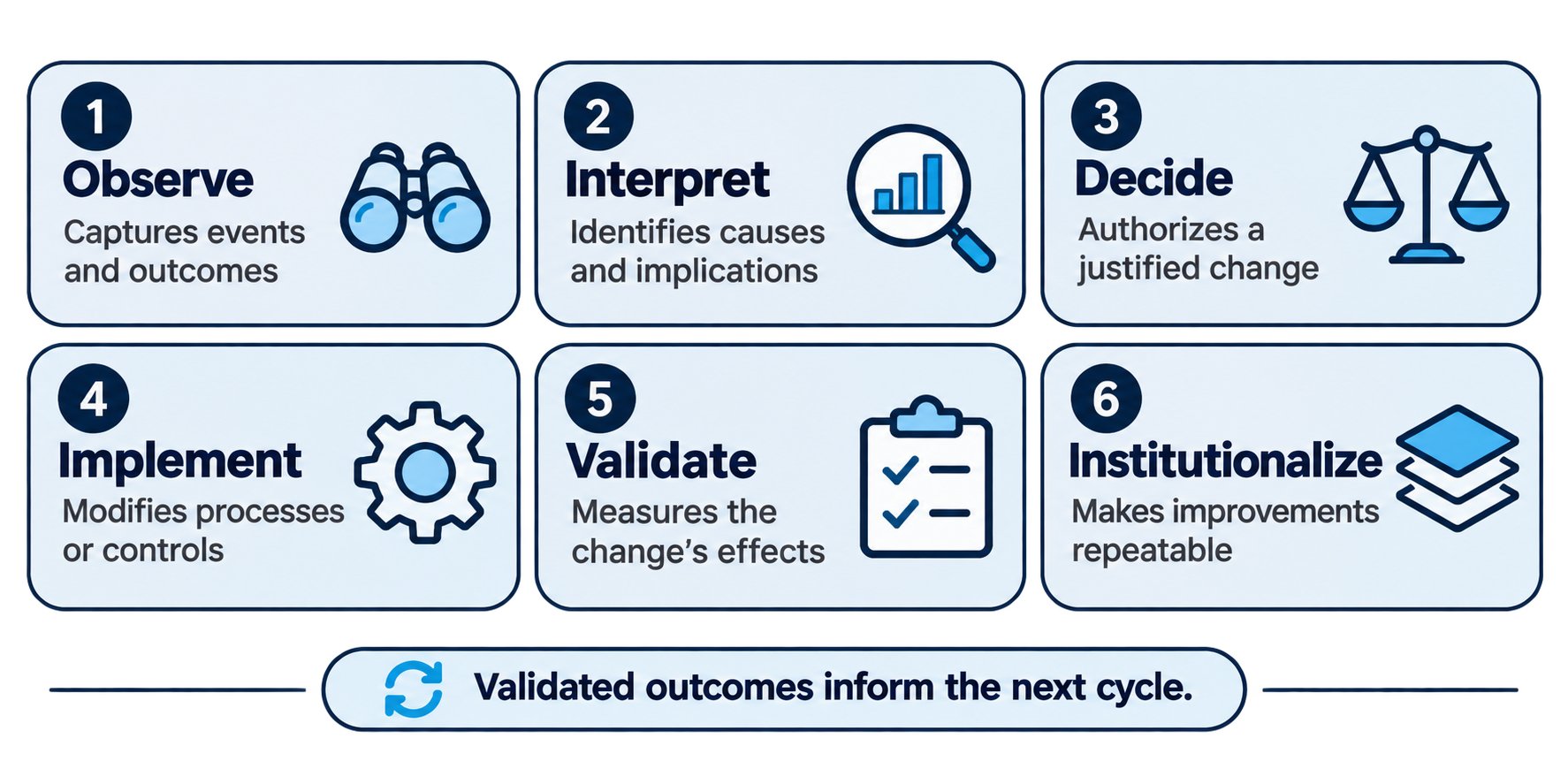
The cycle is continuous.
A change that produces better results should become part of the organization’s operating capability.
A change that fails should generate new evidence.
And changes in business conditions should trigger reconsideration of previously successful decisions.
This is not simply continuous improvement under a new name.
AI changes the potential scale, frequency, and complexity of the decisions involved.
Organizations may increasingly operate systems that make or recommend thousands of consequential decisions each day.
The enterprise must therefore develop feedback mechanisms capable of operating at comparable scale.
The strategic advantage comes from shortening the time between evidence and validated organizational improvement—not merely the time between a question and an answer.
The Enterprise Learning Velocity Model
Learning speed should be treated as a measurable enterprise capability.
I propose an Enterprise Learning Velocity Model built around six stages.
Enterprise Learning Velocity Model
| Stage | Core Question | Required Capability |
|---|---|---|
| Observation | What happened? | Reliable operational telemetry and outcome records |
| Interpretation | Why did it happen? | Analysis, context, provenance, and causal investigation |
| Decision | What should change? | Professional judgment and explicit decision authority |
| Implementation | Can we make the change? | Integrated processes, architecture, and accountable execution |
| Validation | Did the change improve results? | Baselines, controlled evaluation, and outcome measurement |
| Institutionalization | Will the improvement persist and spread? | Reusable knowledge, updated controls, and organizational adoption |
The model highlights an important principle.
Learning velocity is constrained by the weakest stage.
An organization may detect failures immediately but require months to authorize corrective changes.
Another may approve changes quickly but lack the architecture necessary to implement them.
A third may implement improvements rapidly but never validate whether they worked.
Each organization possesses a different learning bottleneck.
Investing in faster AI models will not necessarily remove those constraints.
Management must identify where evidence stops moving toward operational improvement.
That is where architectural and organizational investment should be concentrated.
The Economics of Learning Velocity
Learning speed has economic consequences.
An organization that identifies and corrects an ineffective process sooner may reduce the duration of financial losses.
An enterprise that rapidly incorporates successful practices may realize benefits earlier.
A company that detects changing customer behavior quickly may adapt its products before competitors.
A manufacturer that learns from equipment failures may reduce recurring downtime.
A cybersecurity organization that incorporates incident findings into effective controls may reduce future exposure.
These benefits arise through several mechanisms.
Economic Mechanisms of Faster Learning
| Mechanism | Potential Economic Effect |
|---|---|
| Earlier failure detection | Reduced duration and severity of losses |
| Faster corrective action | Lower recurring operational costs |
| Quicker replication of successful practices | Earlier and broader benefits realization |
| Improved decision quality | Reduced rework, waste, and avoidable errors |
| Faster adaptation to market changes | Better retention, responsiveness, or revenue opportunities |
| Reduced recurrence of known failures | Lower incident, remediation, and assurance costs |
However, learning speed should not be evaluated independently of learning quality.
An organization that changes processes frequently without validating evidence may create instability.
Rapid adaptation based on incorrect conclusions can be more damaging than deliberate action based on reliable information.
The objective is therefore not maximum change frequency.
It is the fastest responsible conversion of validated evidence into improved enterprise performance.
An Illustrative Financial Case
Consider a company operating an AI-enabled customer service process.
The system begins producing a higher rate of incorrect account adjustments.
The problem affects 400 transactions each week.
Each incorrect adjustment creates an average of $75 in additional remediation and customer service costs.
The resulting direct operational exposure is approximately $30,000 per week.
Two organizations encounter the same problem.
The first takes eight weeks to identify the underlying cause, authorize a correction, deploy the change, and verify its effectiveness.
The second completes the same learning cycle in two weeks.
Assuming the problem remains constant, the second organization avoids six additional weeks of exposure.
Illustrative Learning Velocity Economics
| Measure | Organization A | Organization B |
|---|---|---|
| Affected transactions per week | 400 | 400 |
| Average cost per affected transaction | $75 | $75 |
| Weekly direct exposure | $30,000 | $30,000 |
| Time to validated correction | 8 weeks | 2 weeks |
| Total direct exposure before correction | $240,000 | $60,000 |
| Difference in exposure | — | $180,000 lower |
All figures are hypothetical and assume comparable detection conditions, constant exposure, and an effective correction. They exclude implementation costs and secondary effects.
The example illustrates why learning velocity matters economically.
Both organizations possess the same AI capability.
Both encounter the same operational problem.
Both eventually correct it.
But the organization that learns faster experiences substantially less exposure.
The same principle applies to revenue opportunities.
An organization that identifies a successful operational improvement and scales it three months earlier may capture benefits that a slower competitor has not yet realized.
The economic value of learning is therefore connected to the timing, quality, and consequences of organizational adaptation.
Why AI Feedback Loops Need Governance
The concept of continuous AI learning can sound attractive.
Systems observe results, identify errors, update their behavior, and improve automatically.
In certain bounded technical environments, automated feedback and optimization can be highly effective.
But enterprise learning introduces governance concerns that cannot be ignored.
Not every observed outcome justifies a change.
Not every correlation establishes causation.
Not every performance improvement is acceptable under legal, ethical, contractual, or business constraints.
And not every AI system should possess authority to modify its own operating rules.
Consider an AI agent optimizing customer retention.
It discovers that offering increasingly generous discounts reduces customer departures.
If the system optimizes retention without appropriate financial constraints, it may improve one performance measure while damaging contribution margin.
The system has learned how to influence a metric.
It has not necessarily learned how to create enterprise value.
Similarly, an AI system may discover that bypassing a review procedure reduces processing time.
That improvement may violate required controls.
A governance framework must therefore establish boundaries around adaptive behavior.
Governance Requirements for AI Learning
- Defined objectives: What outcomes may the system optimize?
- Decision authority: Which changes may be made autonomously?
- Operational constraints: What limits must remain enforceable?
- Evidence requirements: What information supports the proposed change?
- Validation thresholds: What level of confidence is required before implementation?
- Human intervention: When must changes be reviewed, suspended, or reversed?
- Version control: Which model, policy, configuration, and data versions were active?
- Accountability: Who owns the consequences of the adaptation?
These controls are not obstacles to learning.
They are necessary to ensure that learning produces authorized and defensible improvements.
The intelligent enterprise should distinguish between learning that improves recommendations and learning that changes operational authority.
The first may be permitted within established analytical boundaries.
The second may require formal approval.
Learning Requires Evidence, Not Just Telemetry
Enterprise technology teams are accustomed to collecting logs, metrics, and monitoring data.
These records are important.
But they do not automatically explain why a decision was made or whether it was appropriate.
A system log may show that an AI agent executed a transaction.
It may identify the time, service account, API endpoint, and transaction result.
But it may not establish the business justification for the action.
It may not identify the policy under which the action was authorized.
It may not preserve the information used to evaluate alternatives.
And it may not connect the transaction to its eventual economic outcome.
That missing context limits organizational learning.
The enterprise needs evidence connecting decisions, actions, and consequences.
The Decision-to-Learning Evidence Chain
| Evidence Element | Learning Purpose |
|---|---|
| Business objective | Establish what the decision was intended to achieve |
| Decision context | Preserve relevant conditions and constraints |
| Information provenance | Identify the authoritative sources supporting the decision |
| Decision authority | Establish who or what was permitted to act |
| Selected action | Record what was approved or executed |
| Operational result | Capture what occurred |
| Business outcome | Determine whether the intended objective was achieved |
| Corrective learning | Document what should change and why |
This is where Evidentiary Architecture™ becomes strategically relevant.
The objective is to design enterprise systems that preserve meaningful decision evidence as part of normal operations.
When evidence is created only after a failure, the organization may lack the information required to understand the failure accurately.
When evidence is generated through the decision and execution process, the enterprise can investigate outcomes more effectively.
It can identify recurring patterns.
It can distinguish model errors from information problems.
It can determine whether failures arose from inadequate authority, flawed assumptions, poor process design, or operational constraints.
And it can preserve the lessons needed to prevent recurrence.
An enterprise cannot reliably learn from decisions it cannot reconstruct.
The Difference Between Model Learning and Enterprise Learning
This distinction is essential.
Machine learning concerns the improvement of computational models through data, training, optimization, or other adaptation mechanisms.
Enterprise learning concerns the improvement of organizational decisions, processes, governance, and capabilities.
The two can reinforce one another.
But they are not equivalent.
An organization may improve the accuracy of an AI model while leaving the business process unchanged.
It may deploy a new model version without addressing the organizational conditions responsible for poor outcomes.
It may reduce prediction errors while continuing to make economically inappropriate decisions.
Conversely, an enterprise may improve performance without changing the underlying model.
It may clarify decision authority.
It may improve information quality.
It may redesign a workflow.
It may change escalation thresholds.
It may train employees to recognize unusual conditions.
Or it may establish better coordination across business functions.
These improvements represent organizational learning.
They may create greater economic value than incremental model improvements.
Model Improvement Versus Enterprise Improvement
| Dimension | Model Learning | Enterprise Learning |
|---|---|---|
| Primary object | Computational model or algorithmic behavior | Organizational capability |
| Typical inputs | Training data, feedback, evaluations | Decisions, operational evidence, outcomes, constraints |
| Improvement target | Model performance against defined objectives | Business outcomes and operating effectiveness |
| Change mechanism | Training, tuning, configuration, model replacement | Process redesign, governance changes, architecture, workforce development |
| Accountability | Model and system owners within assigned responsibilities | Accountable business and executive leadership |
| Success criterion | Validated technical performance | Demonstrated operational and economic improvement |
The intelligent enterprise must integrate both disciplines.
Model improvement should be evaluated in relation to business outcomes.
Enterprise improvement should use AI where it meaningfully accelerates analysis, diagnosis, experimentation, and execution.
But leadership must not confuse better models with a better organization.
The Learning Architecture of the Intelligent Enterprise
A learning enterprise requires an architectural foundation.
That foundation must connect operational systems, AI services, authoritative information, decision records, performance measurement, and governance mechanisms.
The objective is to establish a continuous relationship between what the enterprise does and what it learns.
Six Architectural Capabilities
1. Operational observability
Systems must capture meaningful events, interventions, and outcomes.
Observability should extend beyond technical availability and response times to include business process performance.
2. Information provenance
The enterprise must establish which information influenced a decision and whether that information was authoritative and appropriate.
3. Decision traceability
Consequential decisions should be connected to their objectives, assumptions, authorization, and execution.
4. Outcome measurement
The organization must determine whether decisions produced their intended operational and economic effects.
5. Controlled adaptation
Changes to models, processes, policies, and delegated authority must occur through appropriate governance mechanisms.
6. Institutional knowledge integration
Validated lessons must become reusable capabilities through updated standards, workflows, controls, training, and architectural patterns.
These capabilities should not operate as isolated systems.
They must form a coherent enterprise architecture.
An organization that captures outcomes but cannot connect them to decisions will struggle to learn.
An organization that identifies lessons but cannot implement changes will remain operationally static.
An organization that implements changes without validation may confuse activity with improvement.
The architecture must support the complete learning cycle.
Why the Learning Loop Must Be Closed
Many enterprises possess feedback systems that are functionally incomplete.
They capture operational events.
They produce reports.
They identify issues.
They conduct reviews.
But the resulting recommendations do not consistently produce verified changes.
The feedback loop remains open.
A closed learning loop requires more than documenting a lesson.
It requires establishing that the lesson changed organizational behavior and improved outcomes.
Consider a cybersecurity incident.
An investigation identifies a weakness in privileged access controls.
The organization documents the finding.
A remediation ticket is created.
The ticket is eventually closed.
Has the organization learned?
Not necessarily.
The relevant questions are whether the control was corrected, whether the correction operates effectively, whether comparable weaknesses exist elsewhere, and whether the organization has reduced the likelihood or impact of recurrence.
The same principle applies to AI.
An AI evaluation may identify an unsafe agent behavior.
The finding should trigger an accountable decision about the necessary change.
The change should be implemented.
Its effectiveness should be tested.
Comparable agents should be assessed for the same weakness.
And the resulting lesson should influence future designs.
That is organizational learning.
A lesson is not institutionalized when it is documented. It is institutionalized when future decisions and operations reflect it.
Learning Speed and the Enterprise Operating Model
Organizational learning is not solely an information technology responsibility.
It depends heavily on the enterprise operating model.
An organization may possess excellent analytical capabilities but remain unable to act because decision rights are fragmented.
A process owner may identify a valuable improvement but lack authority over the systems or departments required to implement it.
A governance team may discover a recurring risk without possessing a mechanism to change operational controls.
A technology team may improve system performance while the business continues measuring the wrong outcomes.
These conditions create learning delays.
The solution requires explicit accountability.
For consequential AI-enabled processes, the enterprise should establish an owner responsible for the complete learning cycle.
That owner must coordinate with technology, finance, risk, data governance, and relevant business functions.
The owner should be accountable not merely for operational performance but also for ensuring that validated lessons produce improvements.
This is particularly important for processes spanning multiple departments.
An AI-enabled order-to-cash workflow may involve sales, finance, operations, customer service, and technology.
Learning cannot remain confined to the department where a problem first appears.
The organization must be capable of evaluating the entire process.
Otherwise, local improvements may create enterprise-wide problems.
Organizational Learning Is a Leadership Discipline
Technology can capture evidence and accelerate analysis.
It cannot independently create a culture in which leaders respond appropriately to inconvenient findings.
Organizational learning requires management behavior.
Executives must be willing to reconsider decisions when assumptions prove incorrect.
They must distinguish accountable experimentation from uncontrolled risk-taking.
They must reward the identification of systemic weaknesses rather than discourage reporting.
They must establish mechanisms for challenging established practices.
And they must avoid treating every failed experiment as evidence of individual incompetence.
This does not mean eliminating accountability.
It means distinguishing among different causes of failure.
An authorized experiment that produces an unexpected result is different from an unauthorized action that violates established controls.
A well-supported decision that fails because market conditions change is different from a decision made without adequate evidence.
A model error is different from a failure to enforce known governance requirements.
The enterprise must preserve these distinctions.
Otherwise, employees may conceal problems or avoid reporting information that challenges management assumptions.
That behavior reduces learning speed.
Effective leadership establishes both accountability and the conditions necessary for accurate organizational feedback.
The Strategic Value of Learning From Near Misses
Organizations often focus learning activities on completed failures.
But near misses can provide valuable evidence.
A near miss occurs when an undesirable outcome is avoided despite conditions that could have produced it.
In an AI-enabled enterprise, examples might include an agent attempting an unauthorized transaction that is blocked by a control, an incorrect recommendation rejected by a human reviewer, or a data quality issue detected before a consequential decision.
These events should not simply disappear into technical logs.
They can reveal weaknesses in information quality, decision boundaries, model behavior, or operating processes.
A blocked unauthorized action may indicate that an access control worked.
But it may also indicate that the agent’s decision policy requires improvement.
A human override may prevent a financial loss.
But repeated overrides may demonstrate that the underlying system is poorly aligned with business conditions.
Near misses provide opportunities to improve before losses occur.
However, organizations should avoid measuring learning success solely by the number of near misses reported.
An increase may reflect deteriorating performance, improved detection, or both.
The relevant objective is to understand the causes, evaluate control effectiveness, and reduce the recurrence of dangerous conditions.
Measuring Enterprise Learning Velocity
If learning speed is strategically important, boards and executives need meaningful measurements.
The challenge is to avoid reducing learning to activity counts.
The number of lessons learned documents is not a reliable measure of organizational learning.
Neither is the number of AI experiments conducted.
Nor is the frequency of model updates.
The enterprise needs measures connecting evidence, adaptation, and improved outcomes.
Enterprise Learning Velocity Scorecard
| Dimension | Illustrative Metric | Management Interpretation |
|---|---|---|
| Detection | Time from material event to identification | How quickly does the organization recognize meaningful change? |
| Diagnosis | Time from detection to validated explanation | How efficiently are causes established? |
| Decision | Time from validated finding to authorized action | Are decision rights enabling timely intervention? |
| Implementation | Time from authorization to operational change | Can the enterprise execute improvements efficiently? |
| Validation | Time from implementation to outcome confirmation | Does the organization verify that changes work? |
| Institutionalization | Time to incorporate validated lessons into reusable practices | Do improvements become part of normal operations? |
| Recurrence | Frequency and severity of repeated known failures | Are lessons preventing avoidable repetition? |
| Economic impact | Verified value from faster correction or adaptation | Does learning improve enterprise performance? |
These measures should be evaluated together.
Reducing diagnosis time is not necessarily beneficial if the organization begins accepting unsupported explanations.
Accelerating implementation may increase risk if controls are bypassed.
Rapid institutionalization may spread ineffective practices if validation is weak.
The objective is a reliable, end-to-end learning system.
Management should also measure the distribution of learning times rather than relying exclusively on averages.
A small number of exceptionally slow cases may reveal serious architectural or governance constraints.
The organization should understand where learning stalls and why.
A Practical Learning Velocity Calculation
For a defined class of operational issues, the enterprise can measure elapsed time across the learning cycle.
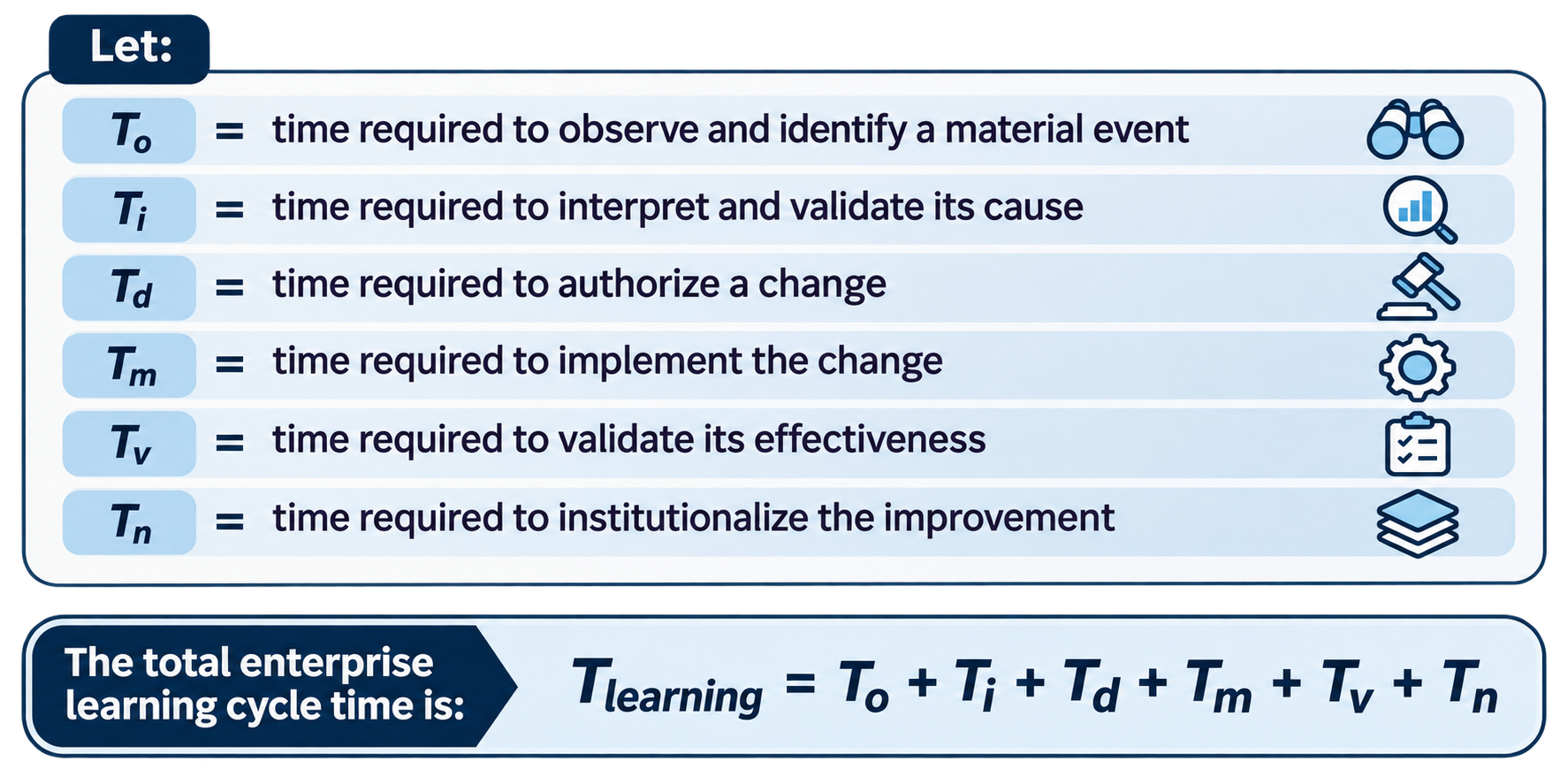
This formulation assumes the stages are measured as nonoverlapping intervals. Where activities overlap, elapsed end-to-end time should be measured directly to avoid double-counting.
The metric can help identify bottlenecks.
Suppose an organization takes:
| Learning Stage | Elapsed Time |
|---|---|
| Observation | 1 day |
| Interpretation | 3 days |
| Decision | 12 days |
| Implementation | 5 days |
| Validation | 4 days |
| Institutionalization | 15 days |
| Total | 40 days |
The organization might initially assume that better AI analytics would accelerate learning.
But observation and interpretation account for only four of the 40 days.
Decision authorization and institutionalization account for 27 days.
Improving model performance may have limited impact.
The more consequential opportunity may involve clarifying decision authority, redesigning approval processes, and establishing mechanisms for incorporating validated changes into enterprise standards.
This illustrates why learning speed is an enterprise architecture and operating-model problem, not merely an AI performance problem.
Learning Speed Can Become a Competitive Flywheel
The strongest learning organizations may develop reinforcing advantages.
Better information enables better decisions.
Better decisions produce improved outcomes.
Reliable outcome evidence enables more accurate learning.
Validated learning improves processes, controls, and information quality.
Those improvements support better future decisions.
Over time, the enterprise develops capabilities that competitors may find difficult to reproduce.
The Enterprise Learning Flywheel
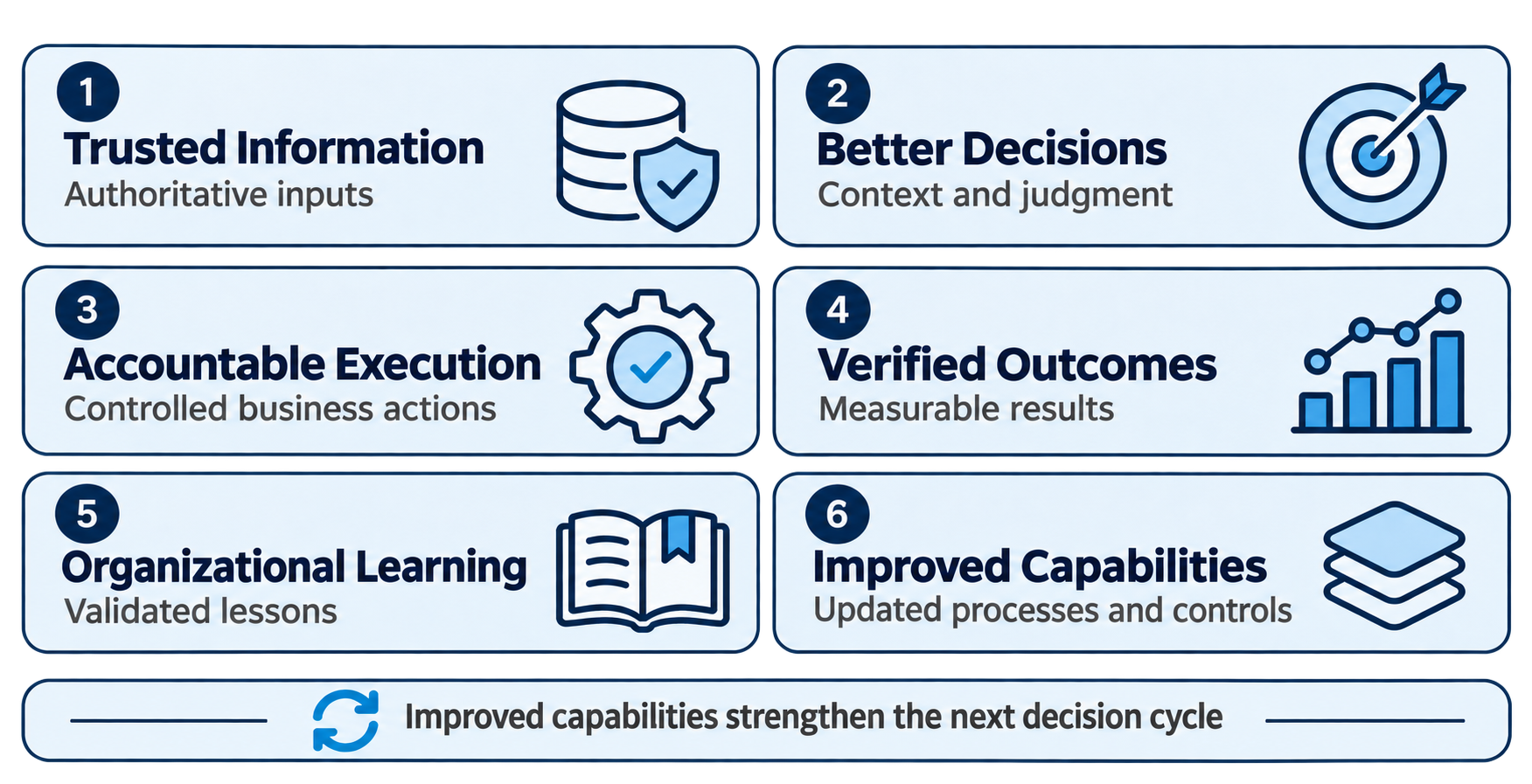
This flywheel is not automatic.
It requires evidence quality, feedback mechanisms, governance, and organizational willingness to adapt.
But when these capabilities reinforce one another, the enterprise may improve faster than competitors using similar AI technology.
That is a potentially durable advantage.
A competitor can purchase access to the same model.
It cannot necessarily purchase the accumulated operational learning embedded in another organization’s architecture, processes, decision practices, and institutional knowledge.
Why Learning Speed May Be More Defensible Than Proprietary Data
Article 17 examined the limitations of proprietary data as a competitive moat.
Learning speed offers a complementary perspective.
A proprietary dataset may provide an initial advantage.
But competitors may acquire comparable information or develop alternative methods.
An enterprise capable of learning faster can continue improving even as individual information advantages erode.
Its differentiation depends on an organizational process rather than a static asset.
That process may include distinctive customer relationships, operating practices, feedback mechanisms, architectural capabilities, and management disciplines.
These elements can be difficult to imitate because they are interconnected.
However, learning speed is not inherently defensible.
A competitor may possess superior learning capabilities.
An organization may learn quickly in one domain but slowly in another.
And rapid learning cannot compensate for a fundamentally weak business model.
The strategic advantage arises when learning is connected to valuable business capabilities and produces sustained performance improvements.
The strongest competitive position may combine proprietary information with an operating model that continuously converts new evidence into better outcomes.
The CEO’s Responsibility: Make Learning an Enterprise Priority
The CEO must establish organizational learning as a strategic capability.
That requires more than encouraging innovation.
Management must identify which business capabilities require rapid adaptation.
It must establish accountability for learning outcomes.
It must align incentives across departments.
It must ensure that important findings can challenge existing assumptions.
And it must allocate resources to the architectural and organizational mechanisms necessary for improvement.
The CEO should also distinguish between experimentation and strategic drift.
An enterprise that continuously launches new initiatives without evaluating previous results is not necessarily learning.
It may simply be increasing activity.
Learning requires disciplined comparison between expectations and outcomes.
It requires decisions about what to continue, improve, scale, or discontinue.
This is especially important for AI investments.
As the cost of generating new AI use cases declines, organizations may be tempted to pursue more opportunities than they can evaluate responsibly.
The learning enterprise must prioritize quality of adaptation over volume of experimentation.
The CIO’s Responsibility: Architect the Feedback System
The CIO’s role extends beyond deploying AI infrastructure.
The intelligent enterprise needs an architecture capable of connecting decisions to outcomes and outcomes to improvement.
The CIO should establish reusable capabilities for operational telemetry, information provenance, decision traceability, evaluation, controlled change, and institutional knowledge management.
These capabilities should support business processes across the enterprise.
They should not be reconstructed independently for every AI project.
The CIO must also ensure that feedback systems do not create uncontrolled data accumulation.
Information retention should be governed.
Sensitive information should be protected.
Access should reflect legitimate authority.
Evidence should be sufficiently complete for its purpose without becoming an unnecessary source of security or privacy exposure.
The objective is a coherent learning architecture.
That architecture should make it easier for the enterprise to understand what happened, determine why, authorize appropriate changes, and verify improvements.
In this environment, the CIO becomes an architect of organizational adaptability.
The Board’s Responsibility: Oversee Adaptive Capability
Boards increasingly recognize that AI introduces new risks and opportunities.
But oversight should extend beyond deployment, compliance, and financial returns.
Directors should also evaluate whether management is building the capacity to adapt as technology, markets, and operating conditions change.
An organization may possess a successful AI strategy today.
That does not guarantee the strategy will remain appropriate.
Models evolve.
Vendors change.
Customer expectations shift.
Regulatory requirements develop.
Competitors introduce new capabilities.
And internal operating conditions change.
The board should therefore ask whether the enterprise can recognize material changes and respond effectively.
It should expect evidence that management learns from operational outcomes.
It should understand how significant AI failures influence future controls.
It should evaluate whether successful initiatives are scaled appropriately.
And it should determine whether underperforming investments are reconsidered rather than sustained indefinitely.
This is not a request for directors to manage individual AI systems.
It is a governance responsibility concerning the organization’s adaptive capability.
The board must understand whether management has established the mechanisms necessary to keep the enterprise effective as conditions change.
The Boardroom Question
When an AI-enabled decision produces an unexpected outcome, how long does it take our organization to identify the cause, authorize a correction, validate its effectiveness, and ensure that the same failure does not recur elsewhere?
If management cannot answer that question, the enterprise may be measuring AI performance without measuring its ability to learn.
The Executive Imperative
Enterprise leaders should treat learning velocity as a strategic design objective.
Ten actions deserve immediate attention.
First, identify consequential learning domains. Focus on business processes where faster adaptation can materially improve financial performance, customer outcomes, operational resilience, or risk exposure.
Second, establish authoritative operational evidence. Ensure that significant decisions can be connected to their supporting information, authorization, execution, and results.
Third, define accountable learning ownership. Assign responsibility for converting validated findings into operational improvements.
Fourth, measure the complete learning cycle. Evaluate observation, interpretation, authorization, implementation, validation, and institutionalization.
Fifth, identify the principal bottlenecks. Determine whether learning is constrained by information quality, analysis, decision authority, architecture, or organizational adoption.
Sixth, establish controlled adaptation mechanisms. Define which changes may be automated and which require human authorization.
Seventh, close the feedback loop. Require evidence that corrective actions improve outcomes rather than merely documenting completion.
Eighth, institutionalize validated lessons. Incorporate improvements into reusable processes, controls, architectural standards, and workforce development.
Ninth, measure economic impact. Establish whether faster learning reduces losses, accelerates benefits, improves decisions, or strengthens competitive performance.
Tenth, reassess learning capabilities continuously. Evaluate whether the organization is becoming more effective at responding to new conditions rather than simply accumulating additional information.
These actions require coordinated leadership across business operations, technology, finance, risk, and governance.
No single function can deliver enterprise learning independently.
Conclusion: The Enterprise That Learns Faster Can Compete Differently
Artificial intelligence is making sophisticated analytical capabilities more accessible.
Organizations can increasingly obtain similar models, tools, and computing resources.
Proprietary information may provide differentiation, but ownership alone does not guarantee sustainable advantage.
The next strategic opportunity lies in the enterprise’s ability to convert experience into improved capability.
That requires more than collecting data.
More than producing analysis.
More than documenting lessons.
And more than deploying increasingly sophisticated AI systems.
The intelligent enterprise must observe outcomes, interpret evidence, authorize appropriate changes, implement improvements, validate results, and institutionalize what it learns.
Those activities must become part of its architecture and operating model.
An organization that learns faster can reduce the duration of operational failures.
It can recognize changing conditions sooner.
It can replicate successful practices more effectively.
It can improve governance through evidence.
And it can convert similar technological capabilities into superior economic results.
The advantage is not simply speed.
It is the disciplined ability to improve.
When competitors can access the same intelligence, the enterprise that learns faster—and turns that learning into better decisions and execution—may build the more durable competitive advantage.
References
Argyris, Chris, and Donald A. Schön. Organizational Learning II: Theory, Method, and Practice. Reading, MA: Addison-Wesley, 1996.
Barney, Jay B. “Firm Resources and Sustained Competitive Advantage.” Journal of Management 17, no. 1 (1991): 99–120. https://doi.org/10.1177/014920639101700108.
Deming, W. Edwards. Out of the Crisis. Cambridge, MA: Massachusetts Institute of Technology, Center for Advanced Engineering Study, 1986.
International Organization for Standardization and International Electrotechnical Commission. ISO/IEC 42001:2023: Information Technology—Artificial Intelligence—Management System. Geneva: ISO, 2023.
March, James G. “Exploration and Exploitation in Organizational Learning.” Organization Science 2, no. 1 (1991): 71–87. https://doi.org/10.1287/orsc.2.1.71.
National Institute of Standards and Technology. Artificial Intelligence Risk Management Framework (AI RMF 1.0). NIST AI 100-1. Gaithersburg, MD: NIST, 2023. https://doi.org/10.6028/NIST.AI.100-1.
Senge, Peter M. The Fifth Discipline: The Art and Practice of the Learning Organization. New York: Doubleday, 1990.
Teece, David J., Gary Pisano, and Amy Shuen. “Dynamic Capabilities and Strategic Management.” Strategic Management Journal 18, no. 7 (1997): 509–33.
Coming Next
Article 19: What Should the CIO Own in the AI Enterprise?
As AI becomes embedded in business processes, enterprise decision-making, and autonomous execution, the CIO’s responsibilities are changing.
The next article examines which capabilities should remain under technology leadership, which responsibilities belong to business executives, and where shared accountability is essential.
It also addresses the growing need for CIOs to lead enterprise architecture, AI integration, information authority, operational assurance, and technology economics without becoming the default owner of every AI-related business outcome.