AI Strategy Series | Article 12 of 20
Building the Intelligent Enterprise
Summary
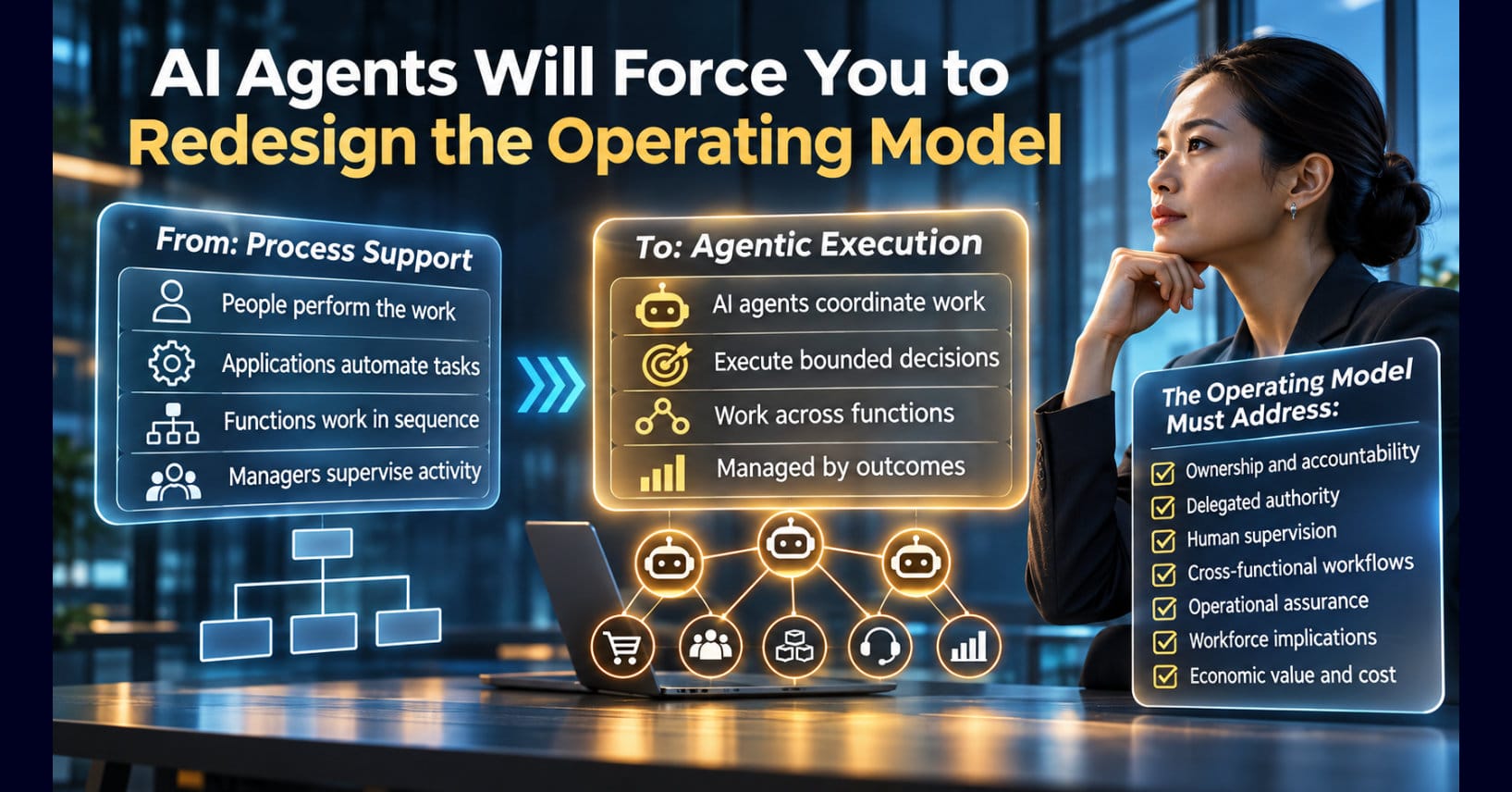
Artificial intelligence is fundamentally changing how enterprises organize, coordinate, and execute work. Unlike traditional applications that support human activities, AI agents can interpret objectives, retrieve information, coordinate workflows, and execute authorized actions across enterprise systems.
In Article 12 of the AI Strategy: Building the Intelligent Enterprise series, Victor M. Font Jr. examines why agentic AI requires more than technical integration. It demands a deliberate redesign of the enterprise operating model.
The article explores the transition from systems of record to systems of action and identifies six major operating-model challenges: business ownership, enforceable decision authority, meaningful human supervision, cross-functional coordination, outcome-based management, and agent lifecycle management.
It introduces four models of human-agent supervision, ranging from human-directed execution to exception-governed autonomy, emphasizing that the appropriate level of supervision depends on decision consequences, reversibility, and operational risk.
The article also presents a structured enterprise AI agent lifecycle and a seven-decision framework covering business ownership, delegated authority, human supervision, workflow architecture, information authority, operational assurance, and economic accountability.
Using enterprise procurement as a practical example, it demonstrates how organizations can redesign workflows around business outcomes rather than simply inserting AI agents into existing departmental processes.
Particular attention is given to the responsibilities of CIOs, CFOs, business executives, workforce leaders, and governance functions in establishing accountability and realizing measurable economic value.
The central argument is that agentic AI is not merely a new automation capability. It represents a fundamental shift in enterprise execution that requires organizations to redesign how work is assigned, authorized, supervised, measured, and governed.
For decades, enterprise operating models have been designed around a fundamental assumption: people perform work, applications support that work, and management structures coordinate the people responsible for executing it.
Artificial intelligence is beginning to challenge that assumption.
Traditional enterprise applications execute predefined transactions. Employees interpret information, make decisions, coordinate activities, and resolve exceptions. Managers supervise performance, allocate resources, and exercise authority within established organizational boundaries.
AI agents introduce something fundamentally different.
They can interpret objectives, retrieve information, select actions, invoke enterprise applications, coordinate multiple steps, evaluate intermediate results, and continue executing until a defined objective is achieved or intervention becomes necessary.
An AI agent may identify a supply shortage, evaluate alternative suppliers, prepare a purchase order, verify contractual conditions, and initiate an authorized transaction.
Another may investigate a customer complaint, retrieve account information, determine available remedies, update a customer relationship management system, and close the service request.
A third may monitor application performance, identify a developing incident, gather diagnostic evidence, execute an approved remediation procedure, and verify whether service has been restored.
These capabilities are not merely improvements in employee productivity.
They change who—or what—performs work inside the enterprise.
And that creates a strategic problem.
Most enterprise operating models were never designed to accommodate software systems that can independently coordinate activities, make bounded decisions, and execute consequential actions across organizational boundaries.
Organizations can introduce AI agents without changing their operating models.
But doing so may create a growing disconnect between how work actually happens and how authority, accountability, supervision, and performance management are formally structured.
That disconnect will become increasingly difficult to manage as agentic capabilities expand.
The enterprise cannot simply add autonomous agents to its existing organizational structure and assume that the original management model will remain sufficient.
AI agents will force organizations to redesign how work is assigned, authorized, supervised, measured, and governed.
The question is whether enterprise leadership will undertake that redesign deliberately—or wait until operational failures reveal where the existing model no longer works.
The Operating Model Was Designed Around Human Execution
An enterprise operating model describes how an organization translates strategy into operational performance.
It establishes how people, processes, technology, information, and governance mechanisms interact to produce business outcomes.
Although operating models vary considerably among industries and organizations, most share several familiar characteristics.
Business functions own defined responsibilities.
Employees execute activities within assigned roles.
Managers supervise teams and approve decisions.
Enterprise applications support transactions and information processing.
Policies establish acceptable behavior.
Escalation paths determine how exceptions are resolved.
Performance measures evaluate the effectiveness of organizational units.
These structures reflect an environment in which people remain the principal interpreters and coordinators of business activity.
Technology may automate individual transactions, but humans generally determine when, why, and how those transactions should occur.
Even sophisticated workflow automation traditionally operates within explicitly defined process sequences.
A workflow engine may route an invoice for approval.
A business rules engine may reject a transaction exceeding a financial threshold.
An integration platform may synchronize records across applications.
But these systems generally execute predetermined logic rather than dynamically interpreting objectives and selecting among possible courses of action.
AI agents introduce greater flexibility into this arrangement.
They may determine which tools to invoke, what information to retrieve, how to sequence activities, and whether additional action is required.
That flexibility can create significant operational value.
It can also challenge the organizational assumptions embedded in existing processes.
The problem is not that AI agents are equivalent to employees.
They are not.
They do not possess organizational standing, fiduciary responsibility, or independent accountability.
The problem is that AI agents can perform activities previously coordinated by employees while remaining software systems whose authority and accountability must originate elsewhere.
This distinction is central to operating-model redesign.
From Systems of Record to Systems of Action
Enterprise architecture has historically emphasized systems of record.
These systems preserve authoritative information about customers, employees, products, assets, finances, and business transactions.
Customer relationship management platforms maintain customer records.
Enterprise resource planning systems manage financial and operational transactions.
Human capital management platforms maintain workforce information.
Enterprise asset management systems preserve equipment histories, maintenance activities, and work orders.
These applications remain essential.
But AI agents introduce an additional architectural consideration.
They can become systems of action.
A system of record preserves information about what exists or what has occurred.
A system of action initiates, coordinates, or executes activities that change business conditions.
The distinction is not absolute. Traditional enterprise applications already perform actions, and many systems combine recordkeeping with transactional capabilities.
What changes with AI agents is the potential for dynamic selection and coordination of actions based on interpreted objectives.
Consider a customer service process.
A conventional application presents customer information to an employee.
The employee interprets the situation, decides what should happen, and performs the appropriate transaction.
An AI assistant may recommend a resolution while leaving execution to the employee.
An AI agent may be authorized to retrieve the information, evaluate policy conditions, select an approved remedy, update the customer record, and communicate the result.
The same business process now operates through a different distribution of responsibilities.
The system of record remains authoritative for customer information.
But the agent participates directly in determining and executing the workflow.
That change has implications for architecture, operations, supervision, and governance.
When software moves from supporting decisions to executing them, the enterprise must reconsider the operating model surrounding those decisions.
The First Operating-Model Challenge: Who Owns the Agent’s Work?
Traditional organizational accountability generally follows established reporting relationships.
A procurement manager is accountable for procurement activities.
A customer service executive is accountable for service performance.
A finance executive is accountable for financial processes.
An IT operations leader is accountable for technology service delivery.
Now consider an AI agent that performs activities spanning several functions.
Suppose an agent identifies a supply shortage.
It retrieves inventory data from an enterprise resource planning system.
It evaluates supplier performance information.
It checks contractual terms.
It recommends a purchase.
It initiates an authorized procurement transaction.
It updates delivery expectations.
It notifies production planning.
The agent has participated in inventory management, supplier evaluation, procurement, contract compliance, and production coordination.
Which function owns the agent?
The question is poorly framed if ownership means simply identifying the department that purchased the software.
The relevant issue is accountability for the business process and the decisions executed within it.
An agent may be technically operated by IT while performing work that belongs to procurement.
It may rely on data governed by supply chain management.
It may invoke financial controls established by the CFO.
It may operate under enterprise risk requirements established by governance functions.
These responsibilities cannot be collapsed into a single technical owner.
But neither can they be left ambiguous.
A workable model distinguishes several forms of responsibility.
| Responsibility | Primary Concern |
|---|---|
| Business process owner | Outcomes, performance, and appropriate use of the agent |
| Decision authority owner | Which decisions the agent may execute and under what conditions |
| Technical service owner | Availability, integration, configuration, and operational reliability |
| Data authority owner | Authoritative information, definitions, quality, and permitted use |
| Risk and control owner | Control requirements, testing, monitoring, and escalation |
| Executive accountable owner | Overall accountability for the business capability and its consequences |
These responsibilities may reside in different organizational functions.
That is acceptable.
What is not acceptable is allowing their distribution to obscure who is accountable when the agent produces an undesirable outcome.
AI agents can distribute execution across systems. They cannot distribute accountability into nonexistence.
The operating model must make these relationships explicit.
The Second Challenge: Decision Authority Must Become Executable
Traditional organizations frequently rely on human judgment to interpret decision authority.
Employees understand their responsibilities through job descriptions, policies, managerial direction, professional experience, and organizational practice.
Some authority boundaries are formal.
Others are contextual.
A procurement employee may know that purchases above a certain amount require additional approval.
A customer service representative may understand when an exception warrants managerial review.
A financial analyst may recognize that an unusual transaction should be escalated.
AI agents cannot safely depend on these informal arrangements.
They require explicit, enforceable boundaries.
An instruction telling an agent to follow company policy is not equivalent to an architecture that prevents unauthorized actions.
The distinction becomes particularly important when agents interact with enterprise systems through APIs, automation platforms, or protocols such as the Model Context Protocol.
A technical integration may make an action available.
That does not establish that the agent is authorized to perform it.
For example, an agent may have technical access to a customer management API that permits record modification.
But its legitimate authority may be limited to updating contact preferences and correcting specific administrative fields.
It may not be authorized to modify contractual terms, credit limits, account ownership, or customer eligibility.
The operating model must distinguish between technical capability and delegated business authority.
This requires an enforceable decision-rights architecture.
At a minimum, that architecture should establish:
- Which agent identity is executing the action.
- Which business function has delegated authority.
- Which actions and data elements are permitted.
- Which contextual conditions must be satisfied.
- What financial, operational, or risk limits apply.
- Which decisions require human approval.
- What evidence must be retained.
- How authority is suspended, revised, or revoked.
The rules should be enforced by trusted services and enterprise applications, not left solely to the agent’s interpretation of natural-language instructions.
A model’s ability to select an action does not confer authority to execute it.
That authority must remain a deliberate enterprise decision.
The Third Challenge: Human Supervision Must Be Redesigned
Many organizations respond to concerns about AI autonomy by requiring a human in the loop.
That requirement may be appropriate.
But it is not a complete operating model.
Human involvement can take several forms.
A person may initiate an agent’s activity.
A person may approve a proposed action.
A person may monitor an agent’s execution.
A person may review exceptions.
A person may intervene when performance deviates from expected conditions.
These arrangements provide different levels of control.
They should not be treated as interchangeable.
Consider an AI agent that prepares 500 procurement recommendations each day.
If a manager must approve every recommendation, the organization may preserve formal human oversight.
But has it preserved meaningful judgment?
If the manager lacks sufficient time, context, or information to evaluate the recommendations, the approval process may become little more than a procedural formality.
The enterprise has retained a human approval step without necessarily retaining effective human control.
This is an operating-model failure.
A better approach is to design supervision around the consequences and reversibility of the decisions involved.
Low-risk, reversible activities may be suitable for automated execution within defined limits.
Higher-impact activities may require explicit approval.
Unusual conditions may trigger escalation.
Repeated control failures may require suspension of the agent’s authority.
The objective is not maximum autonomy or maximum human intervention.
It is an appropriate distribution of responsibility.
Four Models of Human-Agent Supervision
| Supervision Model | Agent Role | Human Responsibility |
|---|---|---|
| Human-directed | Agent performs requested tasks | Human initiates and evaluates the work |
| Human-authorized | Agent proposes consequential actions | Human approves execution |
| Human-supervised | Agent executes within defined limits | Human monitors performance and handles exceptions |
| Exception-governed | Agent executes routine workflows autonomously | Human intervenes when predefined conditions require it |
These models are not a maturity ranking.
An exception-governed arrangement is not automatically superior to a human-directed one.
The appropriate model depends on the business process, decision consequences, reliability requirements, and acceptable risk.
For some activities, retaining direct human control will remain essential.
For others, requiring individual approval of every transaction may eliminate much of the value AI agents could provide.
The operating model must determine where human judgment creates value and where human intervention is required for accountability and control.
That is a business design decision, not merely a model configuration.
The Fourth Challenge: Organizational Boundaries Will Become Increasingly Artificial
Enterprise departments exist partly because coordinating people and information has historically been expensive.
Functions specialize.
Responsibilities are divided.
Information moves through established channels.
Managers coordinate dependencies.
These arrangements create accountability and expertise, but they also introduce handoffs, queues, and delays.
AI agents can potentially reduce some of these coordination costs.
An agent may retrieve information from several systems, reconcile inconsistencies, and coordinate actions without waiting for employees in multiple departments to exchange messages.
That capability challenges the assumption that every cross-functional activity requires a corresponding sequence of human handoffs.
Consider employee onboarding.
A traditional process may involve human resources, IT, facilities, finance, security, and departmental management.
Each function performs its assigned activities.
Requests move through tickets, emails, approvals, and service queues.
An appropriately designed agentic workflow could coordinate many of these activities through enterprise services.
It might verify that required approvals exist, initiate account provisioning, request equipment, schedule orientation activities, and monitor completion.
The agent would not eliminate the accountability of the participating functions.
Nor should it bypass their controls.
But it could change how those functions coordinate.
Instead of each department manually managing its portion of the process, the enterprise could establish an end-to-end workflow with defined service responsibilities and automated orchestration.
This creates an important operating-model opportunity.
Organizations may begin designing work around business outcomes rather than departmental sequences.
That does not mean functional specialization disappears.
Legal expertise remains necessary.
Financial accountability remains necessary.
Clinical judgment remains necessary.
Cybersecurity responsibilities remain necessary.
But the coordination mechanisms connecting those functions can change substantially.
The enterprise should distinguish between organizational boundaries that preserve necessary expertise and accountability and boundaries that exist primarily because older processes required manual coordination.
AI agents may make the latter increasingly difficult to justify.
The Fifth Challenge: Management Must Shift From Activity Supervision to Outcome Supervision
Traditional management practices often emphasize activity.
Managers review assignments.
They monitor workload.
They approve transactions.
They evaluate employee output.
They intervene when tasks are delayed.
These practices reflect a world in which work is performed primarily by people and coordinated through human reporting relationships.
Agentic execution changes the supervisory problem.
A manager may oversee a business process in which much of the routine work is performed by software.
The relevant questions become different.
Is the process achieving its intended outcome?
Are agents operating within delegated authority?
Are exceptions being identified and escalated?
Are the underlying data sources reliable?
Are error rates increasing?
Are operational costs changing?
Are controls functioning as intended?
Is the agent’s behavior remaining within the conditions under which deployment was approved?
These questions require a different management discipline.
The manager is no longer supervising only employee activity.
The manager is supervising a business capability that combines human judgment, software execution, enterprise information, and automated decision-making.
That responsibility demands new operational visibility.
Managers need more than a list of completed agent tasks.
They need evidence of process performance, decision legitimacy, exception handling, and business outcomes.
This is where agentic operating models intersect with observability and assurance.
An organization may know that an agent executed 10,000 transactions.
That statistic does not establish whether those transactions were appropriate.
A meaningful operational view must distinguish successful execution from authorized, accurate, and economically valuable execution.
The management question is not simply whether the agent completed the work. It is whether the enterprise should have permitted the work to be completed in that manner.
The Sixth Challenge: Agents Require an Operational Lifecycle
Employees have established organizational lifecycles.
They are recruited, onboarded, assigned responsibilities, trained, supervised, evaluated, transferred, and eventually separated from the organization.
Enterprise applications also have lifecycles.
They are designed, implemented, tested, operated, maintained, upgraded, and retired.
AI agents require an operational lifecycle that combines elements of both while recognizing that they are software systems rather than employees.
An agent may have an identity.
It may possess delegated permissions.
It may be assigned a defined business function.
It may use enterprise tools.
It may operate under performance expectations.
It may require supervision.
Its authority may need to change over time.
Yet traditional application management practices do not always address the operational consequences of dynamically selected actions.
And traditional workforce management practices do not apply directly to software.
Enterprises therefore need a deliberate agent lifecycle.
An Enterprise AI Agent Lifecycle
1. Business justification
Define the business outcome, process responsibility, and economic rationale for deploying the agent.
2. Authority design
Establish permitted actions, decision boundaries, data access, approval requirements, and escalation conditions.
3. Technical implementation
Configure the agent, integrations, tools, identity, and enforcement mechanisms.
4. Evaluation and authorization
Test functionality, reliability, security, control effectiveness, and behavior under exceptional conditions before granting production authority.
5. Controlled deployment
Introduce the agent within approved operational boundaries and establish monitoring responsibilities.
6. Continuous supervision
Measure process performance, exceptions, authority compliance, costs, and business outcomes.
7. Change management
Reevaluate the agent when models, prompts, tools, permissions, workflows, or underlying business conditions change materially.
8. Suspension and retirement
Revoke authority, terminate access, preserve required records, and address unfinished transactions when the agent is suspended or decommissioned.
This lifecycle should not be confused with a human employment lifecycle.
An agent does not become an organizational officer because it possesses an identity or performs work.
Its identity exists to support technical authentication, authorization, traceability, and operational management.
Its authority is delegated.
Its accountability remains with the organization.
Agent Identity Is Not Agent Accountability
As organizations deploy more agents, they will increasingly need to distinguish among them.
Each production agent should have an identifiable technical and operational identity appropriate to its architecture.
That identity should support authentication, authorization, monitoring, and attribution of actions.
However, identity alone is insufficient.
Knowing which agent executed a transaction does not establish why the transaction was authorized.
Nor does it identify the executive accountable for the underlying business process.
Consider an agent that modifies a supplier payment instruction.
An audit log may identify the agent and the API call.
But a defensible operational record should also establish the business context, the authority under which the action occurred, the information used, the applicable controls, and the outcome.
This becomes especially important when agents delegate activities to other agents.
A coordinating agent may invoke a specialized agent to evaluate a contract.
That agent may invoke another service to retrieve supplier data.
The resulting transaction may involve several technical identities.
The enterprise must preserve the chain of delegated authority across the execution path.
Otherwise, it risks creating a technically observable process whose accountability is difficult to reconstruct.
Traceability must follow the business decision, not merely the individual software components participating in it.
This is one reason agentic architecture and operating-model design cannot be treated as separate disciplines.
Multi-Agent Systems Will Complicate Coordination
The operating-model challenge becomes more pronounced when multiple agents collaborate.
A single agent performing a narrowly defined activity can often be governed through relatively straightforward boundaries.
A multi-agent system introduces additional coordination questions.
Which agent establishes the objective?
Which agent may delegate work?
What authority can be passed to another agent?
Can one agent modify the instructions or operating conditions of another?
How are conflicting recommendations resolved?
Who determines when the overall workflow is complete?
What happens when one agent fails while others continue?
How are cumulative financial and operational exposures controlled?
These are not merely software engineering questions.
They are questions about the enterprise’s distribution of authority and responsibility.
For example, an organization might deploy specialized agents for procurement analysis, supplier evaluation, contract verification, and purchase execution.
Individually, each agent may operate within an approved scope.
But the combined workflow could produce a consequential financial commitment.
The enterprise must ensure that the overall transaction remains within authorized limits.
This requires controls at the workflow level, not only at the individual agent level.
An agent’s permission to perform a component action should not automatically permit a chain of agents to create an outcome beyond the authority granted to the originating business process.
The same principle applies to operational risk.
Several individually acceptable actions may produce an unacceptable cumulative exposure.
Agent-level controls are necessary. Enterprise-level outcome controls remain essential.
As multi-agent systems become more common, organizations will need orchestration and control mechanisms that preserve these distinctions.
The Economics of Agentic Work Are Different
AI agents also challenge traditional approaches to workforce planning and productivity measurement.
An organization may evaluate an agent by comparing its operating cost with the labor hours required to perform equivalent activities.
That comparison can be useful.
But it is incomplete.
Agentic systems can change the economics of coordination.
They may reduce waiting time.
They may eliminate repetitive handoffs.
They may operate continuously.
They may support higher transaction volumes without proportional increases in staffing.
They may improve responsiveness by executing activities when conditions arise rather than waiting for scheduled human intervention.
These benefits can be more consequential than task-level labor savings.
Consider a supply chain process that requires several employees to coordinate a routine replenishment decision.
An agentic workflow may reduce the elapsed time between identifying the need and initiating the approved transaction.
The economic benefit may arise from fewer stockouts, lower inventory buffers, improved asset utilization, or reduced production disruption.
Those outcomes are not adequately captured by calculating the minutes employees no longer spend exchanging information.
At the same time, agents introduce operating costs.
Inference and tool usage may be consumption-based.
Monitoring and evaluation require infrastructure.
Exceptions require human attention.
Errors may generate rework.
Additional controls may be necessary as authority expands.
A credible economic analysis must therefore evaluate the complete process.
The business case for agentic AI should measure changes in enterprise throughput, quality, cost, and risk—not simply the replacement of human activity.
This connects directly to the productivity conversion gap discussed in Article 11.
AI agents can create substantial value by changing how work is coordinated.
But that value must be deliberately designed and measured.
Why the CIO Cannot Own the Entire Agentic Operating Model
The CIO will play a central role in enterprise agentic AI.
The technology organization must establish architecture, integration standards, identity services, security controls, observability, resilience, and operational support.
It must also address platform selection, technical debt, interoperability, and vendor dependencies.
But the CIO cannot independently determine the business authority that agents should possess.
That responsibility belongs to the enterprise functions accountable for the decisions and outcomes involved.
Consider an AI agent operating within accounts payable.
IT may establish the technical controls that prevent unauthorized transactions.
But finance leadership must determine the acceptable financial limits, approval conditions, exception rules, and business consequences.
Similarly, IT may provide the architecture for a customer service agent.
But customer operations leadership must determine which remedies may be offered, which commitments may be made, and when human intervention is required.
The CIO enables the capability.
The business owns the outcome.
Risk and governance functions establish and evaluate the relevant control requirements.
Finance validates the economics.
Human resources and organizational development support changes to employee responsibilities and management practices.
These responsibilities require coordination.
They should not be confused with interchangeable accountability.
An enterprise AI steering committee may establish standards, resolve cross-functional conflicts, and prioritize investment.
But a committee should not become a substitute for named executive accountability.
Agentic AI requires federated execution with explicit business ownership and enterprise-wide architectural controls.
That is a more demanding model than simply assigning every AI initiative to an IT department or centralized AI Center of Excellence.
The Agentic Operating Model: Seven Design Decisions
Enterprise leaders should address seven fundamental design decisions before expanding autonomous execution.
| Design Decision | Executive Question |
|---|---|
| Business ownership | Which executive is accountable for the outcome produced by the agent? |
| Delegated authority | Which decisions and actions may the agent execute independently? |
| Human supervision | Where must people approve, monitor, or intervene? |
| Workflow architecture | How will agents coordinate work across systems and functions? |
| Information authority | Which data sources and definitions may the agent rely upon? |
| Operational assurance | How will the enterprise verify correct, authorized, and effective execution? |
| Economic accountability | How will the organization measure the value and total cost of agentic work? |
These decisions should be documented and revisited as agent capabilities change.
They are not one-time implementation choices.
An agent that initially retrieves information may later receive permission to update records.
An agent that initially recommends procurement actions may later be authorized to initiate purchases.
An agent that operates within one department may eventually coordinate activities across several functions.
Each expansion changes the operational and governance implications.
Authority should therefore evolve through deliberate approval, testing, and evidence—not merely through configuration changes made for convenience.
A Practical Example: Redesigning Enterprise Procurement
Consider a manufacturer with a conventional procurement operating model.
Inventory planners identify replenishment requirements.
Procurement analysts evaluate suppliers.
Contract specialists review terms.
Managers approve commitments.
Purchasing personnel create orders.
Finance verifies financial controls.
Operations monitors delivery.
The process involves multiple functions, systems, and handoffs.
Now suppose the organization introduces AI agents.
A planning agent monitors inventory and demand signals.
A supplier evaluation agent retrieves performance and pricing information.
A contract analysis agent identifies applicable purchasing conditions.
A procurement execution agent prepares and, where authorized, submits transactions.
A monitoring agent tracks delivery commitments and identifies exceptions.
The organization could simply insert these agents into the existing process.
Employees would continue to manage the same handoffs, approvals, and departmental queues.
Some tasks would become faster.
But the underlying operating model would remain largely unchanged.
Alternatively, the organization could redesign the process around the business outcome: maintaining material availability within defined cost, quality, and risk constraints.
Routine replenishment activities could follow an automated path when approved conditions are satisfied.
Unusual supplier terms could trigger contract review.
Purchases exceeding delegated limits could require managerial authorization.
Conflicting inventory information could suspend execution until the authoritative record is established.
Supplier performance deterioration could trigger an exception workflow.
Every consequential transaction could preserve the relevant authority and execution evidence.
The process owner would remain accountable for procurement performance.
The technical service owner would remain responsible for agent infrastructure.
Finance would retain its financial control responsibilities.
Contract and risk functions would retain their respective authority.
The operating model would change because coordination, supervision, and execution would no longer depend on the original sequence of manual handoffs.
The objective would not be to remove people indiscriminately.
It would be to direct human expertise toward decisions requiring judgment while allowing controlled automation to execute appropriate routine activities.
This is what agentic operating-model redesign looks like in practice.
The Workforce Implications Cannot Be Deferred
AI agents will change the work employees perform.
Some activities will disappear.
Others will become less frequent.
New responsibilities will emerge.
Employees who previously executed routine transactions may increasingly supervise automated workflows, resolve exceptions, evaluate complex situations, and improve process performance.
Managers may need to understand agent behavior, operational controls, and the interpretation of automated decision evidence.
Business analysts may become more involved in defining decision authority and workflow conditions.
Enterprise architects may need to model relationships among business processes, agents, data authority, and execution controls.
Technology operations teams may assume new responsibilities for agent lifecycle management and reliability.
These changes require deliberate workforce planning.
Organizations should not assume that employees can transition into redesigned roles without preparation.
Nor should they assume that every employee will automatically benefit from the redistribution of work.
Leadership must evaluate changes in required competencies, decision responsibilities, workload, professional judgment, and career development.
The workforce implications are particularly important in industries where human relationships and professional accountability are central to service quality.
Healthcare provides a clear example.
An AI agent may coordinate administrative activities or prepare clinical information.
But the organization must preserve appropriate clinical decision authority, professional standards, and patient-centered responsibilities.
A technically efficient workflow that weakens professional judgment or patient trust may be an operational failure.
The same principle applies in financial services, legal operations, public administration, and other consequential environments.
Workforce strategy must be designed alongside the agentic operating model, not introduced after the technology has already changed the work.
What Boards Should Ask About Agentic AI
Boards do not need to approve every agent configuration or operational workflow.
They do need confidence that management has established an appropriate operating model for autonomous execution.
The questions should focus on accountability, authority, operational resilience, and business outcomes.
- Which business processes currently permit AI agents to execute actions without individual human approval?
- Who is accountable for those processes and their outcomes?
- How is delegated authority defined, enforced, and reviewed?
- What prevents an agent from exceeding its approved scope?
- How are human supervision and exception handling designed?
- Can management demonstrate what agents did, why actions were authorized, and what outcomes resulted?
- How are agent failures, unauthorized actions, and cumulative exposures detected and contained?
- What operating-model and workforce changes are required to realize the expected value?
- How does management determine whether agentic execution improves enterprise economics?
- What conditions would cause an agent’s authority to be suspended or withdrawn?
These questions are not intended to discourage adoption.
They establish the management discipline necessary to scale agentic capabilities responsibly.
The greater the autonomy, the more important it becomes to demonstrate that the enterprise has deliberately designed the surrounding operating model.
The Boardroom Question
If an AI agent can independently coordinate work, make bounded decisions, and execute transactions across several business functions, does our operating model clearly establish who owns the outcome, who authorized the activity, and who is responsible when something goes wrong?
This is not simply an AI governance question.
It is an enterprise design question.
An organization that cannot answer it has not fully defined how autonomous work fits within its management structure.
The Executive Imperative
Enterprise leaders should begin redesigning operating models before autonomous agents become deeply embedded in business execution.
That does not require replacing the entire organizational structure.
It requires identifying where agentic capabilities challenge existing assumptions about work, authority, supervision, and accountability.
The CIO should establish architectural standards for agent identity, integration, authorization, observability, and lifecycle management.
Business executives should define the outcomes, responsibilities, and decision boundaries associated with agentic workflows.
The CFO should establish credible measures of economic value and total operating cost.
Risk and governance leaders should define assurance requirements appropriate to the consequences of autonomous action.
Workforce leaders should prepare employees and managers for changes in responsibilities, skills, and supervision.
Together, these functions must establish an operating model in which AI agents can contribute to enterprise performance without creating ambiguity about authority or accountability.
The strategic objective is not maximum autonomy.
It is the deliberate allocation of work among people, agents, and enterprise systems according to capability, consequence, and accountability.
Organizations that make these decisions explicitly will be better positioned to scale agentic AI.
Those that treat agents as another software feature may find themselves operating autonomous capabilities within management structures that no longer adequately describe how the enterprise functions.
Conclusion: Autonomous Execution Requires Deliberate Enterprise Design
AI agents represent a consequential shift in enterprise technology.
They can move beyond assisting employees to coordinating activities and executing work.
They can reduce manual handoffs, accelerate decisions, and change the economics of business processes.
But those benefits do not emerge simply because an organization deploys agentic software.
They depend on how the enterprise redesigns the surrounding operating model.
Business ownership must remain explicit.
Decision authority must become enforceable.
Human supervision must be meaningful.
Cross-functional workflows must be reconsidered.
Operational evidence must support accountability.
Workforce responsibilities must evolve.
Economic performance must remain the ultimate measure of value.
These are not isolated technical implementation concerns.
They are fundamental questions about how the enterprise is organized and managed.
The defining challenge of agentic AI is not teaching software to perform more work. It is redesigning the enterprise so that autonomous execution produces value without dissolving accountability.
The organizations that understand this distinction will approach AI agents as a catalyst for operating-model transformation.
The organizations that overlook it may discover that their technology has advanced beyond the structures responsible for controlling it.
AI agents will force enterprises to redesign their operating models.
The only real choice is whether that redesign will be intentional.
References
Davenport, Thomas H., and Nitin Mittal. All-in on AI: How Smart Companies Win Big with Artificial Intelligence. Boston: Harvard Business Review Press, 2023.
Dumas, Marlon, Marcello La Rosa, Jan Mendling, and Hajo A. Reijers. Fundamentals of Business Process Management. 2nd ed. Berlin: Springer, 2018.
International Organization for Standardization and International Electrotechnical Commission. ISO/IEC 42001:2023: Information Technology—Artificial Intelligence—Management System. Geneva: ISO, 2023.
National Institute of Standards and Technology. Artificial Intelligence Risk Management Framework (AI RMF 1.0). NIST AI 100-1. Gaithersburg, MD: NIST, 2023.
National Institute of Standards and Technology. AI RMF Generative Artificial Intelligence Profile. NIST AI 600-1. Gaithersburg, MD: NIST, 2024.
Ross, Jeanne W., Peter Weill, and David C. Robertson. Enterprise Architecture as Strategy: Creating a Foundation for Business Execution. Boston: Harvard Business School Press, 2006.
Weill, Peter, and Jeanne W. Ross. IT Governance: How Top Performers Manage IT Decision Rights for Superior Results. Boston: Harvard Business School Press, 2004.
Coming Next
Article 13: Your Org Chart Was Designed for Human Information Flow
Traditional organizational structures reflect the historical cost of coordinating people, information, and decisions.
Departments specialize. Managers aggregate information. Reporting relationships establish authority. Hierarchies coordinate activities across increasingly complex enterprises.
But what happens when AI can retrieve, interpret, and distribute information across those boundaries almost instantaneously?
The next article examines how artificial intelligence challenges the information-flow assumptions underlying conventional organizational design.
We will explore why management layers, departmental boundaries, reporting relationships, and coordination mechanisms may need to evolve as AI changes how information moves and decisions are prepared.
If AI changes the economics of information flow, it may also change the economics of organizational hierarchy.