AI Strategy Series | Article 10 of 20
Building the Intelligent Enterprise
Summary
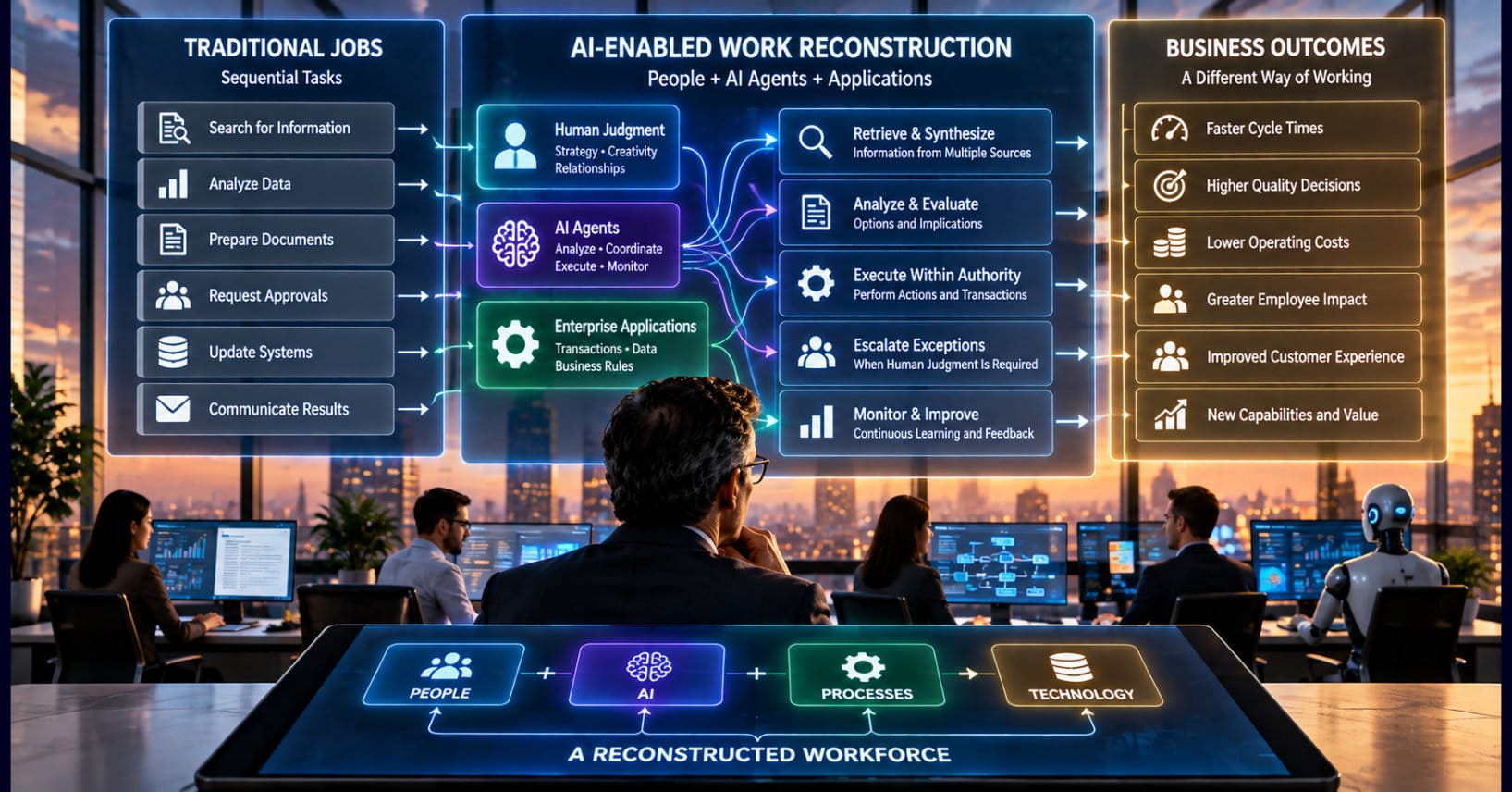
Enterprise discussions about artificial intelligence frequently focus on job displacement, workforce reductions, and task automation. However, this perspective overlooks a more consequential transformation: AI is changing how organizations structure and execute work.
In Article 10 of the AI Strategy: Building the Intelligent Enterprise series, Victor M. Font Jr. examines why successful AI transformation requires reconstructing business processes rather than simply automating existing job responsibilities.
The article distinguishes between jobs as organizational constructs and work as the collection of activities, decisions, information flows, and responsibilities required to produce business outcomes.
Using examples from insurance claims processing, customer service, procurement, finance, and supply chain operations, it demonstrates how AI can change the distribution of work among employees, enterprise applications, and autonomous agents.
Particular attention is given to the economics of coordination, decision authority, organizational boundaries, workforce planning, and the limitations of measuring productivity through isolated task improvements.
The article introduces a six-dimensional framework for AI-enabled work reconstruction, addressing business outcomes, activity necessity, human contribution, AI capabilities, decision authority, and end-to-end process performance.
It also examines why workforce strategies must follow redesigned business processes rather than begin with predetermined staffing reductions.
The central argument is that AI’s greatest strategic value will come not from automating existing jobs but from redesigning how people, intelligent systems, and enterprise applications collaborate to produce measurable business outcomes.
The enterprise conversation about artificial intelligence and employment is focused on the wrong unit of analysis.
Executives ask which jobs AI will eliminate.
Employees wonder whether their positions will survive.
Consultants publish estimates of how many occupations are exposed to automation.
Technology vendors demonstrate systems capable of performing tasks previously assigned to human workers.
These discussions are understandable. Artificial intelligence will affect employment, and some positions will undoubtedly disappear as organizations adopt new operating models.
But concentrating exclusively on job replacement obscures a more significant transformation.
Artificial intelligence does not simply automate jobs. It changes how work is decomposed, coordinated, executed, and evaluated.
A job is an organizational construct.
It represents a collection of responsibilities, activities, decisions, relationships, and accountabilities assigned to a person or position.
Work is something different.
Work consists of the activities required to produce a business outcome.
Those activities can be distributed across employees, applications, external providers, automated systems, and increasingly autonomous AI agents.
When artificial intelligence changes how those activities are performed, the consequences extend beyond individual job descriptions.
Business processes change.
Decision boundaries move.
Coordination requirements shift.
Information flows are reconstructed.
Management responsibilities evolve.
And the organization may discover that its existing operating model was designed around limitations that no longer apply.
The strategic question is therefore not simply:
Which jobs can AI automate?
It is:
If we designed this work today, with artificial intelligence available as a native enterprise capability, would we organize it the same way?
For many business processes, the answer will be no.
The Job Is the Wrong Starting Point
Traditional automation initiatives frequently begin by identifying repetitive activities within existing jobs.
A finance employee manually reconciles transactions.
A customer service representative searches for account information.
A procurement specialist compares supplier quotations.
A human resources administrator reviews employee documentation.
The organization introduces technology to perform selected activities faster or with less human effort.
The existing process remains largely intact.
Employees continue performing the surrounding work.
This approach can generate measurable productivity improvements.
But it also preserves assumptions embedded in the original operating model.
Why does the finance employee perform reconciliation at the end of the month?
Why must the customer service representative search across several systems before resolving a problem?
Why does procurement require multiple handoffs to compare suppliers?
Why does an employee need to assemble information manually before a manager can make a decision?
Some of these activities exist because of legitimate business requirements.
Others exist because information is fragmented, applications cannot communicate, decisions are centralized, or earlier technologies could not support more integrated execution.
AI creates an opportunity to distinguish between the two.
The objective should not automatically be to automate every existing activity.
It should be to determine whether those activities remain necessary.
Automating an inefficient process may make the inefficiency faster. Reconstructing the work can eliminate the inefficiency altogether.
That distinction separates incremental automation from enterprise transformation.
Jobs Are Bundles of Tasks, Decisions, and Responsibilities
An enterprise job description typically combines several different forms of work.
Consider a customer service representative.
The position may involve receiving inquiries, identifying customers, retrieving information, interpreting policies, evaluating available options, making decisions, executing transactions, documenting interactions, and managing customer relationships.
These activities have different characteristics.
Some involve information retrieval.
Others require judgment.
Some follow established rules.
Others involve ambiguity, negotiation, or empathy.
Some require authority to modify enterprise records.
Others involve responsibility for outcomes that cannot be delegated to a software system without additional organizational decisions.
Treating the entire job as a single automation target ignores these distinctions.
A more useful approach separates the work into its constituent elements.
| Work Component | Traditional Execution | Potential AI-Enabled Approach |
|---|---|---|
| Information retrieval | Employee searches multiple systems | AI retrieves relevant information from authorized sources |
| Classification | Employee categorizes requests | AI classifies routine requests with appropriate validation |
| Analysis | Employee evaluates information | AI prepares analysis and identifies alternatives |
| Decision support | Employee develops recommendations | AI generates recommendations for authorized decision-makers |
| Transaction execution | Employee updates enterprise applications | AI executes permitted actions through controlled services |
| Exception handling | Employee investigates unusual situations | AI identifies exceptions and routes them for appropriate review |
| Relationship management | Employee communicates and negotiates | Human remains responsible, supported by AI-generated context |
| Accountability | Employee or manager owns the outcome | Organizational accountability remains explicitly assigned |
This decomposition reveals opportunities that job-level automation estimates cannot adequately explain.
Some activities may be automated.
Others may be augmented.
Some may become unnecessary.
Others may become more important because AI changes the volume, speed, or complexity of work.
And entirely new responsibilities may emerge.
The resulting job may bear little resemblance to its predecessor, even when the employee remains in the same department.
The Difference Between Task Automation and Work Reconstruction
Consider a hypothetical insurance company processing customer claims.
Its existing process involves several departments.
A customer submits a claim.
An intake employee reviews the submission.
A second employee verifies policy information.
An analyst examines supporting documentation.
A specialist evaluates coverage.
A supervisor approves certain decisions.
Another employee communicates the outcome.
A payment system executes an approved settlement.
The process includes multiple queues, handoffs, and opportunities for delay.
A conventional automation initiative might identify individual tasks that can be performed faster.
Document classification becomes automated.
Policy lookup becomes automated.
Claim summaries are generated by AI.
Customer communications are drafted automatically.
These improvements may reduce processing time.
But the underlying workflow remains largely unchanged.
The claim still moves through the same organizational structure.
Each handoff still occurs.
Each queue still exists.
Each department still performs its assigned portion of the process.
Now consider a different approach.
The organization begins by asking what activities are necessary to reach a defensible claims decision.
It identifies the information required, the decisions involved, the applicable business rules, and the circumstances requiring human intervention.
It then designs an AI-enabled workflow around those requirements.
Routine information collection occurs automatically.
Policy information is retrieved from authoritative systems.
Supporting documents are analyzed.
Coverage rules are evaluated through appropriate business services.
Low-complexity cases that satisfy explicitly defined criteria may proceed through controlled processing.
Ambiguous or consequential cases are routed to qualified employees.
The customer receives timely status information throughout the process.
The organization retains appropriate decision records and transaction controls.
This is not simply a faster version of the original workflow.
It is a different allocation of work.
The enterprise has reconsidered which activities require human participation, which can be performed by software, and how the process should be coordinated.
The transformation occurs when the organization redesigns the flow of work rather than automating isolated tasks within the existing flow.
AI Changes the Economics of Coordination
One of the least discussed consequences of artificial intelligence is its potential effect on coordination costs.
Enterprises devote substantial resources to moving information between people, departments, and systems.
Employees prepare reports for managers.
Analysts consolidate information from different applications.
Coordinators schedule activities and track dependencies.
Supervisors review routine exceptions.
Project teams conduct meetings to establish a common understanding of work.
These activities are not inherently wasteful.
Coordination is necessary whenever specialized resources must work together.
But the cost of coordination has historically influenced organizational design.
Companies create departments, management layers, standardized procedures, and reporting structures partly because coordinating complex work requires effort.
Artificial intelligence can change some of those economics.
AI systems can assemble information from multiple sources.
They can monitor workflow conditions.
They can identify dependencies.
They can generate status reports.
They can route exceptions.
They can support communication across organizational boundaries.
And, where authorized, they can initiate activities that previously required manual coordination.
This creates an opportunity to redesign how work moves through the enterprise.
For example, a supply chain organization may employ teams responsible for monitoring inventory, reviewing supplier performance, identifying delivery exceptions, and coordinating corrective actions.
AI could reduce the manual effort required to detect and communicate routine exceptions.
Employees could then concentrate on supplier negotiations, complex disruptions, strategic sourcing, and decisions involving competing business priorities.
But the benefits will depend on the underlying architecture.
An AI system cannot coordinate work effectively if the enterprise lacks reliable information, integration interfaces, or clearly defined authority.
This connects directly to Article 6, AI Readiness Is an Architecture Question.
The ability to reconstruct work depends on the enterprise’s ability to connect intelligence with operational execution.
The Human Role Does Not Simply Disappear
Discussions about AI-driven automation often imply a binary outcome.
Either a human performs the work or AI does.
In practice, enterprise work can be divided into several operating arrangements.
Human Execution With AI Assistance
The employee remains responsible for performing the activity.
AI provides information, drafts, analysis, or recommendations.
Examples include a financial analyst using AI to investigate unusual transactions or a software engineer using AI to accelerate development.
The work remains human-directed.
Human Decision With AI Preparation
AI performs much of the information gathering and preliminary analysis.
A human evaluates the recommendation and makes the consequential decision.
This arrangement may be appropriate for complex credit decisions, significant procurement commitments, or contractual interpretations.
The human contribution shifts from assembling information toward evaluating alternatives and exercising judgment.
AI Execution Within Defined Authority
AI performs activities within explicit operational boundaries.
A system may classify routine requests, update permitted records, or execute transactions that satisfy established criteria.
Humans supervise the process and handle exceptions.
The enterprise must enforce the relevant authority through its systems and business rules.
Autonomous Execution With Human Accountability
For some bounded processes, AI may coordinate and execute substantial portions of the workflow without requiring approval for every action.
Humans remain responsible for establishing objectives, defining permissible authority, monitoring performance, and intervening when necessary.
This arrangement is not appropriate for every business activity.
Its suitability depends on consequences, reversibility, reliability, observability, and the organization’s ability to maintain effective control.
The important point is that these arrangements represent different designs for work.
They are not simply stages on an inevitable path toward eliminating human participation.
The objective is to assign each activity to the combination of human and technological capabilities best suited to producing the intended outcome.
Work Reconstruction Changes Decision Authority
When organizations redesign work around AI, they must also reconsider where decisions occur.
Traditional workflows often distribute decision authority according to organizational hierarchy.
Employees collect information.
Supervisors review recommendations.
Managers approve exceptions.
Executives authorize significant commitments.
Some of these arrangements reflect legitimate accountability requirements.
Others developed because information was difficult to access or because lower organizational levels lacked the tools required to evaluate complex situations.
AI can change those conditions.
An employee may now have access to analysis that previously required a specialized team.
An operational system may identify exceptions before a manager receives a periodic report.
An AI agent may be capable of executing a routine decision within clearly defined limits.
These changes create opportunities to move decisions closer to the work.
But technical capability does not establish organizational authority.
As examined in Article 4, Where Should AI Actually Have Decision Authority?, the enterprise must deliberately determine which decisions AI may inform, recommend, execute, or make autonomously within bounded conditions.
Work reconstruction therefore requires explicit decisions about authority.
Who owns the outcome?
Which actions may AI execute?
Which decisions require human approval?
What conditions trigger escalation?
Who can suspend the workflow?
How are errors corrected?
These questions should be resolved as part of process design.
They should not be deferred until after the technology has been deployed.
Redesigning work without redesigning decision authority creates a faster process with potentially ambiguous accountability.
The Operating Model Must Change With the Work
An operating model describes how an organization organizes people, processes, technology, information, and responsibilities to deliver business outcomes.
AI affects each of these elements.
Employees may spend less time gathering information and more time evaluating exceptions.
Managers may supervise workflows involving both human workers and autonomous systems.
Technology teams may become responsible for services that actively participate in business execution.
Business units may rely on shared AI capabilities rather than maintaining separate analytical functions.
Traditional departmental boundaries may become less relevant to certain workflows.
Consider an enterprise sales operation.
Historically, account executives may depend on sales operations personnel to prepare reports, analysts to evaluate customer information, legal teams to review standard contractual terms, and administrative staff to coordinate documentation.
AI may reduce the effort required for several of these activities.
But that does not necessarily mean each supporting function should simply reduce staffing in proportion to time saved.
The enterprise may instead redesign the sales process.
Account teams could receive integrated intelligence about customer needs, contractual conditions, product availability, and commercial options.
Routine administrative work could be coordinated through AI-enabled services.
Specialists could concentrate on complex negotiations, unusual contractual issues, and strategic customer relationships.
The resulting operating model may require different responsibilities, reporting relationships, skills, and performance measures.
The organization should evaluate these changes together.
Otherwise, it risks deploying AI into a structure that continues operating as though the technology did not exist.
AI May Eliminate Activities Without Eliminating Jobs
One of the most important distinctions in workforce planning is that reducing the time required for an activity does not necessarily eliminate the need for a position.
Suppose an employee spends 30 percent of the workweek preparing recurring reports.
AI reduces that effort substantially.
The organization has created capacity.
But what happens to that capacity?
There are several possibilities.
The employee may produce more work.
The organization may improve service quality.
The employee may assume additional responsibilities.
The department may reduce overtime or external spending.
Management may redesign the position.
Or the organization may eventually require fewer employees.
These outcomes are not interchangeable.
A reduction in task time does not automatically translate into an equivalent reduction in staffing costs.
Workload variability, minimum staffing requirements, customer demand, specialized expertise, and the indivisibility of certain responsibilities all affect the result.
An employee whose reporting work has been automated may still be needed for analysis, exception handling, customer relationships, or other responsibilities.
Conversely, when AI eliminates enough work across a process, organizations may consolidate positions or remove entire functions.
Both outcomes are possible.
The strategic mistake is assuming that task-level automation estimates can be converted directly into job elimination forecasts.
Time saved is an operational input. Workforce reduction is an organizational decision. Business value depends on what the enterprise does with the capacity it creates.
This distinction should be explicit in AI investment proposals.
The Productivity Trap: Faster Tasks, Unchanged Processes
Organizations frequently measure AI productivity by comparing how long an employee takes to complete a task with and without AI assistance.
That can be a useful starting point.
But task-level productivity does not necessarily translate into process-level performance.
Consider a business process involving five sequential activities.
AI reduces the time required for the second activity by 70 percent.
That sounds impressive.
However, the fourth activity remains a bottleneck.
The overall process may improve only marginally.
Similarly, an employee may generate reports faster while the management decision those reports support remains delayed.
A development team may produce code more quickly while testing, integration, and release processes remain unchanged.
A customer service representative may retrieve information instantly while waiting for another department to authorize the resolution.
In each case, AI improves a local activity without necessarily improving the complete business outcome.
This is a familiar problem in operations management.
Optimizing one component of a process does not guarantee improvement in overall throughput.
AI makes the problem more visible because the productivity gains within individual tasks can be dramatic.
The enterprise must therefore measure outcomes across the complete workflow.
Relevant measures may include:
- End-to-end cycle time.
- Cost per completed transaction.
- First-contact resolution.
- Error and rework rates.
- Throughput and capacity.
- Customer satisfaction.
- Exception frequency.
- Time required for consequential decisions.
- Quality and consistency of business outcomes.
These measures connect AI investment to operational performance.
The enterprise should not confuse making individual employees faster with making the business process better.
Work Reconstruction Requires Process Architecture
If AI changes how work is performed, organizations need a disciplined way to understand and redesign that work.
This requires more than documenting existing procedures.
The enterprise must identify the relationship between activities, information, decisions, systems, and outcomes.
A useful starting point is to decompose a business process into five elements.
1. The Business Outcome
What is the process intended to accomplish?
For customer service, the outcome may be resolving a customer’s problem accurately and efficiently.
For procurement, it may be obtaining required goods or services at acceptable cost and risk.
For finance, it may be producing accurate financial information and completing required transactions.
The outcome should be defined independently of the existing organizational structure.
2. The Required Activities
Which activities are genuinely necessary to achieve the outcome?
Which exist because of legacy systems, manual information transfers, or historical organizational boundaries?
Which activities can be eliminated, consolidated, or redesigned?
This step prevents the enterprise from automatically preserving unnecessary work.
3. The Information and Decisions
What information is required?
Which sources are authoritative?
What decisions must be made?
Which decisions require professional judgment, formal approval, or specialized expertise?
Which can be executed according to established business rules?
This step connects work design to information architecture and decision authority.
4. The Execution Architecture
Which activities should employees perform?
Which should conventional applications perform?
Which can AI assist?
Which can AI execute within defined authority?
How will the components interact?
What happens when an activity fails?
This step connects the redesigned process to enterprise architecture.
5. The Performance Model
How will the organization determine whether the reconstructed process is better?
Which measures reflect the intended business outcome?
How will it evaluate quality, cost, speed, resilience, and customer impact?
How will performance changes affect workforce planning?
This step ensures that the initiative remains connected to business value.
The resulting design may preserve some existing activities, eliminate others, and introduce new ones.
That is the essence of work reconstruction.
A Practical Framework for AI-Enabled Work Reconstruction
Enterprise leaders can evaluate work across six dimensions.
| Dimension | Central Question | Strategic Consideration |
|---|---|---|
| Business Outcome | What result must the process produce? | Begin with value, not automation potential |
| Activity Necessity | Which activities are still required? | Eliminate unnecessary work before automating it |
| Human Contribution | Where does human judgment or interaction create value? | Preserve meaningful human responsibilities |
| AI Capability | Which activities can AI reliably support or execute? | Match technology to the characteristics of the work |
| Decision Authority | Who may make or execute each decision? | Establish enforceable authority and accountability |
| Process Performance | Does the redesigned workflow improve the complete outcome? | Measure end-to-end results rather than isolated task speed |
This framework is intended to guide operating model decisions.
It is not a formula for determining how many employees an organization should eliminate.
The objective is to understand how work can be performed more effectively.
Workforce implications should follow from that analysis rather than dictate it prematurely.
The Workforce Strategy Must Follow the Work Strategy
AI workforce planning often begins with questions about training and reskilling.
Those questions matter.
But training employees for an operating model that has not yet been defined is unlikely to produce optimal results.
The enterprise should first understand how work is changing.
Which responsibilities will remain?
Which activities will be automated?
Which decisions will require human judgment?
Which new capabilities will employees need?
Which roles will become more important?
Which positions may be consolidated or redesigned?
Only then can leadership develop a coherent workforce strategy.
For example, a financial analyst whose routine reporting activities are automated may need stronger skills in business interpretation, exception analysis, model evaluation, and decision support.
A customer service representative may spend less time locating information and more time resolving complex customer situations.
A manager may need to supervise workflows involving autonomous agents rather than only human employees.
An enterprise architect may need to design interactions among people, applications, AI models, and agent execution services.
These changes are not simply about learning to write better prompts.
They involve changes in professional responsibilities.
The most important AI workforce question is not whether employees know how to use AI tools. It is whether their capabilities align with the work the enterprise will need them to perform.
That alignment requires coordination among business leadership, human resources, technology, and operational management.
Managers Will Need to Supervise Work Differently
Traditional management structures assume that work is primarily performed by employees operating within defined organizational roles.
Managers assign responsibilities.
They monitor progress.
They review results.
They resolve exceptions.
They coordinate resources.
They evaluate performance.
AI introduces new execution participants that do not fit neatly into conventional supervisory models.
An autonomous agent may perform activities continuously.
It may coordinate work across several systems.
It may execute transactions within defined limits.
It may generate outputs that employees must review.
It may encounter exceptions requiring escalation.
The manager responsible for the business outcome must understand how these activities are controlled.
This does not mean managers need to become AI engineers.
It means the operating model must establish how AI-enabled work is supervised.
Managers need visibility into what work is being performed, which exceptions require intervention, and whether outcomes meet established expectations.
They also need clarity about the boundaries of their authority.
Can they suspend an agent?
Can they change its operating limits?
Who approves changes to the workflow?
Who investigates recurring errors?
Who determines whether an automated activity remains appropriate?
These responsibilities must be designed into the operating model.
Simply assigning AI tools to existing departments without reconsidering supervisory responsibilities may create confusion.
Organizational Boundaries May Become Less Important
Enterprise departments often reflect the specialization required to perform particular types of work.
Finance manages financial activities.
Human resources manages workforce processes.
Procurement manages purchasing.
Operations manages production and service delivery.
Information technology supports the systems connecting these functions.
These boundaries serve legitimate purposes.
But they can also create friction when business outcomes require coordinated activity across multiple departments.
AI-enabled workflows may reduce some of that friction.
A process that previously required employees to transfer information among departments may be coordinated through shared services and AI-supported execution.
For example, resolving a customer delivery problem may involve customer service, inventory management, logistics, finance, and supplier coordination.
An AI-enabled workflow could assemble relevant information, identify available options, and coordinate permitted actions across those functions.
Employees would still participate where judgment, negotiation, approval, or specialized expertise is required.
But the process might no longer depend on the same sequence of manual handoffs.
This raises a strategic question.
If work can be coordinated across functions more efficiently, should the organization preserve every existing boundary?
The answer will vary.
Some boundaries reflect regulatory requirements, segregation of duties, specialized expertise, or necessary accountability.
Others exist because historical information and coordination costs made them practical.
AI creates an opportunity to reconsider which boundaries remain necessary.
That opportunity should be approached deliberately rather than assuming that organizational consolidation is inherently beneficial.
The Architecture Must Support the New Division of Work
Reconstructing work around AI is not merely an organizational design exercise.
It requires an architecture capable of supporting the new allocation of responsibilities.
AI systems need access to authoritative information.
Applications must expose appropriate services.
Business rules must remain enforceable.
Identity and authorization mechanisms must support nonhuman actors.
Workflow systems must coordinate execution.
Operational monitoring must identify failures and exceptions.
The enterprise must also preserve appropriate records of consequential activity.
These requirements become especially important when work crosses application and departmental boundaries.
Consider a redesigned procurement workflow in which AI evaluates supplier options and prepares purchase orders.
The system may need to access inventory information, supplier agreements, budget availability, purchasing policies, and approval hierarchies.
It may need to interact with multiple enterprise applications.
It must enforce spending limits.
It must recognize when human approval is required.
And it must handle failed or partially completed transactions.
The intelligence layer is only one part of the solution.
The architecture supporting the work determines whether the redesigned process can operate reliably.
This reinforces an important principle from earlier articles in the series.
Enterprise AI strategy cannot be separated from enterprise architecture because the value of AI increasingly depends on its ability to participate in business execution.
The Risk of Reconstructing Work Around Technology Rather Than Outcomes
There is an important danger in the enthusiasm surrounding AI-driven transformation.
Organizations may redesign work simply because AI makes a particular arrangement technically possible.
That is not sufficient justification.
A workflow that removes human participation may become less reliable.
A process that accelerates decisions may increase errors.
An autonomous system may create operational dependencies that outweigh its productivity benefits.
A redesigned customer interaction may reduce costs while damaging customer relationships.
A highly automated process may become difficult to recover when technology fails.
These outcomes should be considered before implementation.
Work reconstruction must remain grounded in business objectives.
The enterprise should evaluate the consequences of changing the division of responsibilities among employees and technology.
It should also consider whether the redesigned process remains understandable, adaptable, and resilient.
The objective is not maximum automation.
It is better execution.
An enterprise should automate only where automation improves the business outcome—and reconstruct work only where the new design creates demonstrable value.
The Boardroom Question
Imagine management presenting an ambitious AI productivity initiative.
The proposal identifies thousands of employee hours that could potentially be automated.
It includes estimates of labor savings.
It describes new AI tools and implementation timelines.
The projected financial return is attractive.
A director asks:
“Are we automating the work we perform today, or redesigning how the business should operate tomorrow?”
That question changes the discussion.
It requires management to distinguish between task efficiency and enterprise transformation.
It also raises additional questions.
Which business processes will change?
Which activities will disappear?
Which decisions will move?
Which responsibilities will remain with employees?
How will the organization measure end-to-end performance?
What architectural capabilities are required?
What workforce changes will follow?
And how will the enterprise ensure that productivity improvements translate into actual business value?
Boards should not need to approve individual workflow designs.
But they should understand whether major AI investments are intended to produce incremental efficiency or more fundamental operating model changes.
Those are different strategic propositions.
They involve different risks, investments, timelines, and potential returns.
The Executive Imperative
Artificial intelligence is changing the economics and execution of enterprise work.
Its significance extends beyond automating individual activities.
AI can alter how information is gathered, how decisions are prepared, how processes are coordinated, and how transactions are executed.
These capabilities create opportunities to reconsider organizational structures and operating models that were designed around earlier technological limitations.
But the enterprise must resist the temptation to equate automation with transformation.
A faster task is not necessarily a better process.
A reduced workload does not automatically produce financial savings.
A successful AI agent does not eliminate the need for accountable management.
And a technically feasible workflow is not necessarily the right business design.
Enterprise leaders should begin with the outcomes they intend to improve.
They should decompose existing work into activities, information requirements, decisions, and responsibilities.
They should identify which activities remain necessary.
They should determine where human participation creates value.
They should establish which functions AI can reliably support or execute.
And they should redesign processes, operating models, and performance measures accordingly.
The workforce strategy should follow the work strategy.
The technology architecture should support the redesigned execution model.
And the business case should measure improvements in enterprise outcomes rather than relying exclusively on estimates of automated employee hours.
The most consequential AI transformation will not come from replacing people with software. It will come from redesigning how people, applications, and intelligent systems work together to create business value.
Some jobs will disappear.
Others will change substantially.
New roles will emerge.
But the deeper transformation is occurring at the level of work itself.
The enterprise that understands this distinction will be better positioned to capture the benefits of AI without merely automating yesterday’s operating model.
AI does not simply automate jobs. It reconstructs work.
And the organizations that recognize that difference will approach AI transformation with a fundamentally different strategy.
References
Autor, David H. “Why Are There Still So Many Jobs? The History and Future of Workplace Automation.” Journal of Economic Perspectives 29, no. 3 (2015): 3–30. https://doi.org/10.1257/jep.29.3.3.
Brynjolfsson, Erik, Danielle Li, and Lindsey R. Raymond. “Generative AI at Work.” Quarterly Journal of Economics140, no. 2 (2025): 889–942. https://doi.org/10.1093/qje/qjae044.
Davenport, Thomas H., and Julia Kirby. Only Humans Need Apply: Winners and Losers in the Age of Smart Machines. New York: Harper Business, 2016.
International Labour Organization. Generative AI and Jobs: A Refined Global Index of Occupational Exposure. Geneva: International Labour Organization, 2025. https://www.ilo.org/.
National Institute of Standards and Technology. Artificial Intelligence Risk Management Framework (AI RMF 1.0). NIST AI 100-1. Gaithersburg, MD: U.S. Department of Commerce, January 2023. https://doi.org/10.6028/NIST.AI.100-1.
Organisation for Economic Co-operation and Development. OECD Employment Outlook 2023: Artificial Intelligence and the Labour Market. Paris: OECD Publishing, 2023. https://doi.org/10.1787/08785bba-en.
Coming Next
Article 11 — The AI Productivity Paradox Is Coming
Organizations are reporting impressive productivity improvements from generative AI.
Employees complete tasks faster. Developers generate code more efficiently. Customer service representatives retrieve information more quickly. Analysts produce reports in less time.
Yet enterprise-level financial performance may not improve at the same rate.
Why?
Because task productivity, process productivity, and enterprise productivity are not the same thing.
In the next article, we examine why AI-generated efficiency gains may fail to appear in operating margins, revenue growth, or return on invested capital—and what enterprise leaders must do to convert local productivity improvements into measurable business value.