Data Governance Series | Article 10 of 20
Governing the Information That Drives the Enterprise
Summary
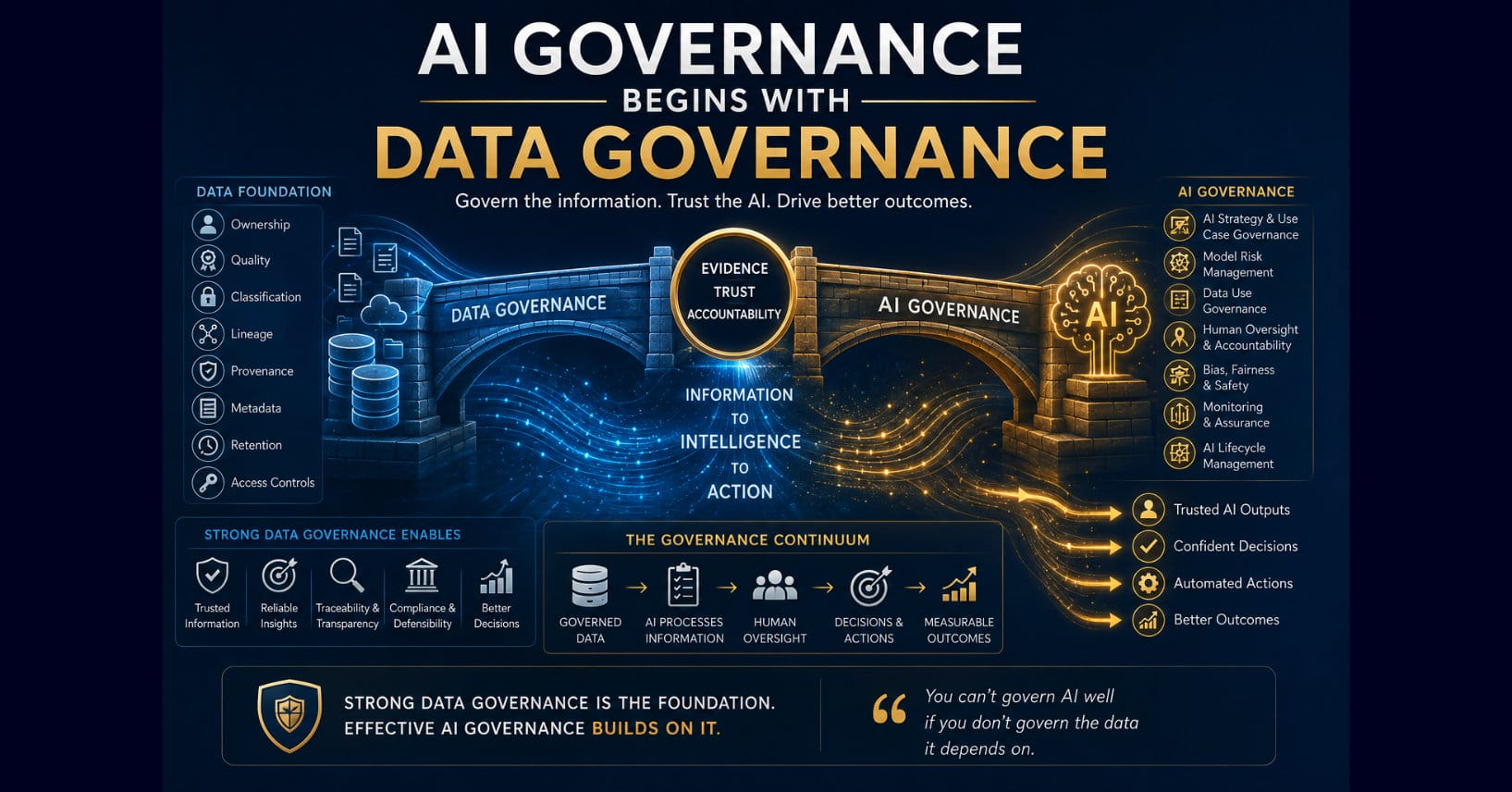
Organizations are rapidly establishing AI policies, inventories, approval processes, model reviews, human oversight, and monitoring. But governing the AI system without governing the information it consumes leaves a fundamental gap.
This article argues that AI governance begins with data governance. AI systems inherit weaknesses in enterprise information environments, including unclear ownership, poor quality, incomplete metadata, missing lineage, uncertain provenance, excessive retention, and conflicting authoritative sources. Retrieval-augmented generation makes these dependencies especially important because semantic relevance does not guarantee that information is current, authoritative, permitted, or appropriate for a particular use.
The article also examines the reverse relationship: AI creates new enterprise data through summaries, classifications, predictions, scores, recommendations, and generated content. Once persisted, those outputs require ownership, classification, retention, provenance, and lifecycle governance. As agentic AI connects information directly to automated action, data governance and AI governance increasingly form a continuous governance loop.
Organizations are rapidly building AI governance programs.
They are establishing acceptable-use policies.
Creating AI inventories.
Reviewing models.
Assessing vendors.
Defining prohibited uses.
Building approval workflows.
Testing outputs.
Monitoring risk.
Establishing human oversight.
Creating AI governance committees.
All of those activities matter.
But there is a problem.
An organization can govern the AI system and still fail to govern what the AI system knows.
The model may be approved.
The use case may be approved.
The vendor may have passed security review.
Human oversight may be defined.
Yet the AI system may still retrieve outdated policies, consume poorly governed datasets, combine information with conflicting definitions, rely upon uncertain third-party data, or generate new information whose provenance disappears once it enters another enterprise system.
At that point, the organization has governed the AI application without governing the information environment upon which the application depends.
That is not enough.
AI governance begins with data governance.
AI Does Not Operate Above the Data Problem
Artificial intelligence can appear to sit above traditional enterprise data management.
The interface reinforces that perception.
A user asks a question.
The AI responds.
The complexity underneath disappears.
But the answer may depend upon:
enterprise databases;
documents;
emails;
knowledge repositories;
APIs;
third-party information;
analytics;
vector databases;
embeddings;
model training data;
retrieved context;
business definitions;
metadata;
and previous AI-generated content.
The AI system does not eliminate the enterprise data environment.
It consumes it.
Every unresolved governance weakness in that environment can therefore become an AI governance weakness.
Poor ownership becomes uncertainty about who can authorize AI use.
Weak metadata becomes poor retrieval context.
Bad quality becomes unreliable output.
Missing lineage becomes weak explainability.
Unknown provenance becomes uncertain trust.
Excessive retention becomes excessive AI exposure.
Conflicting authoritative sources become conflicting answers.
AI does not solve those problems.
It can make them more consequential.
The Model Is Only One Layer
Much of the AI governance conversation understandably concentrates on models.
Which model are we using?
How accurate is it?
Does it hallucinate?
Is it biased?
Can we explain it?
How secure is it?
Where is it hosted?
Those are legitimate questions.
But an enterprise AI system is not merely a model.
A simplified architecture may look like:
Enterprise Data → Retrieval/Processing → Model → Output → Decision → Action
Governance can fail at every stage.
The source data may be inappropriate.
Retrieval may select the wrong information.
Processing may remove important context.
The model may infer incorrectly.
The output may be presented with excessive confidence.
A human may misunderstand it.
An automated agent may act upon it.
Focusing governance only on the model addresses one component of a much larger decision system.
The First AI Question Should Be About Information
When evaluating an enterprise AI use case, organizations often begin with:
What model should we use?
A better starting point may be:
What information will this system depend upon?
That question immediately exposes governance requirements.
What sources will it access?
Who owns them?
Are they authoritative?
Are they current?
What classifications apply?
What quality limitations exist?
What retention requirements apply?
What jurisdictions are involved?
May the information be used for this purpose?
May it leave the enterprise environment?
May it be used for model training?
Can it be combined with other information?
Does it contain third-party restrictions?
Does it include AI-generated content?
Can its provenance be established?
If the organization cannot answer those questions, selecting a model is premature.
The governance problem exists before the model is called.
Access Is Not Authorization
One of the most important distinctions in enterprise AI is the difference between technical access and governed authorization.
Suppose an employee has permission to access 50,000 documents in a collaboration platform.
An enterprise AI assistant operates under that employee’s identity.
Technically, the assistant may be capable of retrieving those same documents.
Does that mean every document should become AI-retrievable?
Not necessarily.
The repository may contain:
superseded policies;
draft contracts;
sensitive investigations;
old personnel information;
confidential legal analysis;
obsolete procedures;
unstructured notes;
documents with third-party restrictions;
and information whose original business purpose has expired.
Traditional access control answers:
“May this user access this object?”
AI governance introduces another question:
“May this information be retrieved, interpreted, combined, summarized, inferred from, or acted upon by this AI system for this purpose?”
Those are not equivalent questions.
Data governance helps establish the distinction.
Retrieval-Augmented Generation Is a Data Governance System
Retrieval-augmented generation, or RAG, is often discussed as an AI architecture.
It is also a data governance architecture.
A RAG system must determine:
what information is indexed;
how it is segmented;
which metadata is preserved;
which sources are authoritative;
how obsolete information is handled;
which permissions apply;
how classifications are enforced;
what information can be retrieved together;
how sources are ranked;
and what evidence is presented with the answer.
These are not merely model questions.
They are information governance decisions.
An excellent language model connected to poorly governed enterprise content can produce highly articulate answers from the wrong information.
The model may perform exactly as designed.
The governance system failed upstream.
Relevance Is Not Authority
This is where the distinction from Article 7 becomes critical.
AI retrieval systems are designed to find information relevant to a request.
Governance requires them to determine whether that information is appropriate to use.
Suppose an employee asks:
“What is our current remote-work policy?”
The retrieval system finds four highly relevant documents:
the current approved policy;
a superseded policy;
a draft revision;
and meeting notes discussing possible future changes.
Semantically, all four are relevant.
Governance says they are not equivalent.
One is authoritative.
One is historical.
One is unapproved.
One is informational.
If metadata does not preserve those distinctions, the AI system may synthesize all four into an answer that has never actually been organizational policy.
The model did not necessarily hallucinate.
The enterprise supplied ambiguous evidence.
Data Quality Becomes AI Quality
Organizations sometimes treat AI output quality as primarily a model-performance issue.
Often, it is not.
Suppose an AI assistant incorrectly tells a customer that a product is available.
The model may have accurately interpreted the inventory record.
The inventory record was wrong.
Suppose an employee receives outdated procedural guidance.
The AI retrieved the correct document.
The document should have been retired.
Suppose an AI system produces an incorrect financial explanation.
The source data used conflicting business definitions.
In each case, the visible failure appears at the AI layer.
The root cause exists in data governance.
This is why AI quality cannot be separated from data quality.
Model evaluation matters.
So does evaluating the information environment the model consumes.
Provenance Becomes AI Assurance
Article 9 examined the growing importance of provenance.
AI makes provenance operationally critical.
When an AI system produces a consequential output, organizations may need to know:
What information influenced it?
Where did that information originate?
Was it observed, reported, derived, or generated?
Was it authoritative?
How current was it?
What transformations had occurred?
Were any inputs themselves AI-generated?
Which model produced the output?
Which model version was used?
What human review occurred?
Without provenance, AI assurance can become superficial.
The organization knows which model produced the answer.
It does not know enough about the evidence the model relied upon.
AI Creates Data Too
The relationship also works in the opposite direction.
AI does not merely consume governed information.
It creates information.
Summaries.
Classifications.
Scores.
Recommendations.
Predictions.
Extracted entities.
Translations.
Generated documents.
Risk assessments.
Inferred relationships.
Agent activity records.
Some of those outputs disappear after use.
Others persist.
Once an AI output is stored in a CRM, ERP system, data warehouse, document repository, knowledge base, or operational application, it becomes part of the enterprise information environment.
Data governance must now answer:
Who owns it?
How is it classified?
How long should it be retained?
Can it be corrected?
Is it authoritative?
Should it be labeled as machine-generated?
What provenance should accompany it?
Can another AI system consume it?
What happens when the originating model changes?
AI governance therefore flows back into data governance.
The relationship is circular.
The AI Feedback Loop
This circular relationship creates a new governance risk.
Consider:
Human/Observed Data → AI Model → Generated Inference → Enterprise System → AI Retrieval → New AI Output
The second AI system may not know that part of its input originated as an inference from the first.
If provenance is lost, generated information can gradually become indistinguishable from observed fact.
Now extend that loop across hundreds of AI-enabled processes.
AI systems generate content.
That content enters repositories.
Other AI systems retrieve it.
New inferences are generated.
Those inferences become new data.
Without provenance and lifecycle controls, enterprises risk creating information environments in which machines increasingly train, reason, and act upon the outputs of other machines without preserving the distinction.
This is not a theoretical governance concern.
It follows directly from integrating generative and agentic AI into enterprise workflows.
Agentic AI Raises the Stakes
Generative AI primarily produces information.
Agentic AI can produce action.
An agent may:
query systems;
retrieve records;
update applications;
create tickets;
send communications;
modify workflows;
initiate transactions;
or trigger other agents.
The governance chain therefore expands:
Data → AI Interpretation → Decision → Action → New Data
A weak data-governance decision at the beginning can now produce an operational consequence at the end.
Suppose an agent reads an outdated supplier status and automatically changes a purchasing workflow.
Or interprets an obsolete policy and denies a request.
Or relies on a duplicate customer record and sends a communication to the wrong person.
Or consumes an AI-generated risk score whose provenance has disappeared.
The quality and governance of the input are now directly connected to automated action.
As AI moves from answering to acting, data governance becomes operational risk governance.
AI Inventories Need Data Dependencies
Many organizations are creating AI inventories.
That is a good development.
But an inventory containing only:
application name;
business owner;
model;
vendor;
use case;
risk classification;
and approval status
is incomplete.
For consequential AI systems, organizations should also understand key data dependencies.
Which enterprise datasets does the system consume?
Which document repositories?
Which external sources?
Which derived data products?
Which AI-generated inputs?
Who owns those sources?
What classifications apply?
What quality thresholds exist?
What lineage is available?
What provenance is preserved?
What restrictions apply?
If the data changes, which AI systems are affected?
This connects the AI inventory to the data-governance environment.
Without that connection, AI risk assessments can become snapshots of applications detached from the information they depend upon.
Data Classification Must Evolve for AI
Traditional classification models often focus on confidentiality.
Public.
Internal.
Confidential.
Restricted.
That remains necessary.
AI introduces additional dimensions.
A dataset may be confidential but approved for use with an internally hosted AI model.
Another may be internal but contractually prohibited from model training.
A third may be publicly available but unsuitable for consequential decision-making because its provenance is weak.
A fourth may contain AI-generated inferences that require human validation.
Organizations may therefore need metadata describing not merely sensitivity but AI-use conditions.
For example:
AI retrieval permitted.
AI training prohibited.
External model prohibited.
Internal inference permitted.
Automated decision prohibited.
Human review required.
Generated content.
Synthetic data.
High-consequence use restricted.
The precise taxonomy will vary.
The principle will not.
AI needs governance context beyond confidentiality.
Retention Becomes an AI Issue
Data retention also takes on new importance.
Historically, retaining unnecessary data created storage, privacy, security, legal, and discovery risk.
AI adds another consequence.
Retained information can become retrievable information.
An outdated document that once sat unnoticed in an archive may suddenly influence an AI answer.
A stale customer record may become model context.
An obsolete procedure may be surfaced as guidance.
An old draft may compete semantically with an approved policy.
This changes the economics of information clutter.
AI makes forgotten data operationally visible again.
Retention governance therefore becomes part of AI quality and AI risk management.
Sometimes the safest information for an AI system is information the organization should no longer possess.
AI Governance Needs Data Owners
AI governance committees cannot make every information decision.
Suppose a proposed AI system will consume customer data.
The AI governance function can evaluate the use case.
Security can evaluate technical controls.
Privacy can assess legal obligations.
Legal can review contracts.
But someone still needs business authority to determine whether customer information is appropriate for the intended purpose.
That is where meaningful data ownership matters.
A data owner should be able to answer questions such as:
Is this source authoritative?
Is the quality sufficient?
Is the use consistent with business purpose?
Are known limitations acceptable?
Should this information be combined with other datasets?
What remediation is required?
What risk can be accepted?
AI governance depends upon data owners who possess actual decision rights.
Otherwise, the AI committee inherits decisions it may not be qualified or authorized to make.
The Governance Boundary Is Disappearing
Organizations often establish separate governance structures.
Data Governance Council.
AI Governance Committee.
Cybersecurity Governance.
Privacy.
Records Management.
Enterprise Architecture.
Risk Management.
Legal.
Each discipline exists for legitimate reasons.
But AI increasingly crosses all of them.
An AI use case may involve:
data ownership;
privacy;
cybersecurity;
model risk;
architecture;
records retention;
third-party risk;
regulatory compliance;
business process;
and human decision authority.
Creating another isolated governance structure can add coordination problems rather than solve them.
The future is likely to require federated governance.
Specialized disciplines retain their expertise and authority.
But they operate through shared decision structures, common metadata, connected inventories, explicit escalation paths, and preserved evidence.
AI governance should connect governance domains.
It should not become another silo.
Data Governance and AI Governance Form a Loop
The relationship can be summarized simply.
Data governance determines:
what information exists;
what it means;
who owns it;
whether it can be trusted;
how it may be used;
where it came from;
and what controls apply.
AI governance determines:
whether and how AI may consume that information;
what models may process it;
what outputs may be produced;
what decisions AI may influence;
what actions may be automated;
and what oversight is required.
Then AI produces new information.
That information returns to data governance.
The loop becomes:
Governed Data → Governed AI → Governed Output → Governed Data
If any part of the loop is weak, the weakness propagates.
Evidence Must Connect the Two
For consequential AI uses, organizations should be able to reconstruct both sides of the governance relationship.
What data was approved?
Who owned it?
What restrictions applied?
What quality status existed?
Which AI use was authorized?
Which model processed the information?
What output resulted?
What human review occurred?
What decision followed?
What action was taken?
What new information was created?
This is where data lineage, decision lineage, provenance, AI governance, and evidentiary architecture begin converging.
The enterprise is no longer governing isolated systems.
It is governing chains of information and decision-making.
Start AI Governance Upstream
Organizations building AI governance programs should therefore resist beginning exclusively with model controls.
Start upstream.
Identify the information.
Establish ownership.
Define authoritative sources.
Classify the data.
Understand quality.
Map lineage.
Preserve provenance.
Establish permissible uses.
Apply retention.
Then connect those controls to AI governance.
This does not mean every data-governance problem must be solved before AI can be deployed.
That would be unrealistic.
It means organizations should understand which data-governance weaknesses matter to each AI use case and address them proportionate to consequence.
Governance follows risk.
Boardroom Takeaway
Executives should not assume that establishing an AI governance committee or approving an AI platform means the enterprise has governed AI.
AI systems inherit the strengths and weaknesses of the information environments they consume.
If ownership is unclear, metadata is weak, quality is unreliable, lineage is incomplete, provenance is unknown, or retention is uncontrolled, those deficiencies become AI governance issues.
Leadership should therefore ask:
“Are we governing the AI system, or are we also governing the information the AI system is allowed to know, interpret, create, and act upon?”
The distinction will become increasingly important as AI moves deeper into enterprise operations.
Because AI governance does not begin when the model produces an answer.
It begins before the model ever sees the data.
AI governance begins with data governance.
Coming Next
Article 11: The Governance Problem Inside RAG
Retrieval-augmented generation gives AI systems access to enterprise knowledge, but access creates a deceptively difficult governance problem.
Which documents should be indexed? Which sources are authoritative? How should superseded information be handled? What happens when permissions change? Can sensitive information appear indirectly through generated answers? How should citations, provenance, and retention work?
The next article examines why RAG is not simply an AI architecture.
It is an information-governance architecture.