Enterprise Requirements Series—Article 19
This article explains how requirements engineering helps organizations build software systems that outlive their original requirements. It explores the importance of separating business intent from technical implementation, focusing on enduring capabilities, anticipating change, and designing requirements that support adaptable architecture and long-term enterprise value.
Building Better Software by Engineering Better Decisions
No successful software system remains exactly as it was originally envisioned.
Businesses evolve.
Markets shift.
Regulations change.
Technologies advance.
Customer expectations rise.
Organizations reorganize.
Yet many software projects are still built as though today’s requirements will remain unchanged forever.
They won’t.
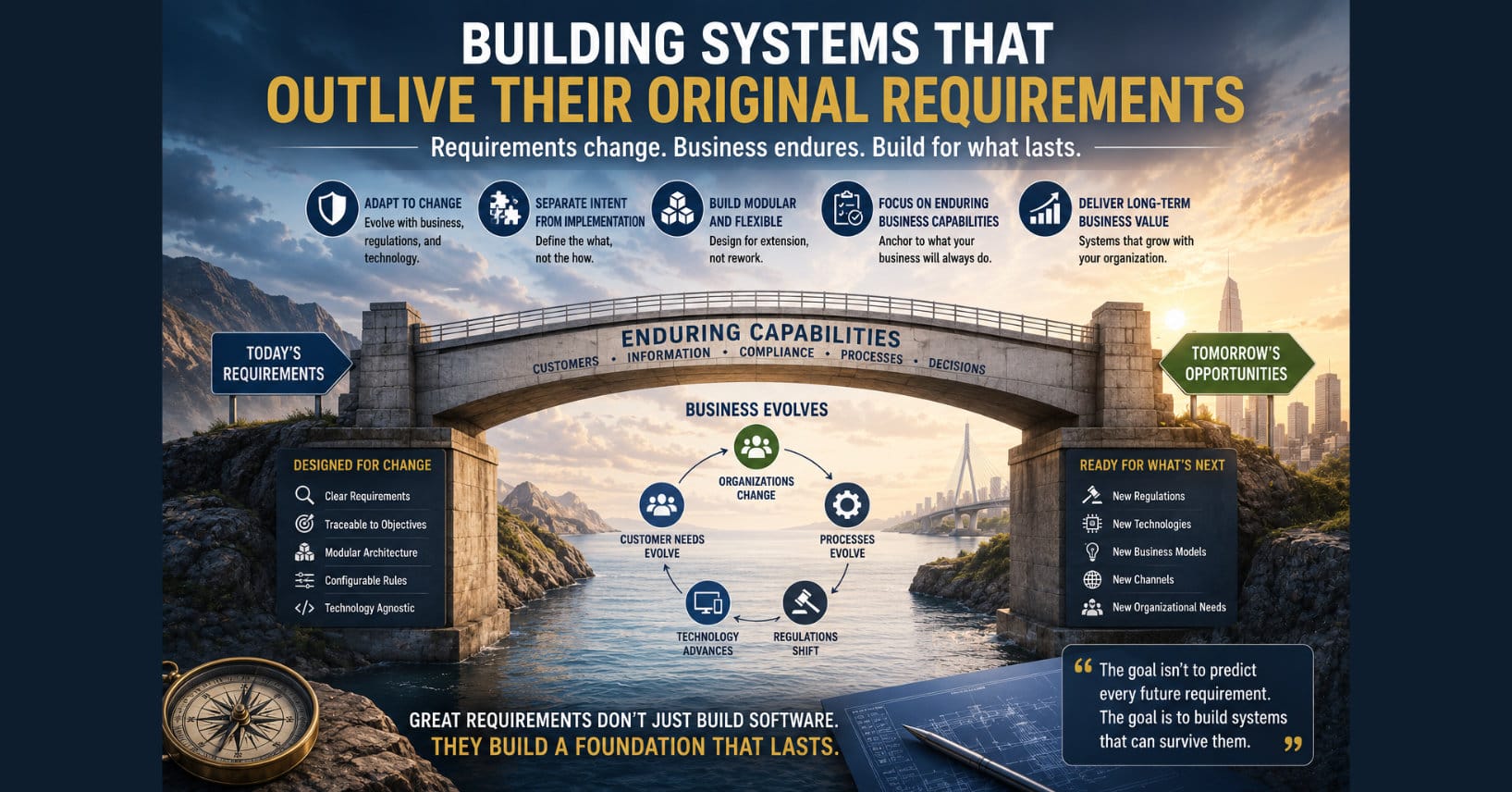
The goal of requirements engineering is not to predict every future requirement.
The goal is to build systems that can survive future requirements.
Every Requirement Has a Lifespan
Requirements are written to solve today’s business problems.
That does not mean they will solve tomorrow’s.
A requirement supporting a new regulation today may become obsolete after legislation changes.
A workflow optimized for one department may become ineffective after an organizational restructuring.
A reporting requirement designed for current leadership may no longer support future decision-making.
Requirements change because businesses change.
Good engineering expects that reality.
Stable Requirements Reveal Enduring Needs
Although individual requirements evolve, many underlying business capabilities remain remarkably stable.
Organizations will continue to:
- Serve customers.
- Protect information.
- Manage financial transactions.
- Demonstrate compliance.
- Make informed decisions.
- Coordinate business processes.
Those enduring capabilities should anchor requirements whenever possible.
The implementation may change.
The business purpose usually does not.
Flexibility Is Not Vagueness
Some teams respond to changing business conditions by writing intentionally broad requirements.
That creates ambiguity, not flexibility.
A good requirement should always be:
- Clear.
- Testable.
- Traceable.
- Measurable.
- Unambiguous.
Flexibility comes from thoughtful architecture and modular design—not from poorly defined requirements.
Well-written requirements define what must remain true while allowing implementation to evolve.
Separate Business Intent from Technical Design
One of the best ways to build systems that endure is to distinguish between business intent and technical implementation.
For example, a requirement might state:
Customers shall receive notification when their order status changes.
It should not specify:
The system shall send an email using Provider X.
The business requirement defines the outcome.
Technology determines the most appropriate implementation.
Tomorrow that notification may be delivered through email, text messaging, a mobile application, or a communication platform that does not yet exist.
The business objective remains unchanged.
Requirements Should Anticipate Change
Requirements engineering is not about resisting change.
It is about preparing for it.
Questions worth asking include:
- Which business rules are likely to evolve?
- Which regulations change frequently?
- Which organizational structures may change?
- Which integrations could be replaced?
- Which policies require configuration rather than code?
These questions encourage solutions that remain useful long after the first deployment.
Requirements Shape Sustainable Architecture
Architects frequently discuss scalability, resilience, and maintainability.
Requirements engineering contributes to each of them.
When requirements distinguish enduring business needs from temporary implementation details, architecture becomes:
- Easier to extend.
- Easier to maintain.
- Easier to integrate.
- Easier to govern.
- Easier to adapt.
Longevity begins long before architecture diagrams are created.
It begins with disciplined requirements.
Enterprise Systems Are Long-Term Investments
Organizations rarely replace enterprise systems because developers lacked technical skill.
They replace them because the systems can no longer adapt to changing business needs.
That is an important distinction.
Successful software is not measured only by how well it performs on the day it is deployed.
It is measured by how effectively it continues supporting the business years later.
Requirements engineering plays a significant role in achieving that longevity.
Future-Proofing Begins with Better Questions
No requirements engineer can predict the future.
They can, however, ask better questions.
Which assumptions are temporary?
Which capabilities are permanent?
Which decisions belong in policy rather than code?
Which business rules require flexibility?
Which requirements should remain stable even if technology changes?
Organizations asking these questions consistently build systems with longer useful lives.
Looking Ahead
The most valuable enterprise systems are not those that perfectly satisfy today’s requirements.
They are the ones that continue delivering business value as tomorrow’s requirements emerge.
Requirements engineering is not merely about defining the next release.
It is about creating a durable foundation for continuous business evolution.
The future cannot be predicted.
But it can be anticipated.
That is one of the greatest contributions disciplined requirements engineering makes to enterprise software.
Requirements Reality
Requirements should solve today’s problem without preventing tomorrow’s opportunity.
Coming Next
Article 20—Requirements Engineering Is Competitive Advantage
Our final article explores why organizations that consistently invest in disciplined requirements engineering deliver better software, adapt more quickly, reduce risk, and ultimately outperform their competitors.