Information Architecture Series | Article 4 of 8
Summary
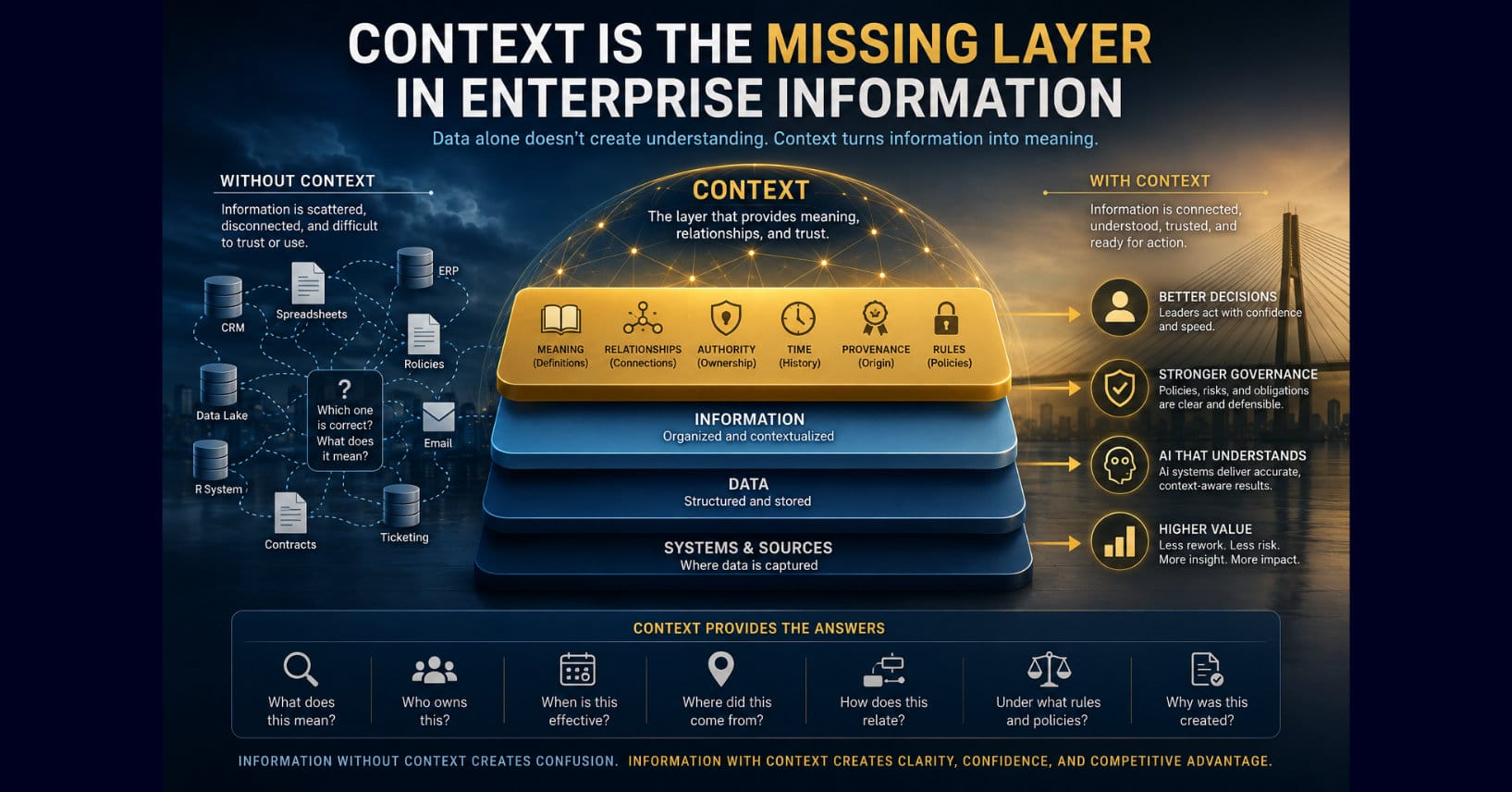
Modern enterprises have become exceptionally good at preserving data, documents, transactions, messages, and records. What they preserve far less consistently is the context explaining what that information means, where it came from, how it relates to other information, who has authority over it, and why it matters.
This article introduces the context gap: the distance between what an enterprise has recorded and what someone must understand to use that information correctly. That gap is often filled manually through institutional knowledge, investigation, reconstruction, and human interpretation.
Artificial intelligence makes context an architectural requirement. Retrieval alone cannot establish authority, applicability, provenance, recency, relationships, or trust. As enterprises automate more information consumption and decision support, context must become part of the information infrastructure rather than remaining scattered across systems and human memory.
Enterprises have become extraordinarily good at keeping things.
Databases retain transactions.
Document repositories retain files.
Email systems retain conversations.
Ticketing platforms retain incidents.
Collaboration systems retain messages.
Cloud storage retains almost everything anyone thought might someday be useful.
The modern enterprise is surrounded by information.
Yet when someone asks a simple question—
Why?
—the architecture often becomes strangely quiet.
Why was this decision made?
Why does this customer have this classification?
Why was this policy changed?
Why does this application behave this way?
Why was this control implemented?
Why does this metric use this definition?
Why was this exception approved?
Why did the organization accept this risk?
The artifact may still exist.
The data may still exist.
The decision may still exist.
What has disappeared is the context.
And without context, an enterprise can preserve enormous quantities of information while steadily losing its ability to understand what that information means.
We Preserve the What Better Than the Why
Most enterprise systems are designed to record state.
A customer is active.
A contract is approved.
A project is delayed.
A vulnerability is accepted.
A transaction occurred.
A policy was updated.
A configuration changed.
These records tell us what happened.
They do not necessarily tell us why.
Consider a risk register containing:
Risk Status: Accepted
That appears to be information.
But imagine reviewing the record two years later.
Who accepted it?
Under what authority?
What evidence was considered?
What alternatives were evaluated?
What assumptions were made?
What compensating controls existed?
How long was the acceptance supposed to remain valid?
What business condition justified the decision?
Has that condition changed?
Without those answers, the enterprise has preserved the outcome but not the reasoning.
That is an incomplete information architecture.
Context Turns Records Into Meaning
Context is what allows information to be interpreted correctly.
It provides the surrounding conditions that explain what an information asset represents, why it matters, and how it should be understood.
Context may include:
- Business definitions
- Relationships
- Provenance
- Ownership
- Authority
- Time
- Location
- Purpose
- Assumptions
- Decision rationale
- Applicable policies
- Regulatory obligations
- Dependencies
- Exceptions
- Confidence
- Version
- Audience
- Usage restrictions
A value without context may be technically accurate and still be misleading.
A document without context may be authentic and still be obsolete.
A decision without context may be recorded and still be indefensible.
A metric without context may be mathematically correct and still tell leadership the wrong story.
Context is not supplemental information.
It is part of the information.
The Meaning of a Number Depends on Its Context
Suppose an executive dashboard reports:
Cybersecurity Risk Score: 72
Is that good?
Bad?
Improving?
Deteriorating?
What scale is being used?
What factors contribute to the score?
How are those factors weighted?
What period does the score represent?
Has the methodology changed?
What systems are included?
What risks are excluded?
What threshold requires executive action?
How confident should leadership be in the underlying data?
The number alone is almost useless.
The context transforms it into decision-ready information.
This distinction matters because enterprises increasingly build dashboards, analytics platforms, and AI systems that make information easier to consume.
Ease of consumption can create an illusion of understanding.
A beautifully rendered number is not necessarily a meaningful number.
Time Is Context
Information also changes meaning over time.
A policy may have been authoritative last year and obsolete today.
A customer classification may have been correct when recorded.
A risk decision may have been reasonable based on the threat environment at the time.
A technology choice may appear questionable today but have been appropriate given the alternatives available five years ago.
Historical information must therefore preserve temporal context.
What did we know at the time?
What rules applied?
What systems existed?
What assumptions were reasonable?
What alternatives were available?
This becomes particularly important during audits, litigation, regulatory investigations, post-incident reviews, and governance assessments.
Organizations are often judged retrospectively.
Without preserved context, yesterday’s decisions are evaluated using today’s knowledge.
That can create a distorted understanding of what actually happened.
Relationships Are Context
Information rarely exists in isolation.
A customer relates to contracts.
Contracts create obligations.
Obligations affect processes.
Processes depend on applications.
Applications depend on infrastructure.
Infrastructure creates risks.
Risks require controls.
Controls generate evidence.
Evidence supports decisions.
Those relationships provide context.
Yet many enterprise systems represent each object separately.
The CRM knows the customer.
The contract management system knows the agreement.
The GRC platform knows the risk.
The configuration management database knows the application.
The ticketing system knows the incident.
The document repository knows the evidence.
Humans are expected to understand how everything connects.
That worked, imperfectly, when experienced employees served as the enterprise’s contextual layer.
It becomes increasingly inadequate when organizations expect machines to reason across those boundaries.
The Enterprise Has a Context Gap
Most enterprises do not lack information.
They lack connected context.
The information exists, but the relationships among information assets are implicit.
The organization knows the customer.
It knows the contract.
It knows the product.
It knows the application.
It knows the control.
It knows the incident.
But it may not have an architectural representation of how those things relate.
This creates what we might call the context gap:
the distance between what the enterprise has recorded and what someone must understand to use that information correctly.
The larger the context gap, the more human interpretation is required.
Employees fill the gap through experience.
Analysts fill it through investigation.
Managers fill it through institutional knowledge.
Developers fill it through undocumented technical understanding.
Auditors fill it through reconstruction.
AI systems attempt to fill it through inference.
Every one of those mechanisms introduces cost or risk.
Institutional Knowledge Is Often Missing Context
When organizations say, “Only Susan knows how that works,” they are describing an information architecture failure.
Susan may know:
Which system is authoritative.
Why the process has an unusual exception.
Which report leadership actually trusts.
What a poorly named database field really means.
Why a customer is classified differently from others.
Which undocumented dependency will break if someone changes a configuration.
The enterprise possesses the information.
Susan possesses the context.
That distinction is dangerous.
If context exists primarily in human memory, then employee turnover becomes information loss.
Documentation programs frequently respond by asking employees to write more documents.
That can help.
But creating more artifacts does not necessarily preserve context.
The architecture must capture relationships, rationale, provenance, authority, and meaning—not merely produce additional files.
Provenance Is Context
One of the most important contextual questions is:
Where did this information come from?
Provenance establishes origin and history.
For enterprise information, that may include:
Who created it?
Which system generated it?
What source data contributed to it?
What transformations occurred?
Who modified it?
What approvals were required?
Which version is current?
What information did it supersede?
Without provenance, information becomes difficult to trust.
This is particularly important when information crosses organizational boundaries or is generated through automated systems.
A number appearing in a dashboard may have passed through several transformations before reaching leadership.
An AI-generated summary may combine information from multiple documents.
A risk score may be derived from numerous controls and assumptions.
A regulatory report may depend on data from several operational systems.
Trust increasingly depends on the ability to trace information back through its lineage and context.
Authority Is Context
Another critical question is:
Who gets to say what this means?
Enterprises often have multiple sources containing similar information.
That does not necessarily mean every source has equal authority.
A sales system may contain a customer address because salespeople need it.
A billing system may contain another address.
A legal system may contain the registered corporate address.
All three may be correct for different purposes.
The architectural problem is not selecting one universal “truth.”
It is defining authority within context.
Authoritative for what?
For which business process?
For which decision?
At what point in time?
Under whose ownership?
Information architecture must represent those distinctions.
Otherwise, employees and AI systems are left to infer authority from convenience.
Decisions Need Context
Enterprise decisions are themselves information assets.
Yet organizations frequently preserve decisions poorly.
Meeting minutes may record that something was approved.
An architecture repository may record the selected technology.
A project system may record the status change.
A risk platform may record acceptance.
But defensible decision-making requires more.
What question was being decided?
Who had decision authority?
What evidence was available?
What alternatives were considered?
What assumptions influenced the decision?
What constraints existed?
What risks were understood?
What rationale supported the choice?
What follow-up actions were required?
When should the decision be revisited?
Preserving those elements turns a decision record into decision evidence.
It allows future leaders to understand not merely what the organization did, but why doing it made sense at the time.
AI Makes Context Architectural
Artificial intelligence changes the importance of context dramatically.
A human employee can encounter incomplete information and ask questions.
“What does this field mean?”
“Is this policy still current?”
“Which report should I use?”
“Why do these systems disagree?”
“Who owns this?”
An AI system can ask similar questions only if the architecture enables it to recognize that the questions need to be asked.
Otherwise, it may proceed.
That is one of the fundamental challenges of enterprise AI.
A model can produce a fluent answer from insufficient context.
Fluency can conceal uncertainty.
Consider an AI assistant asked:
Can this customer receive the requested service under the current contract?
Answering correctly may require understanding:
The customer identity.
The relevant contract.
Current amendments.
Product definitions.
Geographic restrictions.
Service eligibility.
Pricing terms.
Regulatory obligations.
Approved exceptions.
Contract effective dates.
Internal policies.
Perhaps even previous decisions.
Retrieving a contract document is not enough.
The AI needs a contextual information environment.
RAG Does Not Automatically Solve Context
Retrieval-augmented generation has become an important enterprise AI pattern.
The concept is powerful: retrieve relevant enterprise information and provide it to the model as grounding context.
But retrieval and context are not the same thing.
A retrieval system may find documents based on semantic similarity.
That does not automatically establish:
Authority.
Applicability.
Recency.
Provenance.
Relationships.
Exceptions.
Business meaning.
Permissions.
Confidence.
If the repository contains three policies with similar language, retrieval may find all three.
The architecture must help determine which one applies.
If a contract has six amendments, retrieval must understand their relationship to the original agreement.
If two business units use the same term differently, semantic similarity alone may actually increase ambiguity.
RAG can provide context to a model.
Information architecture determines whether that context is coherent.
Knowledge Graphs Reveal Why Relationships Matter
This is one reason knowledge graphs and semantic technologies are receiving renewed attention.
A traditional repository might tell us that several information objects exist.
A knowledge graph can represent how those objects relate.
Customer has contract Contract A.
Contract A contains obligation Obligation 17.
Obligation 17 is fulfilled by Process B.
Process B depends on Application C.
Application C is protected by Control D.
Control D produces Evidence E.
Now an enterprise can traverse meaning.
This does not mean every organization needs a massive knowledge graph initiative.
It means the underlying architectural principle matters:
Relationships are information.
If the enterprise fails to preserve them, humans and machines must reconstruct them repeatedly.
Context Must Travel With Information
Traditional information environments frequently separate content from context.
The document is in one system.
Its classification is somewhere else.
Its owner is in an organizational directory.
Its approval history is in workflow logs.
Its related decision is in meeting minutes.
Its applicable policy is in another repository.
Its retention rule is in a records schedule.
Its business definition exists in someone’s head.
Technically, all the pieces exist.
Architecturally, the context is scattered.
A more mature information architecture makes context portable.
As information moves through systems, enough metadata, provenance, classification, relationships, and authority should travel with it to preserve meaning.
This becomes essential in API-driven architectures, cloud ecosystems, analytics platforms, and AI systems where information is constantly crossing system boundaries.
Context Is Infrastructure
Enterprises historically treated context as documentation.
That is no longer sufficient.
Context is becoming infrastructure.
AI needs it.
Governance needs it.
Automation needs it.
Analytics needs it.
Compliance needs it.
Cybersecurity needs it.
Decision-making needs it.
Knowledge management needs it.
Digital transformation needs it.
The more organizations automate the consumption and interpretation of information, the less they can depend on humans to supply missing context manually.
This changes the architectural priority.
The enterprise must begin designing not only where information lives and how it moves, but how meaning travels with it.
Closing the Context Gap
Closing the context gap does not require documenting everything.
That would create another information problem.
The objective is to identify where context materially affects interpretation, trust, decisions, obligations, risk, or automated action.
Start with high-value information.
Critical business concepts.
Executive metrics.
Policies.
Contracts.
Controls.
Risks.
Customer information.
Regulatory obligations.
Architecture decisions.
AI knowledge sources.
For each, ask:
What would someone need to know to interpret this correctly five years from now?
What would an AI system need to know to use it correctly today?
Those two questions reveal a surprising amount about the quality of an enterprise information architecture.
The Enterprise Must Preserve Meaning
Storage has become cheap.
Information has become abundant.
Retrieval is becoming nearly instantaneous.
None of those developments guarantees understanding.
The competitive and operational advantage increasingly lies elsewhere:
in preserving meaning.
An enterprise that understands the relationships, provenance, authority, history, and rationale surrounding its information can move faster without sacrificing trust.
It can automate more safely.
It can govern more effectively.
It can reconstruct decisions more defensibly.
It can preserve institutional knowledge beyond individual employees.
And it can give artificial intelligence something far more valuable than access to documents.
It can give AI context.
Because the next generation of enterprise systems will not merely need to retrieve what the organization knows.
They will need to understand what that knowledge means.
Coming Next
Article 5: Designing the Enterprise Information Model
If context provides meaning, the next architectural question is how to represent that meaning systematically. The next article examines the enterprise information model: the domains, concepts, relationships, metadata, classifications, ownership, and lifecycle structures that turn disconnected information into an understandable enterprise knowledge environment.