Information Architecture Series | Article 3 of 8
Summary
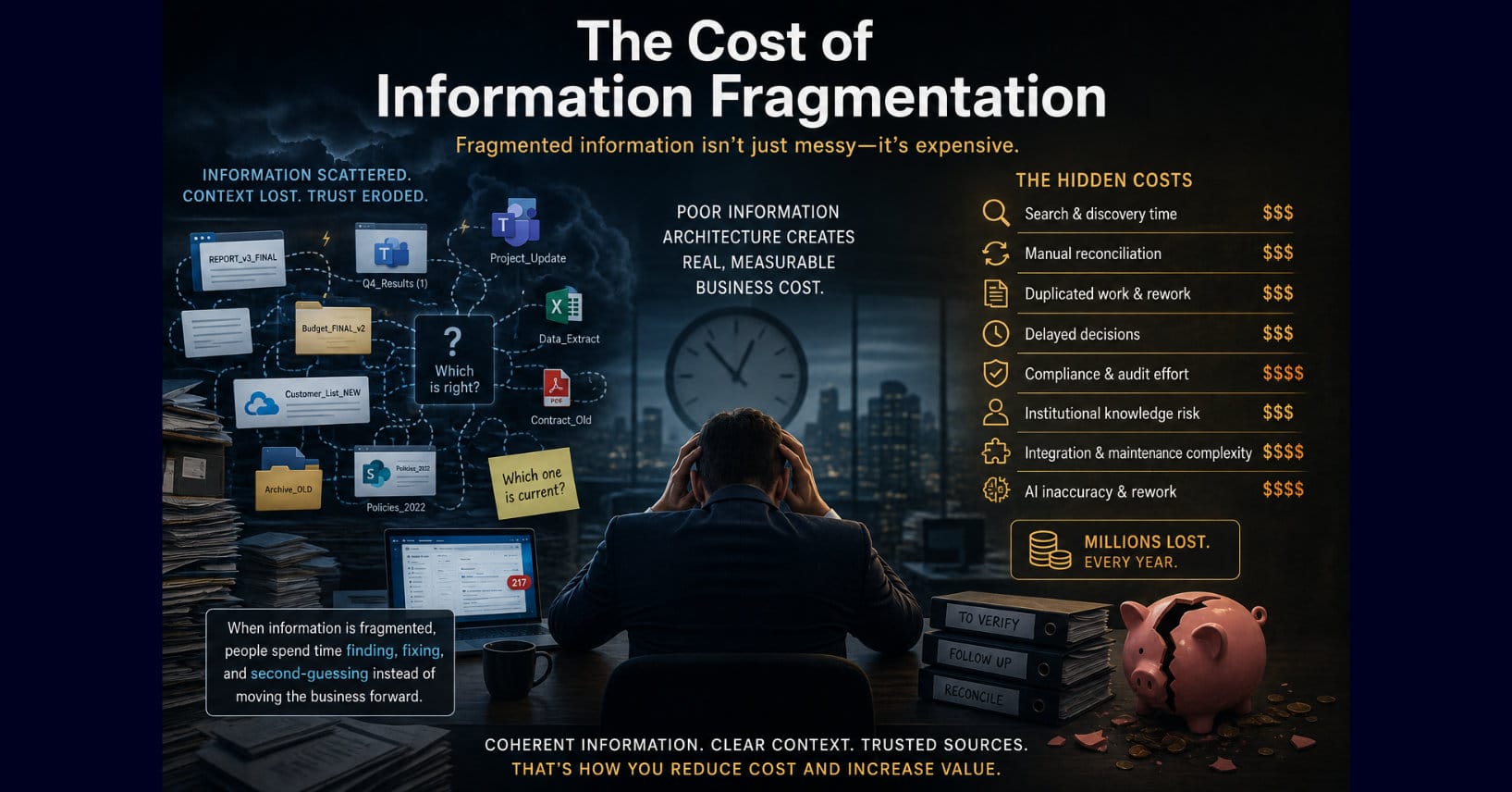
Information fragmentation rarely appears as a distinct technology expense, yet enterprises pay for it every day. The cost is distributed across ordinary work: employees searching for authoritative documents, analysts reconciling conflicting reports, developers compensating for inconsistent definitions, compliance teams reconstructing evidence, and executives waiting for trustworthy information.
Fragmentation occurs not simply because information resides in multiple systems, but because its meaning, authority, relationships, and context become disconnected. Organizations compensate through manual processes and institutional memory, creating hidden productivity costs and key-person dependencies.
Artificial intelligence makes these weaknesses increasingly visible. AI can retrieve fragmented information faster, but it cannot automatically determine which source is authoritative or reconstruct organizational context that was never preserved. Addressing fragmentation therefore requires information coherence, not merely centralization.
Most enterprises know what they spend on technology.
They know the cost of cloud infrastructure, software licenses, storage, cybersecurity, networks, development teams, support contracts, and transformation programs.
What they rarely know is how much they spend compensating for information fragmentation.
That cost does not appear as a line item called Information Fragmentation.
It appears as time.
Employees searching for documents.
Analysts reconciling conflicting reports.
Developers investigating undocumented dependencies.
Managers asking which version is correct.
Compliance teams reconstructing evidence.
Operations personnel maintaining spreadsheets because enterprise systems do not provide the context they need.
Executives waiting for someone to explain why two dashboards show different numbers.
Each event looks small.
Across an enterprise, they accumulate into something much larger:
a persistent tax on organizational performance.
Fragmentation Is More Than Information in Different Places
Large organizations will always distribute information across multiple systems.
That alone is not fragmentation.
A customer record may appropriately reside in a CRM platform while financial transactions reside in an ERP system and contractual documents reside in a document management platform.
Distribution becomes fragmentation when the organization loses the ability to understand how those pieces fit together.
Fragmentation occurs when:
- Information about the same business concept exists in multiple locations without clear authority.
- Terminology differs across systems or business units.
- Relationships among information assets are undocumented.
- Context is stored separately from the information it explains.
- Metadata is inconsistent or missing.
- Employees cannot reliably discover authoritative information.
- Copies proliferate without lifecycle controls.
- Business processes depend on information maintained outside governed systems.
- Organizational knowledge depends on people remembering how everything connects.
The problem is therefore not simply that information is distributed.
The problem is that its meaning, authority, relationships, and context are fragmented along with it.
The Search Tax
The most visible cost of fragmentation is search.
An employee needs a document.
Where is it?
SharePoint?
Teams?
OneDrive?
The CRM?
The project management platform?
A network share?
An email attachment?
A departmental repository?
Someone’s personal folder?
The employee searches one system, then another.
Eventually, the document appears.
But another question immediately follows:
Is this the right version?
Finding information and trusting information are two different problems.
Enterprise search can improve retrieval, but retrieval alone cannot establish authority.
If search returns four documents with similar names, employees still need enough context to determine which one matters.
The organization pays twice: once to find the information and again to validate it.
Multiply those minutes across thousands of employees, hundreds of working days, and millions of information interactions.
The result is not a minor productivity issue.
It is an operating expense.
The Reconciliation Tax
Fragmentation becomes more expensive when information disagrees.
Finance reports one number.
Operations reports another.
Sales has a third.
Nobody necessarily made a mistake.
Each group may be using a different source, definition, reporting period, business rule, or interpretation.
Now people must reconcile the information before they can use it.
Meetings are scheduled.
Spreadsheets are exchanged.
Queries are rerun.
Definitions are compared.
Someone traces the numbers back to their sources.
Eventually, the organization reaches agreement.
Then the same exercise happens again next month.
This is an important characteristic of fragmented information environments:
They repeatedly charge the enterprise for resolving questions it has already answered.
The answer may have existed before.
What was missing was the architecture necessary to preserve the answer, its definition, its provenance, and its context.
The Duplication Tax
When employees cannot reliably find or trust existing information, they create new information.
A new spreadsheet.
A new presentation.
A new report.
A new customer list.
A new project tracker.
A new knowledge base.
A new SharePoint site.
A new database.
A new dashboard.
The decision is rational.
Recreating something may be faster than locating and validating what already exists.
But each duplicate creates another potential source of truth.
Soon the organization has:
Customer_List.xlsx
Customer_List_NEW.xlsx
Customer_List_FINAL.xlsx
Customer_List_FINAL_v2.xlsx
Customer_List_USE_THIS_ONE.xlsx
At some point, information management becomes archaeology.
The humor disappears quickly when those files influence revenue forecasts, regulatory reporting, customer decisions, or executive strategy.
Duplication does more than consume storage.
It multiplies ambiguity.
Every copy creates another object that must eventually be discovered, classified, secured, retained, updated, reconciled, migrated, archived, or deleted.
The cost compounds.
The Context Tax
Some of the most expensive fragmentation is invisible because the data itself remains intact.
What disappears is context.
A spreadsheet survives, but nobody remembers why one column is manually adjusted.
A system configuration survives, but the architecture decision behind it does not.
A contract survives, but the operational interpretation agreed upon three years earlier is buried in email.
A policy survives, but the exception approved by leadership exists in meeting notes.
A risk rating survives, but the assumptions supporting the rating do not.
This creates a dangerous illusion.
The enterprise appears to possess the information because the artifacts still exist.
But the knowledge required to interpret them has fragmented.
Organizations then pay people to reconstruct that context.
Sometimes reconstruction takes hours.
Sometimes weeks.
Sometimes it is impossible.
The Dependency on Institutional Memory
Fragmented enterprises often compensate through people.
Someone knows which report is reliable.
Someone knows which database contains the authoritative customer status.
Someone knows why the policy says one thing while operations does another.
Someone remembers what happened during the acquisition.
Someone knows which spreadsheet must be updated before the dashboard refreshes.
These employees become human integration layers.
They connect systems, terminology, history, exceptions, and organizational context that the architecture itself failed to preserve.
Their expertise is enormously valuable.
The problem is that the enterprise begins depending on memory as infrastructure.
Then someone retires.
Changes roles.
Leaves the company.
Becomes unavailable during an incident.
The organization discovers that what it believed was institutional knowledge was actually individual knowledge.
Information fragmentation creates key-person risk.
The Decision Tax
Executives experience fragmentation differently.
They experience it as uncertainty.
Which number is correct?
Is this information current?
Why did the forecast change?
Which system produced this figure?
Does this report use the same definition as last quarter?
Was this policy superseded?
Who approved this exception?
What evidence supports this recommendation?
Every unresolved question delays a decision or weakens confidence in it.
Sometimes leadership waits.
Sometimes leadership decides anyway.
Neither outcome is ideal.
Decision velocity depends partly on information readiness.
If decision-makers must repeatedly validate the information supporting a decision, the organization has introduced friction into its own governance process.
The cost of fragmentation therefore extends beyond employee productivity.
It affects the speed and quality of enterprise decision-making.
The Compliance and Evidence Tax
Fragmentation becomes particularly visible during audits, investigations, regulatory inquiries, litigation, and cybersecurity incidents.
Suddenly the enterprise must answer questions such as:
What policy was in effect on a particular date?
Who approved this change?
Which systems were affected?
What evidence demonstrates that the control operated?
What information was available when leadership made the decision?
Where is the documentation?
Who owns it?
Is it complete?
Can its provenance be established?
Organizations with fragmented information environments often respond by assembling teams to reconstruct the past.
Email is searched.
Tickets are reviewed.
Documents are compared.
Logs are exported.
Meeting minutes are examined.
Employees are interviewed.
The enterprise may ultimately produce the required evidence.
But the cost of producing it reveals something important.
The organization possessed the information.
It did not possess it in a form that was readily reconstructable.
That difference matters.
The Integration Tax
Information fragmentation also increases technology costs.
When business concepts are represented differently across systems, every integration must compensate for those differences.
Mappings multiply.
Transformation logic grows.
Exceptions accumulate.
Middleware becomes increasingly complex.
APIs expose inconsistent representations of the same concepts.
Developers build translation logic between systems that were never semantically aligned.
Over time, the integration layer begins encoding organizational ambiguity.
This creates a peculiar form of technical debt.
The enterprise is not merely maintaining software complexity.
It is maintaining unresolved disagreements about meaning.
Every new application must inherit those disagreements.
Every modernization program must confront them.
Every acquisition adds more.
The technology estate becomes harder to simplify because information fragmentation has become embedded in the architecture.
The AI Tax
Artificial intelligence introduces another cost.
Organizations increasingly want AI systems to search enterprise repositories, summarize documents, answer employee questions, analyze customers, support decisions, and perform tasks through autonomous or semi-autonomous agents.
But AI encounters the same fragmented information environment employees do.
The difference is that employees often possess contextual knowledge the AI system does not.
If five policies exist, an experienced employee may know which one is current.
If two systems disagree, an analyst may know which source to trust.
If terminology differs between departments, a manager may understand the distinction.
AI must obtain that context somewhere.
Without it, retrieval can produce technically relevant but operationally incorrect information.
A model may summarize an obsolete policy perfectly.
An agent may retrieve the wrong customer status efficiently.
A recommendation may be based on information whose provenance is unclear.
The model has not necessarily failed.
The information architecture has.
Organizations may then spend significant amounts of money adding retrieval systems, vector databases, knowledge graphs, metadata enrichment, semantic layers, guardrails, and validation processes to compensate.
Some of those technologies are valuable.
But technology cannot fully automate semantic decisions the enterprise itself has never made.
The AI tax is therefore becoming one of the most visible consequences of decades of information fragmentation.
Fragmentation Compounds
Information fragmentation behaves much like technical debt.
Small compromises accumulate.
A temporary spreadsheet becomes permanent.
A duplicate repository becomes operational.
An exception becomes standard practice.
A local definition becomes embedded in reporting.
An undocumented integration becomes business-critical.
A departed employee’s folder becomes institutional history.
No single decision creates the problem.
The accumulation does.
And like technical debt, the cost is nonlinear.
The more fragmented the information environment becomes, the more effort is required to understand it.
New systems must integrate with more sources.
New employees must learn more exceptions.
New analytics must reconcile more definitions.
New AI systems must navigate more ambiguity.
New governance processes must account for more uncontrolled information.
The enterprise spends increasing amounts of effort maintaining coherence.
Why the Cost Is Difficult to See
Organizations measure infrastructure utilization.
They measure application availability.
They measure incident response.
They measure project delivery.
They measure cloud spending.
They measure development velocity.
They may even measure data quality.
Few measure how much employee effort is consumed compensating for fragmented information.
The cost is distributed across departments and hidden inside ordinary work.
A fifteen-minute search does not generate an incident ticket.
A two-hour reconciliation meeting does not appear as information architecture expense.
A manager recreating a report does not trigger an architectural review.
A developer spending three days understanding inconsistent customer definitions may simply appear to be doing integration work.
Fragmentation hides inside productivity.
That makes it easy to tolerate.
Measuring the Friction
Organizations do not need a perfect financial model to begin understanding the cost.
They can start by measuring friction.
How long does it take employees to find authoritative information?
How frequently are reports reconciled manually?
How many repositories contain overlapping content?
How many critical processes depend on spreadsheets outside governed platforms?
How frequently do teams recreate information because existing information cannot be located or trusted?
How many business terms have multiple definitions?
How many systems claim authority over the same business concept?
How much audit preparation involves manual evidence reconstruction?
How much integration logic exists solely to reconcile semantic differences?
How often do AI systems retrieve obsolete, conflicting, or contextually inappropriate information?
These measures begin converting an invisible architectural problem into something leadership can see.
The Objective Is Not Centralization
The solution to fragmentation is not necessarily putting everything into one system.
That approach has been attempted many times.
The enterprise data warehouse was going to solve it.
The document management platform was going to solve it.
The data lake was going to solve it.
The cloud was going to solve it.
The knowledge management platform was going to solve it.
Now AI is sometimes presented as though it will solve it.
The underlying mistake is assuming that information fragmentation is primarily a location problem.
It is not.
It is a coherence problem.
Information can remain distributed while still being architecturally coherent.
The enterprise needs to understand:
- What information exists
- What it means
- Where authority resides
- How concepts relate
- Who owns them
- How information moves
- Which rules apply
- How context is preserved
- How information can be discovered
- How trust can be established
Centralization is one architectural option.
Coherence is the objective.
From Hidden Cost to Architectural Priority
Information fragmentation persists partly because the enterprise has learned to compensate for it.
Employees search harder.
Analysts reconcile.
Developers integrate.
Managers interpret.
Compliance teams reconstruct.
Experienced employees remember.
Those behaviors keep the organization functioning.
They also hide the architecture problem.
The question leadership should ask is not merely:
Can our people find the information they need?
It is:
How much organizational effort are we spending because our information does not explain itself?
That is a much more consequential question.
Because information fragmentation is not free.
The enterprise pays for it through lost productivity, duplicated work, slower decisions, integration complexity, compliance effort, institutional memory risk, and increasingly unreliable AI.
Most organizations are already paying the bill.
They simply have not calculated it yet.
Coming Next
Article 4: Context Is the Missing Layer in Enterprise Information
Enterprises have spent decades storing data and documents. What they have been far less successful at preserving is the context that explains what information means, where it came from, how it relates to other information, and why it matters. The next article examines why context may be the most important missing layer in the modern enterprise information environment.