Data Governance Series | Article 8 of 20
Governing the Information That Drives the Enterprise
Summary
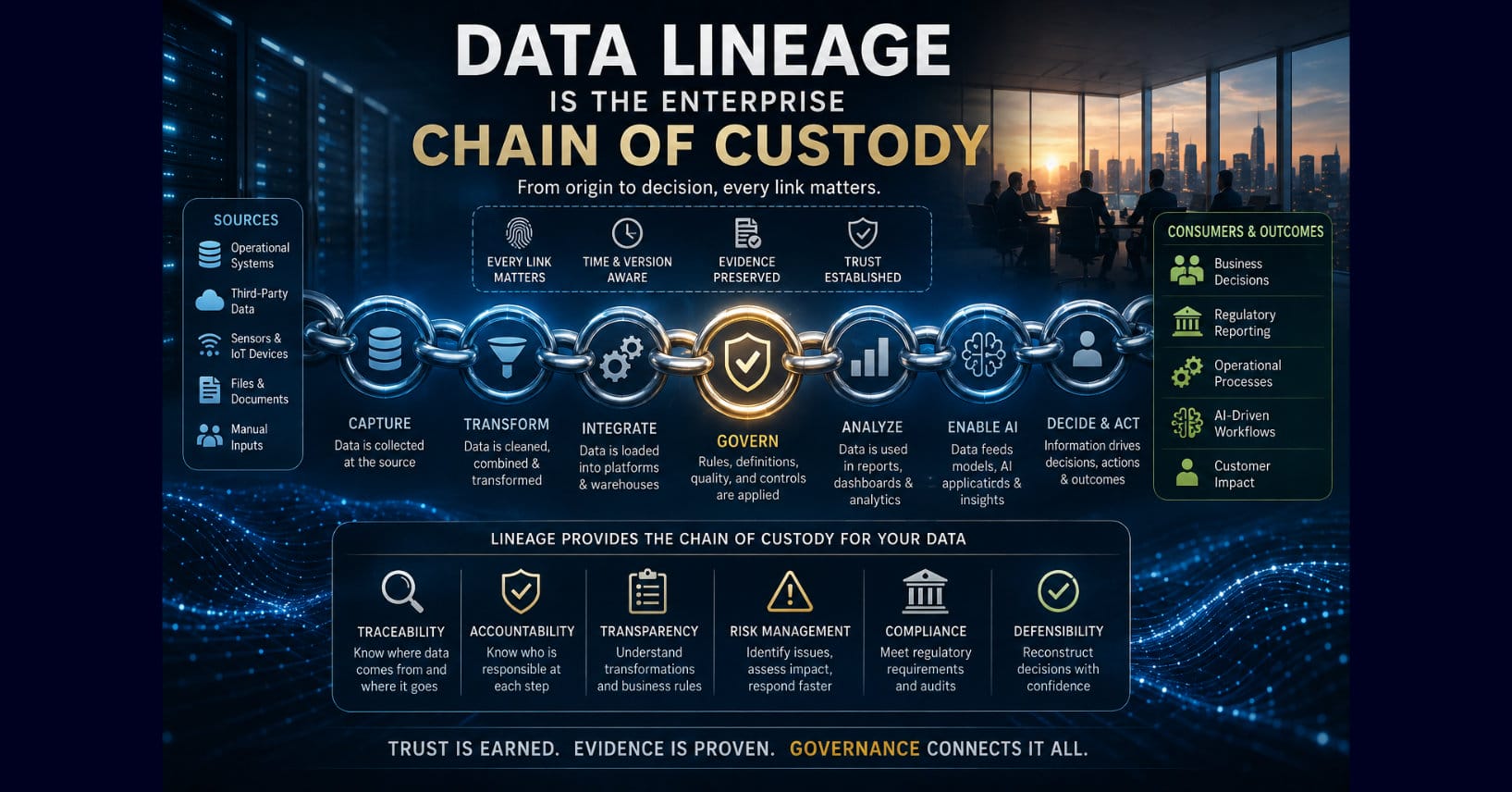
Data lineage is often treated as a technical map showing how information moves between systems. For consequential enterprise data, that definition is becoming insufficient.
This article reframes data lineage as the enterprise chain of custody: the ability to establish where information originated, how it moved, what transformations and business rules were applied, which systems consumed it, and what decisions ultimately depended upon it. It examines the distinction between technical and business lineage, the importance of forward and backward traceability, and how lineage makes data-quality problems actionable by exposing downstream dependencies.
The article also explores how AI extends traditional data lineage into decision lineage. As models retrieve, transform, infer from, and generate enterprise information, organizations increasingly need to trace the complete chain from source through model output to decision, action, and outcome. For consequential uses, historical reconstructability becomes essential to auditability, accountability, and defensibility.
Imagine an executive approves a consequential business decision based on a dashboard.
Six months later, the decision is challenged.
Perhaps an auditor questions the underlying number.
A regulator asks how the organization calculated it.
A customer disputes an automated determination.
A board member wants to understand why management believed the information was reliable.
Or an AI system produced a recommendation that ultimately proved wrong.
The organization opens the dashboard.
The number is still there.
Now someone asks:
Where did it come from?
The investigation begins.
The dashboard retrieves data from a semantic layer.
The semantic layer queries a warehouse.
The warehouse receives transformed data from an integration pipeline.
The pipeline combines three operational systems.
One of those systems receives information from a third-party provider.
Another value was manually adjusted.
A business rule changed two weeks before the decision.
Someone exported part of the dataset into a spreadsheet.
The spreadsheet fed a temporary upload.
Nobody remembers exactly why.
The organization knows what number leadership saw.
It cannot easily reconstruct how that number became what it was.
That is not merely a technical documentation problem.
It is a governance problem.
For consequential enterprise information, data lineage is becoming something much more important than a diagram of systems and pipelines.
Data lineage is the enterprise chain of custody.
The Chain-of-Custody Analogy
In legal, forensic, and investigative environments, chain of custody establishes the history of evidence.
Where did it originate?
Who possessed it?
What happened to it?
Was it altered?
How was it preserved?
Can its integrity be demonstrated?
The objective is not merely to know that evidence exists.
It is to establish sufficient confidence in how that evidence moved from its origin to its eventual use.
Enterprise data increasingly requires similar reasoning.
Where did this value originate?
Which system captured it?
What transformations occurred?
Which business rules were applied?
Was it combined with other data?
Was it manually adjusted?
Which version of the logic was used?
Which systems consumed it?
Which reports displayed it?
Which AI models retrieved it?
Which decisions depended upon it?
That history establishes context.
Without it, organizations may possess information without being able to explain why anyone should trust it.
Lineage Is More Than Source and Destination
Traditional lineage diagrams often show data movement.
System A feeds System B.
System B feeds the warehouse.
The warehouse feeds the dashboard.
Useful.
But incomplete.
For governance purposes, lineage should increasingly capture not merely where data traveled but what happened along the way.
Suppose a revenue value moves from an ERP system into a warehouse.
During transformation:
currency is converted;
refunds are excluded;
certain transaction types are reclassified;
late entries are moved into another reporting period;
intercompany transactions are eliminated;
and manual adjustments are added.
The value appearing in the dashboard is not simply the value from the ERP.
It is a governed information product produced through a series of decisions.
Lineage should help explain those decisions.
Otherwise, the organization knows the route but not the journey.
Every Transformation Creates Meaning
Transformation is often treated as a technical activity.
Join.
Filter.
Aggregate.
Map.
Normalize.
Convert.
Deduplicate.
Enrich.
From a governance perspective, each transformation can alter meaning.
Consider something as simple as filtering.
A dataset contains 10 million transactions.
A transformation excludes transactions marked “test,” “reversed,” or “internal.”
The resulting dataset contains 8.7 million transactions.
Which dataset represents “all transactions”?
The answer depends upon the business definition.
The transformation encoded that definition.
Someone decided which records counted.
That decision may be buried inside SQL, ETL logic, a Python script, a spreadsheet formula, a BI semantic model, or an application configuration.
Lineage exposes where business meaning is being created through technology.
That makes it relevant not merely to engineers but to governance.
The Spreadsheet Breaks the Chain
One of the most common lineage failures occurs when data leaves governed systems.
An analyst exports a report.
The file opens in Excel.
Rows are removed.
Values are corrected.
A lookup table is added.
Several formulas are created.
A manager provides an adjustment.
The final number is copied into a presentation.
The presentation goes to leadership.
Technically, the enterprise may have excellent lineage from the source application to the original report.
Then the chain disappears.
The most consequential transformation occurred manually.
This does not mean spreadsheets should be prohibited.
They remain indispensable business tools.
It means organizations should recognize when a spreadsheet becomes part of a consequential information chain.
At that point, the question is no longer:
“Is someone using Excel?”
It is:
“Did an uncontrolled transformation become part of the evidence supporting this decision?”
That deserves governance.
Lineage Makes Quality Actionable
Data quality without lineage creates a difficult question.
A defect is discovered.
What does it affect?
Suppose an organization learns that a customer-status field has been incorrect for three weeks.
Without lineage, teams begin searching.
Which reports use it?
Which dashboards?
Which regulatory calculations?
Which automated workflows?
Which AI systems?
Which external feeds?
Which decisions?
The organization knows there is a defect but cannot immediately determine its blast radius.
Lineage changes the response.
A governed lineage model can help identify downstream dependencies.
The question becomes:
If this data is wrong, what else may be wrong?
That is one of lineage’s most important governance functions.
It transforms quality monitoring into impact analysis.
Lineage Works in Both Directions
Lineage is often described from source to destination.
But governance needs both directions.
Forward lineage asks:
Where does this data go?
Which systems consume it?
Which reports display it?
Which models use it?
Which business processes depend upon it?
Backward lineage asks:
Where did this information come from?
Which sources contributed?
Which transformations occurred?
Which rules applied?
Which versions were active?
Both are necessary.
Forward lineage supports impact analysis.
Backward lineage supports reconstruction.
Together, they allow the enterprise to understand both consequence and origin.
The Executive Dashboard Is the End of a Long Story
Executives often experience enterprise data as dashboards.
A metric appears.
Revenue.
Margin.
Customer churn.
Cyber risk.
Employee turnover.
Supply-chain exposure.
Forecast.
Compliance status.
The number looks singular.
Its history may be anything but.
A single executive KPI may represent information from dozens of systems, hundreds of transformations, multiple definitions, manual adjustments, and several governance decisions.
That complexity is invisible by design.
Dashboards simplify.
But simplification should not eliminate reconstructability.
Leadership does not need to inspect every transformation before making a decision.
The organization should nevertheless be capable of reconstructing the chain when necessary.
That is the difference between simplicity and opacity.
AI Extends the Chain of Custody
Artificial intelligence makes lineage substantially more complex.
Consider an AI assistant answering an executive question.
The user asks:
“Which customers are most at risk of leaving this quarter?”
The AI system may:
retrieve customer records;
query a churn model;
access recent support interactions;
retrieve account notes;
summarize relevant documents;
combine model predictions;
infer patterns;
and generate a narrative recommendation.
What is the lineage of the answer?
It is no longer enough to identify a database table.
The response may depend upon:
source data;
retrieval logic;
model versions;
prompts;
embeddings;
ranking algorithms;
business rules;
generated inference;
and external model behavior.
The chain of custody has expanded.
Organizations deploying consequential AI need to think about decision lineage, not merely data lineage.
What information influenced the output?
Which model processed it?
What transformation occurred?
What recommendation resulted?
Who relied upon it?
What action followed?
That is a new governance frontier.
Generated Information Needs Lineage Too
AI introduces another complication.
The output itself can become data.
An AI system generates a risk classification.
The classification is written into a customer record.
Another application retrieves it.
An analyst includes it in a report.
A second AI system uses it as input.
The original inference has now entered the enterprise data supply chain.
If lineage records only the immediate source, the second system may see:
Customer database → risk classification.
But the true lineage is:
Operational data → AI model → generated inference → customer database → downstream system.
That distinction matters.
Machine-generated information should not lose its origin merely because it was persisted into a conventional database.
Otherwise, generated inference can gradually acquire the appearance of authoritative fact.
Provenance and Lineage Are Related but Different
Lineage and provenance are often used interchangeably.
They overlap, but the distinction is useful.
Lineage describes the path information traveled and the transformations it experienced.
Provenance addresses the origin, authenticity, and evidentiary basis of the information.
Lineage asks:
Where did this data come from and what happened to it?
Provenance asks:
Why should we believe the origin and history are trustworthy?
A lineage diagram might show that a value came from a vendor feed.
Provenance asks which vendor, under what agreement, through what collection method, with what validation, and with what evidence supporting authenticity.
Both become important when information supports consequential decisions.
Lineage provides the chain.
Provenance strengthens confidence in the links.
Technical Lineage Is Not Enough
Modern data platforms can automatically discover substantial technical lineage.
That is valuable.
Systems can identify:
tables;
columns;
pipelines;
queries;
transformations;
dependencies;
and downstream consumers.
But technical lineage alone may not explain business meaning.
A SQL transformation may contain:
WHERE STATUS_CODE <> 'X7'
Technically clear.
Governance asks:
What does X7 mean?
Why is it excluded?
Who approved the exclusion?
When did that rule become effective?
Does it apply to all business units?
What happens if the rule changes?
Technical lineage tells us what the system did.
Business lineage explains why.
Mature governance needs both.
Decision Lineage Is the Next Layer
The most consequential evolution may be connecting data lineage to decision lineage.
Traditional lineage ends at the report.
Governance should increasingly ask what happened next.
A report informed a management review.
The management review produced a decision.
The decision authorized an action.
The action created an outcome.
Now the chain becomes:
Source → Transformation → Information → Decision → Action → Outcome
For AI-enabled processes:
Source → Transformation → Model → Output → Decision → Action → Outcome
This connection matters because organizations do not govern data for its own sake.
They govern data because it influences behavior.
The ultimate value of lineage is understanding how information became consequential.
Lineage Supports Defensibility
Suppose a regulator asks why an organization made a particular determination.
A weak response might be:
“The system calculated it.”
A better response is:
“The decision relied upon these sources, processed through these approved transformations, using this version of the business rule, reviewed under this control, and approved by this authority.”
That answer requires lineage.
It also requires evidence.
The organization must preserve enough information to reconstruct the relevant state at the time the decision occurred.
Current lineage alone may not be sufficient.
Systems change.
Rules change.
Mappings change.
Models change.
Sources change.
A lineage map showing today’s environment may not explain yesterday’s decision.
Consequential lineage therefore needs a temporal dimension.
Time Is Part of the Chain
Imagine a calculation performed on January 15.
A transformation rule changed on February 1.
An auditor reviews the January calculation in June.
If the lineage system displays only the current rule, the organization may reconstruct the wrong process.
Governance therefore needs to know:
Which sources existed at the time?
Which transformation version was active?
Which business definition applied?
Which model version was used?
Which quality exceptions were open?
Which owner held authority?
Which controls were operating?
The phrase “what did we know at the time?” is fundamentally a lineage question.
Historical reconstructability is what turns lineage into evidence.
Lineage Should Be Proportional to Consequence
Not every data element requires forensic-grade lineage.
Attempting to capture everything at maximum detail can create enormous cost and complexity.
Governance should be proportional.
Ask:
What decisions depend upon this information?
What happens if it is wrong?
Is it used for regulatory reporting?
Financial reporting?
Safety?
Employment?
Customer eligibility?
Cybersecurity?
AI-assisted decisions?
Board reporting?
Contractual commitments?
The greater the consequence, the stronger the lineage requirement should become.
A low-risk internal convenience report may require minimal lineage.
A dataset influencing a material financial, regulatory, safety, or automated decision may require detailed reconstruction capability.
Governance should follow consequence.
Lineage Reveals Hidden Dependencies
Lineage also exposes architectural risk.
Organizations often discover that critical information depends upon surprising components.
A board metric relies on a spreadsheet.
A regulatory report depends on an unsupported application.
A customer-risk model depends on an external dataset.
A financial calculation relies on a manual file transfer.
An AI assistant retrieves from a repository nobody formally owns.
These dependencies may function perfectly for years.
Lineage makes them visible before failure does.
That visibility allows organizations to address fragile information chains proactively.
Lineage Is a Governance Asset
This changes how organizations should think about lineage investment.
It is not merely a data-engineering convenience.
Lineage supports:
data quality;
impact analysis;
regulatory compliance;
auditability;
AI governance;
incident response;
operational resilience;
change management;
risk assessment;
decision reconstruction;
and evidentiary defensibility.
The same lineage information can serve multiple governance functions.
That makes lineage foundational infrastructure.
The Chain Must Be Governed
Lineage itself also requires governance.
Automatically discovered lineage can be incomplete.
Manual transformations may remain invisible.
Third-party systems may provide limited transparency.
AI services may obscure internal processing.
Business definitions may not map cleanly to technical transformations.
Organizations therefore need confidence levels.
A lineage relationship might be:
automatically verified;
system-reported;
manually documented;
inferred;
or unknown.
That distinction matters.
A beautiful lineage diagram can create false confidence if nobody knows whether it is complete.
The chain of custody is only as trustworthy as the evidence supporting the chain.
From Pipeline Map to Enterprise Evidence
The shift can be summarized simply.
Traditional lineage says:
“This data moved from here to there.”
Governance lineage says:
“This information originated here, changed in these ways, under these rules, through these systems, and ultimately supported this use.”
Evidentiary lineage adds:
“And we can demonstrate that this was the chain that existed when the consequential decision was made.”
That is a much more powerful capability.
It connects technical architecture with accountability.
Boardroom Takeaway
Executives do not need to understand every pipeline, transformation, or database dependency.
They do need assurance that consequential information can be traced and reconstructed when necessary.
For critical financial, regulatory, operational, cybersecurity, customer, and AI-supported decisions, the organization should be capable of explaining where the information originated, what transformations occurred, which rules applied, and what downstream decisions depended upon it.
The leadership question is:
“If this number were challenged six months from now, could we reconstruct exactly how it became the number we relied upon?”
If the answer depends on finding the right engineer, analyst, spreadsheet, or email thread, the enterprise does not yet have a reliable chain of custody.
Data lineage is becoming that chain.
And as information increasingly drives automated and AI-assisted decisions, its importance will only grow.
Coming Next
Article 9: The Rise of Data Provenance
Lineage tells us where information traveled and what happened to it.
The next question is more fundamental:
Why should we trust where it came from in the first place?
As enterprises consume more external data, synthetic information, AI-generated content, third-party intelligence, and machine-produced inferences, establishing origin and authenticity becomes increasingly important.
The next article examines why data provenance is moving from a specialized concern into a core requirement for enterprise trust and AI governance.