Data Governance Series | Article 14 of 20
Governing the Information That Drives the Enterprise
Summary
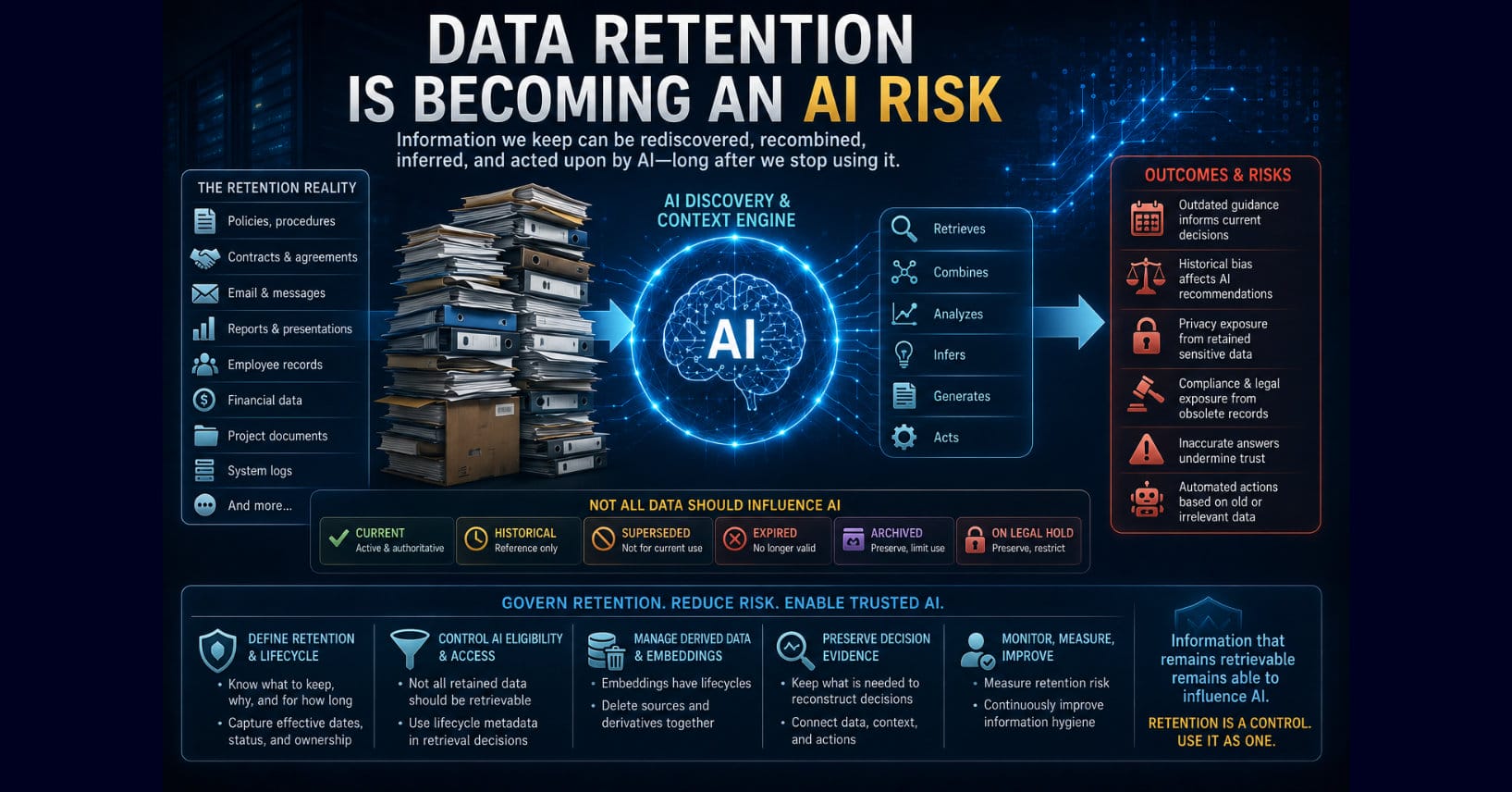
Data retention has traditionally been governed through legal, regulatory, privacy, records management, and storage requirements. Enterprise AI adds another dimension: retained information can now be rediscovered, combined, interpreted, and acted upon long after the organization stopped using it operationally.
“Data Retention Is Becoming an AI Risk” examines how RAG, semantic retrieval, and agentic AI can reactivate obsolete policies, historical records, archived documents, sensitive information, and poorly governed data. The article distinguishes between the obligation to retain information and permission for AI to use it, arguing that “must retain” should never automatically mean “may use.”
The article explores lifecycle metadata, zombie data, historical bias, legal holds, embeddings, AI-generated derivatives, deletion propagation, temporal provenance, decision evidence, and AI-aware disposition. It argues that organizations need machine-readable lifecycle states that distinguish current, historical, superseded, expired, archived, and legally preserved information.
For years, organizations have treated data retention primarily as a records management problem.
How long must we keep this?
When can we delete it?
What does regulation require?
What does litigation require?
How much is all this storage costing us?
Those remain important questions.
Artificial intelligence adds another one:
What can our AI systems do with information we decided to keep?
That question changes the economics and risk of retention.
An obsolete document sitting quietly in an archive once presented relatively limited operational risk. Someone had to know it existed, find it, open it, understand it, and decide to use it.
Enterprise AI can rediscover that document instantly.
Retrieval-augmented generation can place it into context.
A model can summarize it.
An agent can act upon it.
Old information can become operationally active again.
That means data retention is no longer merely about how long information exists.
It is increasingly about how long information remains capable of influencing enterprise intelligence.
Retained Does Not Mean Relevant
Enterprises retain enormous quantities of information.
Contracts.
Policies.
Presentations.
Reports.
Email.
Chat messages.
Customer records.
Employee records.
Financial data.
Project documentation.
System logs.
Meeting transcripts.
Research.
Spreadsheets.
Backups.
Archived websites.
Historical databases.
Some must be retained.
Some should be retained.
Some exists because nobody ever made a decision about it.
The result is an enterprise information environment containing multiple generations of institutional history.
Humans often recognize this intuitively.
A ten-year-old presentation looks old.
A retired application feels historical.
A folder named “Archive” sends a signal.
AI does not necessarily interpret those signals unless the architecture makes them explicit.
To a retrieval system, an obsolete paragraph can still be semantically relevant.
And relevance can reactivate information that the enterprise stopped treating as operational years ago.
AI Makes Old Data Discoverable Again
Traditional enterprise search already increased information discoverability.
Generative AI changes the scale.
Users no longer need to know:
which repository contains the information;
what the document was called;
who created it;
which folder contains it;
or what exact keywords were used.
They can simply ask a question.
The AI searches.
This means information that was functionally buried can become immediately useful—or immediately dangerous.
Consider a user asking:
“What is our policy for approving exceptions to this control?”
The RAG system retrieves an old procedure that describes an exception process abandoned three years ago.
The document was retained legitimately.
The AI uses it incorrectly.
The retention decision was reasonable.
The retrieval decision was not.
This distinction will become increasingly important.
Retention and AI Eligibility Are Different Decisions
Historically, organizations have often treated retained information as broadly available within whatever permissions governed the repository.
AI introduces a reason to separate two questions:
Should we retain this information?
and
Should AI be allowed to use this information?
The answers may be different.
A superseded policy may need to be retained for seven years.
That does not mean it should influence answers about current policy.
An expired contract may need to remain available to Legal.
That does not mean a sales AI should use its terms when drafting a new proposal.
Historical financial records may need to be retained.
That does not mean every forecasting model should treat them as equally representative of current conditions.
Employee records may need to be preserved for compliance.
That does not mean they should remain available for every future AI inference.
Retention preserves information.
AI eligibility determines whether that information may participate in machine reasoning.
Those controls should not be confused.
Archives Are Becoming AI Data Sources
The concept of an archive is changing.
Traditionally, archival information was removed from active operational use while preserved for historical, legal, compliance, or evidentiary purposes.
AI can erase that practical distinction.
Connect an archive to enterprise search or RAG and archived information becomes computationally active.
The file may still say “Archive.”
The AI does not care unless the retrieval architecture does.
This creates a governance requirement:
Archival status must become machine-readable.
AI systems need to know whether information is:
current;
historical;
superseded;
expired;
archived;
reference-only;
subject to legal hold;
or prohibited from operational use.
The archive cannot remain merely a location.
It needs semantic governance.
Retention Without Lifecycle Metadata Is Dangerous
A mature retention program does more than establish deletion dates.
It defines lifecycle states.
For AI, those states become especially valuable.
Imagine every significant information asset carrying metadata such as:
creation date;
effective date;
expiration date;
supersession status;
record category;
retention requirement;
disposition date;
legal hold status;
authoritative status;
AI retrieval eligibility;
AI training eligibility;
and operational-use status.
Now the AI architecture has something to work with.
Retrieval can exclude expired material.
Historical queries can deliberately include it.
Legal holds can preserve information without making it operational.
Superseded documents can remain discoverable without being treated as current authority.
Lifecycle metadata becomes an AI control.
The Problem of “Zombie Data”
Organizations often possess data that is neither properly alive nor properly dead.
It is no longer actively maintained.
Nobody clearly owns it.
Its business purpose has disappeared.
Its quality is uncertain.
Its definitions may be obsolete.
But it remains accessible.
Call it zombie data.
Before AI, zombie data often sat quietly in shared drives, old databases, forgotten SharePoint sites, abandoned SaaS platforms, and backup environments.
AI gives zombie data a second life.
Semantic retrieval can find it.
Models can interpret it.
Agents can operationalize it.
That creates a new category of risk:
information that survived its governance lifecycle but remains technically usable.
AI makes that condition much harder to ignore.
Data Minimization Gains New Importance
Data minimization has long been associated with privacy and security.
Keep only what you need.
AI strengthens the argument.
Every retained information asset potentially expands:
the retrieval surface;
the inference surface;
the privacy surface;
the attack surface;
the compliance surface;
and the decision surface.
The question is no longer merely:
“What is the cost of storing this data?”
It becomes:
“What is the cost of allowing this data to remain computationally available?”
Storage has become cheap.
Interpretation has become cheap too.
That combination changes retention economics.
More Data Is Not Always Better AI
AI culture sometimes encourages a simple intuition:
More data produces better intelligence.
Sometimes it does.
Sometimes more data produces more confusion.
An enterprise knowledge base containing:
three versions of a policy;
two conflicting definitions;
an obsolete procedure;
a draft revision;
meeting notes;
and an AI-generated summary
does not necessarily become more useful because all seven are indexed.
The system may have more context.
It may have less clarity.
Data volume is not the same as information quality.
For enterprise AI, selective exclusion can be a governance capability.
Knowing what the AI should not know may be as important as knowing what it should know.
Historical Data Can Encode Historical Bias
Retention creates another AI concern.
Historical information reflects historical decisions.
Historical practices.
Historical assumptions.
Historical incentives.
Historical inequalities.
Historical errors.
An organization may have corrected those conditions.
Its retained data still contains them.
An AI system trained on or grounded in historical information can reintroduce patterns the organization intentionally abandoned.
For example, historical:
hiring decisions;
credit decisions;
customer classifications;
fraud investigations;
performance evaluations;
pricing practices;
or risk assessments
may reflect standards no longer considered appropriate.
The data may be factually accurate as history.
It may be inappropriate as guidance.
That distinction matters.
Accurate History Can Still Be Bad Context
This is a subtle governance problem.
Information does not need to be wrong to create AI risk.
It can be perfectly accurate about the past.
The problem is using it to answer a question about the present.
A 2019 policy may accurately describe the 2019 policy.
A 2021 compensation structure may accurately describe 2021.
A former regulatory interpretation may accurately document what the organization believed at the time.
AI can mistake historical truth for current truth.
That means governance must distinguish:
historical accuracy from current applicability.
Retention preserves the former.
Lifecycle governance protects the latter.
Legal Holds Create Special AI Problems
Legal holds require organizations to preserve potentially relevant information.
That information may include:
email;
documents;
chat messages;
system records;
employee information;
and other sensitive material.
Preservation does not necessarily imply permission for unrelated AI use.
An organization could therefore face a strange situation.
Information must not be deleted.
But it may also need to be excluded from:
AI retrieval;
model training;
automated inference;
summarization;
or operational decision-making.
This reinforces the separation between:
retention status and AI-use status.
“Must retain” should not automatically become “may use.”
Privacy Rights Must Reach AI Derivatives
Deletion becomes more complicated when AI enters the information lifecycle.
Suppose an organization is required to delete a person’s data.
The original record is removed.
But that information may also have been:
chunked;
embedded;
cached;
summarized;
copied into a prompt log;
used to create a classification;
included in a generated report;
stored in conversation history;
or incorporated into another derived record.
What does deletion mean now?
Deleting the source may not delete its descendants.
This is why lineage becomes essential to retention governance.
The organization must increasingly understand:
What did this data become?
Embeddings Have Lifecycles Too
Vector embeddings deserve particular attention.
An enterprise may delete the original source document but leave the associated vectors in a database.
That creates obvious governance questions.
Does the embedding constitute retained information?
Can it still influence retrieval?
Can it reveal characteristics of the original data?
Should it inherit the source retention schedule?
Should deletion of the source automatically trigger deletion of its derived vectors?
How can the enterprise demonstrate that removal occurred?
These are lifecycle questions.
Treating embeddings as disposable technical artifacts can leave governance gaps.
AI Outputs Create New Retention Decisions
AI does not merely consume retained data.
It creates new information.
Summaries.
Classifications.
Scores.
Recommendations.
Predictions.
Drafts.
Inferences.
Reports.
Agent logs.
Conversation histories.
Tool outputs.
Decision records.
Some may be ephemeral.
Others may become business records.
Organizations need criteria for determining when AI-generated output crosses that boundary.
If an AI-generated recommendation influences a significant decision, should it be retained?
If an AI agent modifies a customer account, what evidence should be preserved?
If a generated summary becomes part of a clinical, legal, financial, or personnel process, what recordkeeping obligations follow?
AI dramatically increases the volume of information that could potentially become evidence.
Retention policy must adapt.
Keeping Everything Is Not Defensibility
Organizations sometimes respond to uncertainty by retaining everything.
It feels safe.
If we keep everything, we can always prove what happened.
Not necessarily.
Excessive retention can make defensibility worse.
More information means:
more discovery exposure;
more privacy exposure;
more cybersecurity exposure;
more contradictory evidence;
more obsolete information;
more uncontrolled copies;
and now, more AI retrieval exposure.
Defensibility does not mean preserving everything indefinitely.
It means preserving the right evidence for the right period under controlled conditions.
Governance requires deliberate retention and deliberate deletion.
Deletion Is a Governance Control
Deletion is often treated as housekeeping.
In an AI-enabled enterprise, deletion becomes a risk control.
Deleting information can reduce:
unauthorized retrieval;
obsolete guidance;
privacy exposure;
attack surface;
inappropriate inference;
model contamination;
and governance ambiguity.
That does not mean deleting aggressively without regard for legal, regulatory, contractual, operational, or evidentiary obligations.
It means recognizing that indefinite retention is itself a decision.
And increasingly, an AI risk decision.
Retention Schedules Need AI Attributes
Traditional retention schedules may identify:
record category;
business owner;
retention period;
legal basis;
disposition method.
AI-era retention schedules may eventually need additional attributes.
For example:
AI retrieval permitted?
AI training permitted?
AI inference permitted?
Historical analysis permitted?
External model processing permitted?
Automated decision use permitted?
Human review required?
Embedding retention period?
Generated derivatives subject to same disposition?
Those attributes convert records management into machine-enforceable governance.
AI Should Understand Time
Enterprise AI needs stronger temporal awareness.
When a user asks:
“What is our current policy?”
the system should understand that “current” is a governance condition.
When a user asks:
“What policy applied in June 2024?”
the system should retrieve historical information intentionally.
That requires effective dates.
Expiration dates.
Version relationships.
Supersession metadata.
Temporal lineage.
AI should not merely know what information says.
It should know when that information was true.
This is an important capability for governable intelligence.
Temporal Provenance Matters
Provenance tells us where information came from.
AI-era governance increasingly needs temporal provenance:
What source existed at the time?
Which version was authoritative?
When was it approved?
When did it become effective?
When was it superseded?
When was it indexed?
When was it removed?
Which version did the AI actually retrieve?
These questions become critical when reconstructing consequential decisions.
Today’s data environment may not explain yesterday’s AI answer.
Governance needs enough historical evidence to bridge that gap.
Retention and Decision Evidence Must Be Connected
Not all information deserves long-term retention.
Some decision evidence does.
Suppose an AI system contributes to:
a major financial decision;
a regulatory filing;
a cybersecurity response;
an employment action;
a customer eligibility decision;
a contractual commitment;
or a significant operational change.
The organization may need to preserve sufficient evidence to reconstruct the decision.
That may include:
the relevant source versions;
retrieved context;
model and prompt versions;
generated output;
human review;
approval;
decision;
and action.
The retention requirement should follow the consequence of the decision, not merely the technical lifecycle of the AI session.
This is where records management intersects with evidentiary architecture.
Agentic AI Raises the Stakes
Agentic systems make retention governance even more consequential.
An AI agent may retrieve historical information.
Interpret it.
Make a decision.
Execute an action.
Write new information back into enterprise systems.
Now an obsolete record can influence current operations without a human ever opening it.
The chain might look like:
Retained Data → Retrieval → AI Interpretation → Decision → Action → New Data
If the original information should no longer have been operationally eligible, the entire downstream chain becomes questionable.
Retention governance becomes action governance.
Retention Policies Must Become Executable
Many organizations have excellent retention policies on paper.
AI requires those policies to become increasingly executable.
A policy might say:
“Superseded operational procedures must be retained for seven years but may not be used as current guidance.”
A human can understand that.
The information architecture must make it enforceable.
That may require:
lifecycle metadata;
document status;
effective dates;
retrieval filters;
AI-use permissions;
policy engines;
automated disposition;
vector deletion;
cache invalidation;
and monitoring.
Policy language alone cannot govern machine-speed retrieval.
Governance must become part of the architecture.
The Enterprise Needs an AI-Aware Disposition Process
Disposition should increasingly ask more than:
Has the retention period expired?
An AI-aware process may need to ask:
Is the information indexed?
Are embeddings derived from it?
Does it exist in caches?
Was it summarized into another record?
Does an AI-generated derivative depend upon it?
Is it present in conversation history?
Does a legal hold apply?
Does decision evidence require preservation?
Should downstream artifacts be deleted, corrected, or relabeled?
Can deletion be verified?
This turns disposition into a lineage-aware process.
Without lineage, enterprises may know what they deleted but not what survived.
Retention Risk Should Be Measured
Organizations can begin measuring this problem.
Useful indicators might include:
percentage of AI-indexed content with defined retention schedules;
percentage with lifecycle metadata;
percentage of archived content excluded from current-answer retrieval;
number of superseded documents retrieved by AI;
orphaned embeddings;
expired information remaining AI-accessible;
average delay between source deletion and vector deletion;
AI-generated records without retention classifications;
legal-hold information available to unrelated AI use;
and percentage of consequential AI decisions with preserved decision evidence.
These measures make retention risk visible.
The Goal Is Not Less Data
The objective is not indiscriminate deletion.
Historical information has enormous value.
It supports:
analysis;
learning;
audit;
research;
trend identification;
legal obligations;
institutional memory;
and accountability.
The governance objective is to distinguish:
information that must exist;
information that may be used;
information that may influence current decisions;
information that may train models;
information that may be retrieved by AI;
and information that must remain preserved but operationally dormant.
Those are different states.
AI makes the distinctions necessary.
The Enterprise Information Lifecycle Is Changing
Traditional information lifecycle management often looks like:
Create → Use → Store → Archive → Dispose
AI complicates the middle.
A more realistic lifecycle may become:
Create → Govern → Use → Retrieve → Combine → Infer → Generate → Store → Reuse → Archive → Dispose
And generated information can reenter the cycle.
That creates recursive information lifecycles.
An AI-generated inference becomes a stored record.
The record becomes future AI context.
The next model produces another inference.
The enterprise is no longer merely retaining data.
It is retaining ingredients for future machine reasoning.
Boardroom Takeaway
Data retention has historically been viewed through legal, regulatory, privacy, operational, and storage lenses.
Enterprise AI adds another dimension.
Every retained information asset may become future AI context.
That means obsolete documents, historical decisions, archived records, expired policies, abandoned datasets, and poorly governed information can become operational again simply because an AI system can retrieve them.
Leadership should ask:
“Are we retaining information because we need to preserve it—or are we unintentionally allowing it to remain active evidence for future AI decisions?”
The distinction matters.
Because in the AI-enabled enterprise, information does not become harmless simply because it becomes old.
If the machine can still retrieve it, interpret it, combine it, and act upon it, the data is still operational.
And that makes retention an AI governance issue.
Coming Next
Article 15: Third-Party Data Is Still Your Governance Problem
Enterprises increasingly depend on data they did not create.
Commercial datasets. Vendor feeds. SaaS platforms. Business partners. Data brokers. Public sources. Industry databases. APIs. Cloud services. AI providers.
The information may originate outside the enterprise, but the decisions made with it do not.
The next article examines why acquiring data from a third party does not transfer accountability for its quality, provenance, legality, permitted use, retention, security, or fitness for purpose—and why AI makes third-party data governance considerably more consequential.