Information Architecture Series | Article 5 of 8
Summary
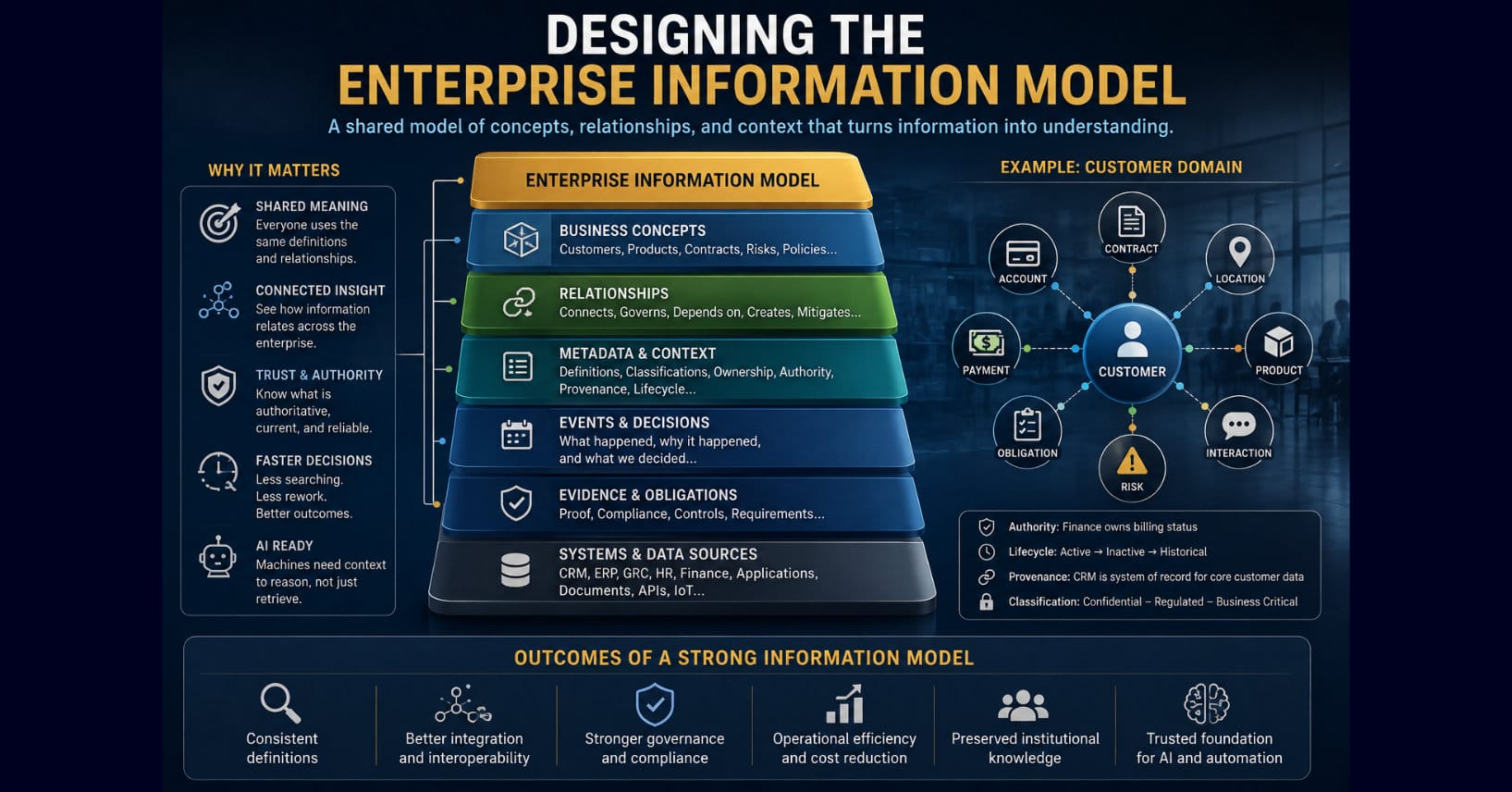
An enterprise information model provides a structured representation of the concepts an organization needs to understand and the relationships among them. Rather than beginning with databases or applications, effective information modeling begins with the business: customers, products, contracts, processes, risks, controls, obligations, decisions, evidence, and the connections among them.
This article examines the architectural components of an enterprise information model, including information domains, business concepts, semantic relationships, metadata, classification, ownership, authority, provenance, lifecycle, events, decisions, and evidence. It also explains why the model should be federated, connected to technology implementation, and focused on areas where information ambiguity creates material business friction.
As artificial intelligence becomes embedded throughout the enterprise, these explicit structures become increasingly important. AI needs more than access to information. It needs organized meaning that helps establish context, relationships, authority, provenance, and trust.
If information architecture is about organizing meaning, eventually the enterprise must decide how that meaning will be represented.
Not merely where information is stored.
Not merely which applications own which records.
Not merely how data moves between systems.
The enterprise needs a model of the things it cares about and the relationships among them.
Customers.
Products.
Contracts.
Employees.
Vendors.
Applications.
Business capabilities.
Processes.
Risks.
Controls.
Policies.
Obligations.
Decisions.
Evidence.
These concepts already exist throughout the organization.
The problem is that they frequently exist differently everywhere.
Sales has one representation of a customer.
Finance has another.
Legal has another.
Operations has another.
The CRM represents one view.
The ERP represents another.
The data warehouse attempts to reconcile them.
Documents add more context.
Employees carry still more in their heads.
The result is not necessarily incorrect information.
It is fragmented meaning.
An enterprise information model provides a way to make that meaning explicit.
Start With the Business, Not the Database
One of the easiest mistakes is beginning an enterprise information model by examining database schemas.
Databases matter.
But they represent how systems implemented business concepts, not necessarily how the enterprise should understand those concepts.
If the organization begins with its existing tables, fields, APIs, and application structures, it risks reproducing decades of system-specific assumptions in a new model.
The better starting point is the business.
What are the important things the enterprise needs to understand?
What relationships exist among them?
What events change them?
What decisions depend upon them?
What obligations govern them?
What information provides evidence about them?
Consider a simple business statement:
A customer purchases a product under a contract.
That statement contains three concepts:
Customer.
Product.
Contract.
It also contains relationships.
A customer purchases a product.
A contract governs that purchase.
Now extend the model.
The contract creates obligations.
Obligations are fulfilled by business processes.
Processes depend on applications.
Applications create risks.
Risks are mitigated by controls.
Controls produce evidence.
Evidence supports decisions.
We have moved from a collection of records to a model of enterprise meaning.
What Is an Enterprise Information Model?
An enterprise information model is a structured representation of the major information concepts the organization needs to understand and the relationships among them.
It operates above individual applications.
That distinction matters.
The CRM may represent customers one way.
The billing platform may represent them another.
The enterprise information model establishes the broader business concept that those system-specific representations describe.
It provides a semantic layer across the technology estate.
A mature enterprise information model may describe:
- Information domains
- Business concepts
- Definitions
- Relationships
- Classifications
- Metadata
- Ownership
- Authority
- Provenance
- Lifecycle
- Business rules
- Policies
- Constraints
- Events
- Decisions
- Evidence
The objective is not to create a gigantic diagram containing everything the organization knows.
The objective is to establish enough shared meaning that information can remain coherent as it moves across systems, processes, teams, and increasingly AI systems.
Begin With Information Domains
Large enterprises contain too much information to model as one undifferentiated whole.
Information domains provide manageable boundaries.
Common domains might include:
Customer
Product
Finance
Workforce
Supplier
Asset
Technology
Risk
Compliance
Operations
Legal
The appropriate domains depend on the organization.
A hospital may require domains for patients, providers, clinical encounters, medications, and care plans.
A manufacturer may emphasize products, materials, suppliers, plants, equipment, and production orders.
A financial institution may emphasize customers, accounts, transactions, instruments, exposures, and regulatory obligations.
The important point is that domains represent meaningful areas of enterprise information, not simply application boundaries.
“Salesforce” is not an information domain.
“Customer” might be.
“SAP” is not an information domain.
“Finance” or “Supplier” might be.
This distinction prevents the enterprise information model from becoming another inventory of systems.
Define the Concepts
Within each domain, identify the concepts that matter.
For a customer domain, those might include:
Customer.
Account.
Contact.
Location.
Relationship.
Agreement.
Interaction.
Segment.
Preference.
Consent.
The definitions matter.
What exactly constitutes a customer?
Is a prospect a customer?
Is a subsidiary a separate customer?
Can one legal entity have multiple accounts?
Can an account represent multiple legal entities?
When does a customer become inactive?
These questions often expose disagreements that have existed for years.
That is useful.
Architecture should reveal ambiguity rather than conceal it.
The goal is not necessarily to force every department to use identical terminology.
Different contexts may legitimately require different representations.
The goal is to understand those differences explicitly.
Model Relationships, Not Just Things
Many enterprise models focus heavily on entities.
Customer.
Contract.
Application.
Risk.
Control.
Those entities matter.
But much of the useful meaning exists in the relationships between them.
A customer holds an account.
A contract applies to a customer.
A policy governs a process.
A process uses an application.
An application stores information.
A risk threatens a business capability.
A control mitigates a risk.
Evidence demonstrates control performance.
A decision accepts a risk.
A regulator imposes an obligation.
An obligation requires a control.
Once those relationships are explicit, the enterprise can ask far more interesting questions.
Which applications support processes affected by this regulation?
Which customers are governed by contracts containing this obligation?
Which risks affect the systems supporting this business capability?
Which controls produce evidence for this regulatory requirement?
Which decisions depended on this information?
This is where information architecture begins becoming operationally powerful.
Relationships Are First-Class Information
Traditional application architectures often bury relationships inside code, foreign keys, integration mappings, documents, or human knowledge.
An enterprise information model treats important relationships as information assets themselves.
This changes how the organization thinks.
Instead of merely asking:
What systems contain information about this customer?
The enterprise can ask:
What relationships does this customer have with products, contracts, obligations, locations, risks, and decisions?
That is a fundamentally richer view.
It also aligns much more closely with how people actually reason.
Humans understand the world through relationships.
Enterprise information systems should increasingly do the same.
Metadata Gives the Model Context
The concepts and relationships in an information model need context.
Metadata provides it.
Consider a policy.
The content of the policy is information.
But useful metadata might include:
Policy owner.
Approval authority.
Effective date.
Review date.
Version.
Status.
Business domain.
Applicable jurisdictions.
Related regulations.
Superseded policies.
Information classification.
Related controls.
Exceptions.
That metadata allows the enterprise to answer questions that the document alone cannot.
Is this policy current?
Who owns it?
Where does it apply?
What replaced the previous version?
Which controls implement it?
Which regulation requires it?
Metadata turns isolated information into manageable information.
Classification Makes Information Governable
Not all information should be treated equally.
An enterprise information model should therefore incorporate classification.
Classification may describe:
Sensitivity.
Criticality.
Regulatory significance.
Business value.
Retention category.
Confidentiality.
Decision relevance.
AI usage restrictions.
For example, information might be classified as:
Public.
Internal.
Confidential.
Restricted.
But classification can extend beyond security.
An information asset might also be:
Authoritative.
Reference.
Derived.
Temporary.
Historical.
Regulated.
Decision-critical.
AI-approved.
Those distinctions become increasingly important as information is consumed automatically.
An AI agent should not have to infer whether a document is authoritative merely because it appears in search results.
The architecture should help make that determination explicit.
Ownership Must Be Defined at the Right Level
Ownership is one of the most frequently discussed and poorly implemented aspects of information management.
Organizations often assign ownership to systems.
IT owns the CRM.
Finance owns the ERP.
Legal owns the contract repository.
But owning a system is not the same as owning the meaning of the information inside it.
Who owns the enterprise definition of customer?
Who decides what constitutes an active supplier?
Who determines the authoritative definition of revenue for a particular reporting purpose?
Who defines the classification of a regulatory obligation?
Those are business ownership questions.
An enterprise information model should distinguish among:
System ownership.
Information ownership.
Data stewardship.
Policy authority.
Technical custody.
These roles may overlap.
They should not automatically be assumed to be identical.
Authority Must Be Contextual
Enterprises often search for a “single source of truth.”
The phrase is appealing.
Reality is usually more complicated.
There may be no single authoritative source for every aspect of a business concept.
The CRM may be authoritative for sales relationships.
The ERP may be authoritative for billing status.
The identity platform may be authoritative for user access.
The contract management system may be authoritative for legal terms.
The enterprise information model should therefore answer a more precise question:
Authoritative for what?
Authority should be associated with context.
Which attribute?
Which business process?
Which decision?
Which time period?
Which jurisdiction?
Which purpose?
This produces a more useful architecture than simply declaring one system the master of everything related to a concept.
Provenance Establishes Trust
Information also needs history.
Where did it originate?
What transformed it?
Which system supplied it?
Who modified it?
Which version preceded it?
What evidence supports it?
If an executive metric is derived from five operational systems and three transformation processes, that lineage matters.
If an AI-generated summary is used in a decision, the sources supporting the summary matter.
If a risk rating changes, the information that caused the change matters.
Provenance allows the enterprise to reconstruct how information came to exist in its current form.
That capability supports trust.
It also supports accountability.
Lifecycle Must Be Architectural
Information has a lifecycle.
It is created.
Used.
Changed.
Shared.
Derived.
Archived.
Superseded.
Retained.
Deleted.
Yet many enterprises treat lifecycle primarily as a storage or records-management issue.
It is broader than that.
The meaning and authority of information can change during its lifecycle.
A draft contract becomes executed.
A current policy becomes superseded.
An active customer becomes inactive.
A preliminary risk assessment becomes approved.
A proposed architecture decision becomes adopted.
A temporary exception expires.
The enterprise information model should represent meaningful lifecycle states and transitions.
Otherwise, systems may preserve the object while losing its current significance.
Model Events as Well as Entities
Events are another important component.
An enterprise is not static.
Things happen.
A customer signs a contract.
A payment fails.
A supplier changes ownership.
A vulnerability is discovered.
A control fails.
A policy is approved.
A risk is accepted.
A system is retired.
A regulation takes effect.
Events change the state of enterprise information.
Modeling important events helps the organization understand not merely what exists, but how and why it changed.
This becomes particularly valuable for automation and AI agents.
Agents frequently operate in response to events.
The better the enterprise understands those events and their consequences, the safer and more useful automation can become.
Decisions Belong in the Model
One category of enterprise information deserves much more architectural attention:
Decisions.
Decisions create changes throughout the enterprise.
A decision approves a vendor.
Accepts a risk.
Funds a project.
Selects an architecture.
Changes a policy.
Terminates a product.
Enters a market.
Deploys an AI system.
Yet decision information is frequently scattered across email, meeting minutes, presentations, ticketing systems, and individual memory.
An enterprise information model can represent decisions as first-class information objects.
A decision can have:
An owner.
Decision authority.
A date.
A question.
Alternatives.
Evidence.
Assumptions.
Rationale.
Risks.
Conditions.
Actions.
Review triggers.
Relationships to affected systems, processes, policies, and obligations.
Once decisions become part of the information model, the enterprise gains something important:
decision lineage.
It becomes possible to understand not only what the enterprise looks like, but why it became that way.
Evidence Belongs in the Model Too
Evidence is the information that demonstrates something occurred, operated, was reviewed, or was decided.
A control produced a log.
A committee approved a policy.
A manager reviewed an exception.
A vulnerability was remediated.
A risk was accepted.
A regulatory obligation was assessed.
Those evidence relationships matter.
If the enterprise models them explicitly, audit and governance activities become less dependent on reconstruction.
The organization moves from:
Can we find evidence?
toward:
We know what evidence should exist, what it demonstrates, where it came from, and which decision or obligation it supports.
That is a much more mature information environment.
Do Not Try to Model Everything
The greatest danger in enterprise information modeling is ambition.
A team decides to create the complete enterprise ontology.
Workshops multiply.
Diagrams grow.
Committees debate terminology.
Months pass.
The model becomes intellectually impressive and operationally irrelevant.
The objective is not philosophical completeness.
It is business usefulness.
Start where information ambiguity creates material friction.
A useful prioritization sequence is:
- Decision-critical information.
- Regulatory and contractual information.
- High-value shared business concepts.
- Information used by multiple systems.
- Information feeding AI and automation.
- Information associated with recurring reconciliation.
- Information dependent on institutional knowledge.
Model the areas where better context produces measurable value.
Then expand.
The Model Should Be Federated
A global enterprise should not expect one central architecture team to define every business concept.
The people closest to a domain often understand its meaning best.
A better approach is federated.
Enterprise architecture establishes common principles.
Domain owners define domain concepts.
Information architects coordinate semantics.
Data architects map technical representations.
Governance establishes accountability.
Security defines protection requirements.
Records management defines retention obligations.
Business leaders establish authority.
AI teams identify machine-context requirements.
The enterprise information model becomes a shared architecture rather than a centrally authored dictionary.
That distinction improves both accuracy and adoption.
The Model Must Connect to Technology
An information model that exists only in architecture documentation will eventually become obsolete.
It must connect to implementation.
Concepts should map to systems.
Definitions should map to metadata catalogs.
Authority should map to data sources.
Classifications should influence access controls.
Lifecycle rules should influence retention.
Relationships should inform APIs and integrations.
Provenance should connect to lineage.
Business terms should connect to analytics.
Policies should connect to controls.
AI retrieval systems should use authority, classification, and contextual metadata.
Knowledge graphs may represent high-value semantic relationships.
The model becomes valuable when it begins influencing how the technology estate behaves.
AI Changes the Design Requirement
Artificial intelligence raises the standard for enterprise information modeling.
Humans are remarkably good at compensating for incomplete models.
They understand implied meaning.
They recognize exceptions.
They ask colleagues.
They remember history.
They interpret organizational language.
AI systems require those relationships to be more explicit.
Consider an AI agent asked to:
Identify customers affected by a newly issued regulatory requirement and determine which contractual obligations may need review.
That task requires relationships among:
Regulations.
Obligations.
Jurisdictions.
Customers.
Contracts.
Products.
Policies.
Perhaps systems and controls.
If those relationships exist only in human knowledge, the agent cannot reliably traverse them.
If the enterprise information model represents them, the problem becomes much more tractable.
This is why enterprise information architecture is becoming part of AI architecture.
The enterprise information model provides the semantic environment in which AI can operate.
From Information Model to Knowledge Environment
The ultimate objective is not a diagram.
It is an environment in which enterprise information explains itself.
A customer is not merely a record.
It is a concept with defined relationships.
A policy is not merely a PDF.
It has authority, applicability, ownership, history, and relationships to obligations and controls.
A decision is not merely a meeting outcome.
It has evidence, rationale, authority, consequences, and lineage.
A risk is not merely a score.
It relates to assets, threats, controls, decisions, and business consequences.
When those relationships become explicit, the enterprise begins moving from information management toward knowledge architecture.
That transition matters.
Because future enterprise systems will increasingly need to answer questions that cross application boundaries.
They will need to understand relationships.
They will need context.
They will need authority.
They will need provenance.
They will need to distinguish what exists from what can be trusted.
And they will need to do all of that at machine speed.
Design Meaning Before Automating Intelligence
Enterprises are racing to make information accessible to artificial intelligence.
That is understandable.
But access is not the same as understanding.
Before connecting every repository to every model, organizations should ask whether the information environment provides enough structure for those models to interpret what they retrieve.
What are the important concepts?
How are they related?
Who owns their meaning?
Which sources are authoritative?
What classifications apply?
Where did the information come from?
What lifecycle state is it in?
Which policies govern its use?
What decisions depend on it?
Those questions define the enterprise information model.
The answers do not need to be perfect before AI can begin.
But they cannot remain permanently implicit.
Because the more decisions enterprises delegate to software, automation, and artificial intelligence, the more dangerous ambiguous information becomes.
The future enterprise will not merely need organized data.
It will need organized meaning.
And organized meaning begins with an information model.
Coming Next
Article 6: Information Architecture Is Becoming AI Architecture
Enterprise AI depends on far more than model capability. Retrieval, grounding, semantic search, knowledge graphs, agent permissions, provenance, authority, and contextual metadata all depend on the information environment surrounding the model. The next article examines why information architecture is rapidly becoming a foundational layer of enterprise AI architecture.