Enterprise Requirements Series — Article 10
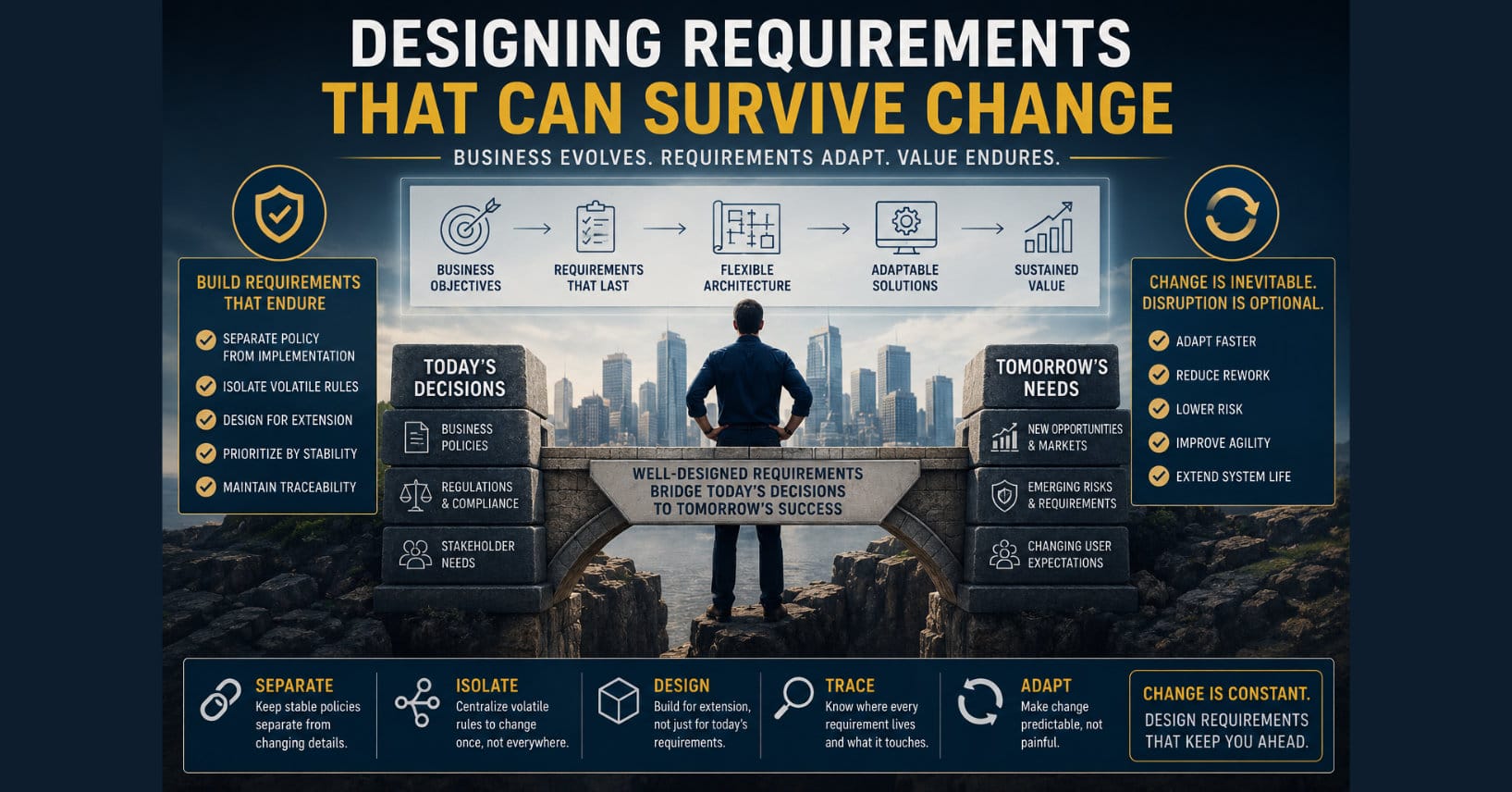
This article explains how to design requirements that remain useful as business conditions change. It explores separating stable policy from volatile implementation details, isolating changing business rules, prioritizing requirements by stability, and maintaining traceability so change becomes predictable rather than disruptive. The article positions adaptable requirements as a foundation for resilient architecture and long-term enterprise software value.
Building Better Software by Engineering Better Decisions
One of the most common criticisms of requirements engineering is that requirements become obsolete almost as soon as they are written.
Markets change.
Regulations evolve.
Business priorities shift.
Technology advances.
Customers expect new capabilities.
By the time development is complete, someone inevitably says:
“Everything has changed.”
The problem is rarely that requirements changed.
The problem is that they were written as though change would never happen.
Good requirements are not designed to resist change.
They are designed to accommodate it.
Change Is Not Failure
Many organizations treat changing requirements as evidence that planning failed.
Sometimes that is true.
More often, it simply reflects reality.
Businesses exist in dynamic environments.
Laws are amended.
Competitors introduce new products.
Supply chains change.
Cybersecurity threats evolve.
Customer expectations mature.
Software must adapt because the business adapts.
Requirements engineering should prepare organizations for that reality rather than pretending it does not exist.
Stable Decisions Should Be Separated from Changing Decisions
Not every requirement changes at the same rate.
Some business rules remain stable for decades.
Others may change every month.
For example:
An employee’s date of hire rarely changes.
Tax regulations change regularly.
A customer’s legal name changes infrequently.
Discount programs may change every quarter.
Core accounting principles remain relatively stable.
Marketing campaigns change constantly.
One of the goals of good requirements engineering is identifying which decisions are stable and which are expected to evolve.
Treating both the same creates unnecessary complexity.
Separate Policy from Implementation
One of the most effective ways to create adaptable systems is to separate business policy from technical implementation.
Consider this requirement:
Orders over $10,000 require executive approval.
That requirement contains two different concepts.
The business policy:
Executive approval is required for high-value purchases.
The implementation detail:
The threshold is currently $10,000.
If leadership later changes the threshold to $15,000, the business policy remains unchanged.
Only one decision changes.
Requirements that separate enduring business intent from adjustable operational values are significantly easier to maintain.
Avoid Embedding Volatile Decisions
Organizations frequently embed changing business rules throughout multiple requirements.
Approval limits appear in workflows.
Reports.
Validation rules.
Notifications.
Interfaces.
Testing scripts.
Documentation.
When the policy changes, dozens of artifacts require updates.
Instead, volatile business rules should be identified once, referenced consistently, and managed centrally whenever possible.
The fewer places a rule appears, the easier it becomes to change.
Design for Extension
Requirements should describe what the organization needs today without preventing tomorrow’s capabilities.
Suppose a system initially supports email notifications.
Instead of writing:
The system shall notify users by email.
Consider:
The system shall notify users using approved communication methods.
A supporting business rule can specify that email is currently the approved method.
If leadership later approves SMS, mobile push notifications, or collaboration platforms, the requirement remains valid.
Only the supporting rule changes.
Small wording changes can dramatically improve long-term flexibility.
Prioritize by Stability
One practice used by mature requirements teams is to evaluate requirements not only by business priority but also by expected stability.
Some requirements are:
- High priority and highly stable.
- High priority but expected to change.
- Low priority but stable.
- Experimental or temporary.
Understanding that distinction helps architects design systems that isolate change instead of allowing it to ripple throughout the entire solution.
It also improves release planning by identifying which capabilities are ready for implementation and which require additional refinement.
Traceability Makes Change Predictable
Requirements cannot survive change if no one knows where they are implemented.
Traceability provides that visibility.
When a requirement changes, organizations should be able to identify:
- Related business rules.
- Architectural decisions.
- Software components.
- Test cases.
- User documentation.
- Training materials.
- Regulatory obligations.
Without traceability, every change becomes an investigation.
With traceability, change becomes manageable.
Adaptability Is an Architectural Quality
Requirements engineering and architecture are often treated as separate disciplines.
In reality, they solve the same problem from different perspectives.
Requirements identify what must change.
Architecture determines how easily change can occur.
Well-structured requirements produce well-structured architectures.
Poorly structured requirements create tightly coupled systems where even minor business changes require extensive redevelopment.
Software that adapts quickly usually began with requirements that anticipated change rather than ignored it.
Looking Ahead
No requirements document can predict every future business need.
That is not its purpose.
Its purpose is to capture today’s decisions in a way that allows tomorrow’s decisions to be incorporated without unnecessary disruption.
Successful organizations do not attempt to eliminate change.
They engineer systems that can respond to it.
Requirements that survive change reduce cost, improve agility, and extend the useful life of enterprise software.
That is one of the clearest indicators of mature requirements engineering.
Requirements Reality
The best requirements are not the ones that never change. They are the ones that make change predictable.
Coming Next
Article 11—Scope Creep Is Usually a Leadership Failure
Scope creep is often blamed on changing requirements, but the real problem usually begins elsewhere. Next, we’ll explore why uncontrolled scope is more often the result of weak governance, unclear priorities, and poor leadership than changing business needs.