Enterprise Requirements Series—Article 5
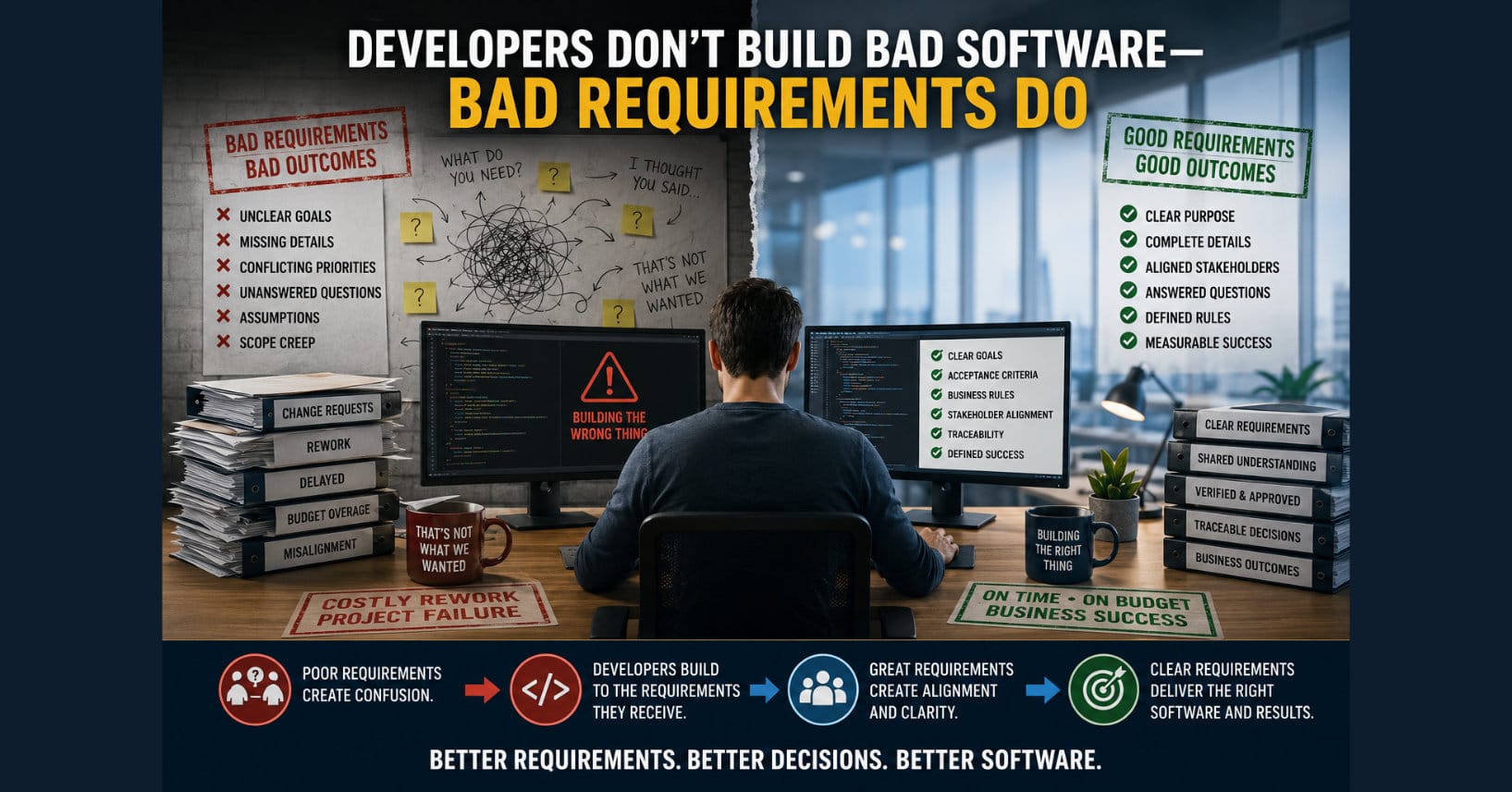
This article explains why failed software projects are often the result of bad requirements rather than bad developers. It argues that developers implement business decisions; they should not be forced to invent them. The article explores how missing requirements become assumptions, why requirements require ownership and accountability, and how better requirements protect development teams while improving business outcomes.
Building Better Software by Engineering Better Decisions
When software projects fail, someone eventually asks the same question.
“Who built this?”
The answer is almost always the development team.
Developers become the visible face of the project because they produced the software.
Visibility, however, is not the same as responsibility.
Most software failures begin long before developers open their first editor, create the first database table, or write the first line of code.
They begin when organizations fail to define what success actually looks like.
Developers rarely build the wrong software because they lack talent. They build the wrong software because they received the wrong requirements.
Developers Implement Decisions
Software developers solve technical problems.
They translate requirements into working systems.
They automate business processes.
They implement business rules.
What they do not do is determine business strategy.
Developers should never have to decide:
- Which department owns a process.
- Which policy takes precedence.
- Which customer receives priority.
- Which regulations apply.
- Which risks the organization is willing to accept.
Those are business decisions.
The requirements should already contain the answers.
When they do not, developers are forced to make decisions they were never authorized to make.
Every Missing Requirement Becomes an Assumption
Nature dislikes a vacuum.
Software projects do, too.
When requirements leave unanswered questions, work does not stop.
Someone fills in the blanks.
Sometimes it is the developer.
Sometimes it is the architect.
Sometimes it is the tester.
Sometimes it is the project manager.
Regardless of who makes the assumption, the organization has quietly transferred a business decision to someone without the authority to make it.
Assumptions eventually become production behavior.
“It Isn’t What We Wanted”
One of the most frustrating conversations in software development happens after deployment.
The business says:
“That’s not what we wanted.”
The developer responds:
“That’s exactly what the requirements specified.”
Both statements may be completely accurate.
The software reflects the documented requirements.
The documented requirements failed to reflect the business need.
This is not a programming defect.
It is a requirements defect.
Requirements Define Accountability
Organizations often discuss accountability after projects encounter difficulties.
True accountability begins much earlier.
Every requirement should have:
- A business owner.
- A clear purpose.
- An identified source.
- Defined acceptance criteria.
- Agreement from affected stakeholders.
Without ownership, no one is responsible for determining whether the requirement is correct.
Without accountability, requirements gradually become assumptions disguised as documentation.
Developers Cannot Validate Business Intent
One of the greatest misconceptions in software engineering is that experienced developers can compensate for weak requirements.
Experienced developers can identify inconsistencies.
They can recommend better technical approaches.
They can recognize missing information.
They can ask excellent questions.
What they cannot do is validate business intent.
Only stakeholders can determine whether a requirement reflects the organization’s goals, policies, and operational needs.
The farther developers move into business decision-making, the greater the likelihood they will make technically reasonable—but organizationally incorrect—choices.
Better Requirements Produce Better Software
Organizations frequently invest in:
- Better programming languages.
- Faster infrastructure.
- Modern development frameworks.
- Automated testing.
- Continuous integration.
- Artificial intelligence.
All of these improve software delivery.
None of them correct missing business requirements.
Technology improves implementation.
Requirements improve outcomes.
Improving development practices while neglecting requirements is like hiring better builders without first agreeing on the blueprint.
Requirements Engineering Protects Developers
Good requirements do more than improve projects.
They protect development teams.
Clear requirements reduce conflicting stakeholder feedback.
Clear requirements reduce unnecessary rework.
Clear requirements improve estimation accuracy.
Clear requirements simplify testing.
Clear requirements provide objective evidence that the delivered software satisfies the agreed business expectations.
Instead of defending implementation decisions, developers can demonstrate compliance with documented requirements.
That benefits everyone involved.
Looking Ahead
Organizations do not create successful software simply by hiring talented developers.
They create successful software by making sound business decisions before development begins.
Requirements engineering ensures those decisions are documented, validated, and understood before implementation starts.
Developers build software.
Requirements determine whether that software solves the right problem.
Requirements Reality
Developers automate business decisions. They should never have to invent them.
Coming Next
Article 6—Business Rules Are Architecture
Every business rule influences system behavior. Next, we’ll explore why business rules are not merely documentation—they are one of the most important architectural inputs in enterprise software.