Digital Transformation Series | Article 1 of 8
Digital Transformation: Redesigning the Enterprise for Continuous Change
Summary
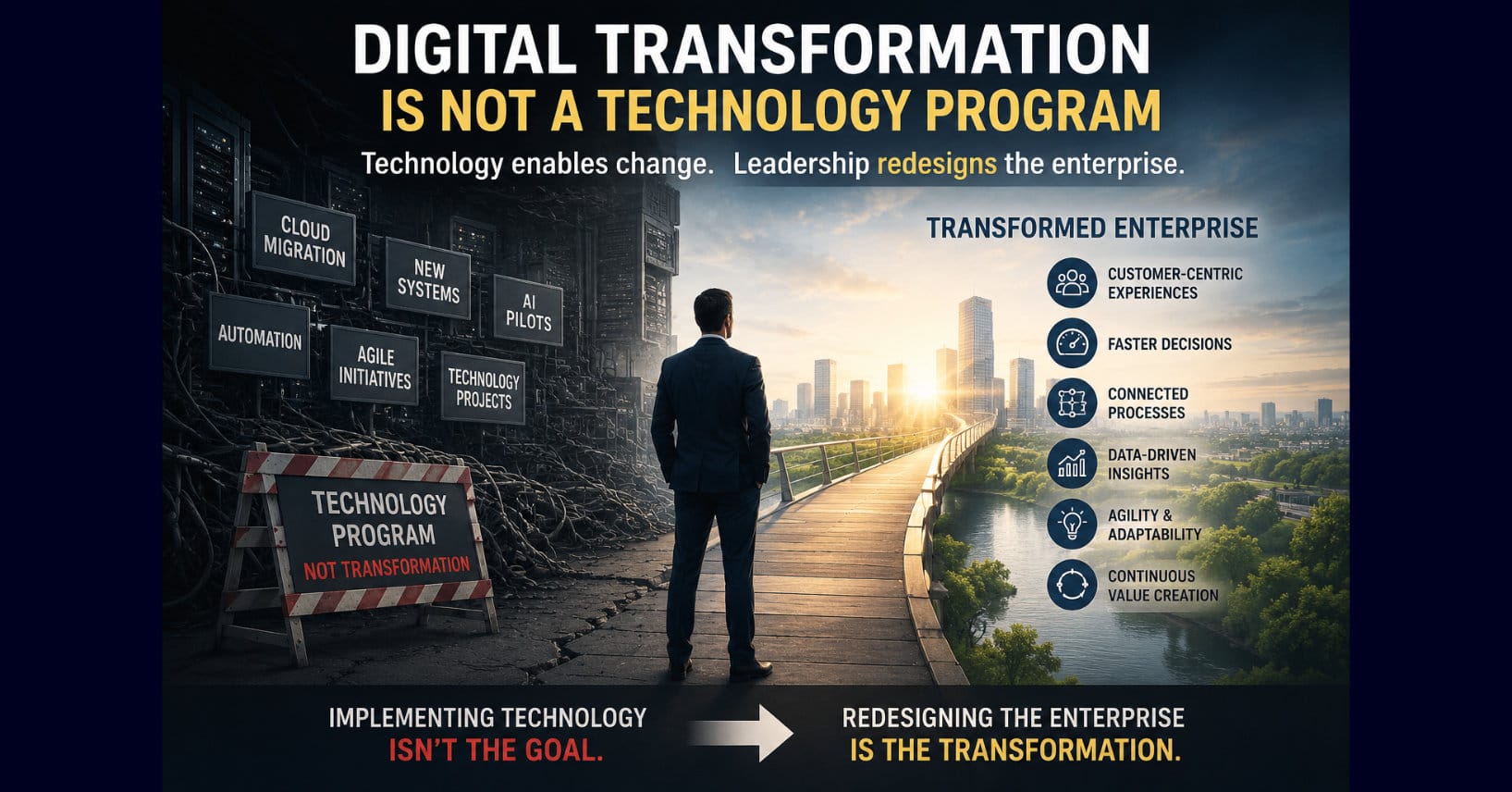
Organizations have invested heavily in cloud computing, ERP platforms, automation, Agile methods, data platforms, and artificial intelligence under the banner of digital transformation. Yet implementing new technology does not necessarily transform an enterprise.
This article distinguishes digitization, digitalization, modernization, and genuine digital transformation. It argues that transformation occurs when technology enables fundamental changes in enterprise capabilities, operating models, processes, information flows, decision-making, and software delivery. Rather than measuring transformation by applications migrated or technologies deployed, leaders should ask what the enterprise can now do that it could not do before.
The ultimate objective is not a permanently “transformed” organization, but a transformable enterprise capable of adapting continuously as technology and markets evolve.
For more than a decade, organizations have spent enormous sums on digital transformation.
They have migrated applications to the cloud. Replaced ERP platforms. Implemented SaaS applications. Automated business processes. Built mobile applications. Adopted Agile development methods. Created data lakes. Deployed collaboration platforms. Experimented with artificial intelligence.
Many of those investments were necessary.
But necessity does not make them transformational.
An organization can modernize nearly every component of its technology environment and still operate much as it did before. The infrastructure may be newer. The applications may be faster. Employees may have better tools. Customers may have better interfaces.
Yet the fundamental mechanics of the enterprise can remain unchanged.
The same decisions require the same approvals. The same organizational boundaries create the same delays. The same information remains trapped inside different business units. The same processes continue because nobody has reconsidered why they exist. Technology teams continue receiving requirements from the business and delivering projects against them.
That is modernization.
It may be valuable modernization. It may even be essential modernization.
But it is not necessarily digital transformation.
Digital transformation begins when technology enables the enterprise to operate differently.
Three Terms That Should Not Mean the Same Thing
Part of the confusion surrounding digital transformation comes from the way several related concepts are routinely treated as interchangeable.
They are not.
Digitization converts information from physical or analog formats into digital formats.
Scanning paper records into a document management system is digitization.
Digitalization uses digital technology to improve an existing process.
Replacing a paper expense report with an online workflow is digitalization.
Digital transformation changes the operating capabilities of the enterprise itself.
That distinction matters.
Imagine an insurance company with a claims process requiring employees to manually collect information from several systems before determining whether a claim can proceed.
The company could digitize supporting documents.
It could digitalize the workflow by creating an online claims application.
It could migrate the claims platform to the cloud.
It could give adjusters mobile applications.
Every one of those initiatives might improve the process.
Transformation occurs when the company redesigns the claims capability itself: integrating information across systems, automating routine decisions, routing exceptions intelligently, providing real-time visibility, and changing how employees intervene in the process.
The question is no longer:
How can technology make this process faster?
It becomes:
If we had today’s technology when we designed this capability, would we build the process this way at all?
That is a fundamentally different question.
Technology Projects Are Not Transformation Strategies
Executives naturally gravitate toward technology initiatives because technology investments are concrete.
A cloud migration has a plan.
An ERP implementation has milestones.
An application modernization program has a budget.
An AI initiative has pilots.
Transformation itself is more difficult to define because it crosses organizational boundaries.
It affects processes, decision rights, information flows, skills, organizational structures, customer interactions, incentives, and technology simultaneously.
As a result, organizations frequently substitute the technology program for the transformation strategy.
The cloud program becomes “the transformation.”
The ERP implementation becomes “the transformation.”
The AI program becomes “the transformation.”
This creates a dangerous management illusion: completing the technology initiative is interpreted as completing the transformation.
But implementing a platform does not determine how the enterprise will use the capabilities that platform creates.
Cloud computing is a good example.
Moving applications from an enterprise data center to cloud infrastructure can improve scalability, resilience, deployment options, and infrastructure economics.
But if applications are migrated without changing their architecture, delivery processes, ownership models, or integration patterns, the organization may have accomplished little more than changing where its servers reside.
The enterprise has moved.
It has not necessarily transformed.
Transformation Changes the Operating Model
The more useful way to think about digital transformation is as enterprise redesign enabled by technology.
The object being transformed is not the technology estate.
It is the operating model.
An operating model describes how an organization turns strategy into execution. It includes how work moves across the enterprise, how decisions are made, how information is exchanged, how capabilities are organized, and how technology supports those activities.
Digital transformation therefore asks questions that conventional technology programs often avoid.
Why does this process require seven approvals?
Why do three business units maintain different versions of the same customer information?
Why does a customer need to provide information the organization already possesses?
Why does creating a new product require changes to twelve applications?
Why does releasing software require weeks of coordination?
Why can one department see information that another department must request manually?
Why are employees compensating for system limitations with spreadsheets?
Why does an executive need a monthly report for information that already exists electronically?
Those are transformation questions.
Notice that none begins with a technology product.
The technology decisions come later.
Start With Enterprise Capability
A useful transformation strategy begins by identifying the capabilities the organization needs to develop.
Consider the difference between these two objectives:
Migrate 80 percent of enterprise applications to the cloud.
and:
Reduce the time required to launch a new digital service from nine months to six weeks.
The first objective measures technology movement.
The second measures enterprise capability.
Cloud technology may be necessary to achieve the second objective. So might APIs, automated testing, DevSecOps, platform engineering, organizational restructuring, new funding mechanisms, and changes in decision authority.
But those are enabling mechanisms.
The capability is the objective.
This distinction changes how transformation programs are designed and measured.
Instead of asking:
What technologies are we implementing?
Leadership begins asking:
What must the enterprise become capable of doing?
That question can radically change the investment portfolio.
The Technology-First Trap
Technology-first transformation tends to follow a predictable pattern.
A promising technology emerges.
Executives recognize its strategic importance.
A major initiative is announced.
Teams begin identifying use cases.
Pilots proliferate.
Consultants arrive.
Vendors demonstrate capabilities.
Budgets grow.
Then the organization encounters the constraints that existed before the technology arrived.
Data is fragmented.
Applications are tightly coupled.
Business processes are inconsistent.
Ownership is unclear.
Integration takes months.
Decision authority is distributed across committees.
Technical debt slows implementation.
Employees create workarounds.
The technology was not the constraint.
The enterprise was.
Artificial intelligence is making this pattern particularly visible.
Organizations can acquire extraordinarily capable AI technology almost instantly. But deploying AI across an enterprise exposes problems that may have accumulated for decades: inconsistent data, undocumented processes, poorly defined ownership, incompatible systems, weak integration, and workflows built around assumptions that no longer apply.
AI does not eliminate those problems.
In many cases, it illuminates them.
The same phenomenon occurred with cloud computing, mobile technology, analytics, ERP systems, and earlier generations of enterprise software.
New technology repeatedly encounters old organizational architecture.
Technology moves quickly.
Enterprises usually do not.
Transformation Requires Business and Technology to Stop Pretending They Are Separate
One of the most persistent obstacles to digital transformation is the traditional separation between “the business” and “IT.”
The language itself reveals the problem.
Business leaders define requirements.
Technology teams implement them.
Business sponsors projects.
IT delivers systems.
Business owns strategy.
Technology supports strategy.
That model made more sense when information technology primarily automated administrative processes.
It becomes increasingly difficult to defend when software, data, platforms, automation, and AI directly determine what an enterprise can do.
In a digitally dependent organization, technology architecture is business architecture.
A decision about an API strategy can determine how quickly partnerships can be established.
A decision about data architecture can determine whether the company can deploy AI effectively.
A decision about software architecture can determine whether a new product takes weeks or years to introduce.
A decision about identity architecture can determine how customers, employees, suppliers, and machines interact with enterprise services.
These are not merely IT decisions.
They are decisions about enterprise capability.
Digital transformation therefore requires business and technology leadership to operate as participants in the same system rather than as customers and suppliers negotiating across an organizational boundary.
The Real Unit of Transformation Is the Enterprise Capability
This leads to a more useful way of structuring transformation.
Instead of organizing primarily around systems or projects, organizations can organize transformation around capabilities.
A capability describes something the enterprise must be able to do.
Examples might include:
- Onboard a customer in minutes rather than days.
- Introduce a new product without modifying dozens of applications.
- Provide employees with real-time access to trusted information.
- Detect supply-chain disruptions before they affect customers.
- Deploy software changes safely multiple times per day.
- Automate routine decisions while escalating exceptions appropriately.
- Integrate an acquisition without spending years consolidating systems.
Each capability can require changes across multiple dimensions.
Processes may need redesign.
Information may need restructuring.
Applications may need modernization.
Interfaces may need standardization.
Teams may need different skills.
Decision rights may need adjustment.
Technology platforms may need replacement.
That is why transformation is inherently an enterprise discipline.
No single technology can deliver it.
Transformation Has No Finish Line
There is another problem with the traditional transformation model.
Organizations frequently describe transformation as a multiyear program.
There is a beginning.
There is a roadmap.
There is a budget.
There is a transformation office.
And eventually there is supposed to be an end.
That assumption is becoming increasingly obsolete.
Technology cycles are accelerating.
Artificial intelligence is compressing software development cycles. Cloud platforms continually introduce new capabilities. Customer expectations evolve rapidly. New competitors can assemble sophisticated technology stacks without building traditional infrastructure. Business models can emerge around capabilities that did not exist several years earlier.
An enterprise cannot realistically transform once and declare the work complete.
The strategic objective must instead be to develop the ability to transform continuously.
That means building architectures that can change.
It means creating software delivery capabilities that can respond quickly.
It means designing information so it can move across organizational boundaries.
It means reducing dependencies that make every change expensive.
It means developing organizational structures capable of absorbing new technologies without launching another massive transformation program every five years.
The ultimate product of digital transformation is therefore not a particular technology environment.
It is a transformable enterprise.
A Better Question for Executive Leadership
Executives reviewing transformation programs are often presented with impressive measures of activity.
Applications migrated.
Systems retired.
Cloud adoption percentages.
Automation initiatives completed.
Agile teams established.
AI use cases launched.
Those metrics may be useful, but they do not answer the most important question.
The better question is:
What can this enterprise do today that it could not do before we made these investments?
If the answer is unclear, the organization may have completed a great deal of technology work without producing meaningful transformation.
That distinction will become increasingly important as enterprises invest heavily in artificial intelligence and the next generation of enterprise platforms.
Buying technology is becoming easier.
Integrating it into a coherent enterprise is not.
The organizations that succeed will not necessarily be those that adopt every new technology first.
They will be the organizations capable of changing their operating models, architectures, information flows, software delivery practices, and decision structures quickly enough to convert technological change into enterprise capability.
That is digital transformation.
And it is much larger than a technology program.
Executive Question
If your current digital transformation program were completed tomorrow, what would your organization actually be capable of doing that it cannot do today?
If leadership cannot answer that question precisely, it may be time to reconsider what is actually being transformed.
Coming Next
Article 2: The Transformation Theater Problem
Transformation offices, innovation labs, cloud programs, AI pilots, Agile initiatives, and ambitious roadmaps can create enormous amounts of activity without materially changing the enterprise.
In Article 2, we will examine how organizations confuse the appearance of transformation with transformation itself—and how leaders can tell the difference.