Enterprise Requirements Series—Article 15
This article explains how failed software projects leave measurable evidence throughout the System Development Life Cycle. It explores early warning signs such as requirements volatility, repeated rework, defect patterns, missed milestones, and stakeholder misalignment, arguing that mature organizations use these indicators to improve requirements engineering, strengthen governance, and prevent future failures through evidence-based decision-making.
Building Better Software by Engineering Better Decisions
Projects rarely fail without warning.
The warning signs are almost always there.
Missed milestones.
Repeated requirement changes.
Conflicting stakeholder feedback.
Growing defect counts.
Increasing technical debt.
Declining team morale.
Yet organizations often recognize these indicators only after the project has exceeded its budget, missed its deadline, or failed to deliver the expected business value.
Project failure is seldom a surprise.
It is usually the result of ignored evidence.
Failure Is a Process, Not an Event
When organizations conduct post-project reviews, they often search for a single cause.
A poor estimate.
An inexperienced developer.
A missed deadline.
A budget cut.
An unrealistic stakeholder.
Complex software projects rarely fail for one reason.
They fail because small problems accumulate until recovery becomes increasingly difficult.
Each problem leaves evidence.
The question is whether anyone is paying attention.
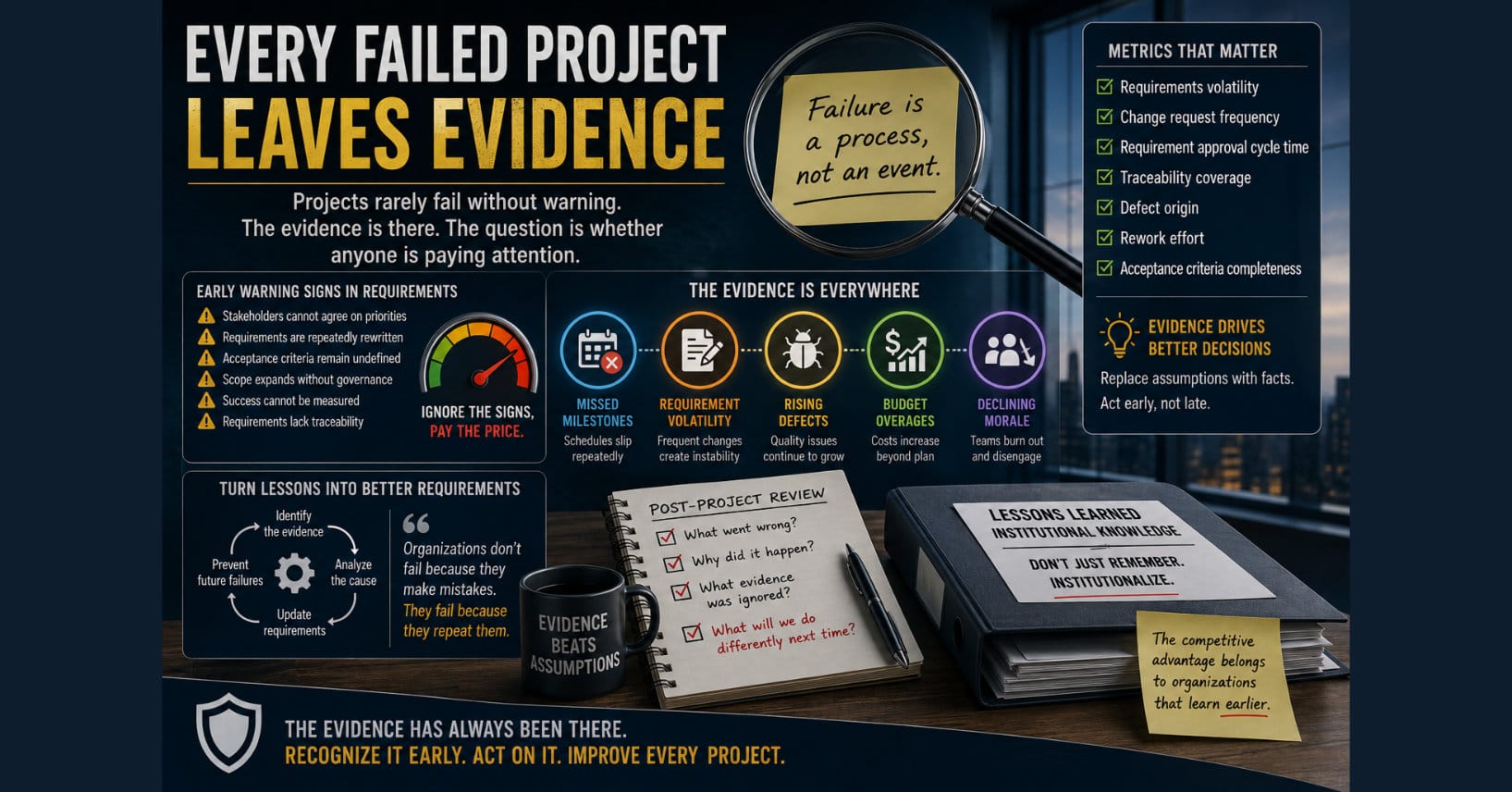
Requirements Leave Early Warning Signs
Many warning indicators appear during requirements engineering.
Examples include:
- Stakeholders cannot agree on priorities.
- Requirements are repeatedly rewritten.
- Acceptance criteria remain undefined.
- Business rules conflict.
- No one owns key requirements.
- Requirements cannot be traced to business objectives.
- Scope continues expanding without governance.
- Requirements contain subjective language.
- Success cannot be measured.
None of these guarantees failure.
Together, however, they should demand immediate attention.
Rework Is Evidence
Organizations often view rework as a normal part of software development.
Some rework is expected.
Excessive rework is evidence.
When developers repeatedly revisit completed functionality, the underlying cause is frequently not poor implementation.
It is poor requirements.
Every unexpected redesign raises an important question:
What decision was missing before development began?
Answering that question often reveals the real source of project instability.
Defects Tell a Story
Defects are more than quality issues.
They are feedback.
Patterns matter.
If most defects originate from misunderstood business rules, requirements discovery requires improvement.
If defects cluster around interfaces, integration requirements may be incomplete.
If acceptance testing repeatedly uncovers missing functionality, stakeholder validation may be insufficient.
Organizations that study defect patterns improve future projects.
Organizations that merely count defects repeat them.
Requirements Metrics Matter
Mature organizations measure more than schedule and budget.
They also monitor indicators such as:
- Requirements volatility.
- Change request frequency.
- Requirement approval cycle time.
- Traceability coverage.
- Requirement clarification requests.
- Acceptance criteria completeness.
- Defect origin.
- Rework effort.
These metrics provide early insight into project health.
Waiting for budget overruns or missed deadlines means the evidence has already become expensive.
Evidence Supports Better Decisions
One of the primary goals of governance is replacing assumptions with evidence.
Requirements engineering contributes by producing measurable information rather than subjective opinions.
Instead of asking:
“Does this project feel healthy?”
Leadership should ask:
- Are requirements stabilizing?
- Is stakeholder agreement improving?
- Are change requests decreasing?
- Is traceability complete?
- Are acceptance criteria defined?
- Are defects declining?
Evidence produces better leadership decisions.
Lessons Learned Should Become Requirements
Many organizations conduct valuable project retrospectives.
Unfortunately, those lessons often remain isolated in meeting notes.
A mature organization asks a different question:
How should this lesson change the way we write future requirements?
If recurring problems appear across multiple projects, they are no longer project problems.
They are organizational problems.
The solution is not remembering the lesson.
The solution is institutionalizing it.
Requirements engineering provides an excellent place to do exactly that.
Mature Organizations Learn Earlier
Successful organizations do not avoid mistakes because they are more talented.
They avoid repeating mistakes because they recognize patterns earlier.
Requirements engineering creates those patterns.
Governance evaluates them.
Leadership acts upon them.
That combination transforms project experience into organizational maturity.
Looking Ahead
Every software project produces evidence.
Successful projects reveal what should be repeated.
Failed projects reveal what should be improved.
Organizations become more successful when they stop treating project failures as isolated events and begin viewing them as opportunities to strengthen their requirements engineering practices.
The evidence has always been there.
The competitive advantage belongs to organizations that learn to recognize it before failure becomes inevitable.
Requirements Reality
Projects rarely fail because the evidence was missing. They fail because the evidence was ignored.
Coming Next
Article 16—The Difference Between Features and Capabilities
Organizations don’t create competitive advantage by delivering more features—they create it by building stronger business capabilities. Next, we’ll explore why successful requirements begin with the outcomes the organization needs to achieve, not simply the functionality the software should provide.