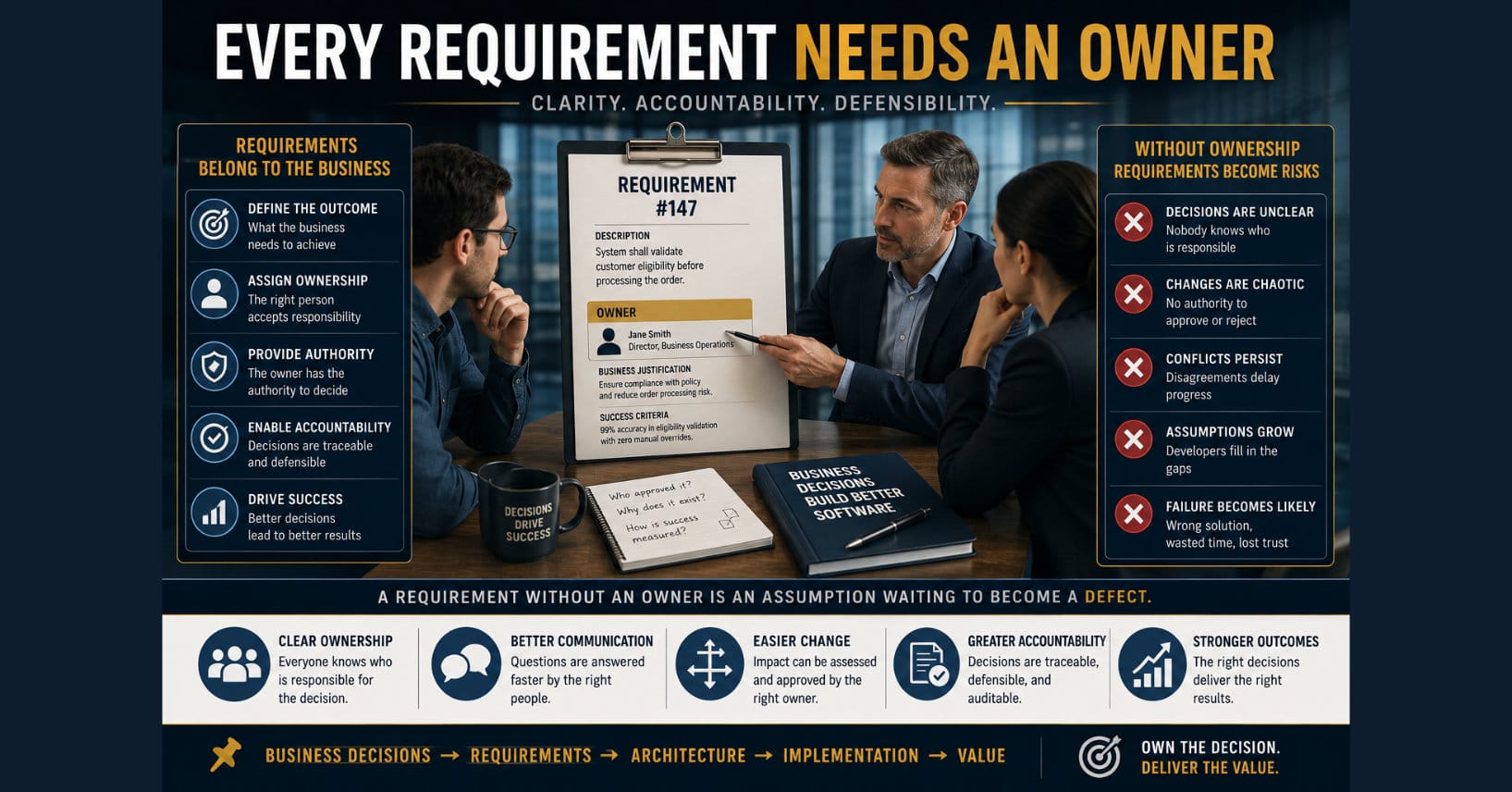
Enterprise Requirements Series—Article 7
This article explains why every software requirement needs a clear business owner. It distinguishes requirement ownership from authorship, shows how anonymous requirements become assumptions, and argues that ownership improves accountability, change control, traceability, and decision quality. The article positions requirements ownership as a leadership responsibility and a foundation for defensible software delivery.
Building Better Software by Engineering Better Decisions
Imagine reviewing a requirements document containing hundreds of well-written requirements.
They are clear.
They are organized.
They are measurable.
They appear complete.
Then someone asks a simple question.
“Who approved Requirement 147?”
Silence.
Nobody knows.
At that moment, the requirement becomes little more than an educated guess.
Requirements are not validated because they are documented.
They are validated because someone with the authority to make the decision accepts responsibility for them.
Every requirement needs an owner.
Requirements Are Business Decisions
One of the most common misconceptions in software projects is that requirements belong to the project team.
They do not.
Requirements belong to the business.
Project managers coordinate them.
Business analysts discover them.
Architects organize them.
Developers implement them.
Testers verify them.
Only the business can decide whether a requirement is correct.
Without business ownership, software teams spend months implementing assumptions instead of decisions.
Accountability Begins Before Development
Organizations often wait until a project encounters problems before asking who owns a decision.
By then, it is too late.
Ownership should exist before development begins.
Every requirement should answer four simple questions:
- Who requested it?
- Who approved it?
- Why does it exist?
- How will success be measured?
If those questions cannot be answered, the requirement is probably not ready for implementation.
The Cost of Anonymous Requirements
Requirements without owners create predictable problems.
When priorities change, no one can decide what should change.
When conflicts arise, no one has the authority to resolve them.
When testers identify inconsistencies, no one can clarify intent.
When developers ask questions, answers become opinions instead of decisions.
Eventually, responsibility shifts to the technical team.
That is exactly where it does not belong.
Ownership Is Not the Same as Authorship
Many organizations confuse writing a requirement with owning it.
The business analyst may document the requirement.
That does not make the analyst responsible for its correctness.
The project manager may organize the backlog.
That does not make the project manager the business owner.
The architect may recommend a better approach.
That does not transfer ownership.
Ownership belongs to the individual or business function with the authority to define the desired business outcome.
Documentation supports ownership.
It does not replace it.
Good Owners Make Better Requirements
An effective requirement owner should be able to answer questions such as:
- What business problem does this solve?
- What happens if we do not implement it?
- Which policy or regulation requires it?
- Who benefits from it?
- Who is affected by it?
- How will we know it succeeded?
- Who has the authority to approve changes?
If those answers cannot be provided, the requirement probably needs additional analysis before development begins.
Ownership Simplifies Change
No project remains unchanged.
Markets evolve.
Regulations change.
Organizations reorganize.
New risks emerge.
Technology advances.
When every requirement has a clearly identified owner, change becomes significantly easier to manage.
The project team knows exactly who should evaluate the proposed change.
The impact can be assessed quickly.
Decisions are documented.
Traceability is preserved.
Without ownership, change requests often become lengthy discussions involving multiple departments trying to determine who has decision-making authority.
That delay increases cost and uncertainty.
Ownership Creates Accountability
Ownership is not about assigning blame.
It is about establishing accountability.
Clear ownership allows organizations to demonstrate:
- Why a requirement exists.
- Who approved it.
- When it changed.
- Why it changed.
- How it was verified.
- Whether it achieved its intended business objective.
That information becomes invaluable during audits, regulatory reviews, post-project evaluations, and future enhancement efforts.
Requirements become organizational knowledge instead of forgotten meeting notes.
Leadership Owns Requirements
Successful organizations recognize that requirements engineering is ultimately a leadership discipline.
Executives establish strategy.
Business leaders define policy.
Department managers establish operational processes.
Compliance officers define regulatory obligations.
Requirements engineering transforms those decisions into specifications that architects, developers, and testers can implement consistently.
Technology teams build the solution.
Leadership owns the decisions.
Looking Ahead
Software development becomes dramatically more predictable when every requirement has a clearly identified owner.
Questions are answered faster.
Changes are evaluated more effectively.
Conflicts are resolved by the people authorized to resolve them.
Most importantly, software reflects deliberate business decisions rather than technical assumptions.
Requirements do not become correct because they are written down.
They become correct because the right people accept responsibility for them.
Requirements Reality
A requirement without an owner is an assumption waiting to become a defect.
Coming Next
Article 8—If You Can’t Test It, It Isn’t a Requirement
A requirement that cannot be verified cannot be trusted. Next, we’ll explore why testability is one of the defining characteristics of high-quality requirements and how measurable, verifiable requirements reduce defects, rework, and project risk.