Data Governance Series | Article 17 of 20
Governing the Information That Drives the Enterprise
Summary
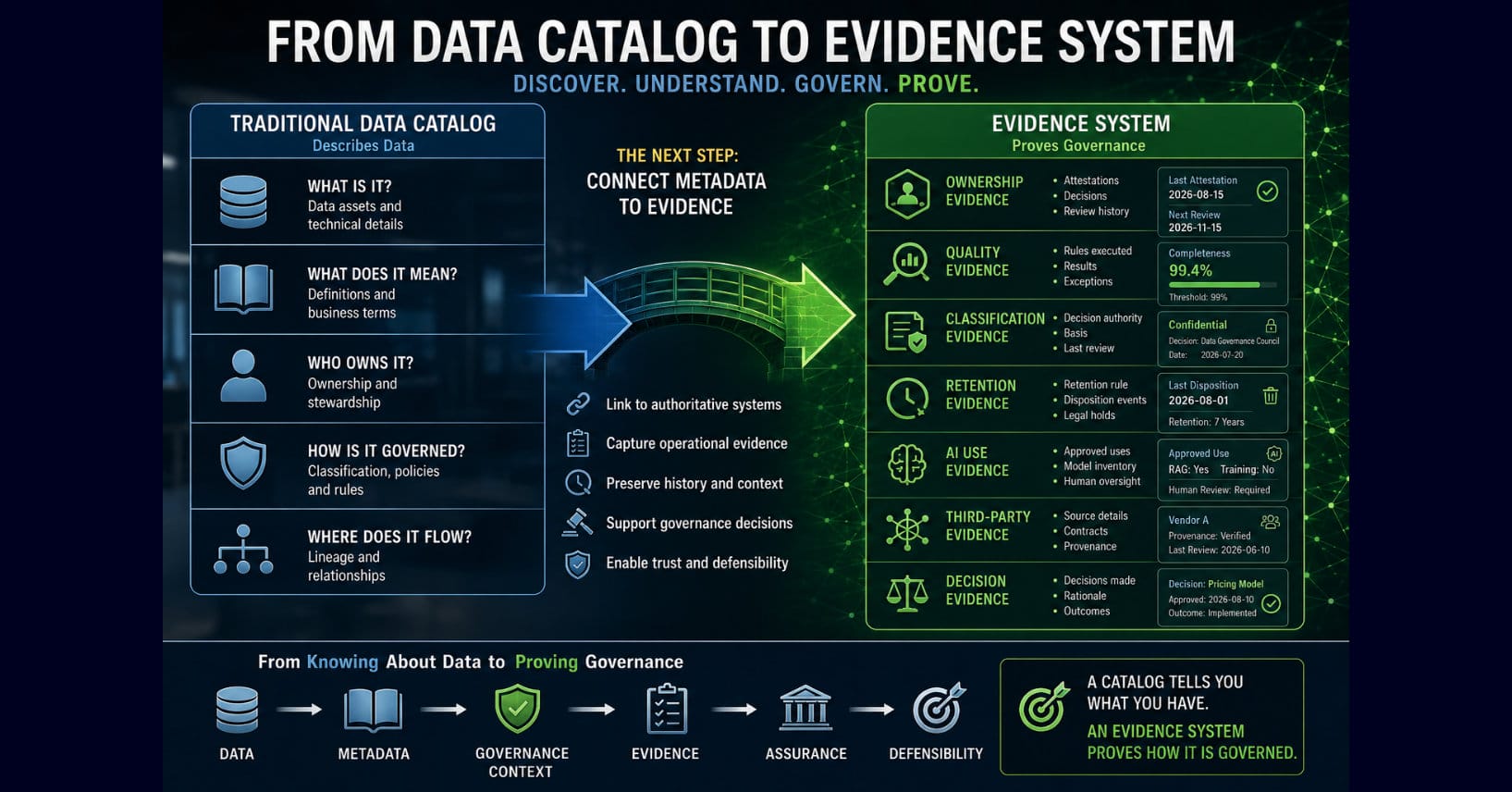
Enterprise data catalogs have evolved from technical inventories into important governance platforms containing definitions, ownership, classification, lineage, quality, provenance, and lifecycle metadata. The next stage is transforming those catalogs into systems capable of demonstrating how data is actually governed.
“From Data Catalog to Evidence System” examines the shift from descriptive metadata to connected governance evidence. Instead of merely recording an owner, classification, quality score, or retention requirement, an evidence-oriented architecture connects those attributes to attestations, control executions, decisions, exceptions, disposition events, AI-use authorizations, third-party provenance, and historical records.
The article introduces the concept of an evidence graph connecting data assets with people, policies, controls, vendors, AI systems, quality measurements, exceptions, decisions, actions, and outcomes. It also explores temporal evidence, decision lineage, executable quality controls, observable ownership, evidence coverage, evidence freshness, governance uncertainty, and AI-assisted governance monitoring.
The objective is not to turn the data catalog into another repository or bureaucracy engine. It is to connect authoritative systems so the enterprise can demonstrate why consequential information is trustworthy enough to influence business and AI-driven decisions.
For years, the enterprise data catalog has answered an important question:
What data do we have?
Modern catalogs have become considerably more sophisticated.
They can tell organizations:
where data resides;
what it means;
who owns it;
how it is classified;
where it came from;
where it flows;
which systems use it;
what quality rules apply;
and sometimes which policies govern it.
These capabilities have made the catalog an important component of enterprise data governance.
But the next generation of governance requires another question:
What can we prove about this data?
Can the organization demonstrate that ownership is active?
Can it show that quality controls actually operated?
Can it identify which exceptions were accepted?
Can it reconstruct why a dataset was considered trustworthy enough for a consequential decision?
Can it show which AI systems consumed the data?
Can it demonstrate whether the information was permitted for that use?
Can it identify what governance evidence existed at the moment a decision was made?
That is a different role for the catalog.
The enterprise does not merely need a system that describes its data.
It increasingly needs a system that helps demonstrate how that data was governed.
Discovery Was the First Problem
The early data catalog solved a fundamental enterprise problem.
Organizations did not know what data they had.
Information was scattered across:
databases;
data warehouses;
data lakes;
applications;
spreadsheets;
shared drives;
SaaS platforms;
cloud environments;
analytics systems;
and departmental repositories.
Analysts spent enormous amounts of time trying to find data.
They asked:
Where is customer revenue?
Which table contains product hierarchy?
Who knows what this field means?
Is this the current dataset?
Can I trust this source?
The catalog improved discovery.
That was necessary.
It was not the end of the problem.
Meaning Came Next
Finding data without understanding it is not particularly useful.
Catalogs therefore expanded into business glossaries and semantic management.
They began capturing:
definitions;
business terms;
domains;
relationships;
data stewards;
reference data;
and naming standards.
Now the enterprise could begin answering:
What does “customer” mean?
What qualifies as “active”?
How is “revenue” calculated?
Which definition applies to this report?
This moved the catalog from technical inventory toward enterprise information architecture.
Again, necessary.
Still incomplete.
Governance Added Context
As data governance matured, catalogs became places to record governance metadata.
Ownership.
Classification.
Criticality.
Retention.
Quality.
Lineage.
Sensitivity.
Policy relationships.
Authoritative status.
The catalog increasingly became a governance control plane.
This evolution was important because governance context became connected to the information being governed.
But recording governance metadata creates another question.
Does the metadata describe an actual governance state?
Or merely the state the organization believes should exist?
An owner field can contain a name.
That does not prove ownership is active.
A classification field can say Confidential.
That does not prove anyone reviewed the classification.
A quality indicator can say Green.
That does not explain which tests ran or why the result was acceptable.
The catalog can describe governance without proving governance.
That is the next gap.
From Metadata to Evidence
Article 16 made the distinction:
A policy describes what should happen.
Evidence demonstrates what did happen.
The same principle applies to catalogs.
Traditional catalog metadata might say:
Owner: Jane Smith
An evidence-oriented catalog could additionally show:
ownership assigned;
assignment approved;
last attestation date;
decisions exercised;
open governance issues;
next review date.
Traditional metadata might say:
Quality: 98.7%
An evidence-oriented system could show:
quality rules executed;
measurement timestamp;
threshold required;
result achieved;
exceptions;
owner acceptance;
remediation status.
Traditional metadata might say:
Classification: Confidential
An evidence-oriented system could show:
classification authority;
decision date;
classification basis;
last review;
downstream inheritance;
AI-use restrictions.
The difference is significant.
The catalog moves from describing a governance attribute to connecting that attribute with evidence.
The Catalog Becomes a Governance Record
Imagine opening the catalog entry for a critical customer dataset.
Instead of seeing only:
Name.
Description.
Owner.
Location.
Classification.
Lineage.
You see:
Ownership
Accountable owner: Chief Customer Officer
Last attestation: August 15
Open ownership issues: None
Quality
Required threshold: 99% completeness
Current measurement: 99.4%
Last control execution: Today
Active exceptions: 1
Exception authority: Data Governance Council
Expiration: September 30
Provenance
Primary source: Customer transaction platform
Third-party enrichment: Two providers
Provenance confidence: Verified
Machine-generated attributes: Identified
AI Use
RAG retrieval: Permitted
Model training: Prohibited
External model processing: Prohibited
Automated decisions: Human review required
Retention
Retention period: Seven years
Legal hold: None
Last disposition event: Completed
Derived embeddings: Governed under source lifecycle
Decision Evidence
Material decisions dependent upon dataset: 4
Last decision review: August 10
Evidence records available: Yes
Now the catalog is doing more than helping someone find data.
It is helping someone determine whether the data is governable, trustworthy, and defensible.
Evidence Should Connect, Not Accumulate
This does not mean copying every governance record into the catalog.
That would create another data warehouse.
The catalog does not need to become:
the ticketing system;
the identity platform;
the GRC platform;
the records repository;
the AI management platform;
or the quality engine.
It needs to connect them.
The architecture may be federated.
Evidence remains in authoritative systems.
The catalog maintains relationships.
For example:
Data Asset → Owner → Attestation
Data Asset → Quality Control → Measurement
Data Asset → Policy → Requirement
Data Asset → Exception → Approval
Data Asset → AI System → Approved Use
Data Asset → Third-Party Source → Provenance Evidence
Data Asset → Retention Rule → Disposition Evidence
Data Asset → Decision → Outcome
The value comes from connection.
The Catalog Becomes an Evidence Graph
This suggests a broader architectural evolution.
The traditional catalog is largely asset-centric.
The evidence system becomes relationship-centric.
A data asset connects to:
people;
systems;
policies;
controls;
vendors;
AI systems;
quality measurements;
decisions;
exceptions;
actions;
and outcomes.
Those relationships create what can effectively become an evidence graph.
The enterprise can begin asking questions such as:
Which consequential AI systems depend upon third-party data with incomplete provenance?
Which critical datasets have not had ownership attested within the required period?
Which Restricted datasets are retrievable by AI systems?
Which quality exceptions are affecting regulatory reporting?
Which archived datasets remain operationally accessible?
Which AI decisions depended upon data that later failed quality thresholds?
Which vendors contribute information to high-consequence decisions?
Those questions are difficult when governance evidence is fragmented.
An evidence graph makes them increasingly answerable.
Evidence Needs Time
A traditional catalog often emphasizes current state.
Who owns the data now?
What is its current classification?
What is its current quality score?
Evidence requires history.
Who owned it when the decision occurred?
What classification applied then?
Which quality result existed?
Which source version was authoritative?
Which exception was active?
Which AI-use permission applied?
This is the temporal dimension of governance.
Without history, the enterprise can describe today’s governance state.
It may not be able to reconstruct yesterday’s decision.
An evidence system therefore needs time-aware relationships.
Current Truth Is Not Historical Truth
Suppose a regulator asks:
“Why did your organization rely on this dataset on March 15?”
The catalog currently shows:
Owner: Finance
Quality: 99.8%
Classification: Confidential
Provenance: Verified
That may tell us nothing about March 15.
Perhaps:
the owner was different;
quality was 94%;
a provenance issue was unresolved;
an exception was active;
and the dataset had not yet been approved for the relevant AI use.
Current metadata cannot answer a historical governance question.
Evidence must preserve what was true when it mattered.
Lineage Becomes Evidentiary
Data lineage traditionally shows how data moves and transforms.
That remains essential.
An evidence system extends lineage into governance.
Consider:
Source → Transformation → Dataset → AI System → Recommendation → Human Decision → Action → Outcome
Now attach evidence:
source provenance;
quality state;
transformation controls;
AI-use authorization;
model version;
human approval;
decision rationale;
action record.
Lineage becomes more than technical traceability.
It becomes a mechanism for reconstructing why the enterprise acted.
This is where data lineage becomes decision lineage.
Provenance Becomes Actionable
Article 9 examined the rise of data provenance.
The evidence system gives provenance operational value.
Instead of merely saying:
“Source: Vendor X,”
the catalog could connect to:
original source documentation;
collection methodology;
refresh date;
confidence level;
contractual restrictions;
quality evidence;
known limitations;
machine-generated status;
and correction history.
Now provenance can influence governance decisions.
Should the data be used?
For which purposes?
At what level of consequence?
With what human oversight?
Provenance stops being descriptive history.
It becomes a decision input.
Quality Evidence Should Travel With the Data
A quality score displayed in a dashboard is useful.
A quality state connected to the data is more powerful.
Suppose an AI system requests a dataset.
The evidence system knows:
quality threshold required for the use: 98%;
current quality: 96.7%;
active exception: Yes;
exception scope: Internal analysis only;
automated decision use: Prohibited.
The AI application can now respond differently.
It might:
exclude the dataset;
warn the user;
require human review;
use an alternate source;
or refuse automated action.
Quality evidence becomes executable governance.
Ownership Becomes Observable
Ownership has historically been difficult to measure.
Catalogs often measure whether an owner is assigned.
An evidence system can measure whether ownership is exercised.
For example:
last attestation;
definitions approved;
quality exceptions accepted;
access decisions made;
retention decisions reviewed;
AI uses authorized;
issues resolved;
governance meetings attended;
or remediation completed.
The objective is not to score people mechanically.
It is to distinguish nominal ownership from active accountability.
A name in a field is metadata.
Exercised authority creates evidence.
Exceptions Become First-Class Objects
Governance exceptions are often scattered across:
email;
tickets;
meeting notes;
spreadsheets;
GRC systems;
and approval workflows.
An evidence system treats exceptions as first-class governance objects.
An exception can be connected to:
the requirement;
the affected data;
the requesting party;
the accountable owner;
the approving authority;
the accepted risk;
compensating controls;
expiration date;
remediation;
and downstream uses.
Now the enterprise can ask:
Which critical datasets operate under active exceptions?
Which exceptions affect AI systems?
Which have expired without remediation?
Which business units repeatedly request the same exception?
Which decisions were made while an exception was active?
That is a much stronger governance capability.
Policies Become Connected Requirements
Policies often exist as documents.
Humans read them.
Controls attempt to implement them.
Auditors compare operations against them.
An evidence system can create stronger relationships between policy requirements and operational evidence.
For example:
Policy Requirement: Critical datasets must have quarterly ownership attestation.
Connected evidence:
Dataset A → Attested August 3
Dataset B → Attested August 8
Dataset C → Overdue
Dataset D → Owner departed
Dataset E → Exception approved
Now the organization can move from asking:
“Do we have an ownership policy?”
to:
“Where is the ownership policy currently failing?”
That is the difference between policy management and governance observability.
AI Inventories Should Connect to Data Catalogs
AI governance programs are building inventories of:
models;
applications;
agents;
use cases;
vendors;
risk classifications;
and approvals.
Those inventories should not remain disconnected from data governance.
Every consequential AI system depends upon information.
The evidence system should connect:
AI System → Data Sources
AI System → Third-Party Data
AI System → Data Classification
AI System → Provenance
AI System → Quality Requirements
AI System → Retention
AI System → Approved Purposes
AI System → Human Oversight
AI System → Decisions
Now AI governance and data governance begin operating on the same architecture.
That is essential.
A governed AI system consuming ungoverned data remains a governance problem.
AI Can Query the Evidence System
Once governance evidence becomes structured and connected, AI itself can help interpret it.
An executive might ask:
“Which AI systems currently rely upon customer data with unresolved quality exceptions?”
Or:
“Show me all critical datasets whose ownership attestations are overdue.”
Or:
“Which third-party datasets influence automated decisions and have provenance confidence below Verified?”
Or:
“Which Restricted datasets were retrieved by AI systems during the last quarter?”
These are natural-language governance queries.
The catalog becomes not merely something employees browse.
It becomes a governance knowledge system AI can interrogate.
AI Can Help Detect Governance Drift
Structured evidence also enables AI-assisted monitoring.
AI could identify:
ownership patterns deteriorating;
recurring quality exceptions;
unusual access combinations;
retention failures;
provenance gaps;
third-party dependency concentration;
classification inconsistencies;
policy-control mismatches;
or AI systems consuming data outside approved purposes.
This does not mean AI should autonomously govern the enterprise.
It means AI can help identify where governance attention is needed.
Evidence provides the grounding.
The Catalog Can Become a Trust Interface
Most data catalogs were designed for data professionals.
Analysts.
Engineers.
Architects.
Stewards.
The evidence system has a broader audience.
A business executive may want to know:
Can I rely on this metric?
An AI system may need to know:
May I use this information?
An auditor may ask:
Can you demonstrate that this control operated?
A regulator may ask:
Why did you rely on this dataset?
A data owner may ask:
What governance decisions require my attention?
A security leader may ask:
Which sensitive datasets are exposed to AI?
The evidence system becomes a trust interface between enterprise information and the people or systems relying upon it.
Trust Should Be Explainable
A catalog may display a trust score.
For example:
Trust Score: 92
That is convenient.
It can also obscure governance.
Why 92?
Because quality is high?
Because provenance is verified?
Because ownership is current?
Because lineage is complete?
Because no exceptions exist?
Because the source is authoritative?
Trust should be decomposable.
A user should be able to understand why the enterprise considers information trustworthy.
This is especially important for consequential decisions.
The goal is not merely to label data “trusted.”
It is to demonstrate the basis for trust.
Evidence Coverage Becomes a Metric
Organizations may eventually measure evidence coverage.
For critical data, what percentage has evidence supporting:
ownership;
quality;
classification;
provenance;
lineage;
retention;
approved use;
AI eligibility;
third-party dependencies;
and significant governance decisions?
This is more meaningful than catalog coverage alone.
A catalog may contain 100 percent of critical datasets.
If only 30 percent have current governance evidence, discovery maturity is high while governance assurance remains weak.
That distinction matters.
Evidence Freshness Matters Too
Evidence can become stale.
An ownership attestation from three years ago is technically evidence.
It may no longer provide meaningful assurance.
A quality assessment from last quarter may be inadequate for a dataset updated hourly.
A vendor review performed before a major methodology change may no longer support reliance.
An AI-use approval issued before the system gained agentic capabilities may no longer reflect the current risk.
Evidence therefore needs lifecycle management too.
Organizations should know:
when evidence was created;
how long it remains valid;
what events invalidate it;
and when reassessment is required.
Evidence is not permanent truth.
The System Should Show Unknowns
One of the most valuable functions of an evidence system is revealing what the enterprise does not know.
Owner: Unknown.
Provenance: Incomplete.
Quality: Not measured.
AI-use permission: Undetermined.
Retention status: Unresolved.
Third-party source: Unverified.
Classification: Pending.
These are not system failures.
They are governance signals.
A mature organization does not hide uncertainty behind default values.
It makes uncertainty visible so someone can decide what to do about it.
Unknown is a governance state.
Do Not Turn the Catalog Into a Bureaucracy Engine
There is an obvious risk.
Once organizations realize how much evidence could be captured, they may attempt to capture everything.
Every approval.
Every meeting.
Every metric.
Every control.
Every email.
Every data movement.
Every decision.
That would create an unusable system.
Evidence should be proportional to consequence.
Critical data requires stronger evidence.
High-consequence decisions require stronger reconstruction.
Low-risk data may require much less.
The goal is not maximum documentation.
The goal is sufficient evidence.
Governance architecture should reduce administrative burden by capturing evidence naturally wherever possible.
Evidence Should Be Generated by Work
The strongest evidence system does not depend upon people constantly updating the catalog manually.
Evidence should flow from operational systems.
Identity platforms provide access evidence.
Quality tools provide measurement evidence.
Workflow systems provide approval evidence.
GRC platforms provide control evidence.
Records systems provide disposition evidence.
AI platforms provide use evidence.
Vendor systems provide third-party evidence.
Lineage tools provide transformation evidence.
The catalog connects them.
Governance becomes a byproduct of controlled operations rather than a separate documentation exercise.
This Is an Architectural Evolution
The shift from data catalog to evidence system is not merely a product feature.
It represents an architectural change.
The enterprise moves from:
Inventory → Metadata → Governance Context → Evidence → Assurance
Each stage builds upon the previous one.
Inventory tells us what exists.
Metadata tells us what it means.
Governance context tells us what rules apply.
Evidence tells us what happened.
Assurance tells us whether reliance is reasonable.
That is a much more powerful information architecture.
Evidence Enables Defensibility
Suppose a consequential decision is challenged.
The enterprise should be able to navigate from:
the decision
to the data used;
to its lineage;
to its provenance;
to the quality state;
to the applicable policies;
to the active exceptions;
to the accountable owner;
to the AI system;
to the human review;
to the approval;
to the resulting action.
That is not simply a data catalog.
It is an evidentiary architecture for enterprise decision-making.
And as AI increases the speed and complexity of those decisions, that capability becomes increasingly valuable.
Boardroom Takeaway
Executives should expect more from enterprise data catalogs than discovery and documentation.
For critical information, leadership increasingly needs to know not merely:
What data do we have?
But:
Who is accountable for it?
Why do we trust it?
Which controls are operating?
What exceptions exist?
Which AI systems depend upon it?
What decisions has it influenced?
And can we prove those answers?
The leadership question is:
“Can our data catalog tell us what we know about our data—or can it also demonstrate why the enterprise is justified in trusting and using it?”
That distinction defines the next stage of data governance maturity.
Because the future catalog will not merely tell the enterprise where its data is.
It will help explain why that data deserves to influence enterprise decisions.
Coming Next
Article 18: Measuring Data Governance Without Fooling Yourself
Data governance programs generate plenty of metrics.
Catalog coverage.
Owners assigned.
Quality scores.
Issues closed.
Policies published.
Training completed.
Committee meetings held.
Those numbers can create an impressive dashboard while telling leadership surprisingly little about whether governance is improving.
The next article examines how to measure data governance without confusing activity with effectiveness—and which indicators can reveal whether ownership, trust, controls, evidence, and decision quality are actually getting better.