Enterprise Requirements Series—Article 3
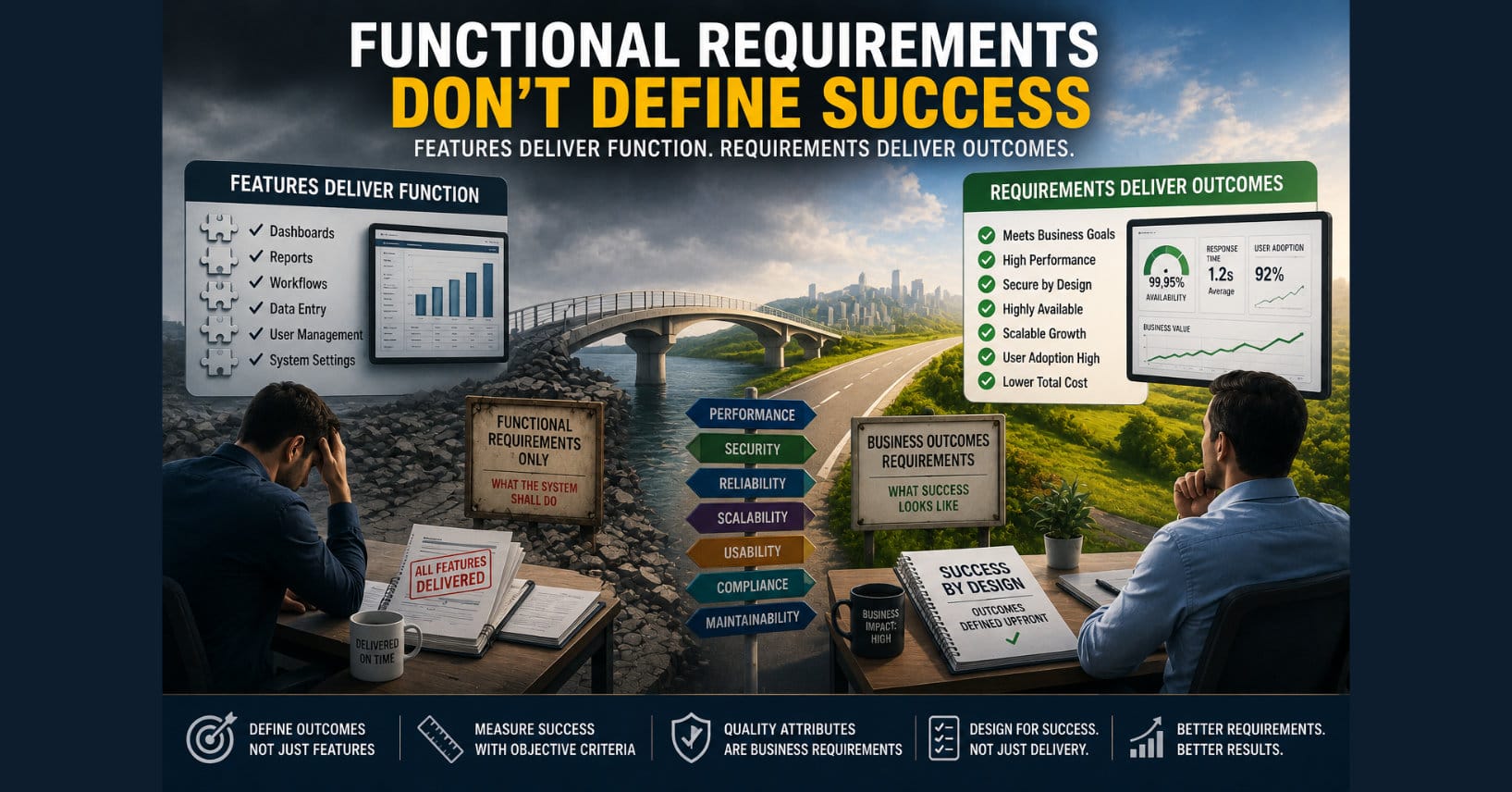
This article explains why functional requirements alone are insufficient to define software success. It shows how performance, availability, security, scalability, maintainability, recoverability, usability, interoperability, and auditability determine whether a system delivers real business value. The article reframes non-functional requirements as business requirements because they define whether software can be trusted, adopted, operated, and defended.
Building Better Software by Engineering Better Decisions
Imagine a project that delivers every requested feature.
Every screen works.
Every report runs.
Every button functions exactly as designed.
The project is delivered on time, within budget, and passes every functional test.
Six months later, users avoid it.
Performance is poor.
Maintenance costs continue to rise.
Security auditors identify serious weaknesses.
The system struggles under production workloads.
Was the project successful?
From a functional perspective, perhaps.
From a business perspective, absolutely not.
Functional requirements define what software does.
They do not define whether the software succeeds.
Features Are Only Part of the Story
Organizations naturally focus on functionality because functionality is visible.
Managers request dashboards.
Users request reports.
Executives request workflows.
Developers implement those capabilities.
The result is often a requirements document filled with statements beginning with:
The system shall…
Those statements are important.
They are also incomplete.
Successful software requires much more than working features.
The Requirements Nobody Notices
Some of the most important requirements are rarely discussed during stakeholder meetings because they are assumed rather than specified.
Questions such as these often appear late in a project:
How many users must the system support simultaneously?
How quickly must transactions complete?
How long may the application be unavailable?
How long must records be retained?
What happens if a server fails?
How will sensitive information be protected?
Can the system continue operating during maintenance?
How quickly must the organization recover from a disaster?
These questions have little to do with features.
They have everything to do with success.
Non-Functional Requirements Are Business Requirements
The phrase “non-functional requirements” is unfortunate.
It implies they are somehow secondary.
They are not.
Consider an online banking system.
Customers expect balances to display correctly.
That is functional.
They also expect:
- Their financial information to remain secure.
- The application to remain available around the clock.
- Transactions to complete in seconds.
- The system to recover quickly after failures.
- Regulatory requirements to be satisfied.
- Audit records to be retained accurately.
None of these expectations describe a feature.
Every one of them determines whether customers trust the system.
In many industries, these requirements are more important than functionality itself.
Every Quality Attribute Is a Requirement
Enterprise systems are expected to satisfy a wide range of quality attributes.
These include:
- Performance
- Availability
- Reliability
- Security
- Scalability
- Maintainability
- Recoverability
- Usability
- Interoperability
- Auditability
These characteristics should never be treated as implementation details.
They are business decisions documented as technical requirements.
Choosing 99.99 percent availability instead of 99.9 percent is not merely an architectural decision.
It is a business decision with financial consequences.
Software Quality Is Designed, Not Added
Many organizations postpone discussions about performance, security, or scalability until development is underway.
That approach rarely succeeds.
Performance cannot simply be installed near the end of a project.
Security cannot be patched into an architecture that was never designed to protect sensitive information.
Maintainability cannot be achieved by adding comments after deployment.
Quality attributes influence architecture from the beginning.
When they are omitted from the requirements, the architecture is forced to compensate later—often at significant cost.
Every Requirement Should Define Success
One useful way to evaluate a requirement is to ask:
What does success look like?
For example:
Instead of:
The system shall generate reports.
Ask:
How quickly?
For whom?
Using what data?
Under what conditions?
With what level of accuracy?
Instead of:
The system shall store customer information.
Ask:
For how long?
Using what security controls?
Who may access it?
What regulations govern retention?
How will the information be backed up?
Good requirements define successful outcomes rather than merely listing expected capabilities.
Success Is Measurable
Organizations often describe success using subjective language.
The application should be reliable.
The interface should be intuitive.
The reports should be useful.
Those statements communicate expectations but provide no objective standard for evaluating success.
Successful requirements replace opinions with measurable outcomes.
Examples include:
- Average response time under two seconds.
- Ninety-nine point nine-five percent system availability.
- Recovery within one hour of a critical failure.
- Encryption of all sensitive data at rest and in transit.
- Compliance with applicable regulatory requirements.
When success can be measured, it can be designed, implemented, tested, and defended.
Requirements Shape Architecture
Every architectural decision begins with a requirement.
Performance requirements influence infrastructure.
Security requirements influence authentication and authorization.
Availability requirements influence redundancy.
Compliance requirements influence data retention.
Maintainability requirements influence modular design.
Architecture is not created in isolation.
It is the technical response to business requirements.
Organizations that neglect non-functional requirements often discover that architecture becomes a series of expensive compromises instead of deliberate engineering decisions.
Looking Ahead
The most successful projects are not those with the longest requirements documents.
They are the ones that clearly define what success looks like before development begins.
Functional requirements explain what software should do.
Quality requirements determine whether anyone will trust, use, or depend on that software after it is delivered.
Enterprise software succeeds because it meets business expectations—not merely because every feature works.
Requirements Reality
Software can satisfy every functional requirement and still fail the business.
Coming Next
Article 4—When Stakeholders Don’t Agree, Requirements Don’t Exist
A meeting filled with agreement doesn’t guarantee shared understanding. Next, we’ll examine why stakeholder alignment is one of the most overlooked disciplines in requirements engineering.