Summary:
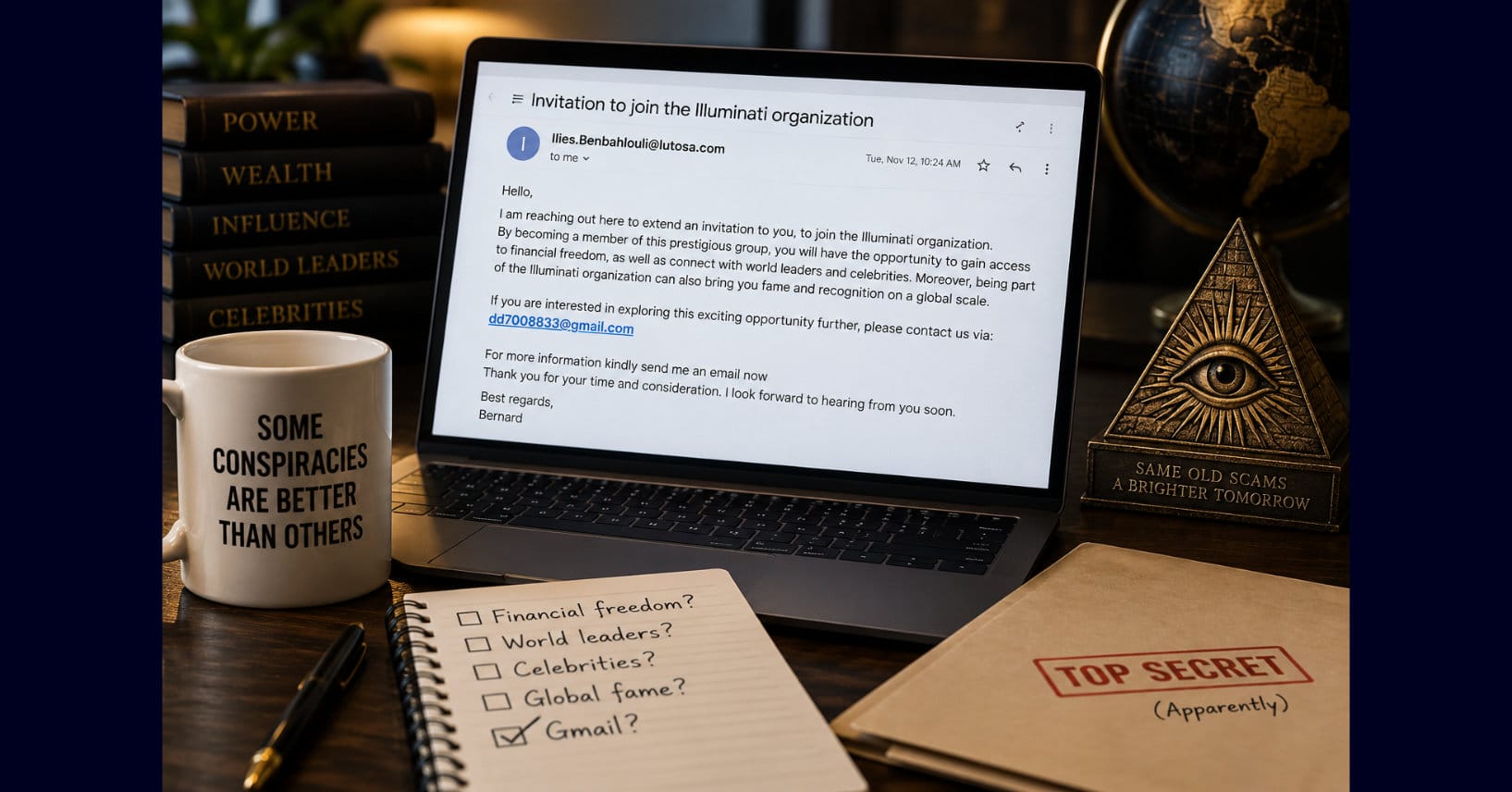
An absurd email invitation to join the Illuminati provides an unexpectedly useful lesson in social engineering. Behind the promises of financial freedom, celebrity connections, exclusivity, and fame is a familiar scam mechanism: get the recipient to respond. This article examines the humor, psychological hooks, identity inconsistencies, and cybersecurity lessons hidden inside an obviously suspicious recruitment pitch.
I received an invitation this week that I confess I was not expecting.
The Illuminati would like me to join.
Yes. That Illuminati.
According to the email, membership in this “prestigious group” would give me access to financial freedom, connections with world leaders and celebrities, and even fame and recognition on a global scale.
There was no secret knock.
No mysterious courier appeared at midnight.
No ancient parchment bearing an unfamiliar seal arrived at my door.
There wasn’t even a cryptic message written in Latin.
They sent me an email.
And apparently, the Illuminati uses Gmail.
The message came from one email address, was signed by someone named Bernard, and instructed me to contact an entirely different Gmail address if I wanted to explore this extraordinary opportunity.
I have questions.
The World’s Most Secret Organization Has a Marketing Problem
For centuries, conspiracy theories have portrayed the Illuminati as an extraordinarily sophisticated organization operating invisibly behind governments, financial institutions, corporations, universities, intelligence agencies, and global elites.
If the mythology is to be believed, these people manipulate civilization from the shadows.
Yet their recruiting department apparently operates like someone selling questionable cryptocurrency from a coffee shop.
Imagine the meeting.
“We have successfully infiltrated the world’s governments.”
“Excellent.”
“We influence international finance.”
“Outstanding.”
“We have access to celebrities, political leaders, and unimaginable wealth.”
“Very good. How are recruitment numbers looking?”
“Not great.”
“What are we doing about it?”
“We opened a Gmail account.”
Problem solved.
There is another small contradiction worth mentioning.
The email promises “fame and recognition on a global scale.”
That seems like an unusual employee benefit for membership in a secret society.
Apparently, secrecy isn’t what it used to be.
But There Is Something Serious Behind the Comedy
It is easy to laugh at an email like this.
We should.
But we should also understand why messages this ridiculous continue to exist.
Scammers are not necessarily trying to convince the most skeptical person reading their message. They need to find the person whose desire, fear, curiosity, loneliness, greed, or fascination is strong enough to override skepticism.
That is the essence of social engineering.
Technology may deliver the message, but psychology does the work.
The promise changes depending upon the target.
Sometimes it is romance.
Sometimes it is an inheritance.
Sometimes it is a job.
Sometimes it is an investment opportunity.
Sometimes it is fear: your account has been compromised, your taxes are overdue, your computer has been infected, or law enforcement is supposedly looking for you.
And sometimes, apparently, it is membership in the Illuminati.
The story changes.
The mechanism does not.
Look at What the Message Actually Offers
Strip away the Illuminati branding and examine the psychological hooks.
Financial freedom.
Access to powerful people.
Celebrity connections.
Fame.
Recognition.
Exclusivity.
Belonging.
Those are powerful human desires.
The scammer has simply wrapped them inside one of the most recognizable secret-society narratives in popular culture.
There is even an implied compliment hidden inside the invitation.
You have been selected.
You are important enough to be noticed.
You may belong among the powerful.
That emotional hook matters.
Many successful scams begin by making the victim feel special before making the victim feel obligated.
The money request comes later.
So does the request for personal information.
So does the “membership fee,” “registration fee,” “initiation fee,” cryptocurrency transfer, identification document, banking information, or whatever the next stage of the operation requires.
The first message has only one job:
Get you to respond.
The First Reply Is the Real Objective
This is why engaging scammers for entertainment is generally a bad idea.
Replying tells the sender something valuable:
This email address belongs to a real person.
Someone reads messages sent here.
Someone is willing to engage.
Perhaps most importantly, someone can be moved from passive recipient to active participant.
That changes the relationship.
The scammer can now begin adapting the story to the victim.
What started as a ridiculous mass email can become a much more personalized social-engineering exercise.
The safest response to an obvious scam is usually the least entertaining one:
No response at all.
Mark it as spam or phishing and move on.
Absurdity Is Not a Security Control
There is a broader cybersecurity lesson here.
We sometimes assume that a scam must be sophisticated to be dangerous.
That is not true.
A poorly written message can still succeed.
An implausible story can still succeed.
An obvious impersonation can still succeed.
A ridiculous promise can still succeed.
Attackers do not need a 100 percent conversion rate.
They need one person at the right psychological moment.
That is why security awareness cannot simply teach people to look for spelling mistakes, strange domains, or suspicious links. Those indicators matter, but modern social engineering increasingly requires something deeper:
Pause and examine the claim itself.
What emotion is this message trying to create?
What action does the sender want me to take?
Why does that action need to happen now?
Why am I being asked to move to another communication channel?
Why does the sender’s identity not match the reply address?
What happens if I simply do nothing?
Those questions are useful whether the message supposedly comes from Microsoft, your bank, your CEO, the IRS, a recruiter, a cryptocurrency investor, or the Illuminati.
The Illuminati Will Have to Carry On Without Me
So, regrettably, I will not be accepting the invitation.
Financial freedom sounds pleasant.
Meeting world leaders could be interesting.
Global fame seems exhausting.
And I remain concerned about an organization supposedly capable of manipulating world events but apparently incapable of implementing basic email-domain governance.
I wish Bernard and the Illuminati well with their recruiting campaign.
But if the people secretly controlling civilization really want to speak with me, they are going to need to do better than Gmail.
Preferably with SPF, DKIM, and DMARC properly configured.
I do have standards.