Information Architecture Series | Article 6 of 8
Summary
Enterprise AI architecture has focused heavily on models, infrastructure, retrieval, and orchestration. But organizations are discovering that model capability is often not the limiting factor. The enterprise information environment is.
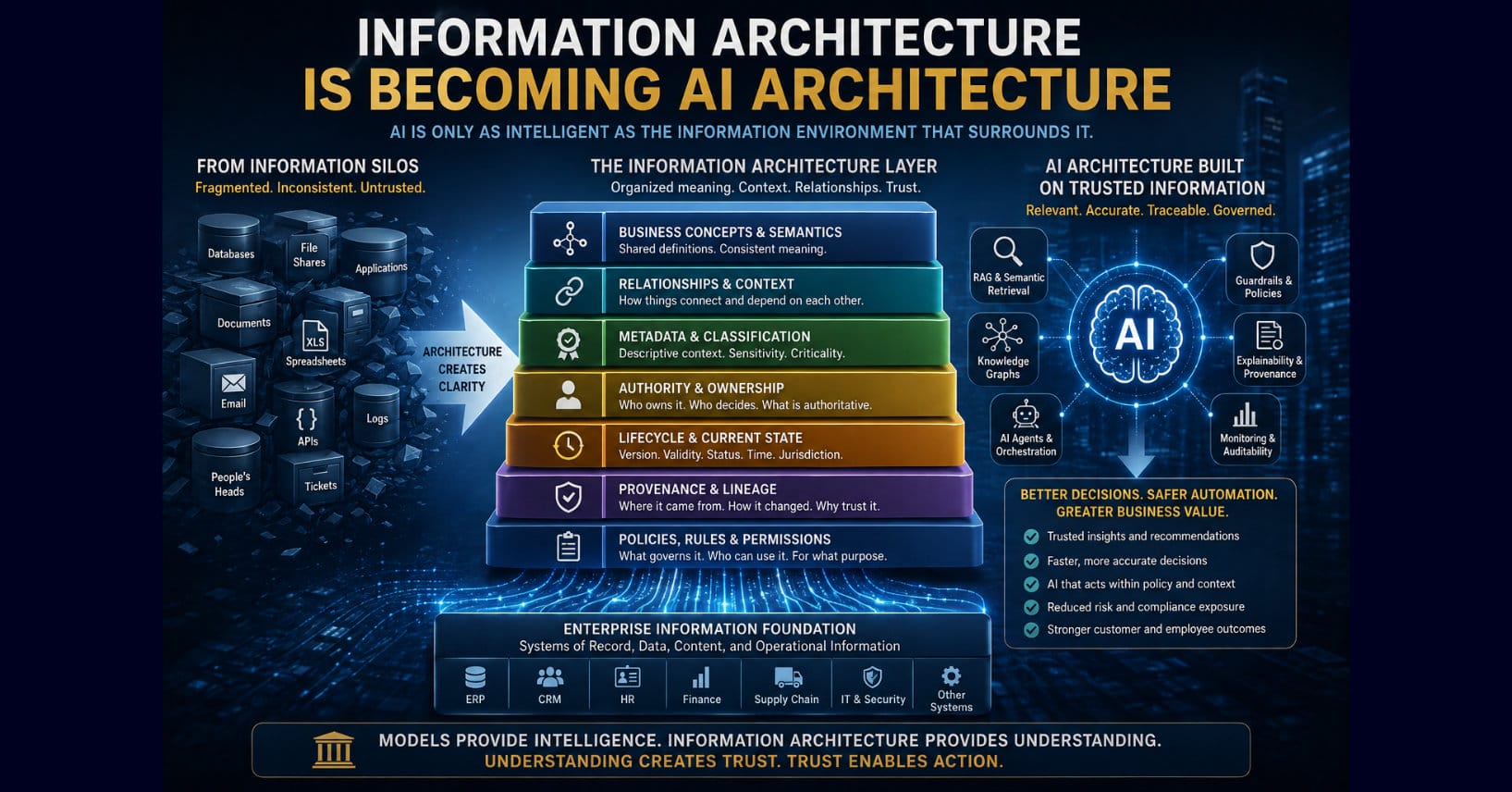
This article explains why information architecture is becoming a foundational layer of AI architecture. Retrieval and vector search can locate relevant content, but they cannot independently establish authority, applicability, provenance, lifecycle state, permissions, or business meaning. Enterprise AI increasingly requires metadata, semantic relationships, knowledge graphs, contextual authority, classification, provenance, and machine-readable governance.
The requirements become even more important as AI evolves from assistants that answer questions to agents capable of taking action. In that environment, information quality becomes action quality. The competitive advantage may ultimately come not from access to the smartest model, but from providing intelligent software with the best-organized enterprise context.
For the past several years, enterprise AI architecture has focused heavily on models.
Which model should we use?
Should we build or buy?
Should we use a proprietary model or open weights?
How large should the context window be?
What inference infrastructure do we need?
Should we fine-tune?
Should we use retrieval-augmented generation?
How do we control cost and latency?
Those are legitimate architectural questions.
But enterprises are discovering another problem.
The model is often not the limiting factor.
The information environment is.
An organization can deploy an extraordinarily capable AI model and connect it to decades of enterprise information.
That does not mean the AI understands the enterprise.
It may have access to policies without knowing which are current.
Contracts without understanding amendments.
Customer records without knowing which system is authoritative.
Metrics without knowing their definitions.
Risk decisions without their rationale.
Documents without provenance.
Data without business context.
Terminology without semantic consistency.
The model may be intelligent.
The information environment surrounding it may not be.
That is why information architecture is becoming a foundational layer of AI architecture.
Enterprise AI Has an Information Problem
Public AI systems are impressive partly because they are trained on enormous bodies of broadly available information.
Enterprise AI operates under different conditions.
The questions are narrower.
The consequences are often greater.
The information is private.
Access is restricted.
Terminology is organization-specific.
Policies change.
Contracts contain exceptions.
Customer relationships are complex.
Regulatory obligations vary by jurisdiction.
Business rules are embedded in applications and processes.
Critical knowledge may exist in email, spreadsheets, meeting notes, ticketing systems, document repositories, databases, and people’s heads.
Enterprise AI therefore faces a different challenge.
It does not merely need information.
It needs the right information, in the right context, with the right authority, for the right task, under the right permissions.
That is an information architecture problem.
Retrieval Is Not Understanding
Retrieval-augmented generation has become one of the dominant patterns for enterprise AI.
The idea is straightforward.
Instead of relying entirely on what a model learned during training, retrieve relevant enterprise information at runtime and provide it to the model as grounding context.
This is powerful.
It is also easy to misunderstand.
Retrieval answers:
What content appears relevant to this query?
It does not necessarily answer:
Is this content authoritative?
Is it current?
Does it apply to this business unit?
Was it superseded?
Does an exception exist?
Who owns it?
Where did it originate?
Is the user permitted to see it?
Is the AI permitted to use it for this purpose?
Does another information source conflict with it?
Semantic similarity is not the same as business applicability.
That distinction becomes critical when AI moves from answering low-risk questions to influencing enterprise decisions.
The Vector Database Does Not Know Your Business
Vector databases have become an important component of modern AI systems because they enable semantic retrieval.
Documents and other information can be represented as embeddings, allowing systems to retrieve content based on conceptual similarity rather than exact keywords.
This is valuable.
But an embedding does not magically encode the enterprise’s governance model.
Two documents may be semantically similar while having very different authority.
A current policy and a superseded policy may contain nearly identical language.
A standard contract and an amended contract may be conceptually similar while creating different obligations.
A public product description and a confidential internal roadmap may discuss the same product.
A proposed architecture and the approved architecture may use nearly identical terminology.
Semantic proximity cannot resolve those distinctions by itself.
AI architecture therefore needs more than embeddings.
It needs metadata.
Classification.
Authority.
Provenance.
Relationships.
Lifecycle state.
Permissions.
Business context.
In other words, it needs information architecture.
Metadata Becomes AI Control Infrastructure
Metadata has traditionally been treated as a discoverability and management capability.
In AI systems, it becomes part of the control plane.
Consider a policy document.
Useful metadata might include:
Policy owner.
Approval authority.
Effective date.
Expiration or review date.
Version.
Status.
Applicable business units.
Jurisdictions.
Related regulations.
Superseded documents.
Confidentiality classification.
AI usage restrictions.
Related controls.
Now an AI retrieval system can do more than find text containing relevant words.
It can filter.
Rank.
Exclude.
Validate.
Contextualize.
A system might exclude superseded policies.
Restrict retrieval to applicable jurisdictions.
Prefer authoritative sources.
Prevent restricted information from entering a prompt.
Warn when a document is approaching expiration.
Metadata that once helped humans organize information now helps machines determine what information they should use.
That is a significant architectural shift.
Authority Must Be Machine-Readable
Humans often know which information source to trust through experience.
“Use the ERP number.”
“Legal owns that definition.”
“That SharePoint site is outdated.”
“The dashboard is right, but only after month-end close.”
“Do not use that field for regulatory reporting.”
Those instructions may never have been formally represented anywhere.
They exist as institutional knowledge.
AI cannot reliably operate at enterprise scale if authority remains implicit.
The architecture must increasingly make authority machine-readable.
Which source is authoritative for which attribute?
Under which circumstances?
For which business process?
At what point in the lifecycle?
Within which jurisdiction?
For which type of decision?
This is more nuanced than declaring a single source of truth.
Enterprise information authority is often contextual.
AI systems need access to that context.
Provenance Becomes Essential
AI introduces another fundamental question:
Where did this answer come from?
For low-risk use cases, a plausible answer may be sufficient.
For consequential enterprise decisions, it often is not.
An executive may need to know which sources supported an AI-generated recommendation.
A compliance team may need to establish which policy the AI applied.
A risk manager may need to understand which evidence contributed to an assessment.
A customer service representative may need to verify which contractual provision supports an answer.
An auditor may need to reconstruct how an automated decision occurred.
This requires provenance.
Not merely citations added to an interface, but architectural traceability through the information chain.
Source.
Version.
Retrieval event.
Transformation.
Model interaction.
Decision.
Action.
Evidence.
The more AI participates in enterprise decisions, the more provenance becomes part of governance.
Knowledge Graphs Become More Interesting
Knowledge graphs have existed for years.
AI is making their value easier to understand.
A vector search can identify information that is semantically similar.
A knowledge graph can represent explicit relationships.
Customer A has contract Contract 27.
Contract 27 contains obligation Obligation 14.
Obligation 14 is governed by Regulation X.
Regulation X applies in Jurisdiction Y.
Obligation 14 is implemented by Process B.
Process B depends on Application C.
Application C is protected by Control D.
Control D produces Evidence E.
Now an AI system can do something more sophisticated than retrieve similar documents.
It can traverse enterprise meaning.
This creates possibilities for reasoning across organizational boundaries that traditional search cannot easily support.
The point is not that every enterprise needs to implement a massive knowledge graph.
The architectural lesson is simpler:
Relationships must increasingly become computable.
If important relationships exist only in people’s heads, AI cannot reliably use them.
AI Agents Raise the Stakes
The information architecture problem becomes more serious when AI moves from assistants to agents.
An assistant retrieves information and produces an answer.
An agent may act.
It may:
Update a customer record.
Approve a workflow step.
Create a service ticket.
Modify a configuration.
Generate a purchase order.
Initiate an investigation.
Escalate a risk.
Send a customer communication.
Trigger another system.
Once AI can act, information quality becomes action quality.
Suppose an agent receives the instruction:
Review customers affected by the new regulatory requirement and initiate remediation where necessary.
To perform that task safely, the agent may need to understand:
Which regulation?
Which version?
When does it become effective?
Which jurisdictions are affected?
Which customers operate there?
Which products do they use?
Which contracts apply?
Which obligations already exist?
Which policies govern remediation?
Which actions require human approval?
Which information is confidential?
Which evidence must be preserved?
That is not merely an LLM prompt.
It is an information architecture.
Permissions Must Follow Information
Traditional access control frequently follows systems.
A user can access the CRM.
A user can access SharePoint.
A user can access a file share.
A user can access the data warehouse.
AI complicates this model.
An AI system may retrieve information from many sources on behalf of a user or process.
Now the architecture must consider:
Who is asking?
What task are they performing?
What information are they entitled to access?
What information is the AI itself permitted to process?
Can retrieved information be combined?
Can the result be retained?
Can the result be sent to another system?
Can an agent take action based on it?
Information permissions must increasingly travel with the information.
Classification, policy, identity, purpose, and context become part of AI authorization.
Access control is no longer merely:
Can this identity open this system?
It becomes:
Can this identity, through this AI capability, use this information for this purpose and take this action?
That is a much richer architectural problem.
Context Windows Do Not Solve the Context Problem
AI vendors increasingly advertise larger context windows.
Larger context windows are useful.
They allow models to process more information during an interaction.
But a larger context window does not solve the enterprise context problem.
Putting more documents into a prompt does not establish:
Which document is authoritative.
Which version applies.
Which definition should be used.
Which exception overrides the rule.
Which relationship matters.
Which information the user should see.
Which evidence supports the conclusion.
The architectural objective is not to maximize the amount of context.
It is to provide the right context.
This distinction will become increasingly important as AI systems gain access to larger portions of the enterprise information environment.
More information can improve intelligence.
More ambiguity can degrade it.
AI Readiness Is Partly Information Readiness
Organizations often assess AI readiness by examining:
Infrastructure.
Models.
Cloud platforms.
Data science skills.
AI talent.
Security.
Governance.
Use cases.
Those factors matter.
But another dimension deserves equal attention:
Is the enterprise information environment ready for machine interpretation?
Can authoritative sources be identified?
Are critical business terms defined?
Is metadata sufficient?
Are relationships represented?
Can provenance be established?
Are lifecycle states clear?
Are classifications usable?
Are permissions enforceable across information boundaries?
Can important decisions be reconstructed?
Can AI distinguish current information from historical information?
If not, the organization may be technically ready to deploy AI while architecturally unready to trust it.
The New AI Stack Has an Information Layer
Enterprise AI architecture is evolving into a multi-layered stack.
At the bottom are enterprise systems and data sources.
Above them may sit integration and data platforms.
Then information capabilities:
Metadata.
Semantic models.
Taxonomies.
Ontologies.
Knowledge graphs.
Authority.
Provenance.
Classification.
Lifecycle.
Permissions.
Above that sit retrieval and orchestration capabilities.
Then models.
Then agents and applications.
Then governance, monitoring, and evidence across the entire stack.
This changes how we think about AI architecture.
The model is no longer the architecture.
It is one component inside a much larger information and decision system.
Organizations that focus exclusively on model selection risk optimizing the smallest part of the problem.
Information Architecture Becomes the Grounding Layer
The most useful way to think about information architecture in the AI era may be as the enterprise grounding layer.
It tells AI:
What concepts mean.
How information relates.
Which sources matter.
Who owns them.
Where they came from.
When they apply.
What rules govern them.
Who may use them.
What decisions depend on them.
What evidence should be preserved.
Without that layer, AI must infer organizational meaning from whatever information happens to be retrieved.
Sometimes it will infer correctly.
Sometimes it will not.
Enterprise architecture should not depend on “probably.”
Architecture Before Autonomy
The pressure to deploy AI agents will increase rapidly.
Organizations will see compelling demonstrations of systems that can reason, plan, call tools, retrieve information, interact with applications, and execute multi-step workflows.
The temptation will be to focus on what the agent can do.
Enterprise leaders should also ask:
What does the agent need to know before we allow it to act?
That question leads directly back to information architecture.
Does it understand the business concepts involved?
Does it know which information is authoritative?
Does it understand applicable policies?
Can it identify relevant relationships?
Does it know when human approval is required?
Can it establish provenance?
Can its actions be reconstructed?
Does it know what it does not know?
The architecture supporting those answers may ultimately matter more than the model powering the agent.
The Competitive Advantage May Be Context
Foundation models will continue improving.
Model capabilities will diffuse.
Inference costs will decline.
AI features will become embedded in nearly every enterprise software category.
Access to capable models will become less differentiating.
What will remain organization-specific is the enterprise’s information environment.
Its terminology.
Its customer relationships.
Its contracts.
Its operational history.
Its decisions.
Its policies.
Its intellectual property.
Its institutional knowledge.
Its evidence.
Its context.
That suggests an important strategic shift.
The competitive advantage may not come from having access to the smartest model.
Competitors may have access to the same model.
The advantage may come from having the best-organized enterprise context surrounding it.
Information Architecture Is Becoming AI Architecture
Information architecture and AI architecture remain distinct disciplines.
But their boundaries are converging.
As AI becomes embedded into enterprise workflows, information architecture increasingly determines what AI can understand, what it can trust, what it can retrieve, what it can infer, and what it can safely do.
Metadata becomes control infrastructure.
Authority becomes machine-readable.
Relationships become computable.
Provenance becomes governance evidence.
Classification becomes AI policy enforcement.
Information models become semantic grounding.
Knowledge architecture becomes reasoning infrastructure.
Context becomes a strategic asset.
The enterprises that recognize this early will approach AI differently.
They will not begin every conversation with:
Which model should we use?
They will increasingly ask:
What information environment does intelligent software need in order to operate correctly here?
That may prove to be the more important architectural question.
Because enterprise AI does not become trustworthy merely when the model becomes smarter.
It becomes trustworthy when the architecture surrounding the model gives intelligence the context it needs to understand the enterprise.
Coming Next
Article 7: From Information Silos to Enterprise Knowledge
Connecting repositories is not the same as connecting knowledge. The next article examines how enterprises can move beyond isolated information stores toward a knowledge environment in which relationships, context, authority, and institutional understanding can cross system and organizational boundaries.