Information Architecture Series | Article 8 of 8
Summary
Most enterprises are rich in data and information but are not necessarily information-ready. Critical knowledge remains fragmented across applications, documents, data stores, collaboration platforms, and institutional memory, forcing employees to search, reconcile, interpret, and reconstruct information before they can confidently use it.
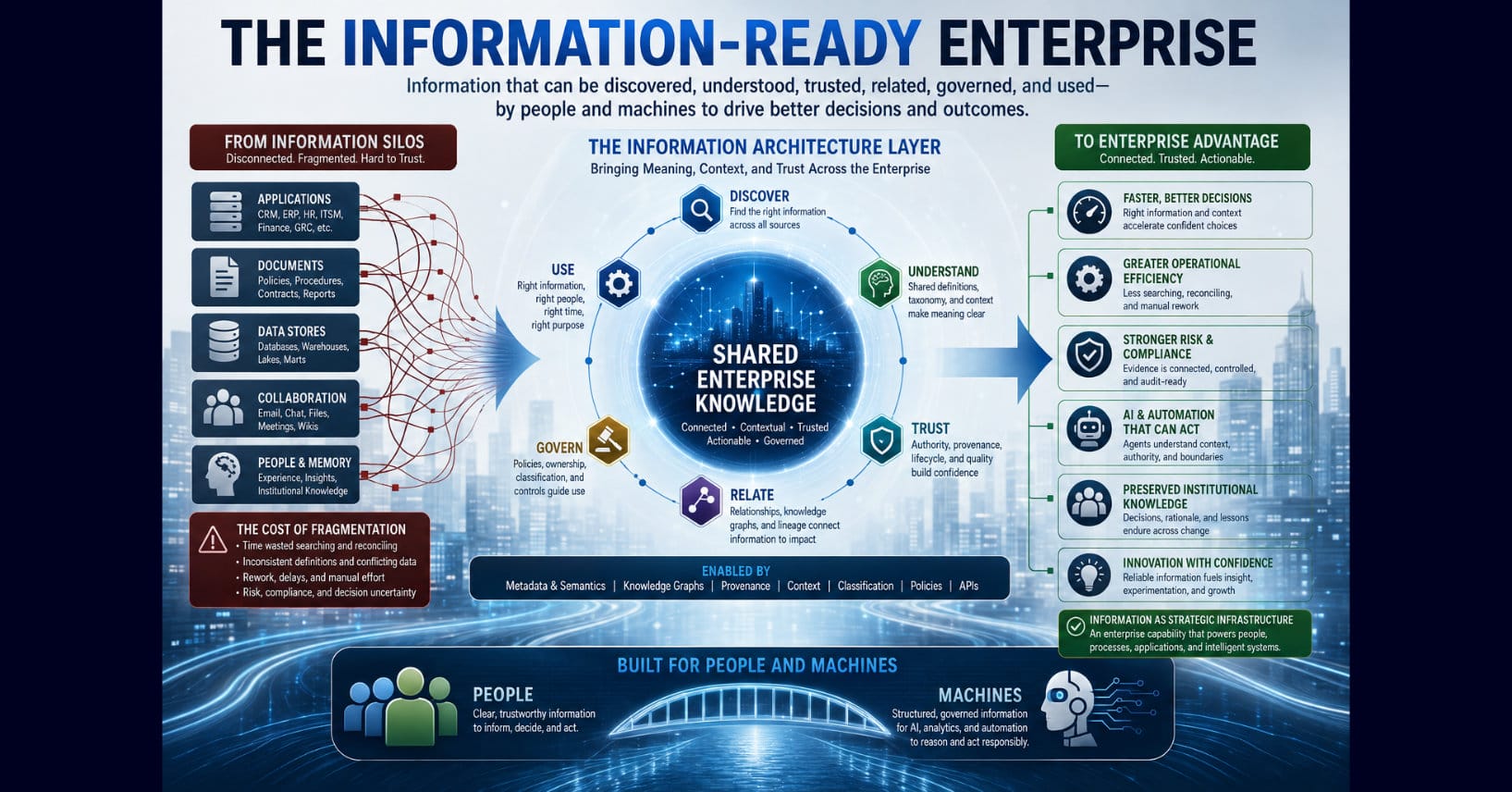
This article defines the Information-Ready Enterprise as an organization where critical information can be discovered, understood, trusted, related, governed, and used appropriately by humans and machines. It introduces six core capabilities of information readiness and a five-level maturity model progressing from Fragmented through Discoverable, Contextualized, Connected, and ultimately Information-Ready.
Information readiness reduces organizational friction, preserves institutional knowledge, improves decision readiness, strengthens digital transformation and modernization, and provides the contextual foundation required for enterprise AI and autonomous agents. As powerful technology becomes broadly available, the quality and coherence of an organization’s unique information environment may become a significant source of competitive advantage.
Most enterprises are data-rich.
Many are information-rich.
Far fewer are information-ready.
The distinction matters.
An organization may possess enormous quantities of data, millions of documents, sophisticated analytics platforms, mature cloud infrastructure, enterprise search, data catalogs, collaboration platforms, and increasingly capable artificial intelligence.
Yet employees may still struggle to answer basic questions.
Which source is authoritative?
What does this metric actually mean?
Is this policy current?
Why was this decision made?
Which systems depend on this vendor?
Which customers are affected by this obligation?
Where did this information come from?
Can we trust it?
Can AI use it?
Possessing information is not the same as being ready to use it.
An Information-Ready Enterprise is one in which critical information can be discovered, understood, trusted, related, governed, and used appropriately by both humans and machines.
That requires more than technology.
It requires architecture.
Information Readiness Is an Enterprise Capability
Information readiness is not a product.
It cannot be purchased as a platform.
It is not achieved by migrating everything to the cloud, implementing a data catalog, deploying enterprise search, or connecting an AI assistant to corporate repositories.
Those capabilities may contribute.
But readiness is an organizational condition.
An enterprise is information-ready when its information environment provides enough structure and context to support reliable action.
That means employees do not need extensive institutional knowledge simply to determine which information can be trusted.
Applications do not need endless custom logic to reconcile unresolved semantic differences.
Governance teams do not need to reconstruct evidence manually every time someone asks what happened.
AI systems do not need to infer organizational meaning from whichever documents happen to rank highest in a search.
The information environment itself begins carrying more of the burden.
The Six Capabilities of Information Readiness
An Information-Ready Enterprise should be able to do six things consistently with its most important information:
Discover it.
Understand it.
Trust it.
Relate it.
Govern it.
Use it.
These capabilities provide a practical way to assess information architecture maturity.
They also shift the conversation away from tools.
The question is no longer:
Do we have an enterprise search platform?
It becomes:
Can people and machines reliably discover authoritative information?
The question is no longer:
Do we have a data catalog?
It becomes:
Can people and machines understand what critical information means?
The question is no longer:
Do we have AI?
It becomes:
Is our information environment sufficiently coherent for AI to use safely?
That is a much higher standard.
1. Discoverable
Information must first be findable.
That sounds obvious.
In practice, it remains difficult.
Critical information may exist in:
Databases.
Document repositories.
Collaboration platforms.
Email.
SaaS applications.
File shares.
Data warehouses.
Ticketing systems.
Knowledge bases.
Source code repositories.
Spreadsheets.
Individual memory.
An Information-Ready Enterprise does not require employees to know the organizational history of where information was stored.
Discovery should increasingly operate across system boundaries.
But discoverability involves more than indexing.
A search result should help answer:
What is this?
Who owns it?
Is it current?
Is it authoritative?
What classification applies?
What is it related to?
Discovery without context merely makes ambiguity easier to locate.
2. Understandable
Finding information is insufficient if nobody understands what it means.
The enterprise must define critical business concepts.
Customer.
Product.
Revenue.
Risk.
Control.
Incident.
Supplier.
Application.
Obligation.
Decision.
Evidence.
Those definitions may vary by context.
That is acceptable if the differences are explicit.
An Information-Ready Enterprise understands its semantic boundaries.
It knows when two systems use the same word differently.
It knows when different words represent the same concept.
It preserves enough metadata and context for people and machines to interpret information correctly.
This is where the enterprise information model becomes important.
Information should not merely exist.
Its meaning should be architecturally represented.
3. Trustworthy
The next question is whether information can be trusted.
Trust requires more than accuracy.
Information may be accurate and still be inappropriate for a particular purpose.
Trust depends on questions such as:
Where did it come from?
Who owns it?
Which source is authoritative?
When was it created?
When was it last updated?
What transformations occurred?
What approvals were required?
Has it been superseded?
What confidence should we place in it?
Which rules govern its use?
An Information-Ready Enterprise makes these characteristics visible.
Provenance becomes part of the architecture.
Authority becomes contextual.
Lifecycle state becomes explicit.
Evidence becomes connected.
Trust is no longer dependent entirely on someone saying:
“That is the report we normally use.”
4. Related
Information becomes more valuable when the enterprise understands relationships.
Customers relate to contracts.
Contracts create obligations.
Obligations relate to policies.
Policies relate to controls.
Controls produce evidence.
Processes depend on applications.
Applications depend on infrastructure and vendors.
Risks affect business capabilities.
Decisions create consequences.
These relationships exist regardless of whether technology represents them.
An Information-Ready Enterprise makes important relationships explicit.
This does not require modeling every possible connection.
It requires identifying the relationships that materially affect:
Operations.
Decisions.
Risk.
Compliance.
Customer outcomes.
Architecture.
Automation.
AI.
Once those relationships become computable, the enterprise can begin answering questions that cross application boundaries.
That is the foundation of enterprise knowledge.
5. Governed
Information readiness without governance can create faster confusion.
The enterprise must know:
Who owns important information?
Who defines its meaning?
Who determines authority?
Who can change it?
Who may access it?
How should it be classified?
How long should it be retained?
Which policies govern its use?
Can it be used by AI?
Can it leave the enterprise?
Can it be combined with other information?
When does human approval become necessary?
Governance turns information architecture into accountable information architecture.
This becomes particularly important as AI systems consume information automatically.
A human employee may recognize that a document should not be used.
An AI system needs rules.
Classification, authority, permissions, provenance, and policy increasingly need to become machine-readable.
6. Usable
Ultimately, information must support action.
Employees need it to perform work.
Executives need it to make decisions.
Analysts need it to generate insight.
Auditors need it to evaluate evidence.
Applications need it to execute processes.
AI systems need it to reason.
Agents need it to act.
An information environment is not ready merely because information is organized.
It must be usable within the context of real enterprise activity.
That means information architecture must connect to implementation.
Metadata should influence search.
Classification should influence access.
Authority should influence retrieval.
Lifecycle should influence retention and applicability.
Relationships should influence impact analysis.
Provenance should support explainability.
Policies should constrain AI behavior.
The architecture should affect how the enterprise operates.
The Information Readiness Maturity Model
Organizations will not achieve these capabilities all at once.
A simple maturity model can help leadership understand progression.
Level 1: Fragmented
Information is organized primarily around applications and departments.
Definitions are inconsistent.
Search depends heavily on knowing where to look.
Authority is informal.
Institutional knowledge fills architectural gaps.
Manual reconciliation is common.
AI access is experimental and repository-specific.
The organization possesses information but struggles to establish coherence.
Level 2: Discoverable
Enterprise search, catalogs, inventories, and metadata improve visibility.
Employees can find more information across repositories.
Major information assets become identifiable.
But discovery still exceeds understanding.
The organization can increasingly answer:
Where is it?
It cannot always answer:
What does it mean, and can I trust it?
Level 3: Contextualized
Critical business concepts are defined.
Ownership becomes clearer.
Authority is documented.
Provenance improves.
Lifecycle states are represented.
Important information includes enough context to support interpretation.
The context gap begins shrinking.
The enterprise can increasingly answer:
What does this mean?
Level 4: Connected
Relationships among important enterprise concepts become explicit.
Information can be traversed across system boundaries.
Knowledge graphs, semantic models, or equivalent capabilities may emerge.
Decisions, evidence, risks, obligations, systems, customers, and processes become more connected.
Knowledge friction declines.
The enterprise can increasingly answer:
How does this relate to everything else?
Level 5: Information-Ready
Information architecture becomes an enterprise operating capability.
Critical information is discoverable, understandable, trustworthy, related, governed, and usable.
Context travels with information.
Authority is machine-readable.
Provenance is traceable.
Policies and permissions constrain automated use.
Humans and AI can operate against a shared information environment with appropriate governance.
The enterprise can increasingly answer:
What can we safely do with what we know?
That is the Information-Ready Enterprise.
Information Readiness Reduces Organizational Friction
Earlier in this series, we described information fragmentation as a distributed operating expense.
Employees search.
Analysts reconcile.
Managers interpret.
Developers translate.
Compliance teams reconstruct.
Experienced employees remember.
All of that work compensates for weaknesses in the information environment.
Information readiness reduces that friction.
Not to zero.
Complex organizations will always require interpretation.
But the architecture can eliminate unnecessary interpretation.
Employees should not repeatedly determine which policy is current.
Analysts should not repeatedly rediscover how a metric is defined.
Developers should not repeatedly reverse-engineer semantic differences between systems.
Auditors should not repeatedly reconstruct evidence relationships.
AI systems should not repeatedly infer authority from semantic similarity.
Every ambiguity resolved architecturally is one less ambiguity the organization must resolve operationally.
Information Readiness Preserves Institutional Memory
Organizations frequently worry about knowledge leaving when experienced employees retire or change roles.
The usual response is documentation.
Documentation helps.
But institutional memory requires more than documents.
The enterprise must preserve:
Decisions.
Rationale.
Relationships.
Assumptions.
Authority.
Exceptions.
Dependencies.
Provenance.
Evidence.
Historical context.
A twenty-page document may contain all of those things.
But if they remain trapped inside the document, the enterprise may still struggle to use them.
Information readiness makes important organizational memory discoverable and connected.
The objective is not to capture everything people know.
It is to prevent the enterprise from repeatedly forgetting what it has already learned.
Information Readiness Improves Decision Readiness
Leadership decisions depend on information.
The quality of that information environment therefore affects governance.
Consider an executive decision involving a major technology investment.
Leadership may need to understand:
Current costs.
Business dependencies.
Customer impacts.
Architecture constraints.
Cybersecurity risks.
Vendor concentration.
Regulatory obligations.
Technical debt.
Contractual commitments.
Previous decisions.
Alternative options.
Information readiness determines how quickly those pieces can be assembled and how confidently they can be trusted.
This creates a direct relationship between information architecture and decision velocity.
Better information does not guarantee better decisions.
But poor information architecture makes good decisions unnecessarily difficult.
Information Readiness Changes Digital Transformation
Digital transformation programs frequently focus on processes and systems.
Replace the legacy application.
Move to the cloud.
Automate the workflow.
Deploy the new platform.
Redesign the customer experience.
Those changes matter.
But transformation also changes information.
New systems introduce new representations.
Old definitions migrate.
Business rules change.
Information relationships shift.
Historical context can disappear.
Authority moves between systems.
New data is generated.
If transformation does not explicitly address information architecture, it may modernize technology while preserving—or worsening—information fragmentation.
A transformed enterprise should not merely run on newer systems.
It should understand itself better.
Information Readiness Changes Modernization
The same principle applies to IT modernization.
Legacy systems often contain more than old code.
They contain decades of accumulated business meaning.
Fields whose names no longer explain their purpose.
Business rules embedded in programs.
Exceptions created for customers who may no longer exist.
Data relationships nobody documented.
Historical decisions reflected in system behavior.
Replacing the system without recovering that meaning can create significant risk.
Information architecture should therefore become part of modernization discovery.
Before retiring a legacy system, ask:
What does this system know that the enterprise has never formally modeled?
That question can reveal some of the most valuable information in the technology estate.
Information Readiness Changes AI Readiness
The AI implications are even more significant.
Organizations frequently ask whether their data is ready for AI.
The better question is broader:
Is our information environment ready for AI?
Can AI determine what information means?
Can it identify authoritative sources?
Can it establish provenance?
Can it distinguish current information from historical information?
Can it understand important relationships?
Can it respect classifications?
Can permissions follow information across systems?
Can the organization reconstruct what information influenced an AI-generated decision?
Can AI distinguish facts from derived or inferred knowledge?
These are information architecture questions.
A company may have excellent models and excellent infrastructure while remaining information-unready.
That gap will become increasingly consequential as AI moves deeper into enterprise operations.
Agents Make Information Readiness Operational
AI agents turn information readiness from an analytical concern into an operational one.
An AI assistant can give a poor answer.
An AI agent can take a poor action.
That difference matters.
Before an agent modifies a customer account, approves an exception, initiates remediation, communicates with a supplier, changes a configuration, or triggers a financial workflow, the enterprise must be confident that the agent understands enough context to act appropriately.
The information environment must help establish:
Identity.
Authority.
Applicability.
Policy.
Relationships.
State.
Provenance.
Permissions.
Decision thresholds.
Human approval requirements.
Evidence requirements.
The architecture surrounding the agent becomes part of the control environment.
The smarter the agent becomes, the more important that environment becomes.
The Information-Ready Enterprise Does Not Centralize Everything
None of this requires one universal enterprise repository.
That is an important distinction.
Information will remain distributed.
Operational systems should continue doing what they do well.
Specialized platforms will remain necessary.
Business domains will maintain legitimate autonomy.
Some information will remain highly restricted.
The objective is not centralization.
It is coherence.
A federated enterprise can still be information-ready if shared architecture allows important information to be understood across boundaries.
The enterprise needs common semantics where they matter.
Explicit relationships where they matter.
Shared metadata where it matters.
Governance where it matters.
Authority where it matters.
The goal is not architectural uniformity.
It is understandable diversity.
A Practical Information Readiness Assessment
Leadership can begin without launching a major transformation program.
Select a small number of consequential enterprise questions.
For example:
Which customers would be affected if this critical application failed?
Which regulatory obligations depend on this business process?
Which controls provide evidence for this requirement?
Which decisions created our current vendor dependency?
Which policies apply to this AI use case?
Which systems contain authoritative information about this customer?
Then attempt to answer them.
Measure:
How many systems were required?
How many people were consulted?
How many definitions had to be reconciled?
How many relationships were reconstructed manually?
How difficult was it to establish authority?
How much context existed only in human memory?
How long did the answer take?
How confident are you that the answer is complete?
That exercise will reveal more about information readiness than a technology inventory alone.
The Next Enterprise Advantage
For decades, enterprises competed partly on systems.
Then data.
Then analytics.
Now AI.
As access to powerful technology becomes increasingly widespread, the differentiator shifts.
Competitors can purchase similar cloud platforms.
They can deploy similar enterprise applications.
They can access similar foundation models.
They can hire capable engineers.
What they cannot easily replicate is the accumulated context of another enterprise.
Its customer relationships.
Its operational history.
Its decisions.
Its institutional knowledge.
Its contracts.
Its processes.
Its evidence.
Its learned experience.
Its understanding of how all those things relate.
That information environment is becoming strategic infrastructure.
The enterprise that organizes it well can make better use of every technology built above it.
From Information Architecture to Information Readiness
This series began with a simple assertion:
Your enterprise already has an information architecture.
The question was whether anyone designed it.
We distinguished information architecture from data architecture.
We examined the hidden cost of fragmentation.
We identified context as the missing layer.
We designed the enterprise information model.
We examined how information architecture is becoming foundational to AI architecture.
We moved from information silos toward enterprise knowledge.
Now the destination becomes clear.
Information architecture should not exist merely to organize information.
It should prepare the enterprise to use what it knows.
That means creating an environment where critical information can be:
Discovered.
Understood.
Trusted.
Related.
Governed.
Used.
By people.
By applications.
By analytics.
By automation.
And increasingly, by artificial intelligence.
That is information readiness.
And as enterprises become more dependent on intelligent software, information readiness will become increasingly inseparable from enterprise readiness itself.
Because the organizations that gain the greatest advantage from AI may not be the ones with the most information.
They may be the ones whose information is ready to become intelligence.
Series Conclusion
The Information Architecture series has examined an enterprise capability that has historically received less strategic attention than applications, infrastructure, data, or cybersecurity.
That is changing.
Information architecture now sits at the intersection of enterprise architecture, digital transformation, data governance, knowledge management, AI strategy, automation, and decision-making.
The next challenge is accountability.
Once an enterprise understands its information, someone must establish who owns it, who can change it, how its quality is maintained, which policies apply, and how appropriate use is enforced.
That brings us to the next Enterprise series:
Data Governance.