Information Architecture Series | Article 7 of 8
Summary
Enterprises have spent decades trying to eliminate information silos through warehouses, document platforms, cloud systems, data lakes, enterprise search, and now artificial intelligence. These technologies improve access, but connecting repositories does not necessarily connect organizational knowledge.
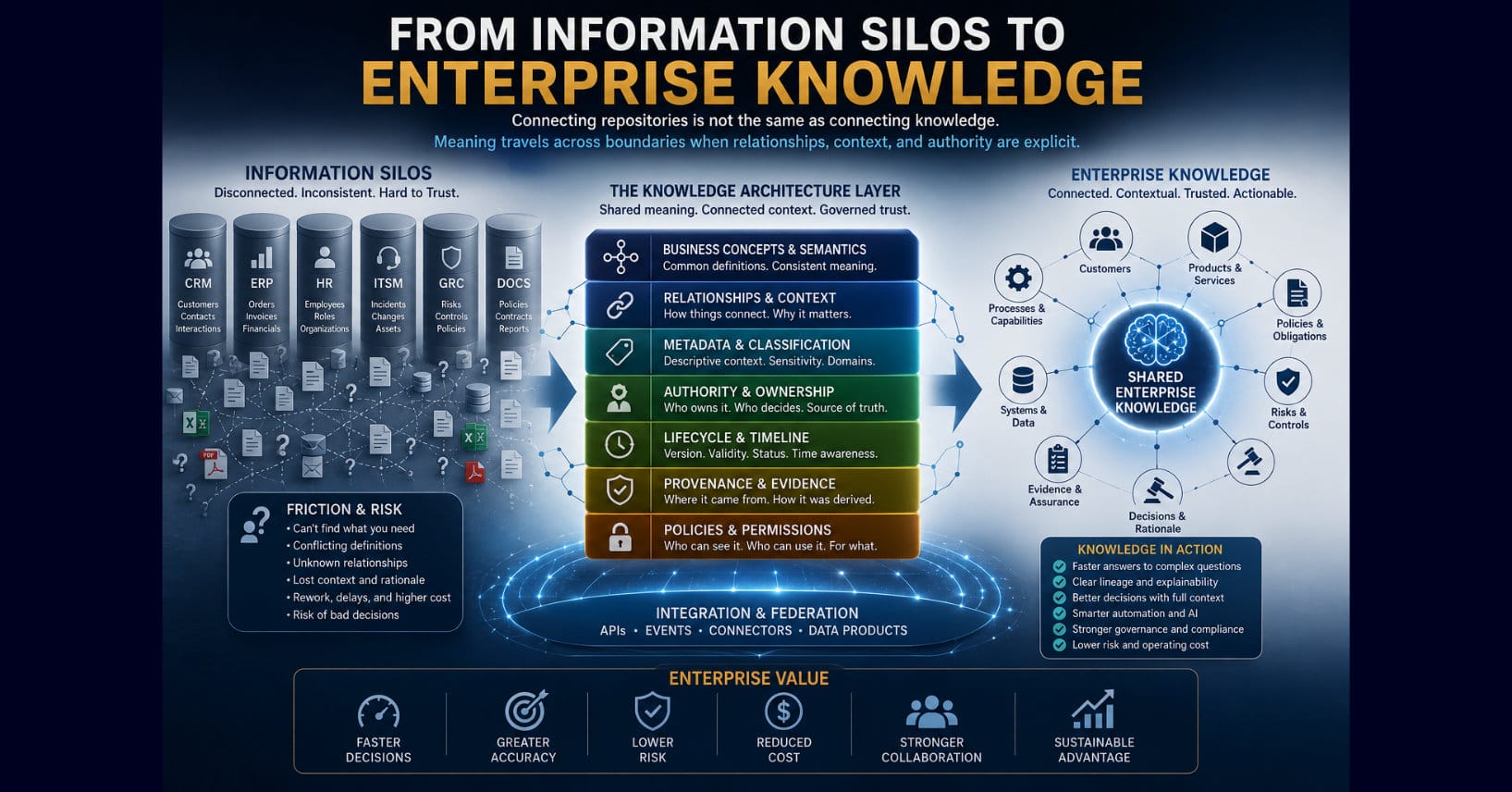
This article examines the shift from information silos to enterprise knowledge. The architectural problem is not simply that information resides in different systems; it is that meaning and relationships frequently stop at those boundaries. A knowledge architecture provides a semantic layer across operational systems through shared concepts, relationships, metadata, authority, provenance, classification, lifecycle, decisions, and evidence.
The article also introduces knowledge friction as a way to measure how much effort organizations spend reconstructing relationships and context. As AI agents become more capable, reducing that friction becomes increasingly important because intelligent systems need enterprise knowledge they can traverse, not merely repositories they can search.
Enterprises have been trying to eliminate information silos for decades.
The usual solution has been technological.
Build a data warehouse.
Deploy a document management system.
Create an enterprise portal.
Implement SharePoint.
Move everything to the cloud.
Build a data lake.
Deploy a data catalog.
Create an enterprise search platform.
Connect everything to artificial intelligence.
Each generation of technology promises to make enterprise information easier to access.
And each generation eventually discovers the same thing:
Connecting repositories is not the same as connecting knowledge.
An enterprise can make thousands of systems searchable and still leave employees unable to determine which information is authoritative.
It can consolidate petabytes of data and still maintain conflicting business definitions.
It can index millions of documents and still lose the reasoning behind important decisions.
It can connect an AI assistant to every repository and still fail to provide the context required to answer consequential questions correctly.
The problem is not simply that information exists in different places.
The problem is that organizational knowledge does not travel easily across those boundaries.
The next stage of information architecture must therefore move beyond information access.
It must make enterprise knowledge traversable.
Silos Are Not Necessarily Bad
The term silo is almost always used negatively.
But information boundaries exist for legitimate reasons.
Finance needs specialized systems.
Legal needs controlled repositories.
Human resources handles sensitive employee information.
Engineering uses tools designed for technical workflows.
Cybersecurity maintains operational security information.
Sales needs customer relationship capabilities.
Research teams may protect intellectual property.
Regulated information may require strict separation.
Trying to put everything into one giant repository would not necessarily improve the enterprise.
It could make governance worse.
The architectural problem is not that boundaries exist.
It is that meaning frequently stops at those boundaries.
A customer means one thing in sales and another in finance.
A risk exists in a GRC platform but is disconnected from the application that creates it.
A contract exists in legal but is disconnected from the operational obligations it creates.
A policy exists in a repository but is disconnected from the controls that implement it.
A technology decision exists in meeting minutes but is disconnected from the systems and costs that resulted from it.
The silo is not merely the system.
The silo is the broken relationship.
Access Was the First Problem
Historically, enterprises struggled to access information across systems.
The information might exist, but employees could not easily reach it.
Integration technologies improved this.
APIs improved it.
Cloud platforms improved it.
Enterprise search improved it.
Modern identity systems improved it.
AI retrieval will improve it further.
Access remains important.
But as access improves, another problem becomes more visible.
An employee may now be able to find ten documents in seconds.
Which one matters?
An analyst may query data from six systems.
Which definition applies?
An AI assistant may retrieve twenty semantically relevant passages.
Which are authoritative?
The enterprise has moved from an access problem to an interpretation problem.
That is progress.
It is also why information architecture becomes more important as technology improves.
Enterprise Knowledge Requires Relationships
Knowledge is not merely a larger collection of information.
Knowledge emerges partly from understanding relationships.
Consider a cybersecurity incident.
The enterprise may possess information about:
The affected server.
The application running on it.
The business process supported by the application.
The customers depending on the process.
The vulnerability that was exploited.
The control that failed.
The vendor responsible for a component.
The regulatory obligation triggered by the incident.
The executive who accepted a related risk.
The evidence required for the investigation.
The organization may possess every one of those information assets.
But if they exist independently, the enterprise must reconstruct the relationships during the incident.
That takes time.
Now imagine that those relationships are already represented.
Server A hosts Application B.
Application B supports Process C.
Process C serves Customer Group D.
Application B depends on Vendor E.
Vulnerability F affects Server A.
Control G mitigates Vulnerability F.
Risk H was accepted for Application B.
Regulation I applies to Customer Group D.
Evidence J demonstrates Control G.
The organization has moved beyond information retrieval.
It has created a knowledge structure.
Knowledge Must Cross Application Boundaries
Enterprise applications are optimized around transactions and workflows.
CRM systems understand sales interactions.
ERP systems understand financial and operational transactions.
HR platforms understand workforce processes.
GRC systems understand risks and controls.
Contract systems understand agreements.
IT service management platforms understand incidents, changes, and assets.
Each system sees a portion of the enterprise.
The enterprise itself is the combination of those perspectives.
An enterprise knowledge architecture therefore cannot simply mirror application boundaries.
It must provide a semantic layer that allows concepts and relationships to cross them.
A customer should remain conceptually understandable whether information comes from CRM, billing, support, legal, or operations.
A business capability should be connectable to the applications supporting it.
A regulatory obligation should be connectable to policies, controls, evidence, systems, and responsible owners.
A decision should be connectable to the evidence, assumptions, risks, and consequences surrounding it.
This does not require replacing the underlying systems.
It requires architecture above them.
The Knowledge Layer
A useful way to think about the future enterprise information environment is as a knowledge layer.
The operational systems remain.
The databases remain.
The documents remain.
The APIs remain.
The analytics platforms remain.
But above those systems sits an architectural layer that provides shared understanding.
That layer may contain:
- Enterprise business concepts
- Semantic definitions
- Metadata
- Taxonomies
- Ontologies
- Entity relationships
- Authority
- Provenance
- Classification
- Lifecycle
- Policies
- Knowledge graphs
- Decision records
- Evidence relationships
The exact technologies will vary.
The architectural purpose does not.
The knowledge layer allows information from different sources to participate in a common model of enterprise meaning.
Search Becomes Knowledge Discovery
Traditional enterprise search asks:
Where is the information?
A knowledge-oriented enterprise can ask richer questions.
Which policies govern this business process?
Which applications support this product?
Which vendors create dependencies for this critical capability?
Which controls address this regulatory obligation?
Which decisions resulted in this architecture?
Which customers would be affected if this service failed?
Which risks were accepted based on assumptions that are no longer valid?
Which evidence demonstrates that this control operated during the relevant period?
These questions cross system boundaries.
They also cross organizational boundaries.
No single application may contain the answer.
The answer emerges from relationships among information.
That is the transition from search to knowledge discovery.
Institutional Knowledge Must Become Enterprise Knowledge
Every organization has people who understand how things really work.
They know which process bypasses the documented workflow.
They know why an application cannot be retired.
They know which customer commitment drove a technical exception.
They know which metric should not be trusted during the first week of the month.
They know why a control exists.
They know why leadership rejected an apparently better architecture.
This is institutional knowledge.
It is valuable.
It is also fragile.
If the knowledge exists only in a person’s memory, it does not truly belong to the enterprise.
The challenge is not to document everything employees know.
That would be impossible.
The challenge is to identify knowledge that materially affects:
Decisions.
Operations.
Risk.
Compliance.
Customer commitments.
Architecture.
Business continuity.
AI and automation.
Then preserve enough context and relationships that the enterprise does not depend entirely on individual memory.
This is how institutional knowledge begins becoming enterprise knowledge.
Documents Are Not Knowledge
Organizations frequently respond to knowledge-management problems by creating more documentation.
Documentation matters.
But a document is a container.
It does not automatically create knowledge.
Imagine an architecture decision recorded in a twenty-page document.
The document may contain:
The problem.
The alternatives.
The selected approach.
The rationale.
The risks.
The dependencies.
The implementation implications.
That is valuable.
But if the document is merely placed into a repository, much of its knowledge remains trapped inside the file.
The enterprise may know that the document exists.
It may not know that:
Decision A selected Technology B.
Technology B supports Capability C.
Technology B depends on Vendor D.
Decision A accepted Risk E.
Assumption F supported Decision A.
If Assumption F later becomes false, the enterprise should ideally know which decisions may need reconsideration.
A document alone cannot easily provide that capability.
A knowledge architecture can.
The Enterprise Knowledge Graph
This is where knowledge graphs become particularly interesting.
A knowledge graph represents entities and their relationships in a form machines can traverse.
Instead of merely storing a collection of records, the enterprise can represent relationships such as:
Customer has Contract.
Contract contains Obligation.
Obligation requires Control.
Control protects Process.
Process depends on Application.
Application depends on Vendor.
Vendor creates Concentration Risk.
Risk was accepted by Decision.
Decision was supported by Evidence.
Evidence originated from System.
Now the enterprise can traverse meaning across systems.
This does not mean every organization should immediately launch an enterprise-wide knowledge graph program.
Technology enthusiasm can easily outrun architectural discipline.
The important principle is that relationships should increasingly be represented explicitly and computationally.
Knowledge graphs are one way to do that.
Taxonomy, Ontology, and Knowledge Graphs Play Different Roles
These concepts are often discussed together, but they serve different purposes.
A taxonomy organizes concepts into categories.
For example:
Technology
→ Applications
→ Customer Applications
→ CRM
An ontology describes concepts, properties, and the kinds of relationships that can exist among them.
For example:
An Application supports a Business Process.
A Business Process fulfills an Obligation.
A Control mitigates a Risk.
A knowledge graph represents actual instances and relationships.
For example:
CRM Platform X supports Customer Onboarding.
Customer Onboarding fulfills KYC Requirement Y.
Control 14 mitigates Identity Risk Z.
Taxonomy helps classify.
Ontology helps define meaning.
Knowledge graphs help represent connected knowledge.
Together, they can provide a powerful semantic foundation.
Authority Still Matters
Connecting information can create a new problem.
Conflicting knowledge becomes easier to discover.
That is not a reason to avoid connection.
It is a reason to model authority.
Suppose three systems contain different customer addresses.
A knowledge layer should not simply merge them into one ambiguous value.
It should preserve context.
Billing address.
Registered corporate address.
Service location.
Sales contact address.
Each value may be authoritative for a different purpose.
Enterprise knowledge therefore requires more than connectivity.
It requires contextual authority.
The architecture must help answer:
Authoritative for what?
According to whom?
During which period?
For which business process?
Under which policy?
Knowledge without authority can simply produce more sophisticated confusion.
Provenance Makes Knowledge Trustworthy
As information becomes increasingly connected, provenance becomes even more important.
If an AI system presents a relationship between a customer and a regulatory obligation, the enterprise may need to know why that relationship exists.
Was it explicitly defined?
Derived from a contract?
Inferred by AI?
Created by an integration rule?
Approved by a business owner?
Imported from an external source?
Knowledge architectures should distinguish between facts, derived information, and inferred relationships.
This becomes essential when AI contributes to the knowledge environment.
An AI-generated relationship should not automatically acquire the same authority as a legally executed contract or an approved policy.
The enterprise needs to know not only what it knows.
It needs to know how it knows it.
AI Can Help Build Enterprise Knowledge
Artificial intelligence is not merely a consumer of enterprise knowledge.
It can also help create it.
AI can identify entities in documents.
Extract relationships.
Suggest classifications.
Generate metadata.
Identify duplicate concepts.
Detect conflicting definitions.
Summarize decision rationale.
Link related information.
Identify missing relationships.
Surface obsolete content.
Extract obligations from contracts.
This can dramatically reduce the effort required to build and maintain a knowledge environment.
But there is an important governance distinction.
AI can propose knowledge.
The enterprise must determine when that proposed knowledge becomes authoritative.
That may require validation.
Approval.
Evidence.
Confidence thresholds.
Human review.
Automated rules.
Different processes may apply depending on the consequence.
AI can accelerate knowledge creation.
It should not silently redefine enterprise truth.
AI Agents Need Enterprise Knowledge
The relationship becomes even stronger with AI agents.
An agent operating across the enterprise needs more than documents.
It needs to understand how things relate.
Imagine an agent responsible for evaluating the impact of a vendor outage.
It may need to determine:
Which applications depend on the vendor?
Which business processes depend on those applications?
Which products depend on those processes?
Which customers depend on those products?
Which contractual service levels apply?
Which regulatory obligations may be affected?
Which executives own the relevant decisions?
Which contingency plans exist?
Which communications require approval?
This is not fundamentally a search problem.
It is a graph traversal problem through enterprise knowledge.
The quality of the agent’s reasoning will depend partly on the quality of those relationships.
Do Not Build Another Knowledge Silo
There is a danger here.
Enterprises may respond to the knowledge problem by purchasing a new “enterprise knowledge platform.”
Then they begin copying information into it.
Soon the knowledge platform becomes another repository.
Another silo.
Another migration program.
Another system employees must maintain.
The better architectural objective is not necessarily to move all knowledge into one place.
It is to create a semantic and governance layer that can connect knowledge where it already exists.
Some information will remain in operational systems.
Some in document repositories.
Some in analytical platforms.
Some in specialized applications.
Some relationships may be represented in a graph.
Some definitions may live in catalogs.
Some policies may remain in governance systems.
The architecture should make these resources understandable together.
The objective is federation with coherence.
Enterprise Knowledge Must Be Governed
A connected knowledge environment introduces governance questions.
Who can define enterprise concepts?
Who approves relationships?
Who owns classifications?
Who resolves semantic conflicts?
Who determines authority?
Who can modify knowledge used by AI?
How are inferred relationships validated?
How are obsolete relationships retired?
How is provenance preserved?
How are access restrictions enforced?
How are sensitive relationships protected?
Knowledge architecture without governance can create an environment where misinformation becomes highly connected.
That is not progress.
Governance provides the accountability necessary to maintain trust.
Measure Knowledge Friction
Organizations can begin assessing their current knowledge environment without implementing new technology.
Ask:
How many systems must someone consult to answer a common cross-functional question?
How often do employees ask colleagues where information is located?
How many critical relationships exist only in people’s heads?
How often must analysts manually combine information from multiple systems?
How frequently do teams disagree about definitions?
How difficult is it to trace an executive metric back to its sources?
How quickly can the enterprise identify downstream consequences of a system, vendor, policy, or regulatory change?
How much time is spent reconstructing why previous decisions were made?
How often does AI retrieve relevant information but lack enough context to answer reliably?
These are indicators of knowledge friction.
The objective of enterprise knowledge architecture is to reduce it.
From Repository Thinking to Relationship Thinking
For decades, enterprise information management has focused heavily on containers.
Which database?
Which folder?
Which site?
Which platform?
Which cloud?
Which repository?
Those questions will remain relevant.
But the more important questions increasingly concern relationships.
What does this mean?
What is it connected to?
Who owns it?
What depends on it?
What governs it?
Where did it come from?
Which decision created it?
Which evidence supports it?
What happens if it changes?
That is the transition from repository thinking to relationship thinking.
And it represents a significant shift in enterprise information architecture.
The Enterprise That Knows What It Knows
The goal is not to create an omniscient organization.
No enterprise will perfectly model everything it knows.
The objective is more practical.
Critical information should be discoverable.
Important concepts should be understandable.
Authoritative sources should be identifiable.
Material relationships should be explicit.
Institutional knowledge should not disappear unnecessarily when employees leave.
Decisions should retain their rationale.
Evidence should remain connected to what it demonstrates.
AI should receive enough context to distinguish plausible information from trusted information.
When those capabilities exist, the enterprise begins moving beyond information management.
It begins developing organizational memory.
That memory becomes increasingly valuable as technology accelerates.
Because the enterprise that can connect what it knows can understand consequences faster.
It can make decisions with greater confidence.
It can automate with better context.
It can govern with stronger evidence.
It can preserve knowledge across organizational change.
And it can give artificial intelligence something far more valuable than access to another repository.
It can give AI an enterprise it can begin to understand.
Coming Next
Article 8: The Information-Ready Enterprise
The final article brings the series together. What does an enterprise look like when information can be discovered, understood, trusted, related, governed, and safely consumed by both humans and machines? The Information-Ready Enterprise examines the capabilities organizations need to turn information architecture from a technical discipline into a strategic enterprise advantage.