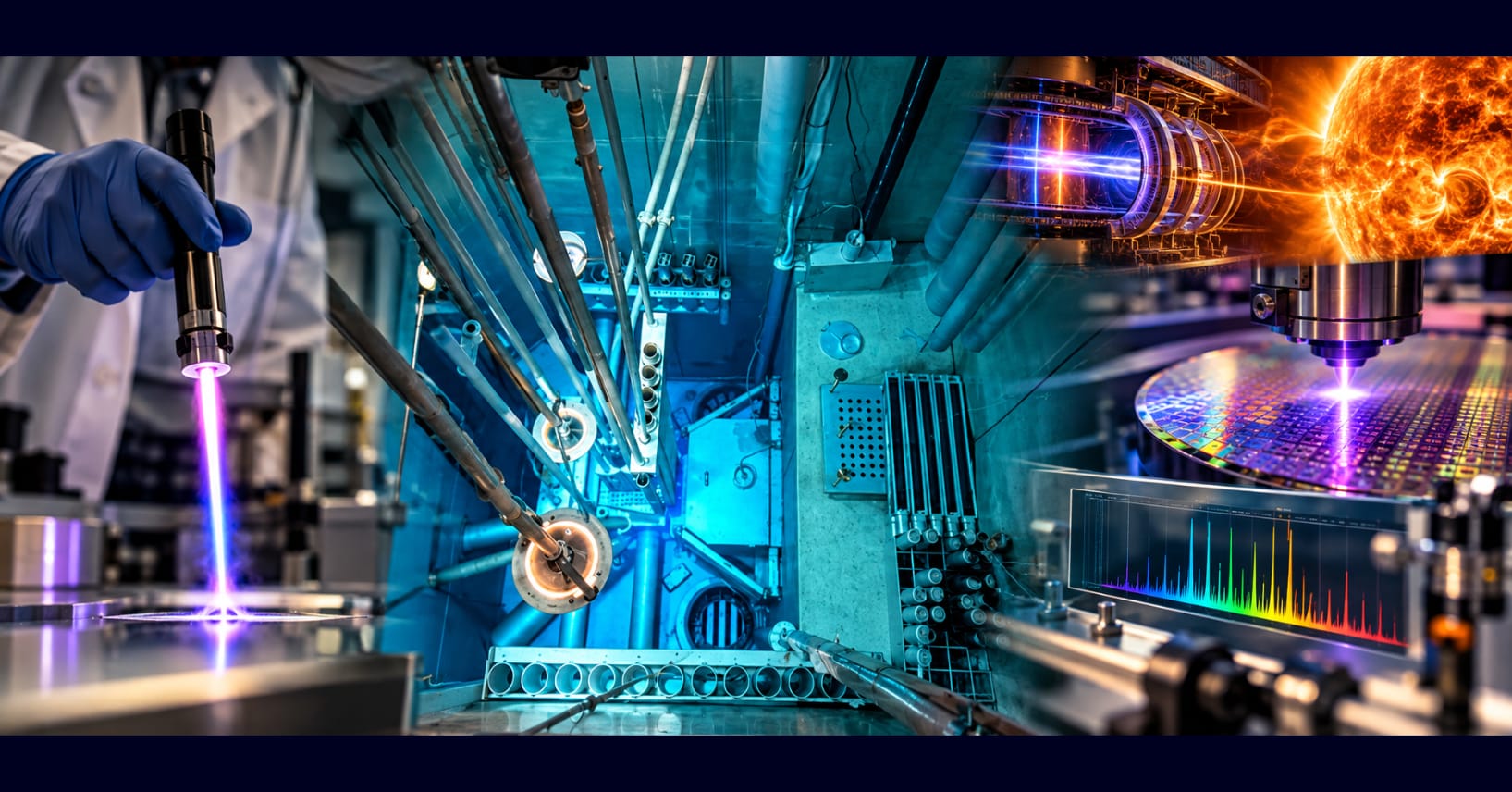
An extraordinary visit with the North Carolina Executive Roundtable revealed how nuclear engineering, plasma physics, laser spectroscopy, and biomedical research are shaping technologies that could transform our future.
Summary
Members of the North Carolina Executive Roundtable toured NC State University’s PULSTAR nuclear reactor and plasma research laboratories, gaining a firsthand look at science with implications far beyond the university campus. From the blue glow of a nuclear research reactor and the challenge of magnetic-confinement fusion to plasma etching used in semiconductor manufacturing, laser spectroscopy, and an argon plasma needle being studied for equine fungal infections, the visit demonstrated how fundamental research becomes practical innovation. The tour, sponsored by Nuclear Engineering Department Head Dr. Steven Shannon, also provided context for his recent congressional testimony on advanced nuclear energy, workforce development, and the research infrastructure required to sustain U.S. technological leadership.
What do a nuclear reactor, computer chips, the surface of the Sun, and a miniature lightsaber have in common?
As I discovered this past Friday, October 9, the answer is a remarkable collection of scientific research laboratories at North Carolina State University in Raleigh.
I joined fellow members of the North Carolina Executive Roundtable (NCER) for a behind-the-scenes tour of NC State’s nuclear reactor, plasma research facilities, and laboratories investigating applications ranging from semiconductor manufacturing to experimental medical treatments.
Our visit was sponsored by Dr. Steven Shannon, professor and head of NC State’s Department of Nuclear Engineering. His research spans industrial plasma applications, advanced manufacturing, and nuclear engineering. In September, he testified before Congress about the future of nuclear energy in the United States.
What made the experience particularly interesting was discovering how seemingly unrelated scientific disciplines intersect.
The physics behind manufacturing microscopic structures on computer chips also has applications in medicine. The behavior of electrically charged gases connects industrial manufacturing with efforts to harness nuclear fusion. And a university research reactor provides experimental capabilities that help scientists understand materials and processes that cannot easily be studied elsewhere.
For someone who has spent decades working in enterprise technology, the experience offered a valuable reminder: many of the technologies we depend upon begin with scientific research that most people never see.
A Nuclear Reactor in the Heart of Raleigh
Our first major stop brought us face-to-face with something many North Carolina residents may not realize exists.
NC State operates a functioning nuclear reactor on its campus.
The PULSTAR reactor, located in Burlington Engineering Laboratory, has been operating since 1972. It is a one-megawatt, pool-type nuclear research reactor used for education, scientific experimentation, and specialized research.
It is also the only remaining operational PULSTAR reactor of the two originally constructed.
Unlike commercial nuclear power plants, which use nuclear reactions to generate electricity, PULSTAR is designed primarily to support research and education.
Its value comes from the experimental environment it provides.
Researchers use the reactor to study neutron interactions, investigate material properties, conduct radiation experiments, and develop a better understanding of nuclear processes.
NC State’s Nuclear Reactor Program traces its origins to 1950, when the university established what it identifies as the world’s first university nuclear reactor program. The current PULSTAR facility continues that legacy.
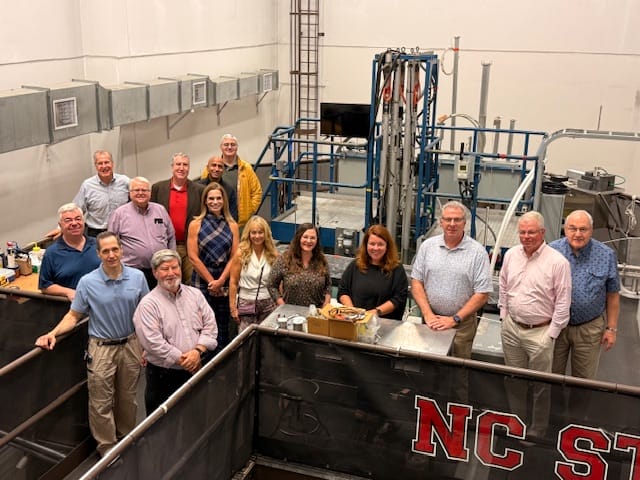
Standing alongside the reactor platform, surrounded by the equipment and infrastructure supporting its operation, provided a perspective that photographs and technical descriptions cannot fully convey.
This is not a theoretical exercise.
It is a functioning research facility where scientists and students investigate nuclear processes under controlled conditions.
Looking Down Into the Reactor Pool
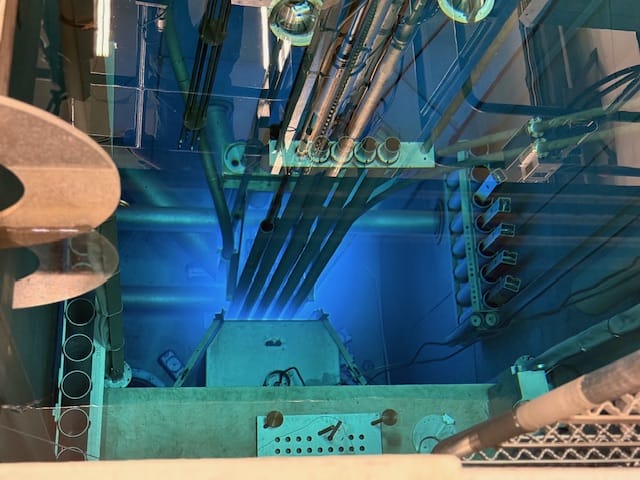
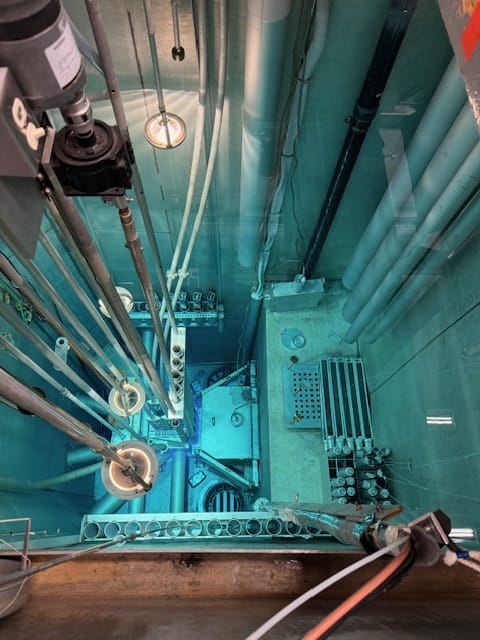
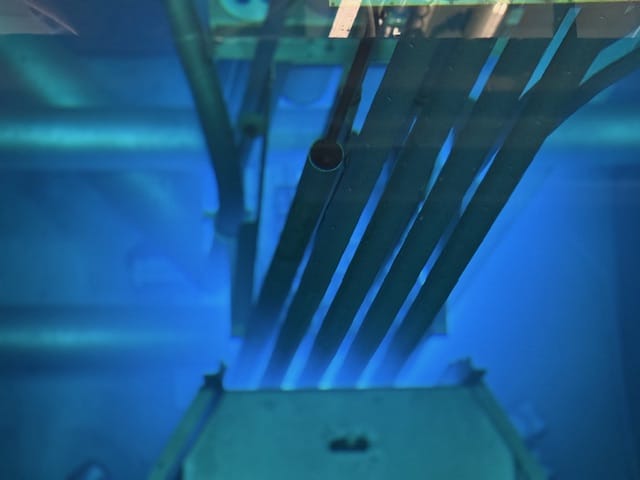
One of the most visually striking parts of the visit was looking directly down into the reactor pool.
The photographs accompanying this article show the view from above, with structural components and instrumentation extending into the water.
The distinctive blue illumination visible in the pool is associated with a phenomenon called Cherenkov radiation.
Cherenkov radiation occurs when charged particles travel through a transparent medium, such as water, faster than light can travel through that medium.
That does not mean the particles exceed the speed of light in a vacuum. Rather, light travels more slowly through water, allowing sufficiently energetic charged particles to exceed its speed within that material.
The resulting electromagnetic radiation produces the characteristic blue glow commonly associated with operating pool-type nuclear reactors.
It is one of those remarkable instances where an abstract principle of physics becomes directly visible.
The water serves several important purposes.
It helps cool the reactor, moderates neutrons, and provides radiation shielding.
The reactor uses uranium dioxide fuel contained within metal cladding. Nuclear fission releases energy and neutrons, sustaining a controlled chain reaction.
Control rods containing neutron-absorbing materials regulate the reaction by changing the number of neutrons available to sustain further fission.
This is fundamentally different from nuclear fusion, which we discussed later during our visit to the plasma laboratories.
Research That Extends Beyond Nuclear Power
One of the important distinctions we learned was that research reactors support far more than the development of nuclear energy.
PULSTAR provides capabilities for neutron imaging, neutron diffraction, neutron activation analysis, and other specialized experimental techniques.
Neutron imaging is particularly interesting because neutrons interact with materials differently from X-rays.
While X-rays are useful for examining many internal structures, neutron imaging can reveal features that conventional radiography may not detect as effectively.
For example, neutron imaging can be useful for identifying hydrogen-containing materials within certain metal structures.
That creates opportunities for inspecting industrial components, evaluating material defects, and investigating processes occurring inside otherwise inaccessible systems.
Neutron diffraction provides another capability: examining the arrangement of atoms within materials.
Understanding those atomic structures helps scientists investigate material properties and how they change under different conditions.
The reactor therefore supports research relevant to manufacturing, materials science, engineering, and fundamental physics.
Looking into that pool reinforced an important point.
Much of modern technological progress depends upon our ability to investigate phenomena that cannot be observed directly with ordinary instruments.
Research reactors provide one of the specialized environments that make those investigations possible.
From Nuclear Fission to the Challenge of Fusion
Our discussions eventually moved from nuclear fission to an entirely different challenge: nuclear fusion.
The distinction is important.
Fission releases energy by splitting heavy atomic nuclei.
Fusion releases energy when lighter atomic nuclei combine to form heavier nuclei.
Fusion is the process that powers the Sun.
And understanding how to harness that process on Earth remains one of the most ambitious challenges in modern energy research.
During our visit to the plasma laboratory, we observed a demonstration involving helium.
That demonstration led to a fascinating discussion about the relationship between plasma, magnetic fields, and the extraordinary conditions required for fusion.
The Sun Has an Advantage We Cannot Reproduce
The Sun’s enormous mass creates a gravitational field capable of confining its interior plasma under tremendous pressure.
Combined with extremely high temperatures, those conditions allow nuclear fusion to occur.
We cannot reproduce the Sun’s gravitational environment in a laboratory.
Instead, scientists investigating magnetic-confinement fusion use powerful magnetic fields to constrain electrically charged plasma.
Plasma is often called the fourth state of matter.
When sufficient energy is introduced into a gas, electrons can become separated from atoms, creating a mixture of charged particles.
Because those particles respond to electromagnetic forces, carefully designed magnetic fields can influence their motion.
This allows researchers to confine extremely hot plasma without permitting it to contact the walls of the containment vessel.
The comparison with the Sun particularly captured my attention.
In a star, gravity provides the confinement necessary to sustain fusion conditions.
In a magnetic-confinement fusion experiment, magnetic fields perform an analogous function.
But the challenge is considerably more complicated than simply constructing a sufficiently powerful magnet.
Scientists must contend with plasma instabilities, turbulence, temperature, density, confinement time, and the behavior of magnetic fields under extreme conditions.
The objective is to maintain conditions that permit sustained fusion reactions while eventually producing more usable energy than the complete system consumes.
Researchers have already demonstrated important fusion milestones, but reliable, commercially viable fusion electricity remains an unresolved engineering challenge.
NC State is contributing to this research through work involving plasma systems and neutral beam injectors, which help heat fusion plasmas. In September 2026, the university announced an additional $2 million Department of Energy award supporting research on neutral beam ion sources.
What struck me was the scale of the challenge.
We were discussing how to reproduce, through engineering, conditions that occur naturally inside a star.
And we were having that conversation in a university laboratory in Raleigh.
Plasma: The Fourth State of Matter
The plasma laboratories introduced us to a different set of scientific applications.
During the tour, we discussed the use of several gases, including helium, hydrogen, argon, and nitrogen.
Under appropriate conditions, electrical energy can transform these gases into plasma.
The resulting plasma can exhibit dramatically different properties depending upon its composition, temperature, pressure, electrical characteristics, and surrounding environment.
These differences make plasma useful for applications ranging from advanced industrial manufacturing to experimental biomedical treatments.
Dr. Shannon’s Fourth State Applications Research Laboratory, known as 4-STAR, investigates how plasma can be generated, controlled, measured, and applied to practical problems.
His research group has contributed to plasma source development, advanced manufacturing, and plasma diagnostics.
In 2025, Shannon received the Plasma Prize from the American Vacuum Society’s Plasma Science and Technology Division, recognizing his contributions to plasma science and semiconductor manufacturing technology.
Two applications we discussed illustrate the extraordinary range of possibilities.
How Plasma Helps Manufacture Computer Chips
Modern semiconductor manufacturing requires precision at a scale that is difficult to comprehend.
Computer chips contain extraordinarily small structures fabricated through repeated processes of material deposition, patterning, and removal.
One of the technologies enabling this precision is plasma etching.
During fabrication, manufacturers use plasma to remove selected materials from semiconductor wafers.
The process depends upon carefully controlled chemical reactions and interactions between energetic particles and the material being processed.
The objective is not simply to remove material.
It is to remove precisely the right material, in precisely the right location, without damaging neighboring structures.
As semiconductor devices become smaller and more complex, these requirements become increasingly demanding.
Dr. Shannon’s research addresses some of these challenges.
His work includes developing plasma systems capable of controlling the energy and direction of ions striking a surface.
In an April 2026 NC State seminar, Shannon described plasma-assisted processes used to create microscopic holes in insulating materials. Some of these structures are only several hundred atoms across while extending to depths many times their width.
These structures are essential to advanced semiconductor interconnections and memory devices.
Consider what that means.
The continued development of artificial intelligence, advanced computing, telecommunications, medical equipment, and virtually every other digital technology depends upon our ability to manufacture increasingly sophisticated semiconductors.
And a significant part of that manufacturing process depends upon plasma physics.
The connection between fundamental scientific research and the global technology economy is far more direct than most people realize.
The Plasma Needle That Looked Like a Lightsaber
Perhaps the most memorable moment of our tour involved a device that looked as though it belonged in a science fiction movie.
A second-year Ph.D. student was demonstrating an argon plasma needle.
When activated, the device produced a narrow, glowing plasma plume extending downward from the apparatus.
My immediate reaction was considerably less scientific than the explanation we had just received.
I told the student that it looked like a miniature, upside-down lightsaber from Star Wars.
He agreed.
He had, in effect, built a lightsaber.
It was a lighthearted exchange, but the underlying science was fascinating.
Unlike the extraordinarily hot plasmas associated with fusion research, certain laboratory plasma devices can operate with gas temperatures compatible with temperature-sensitive materials and biological applications.
These are commonly called cold atmospheric plasmas.
Although the gas can remain comparatively cool, the plasma still produces chemically reactive species capable of interacting with microorganisms and biological materials.
And that brings us to one of the most unexpected applications discussed during our visit.
Treating Fungal Infections in Horses’ Eyes
Researchers at NC State have been investigating whether cold atmospheric plasma can help treat fungal infections affecting horses’ eyes.
The condition, known as fungal keratitis, occurs when fungi infect the cornea.
It can cause inflammation, pain, tissue damage, impaired vision, and potentially blindness.
Treatment can be challenging because some fungal infections respond poorly to conventional antifungal medications.
Cold atmospheric plasma offers a possible additional approach.
The reactive chemical species produced by plasma can interact with fungal organisms, potentially damaging or inactivating them.
The scientific challenge is determining whether researchers can produce a useful antimicrobial effect without causing unacceptable injury to healthy eye tissue.
That requires careful control of plasma characteristics, treatment duration, and biological response.
NC State researchers have investigated this approach in experimental models involving fungal organisms associated with equine keratitis.
A 2025 doctoral dissertation by Darby Roberts examined the effects of cold atmospheric plasma on Aspergillus flavus and Fusarium keratoplasticum, including fungal viability and antifungal response.
This remains experimental research, not an established clinical replacement for conventional veterinary treatment.
Nevertheless, the implications are remarkable.
A technology that contributes to manufacturing microscopic structures on semiconductor wafers may also help researchers develop new approaches to treating infections in living tissue.
And the demonstration device looked like something George Lucas might have imagined.
Sometimes scientific discovery has a sense of humor.
Using Lasers to Understand Matter
Another fascinating part of our visit involved laser spectroscopy.
Spectroscopy is the study of how matter interacts with electromagnetic radiation.
By examining how materials absorb, emit, or scatter light, scientists can investigate their composition and physical properties.
Lasers provide particularly useful tools because they can produce highly controlled beams of light.
Depending upon the experimental technique, laser spectroscopy can be used to investigate atomic and molecular behavior, measure properties of plasma, and characterize materials.
One technique, laser-induced breakdown spectroscopy, uses a focused laser pulse to create a tiny plasma at the surface of a material.
As the excited atoms and ions emit light, the resulting spectrum can reveal information about the elements present.
Other laser-based methods examine absorption or changes in spectral lines to measure plasma properties.
NC State’s plasma research includes laser-based diagnostic techniques for investigating magnetic fields and other characteristics of hydrogen and helium plasmas.
The broader significance is measurement.
Scientific progress depends upon being able to observe phenomena, quantify their behavior, and compare experimental results with theoretical predictions.
This is especially important when dealing with environments that are difficult to observe directly.
Whether researchers are studying nuclear reactions, investigating plasma behavior, or manufacturing microscopic semiconductor structures, precise measurements are essential.
It reminded me of a principle familiar throughout engineering and enterprise technology:
You cannot reliably control what you cannot accurately measure.
The instruments may differ dramatically, but the underlying discipline remains the same.
Dr. Steve Shannon Takes the Nuclear Energy Discussion to Congress
Our visit was particularly timely because Dr. Shannon had recently brought many of these issues before Congress.
On September 2, 2026, he testified before the U.S. House Committee on Science, Space, and Technology’s Subcommittee on Energy.
The hearing, titled Powering the Nuclear Renaissance: Accelerating U.S. Leadership in Advanced Nuclear Reactors, examined opportunities and challenges associated with expanding advanced nuclear energy capabilities in the United States.
Shannon appeared alongside representatives from Oak Ridge National Laboratory and several advanced nuclear technology companies.
His testimony emphasized four interconnected issues: the readiness of advanced nuclear technologies, growing student interest in nuclear engineering, workforce development challenges, and the need for additional university research infrastructure.
One particularly revealing statistic concerned student enrollment.
According to NC State, more than 100 students enrolled in the university’s introductory nuclear engineering course this fall.
That represents more than twice the enrollment recorded three years earlier.
The interest is encouraging, but it also presents a challenge.
Universities must have sufficient faculty, facilities, equipment, and funding to educate the next generation of nuclear professionals.
And the workforce requirements extend well beyond nuclear engineers.
The industry also needs reactor operators, maintenance technicians, fuel specialists, cybersecurity professionals, and other technical disciplines.
Shannon emphasized that research facilities and test reactors are essential to supporting the development and deployment of advanced nuclear technologies.
He also discussed NC State’s proposed advanced research and test reactor, which could help address gaps in the nation’s experimental infrastructure.
His testimony highlighted a critical distinction between developing a technology and establishing the institutional capacity necessary to deploy it successfully.
The full congressional hearing and supporting testimony are available through the U.S. House Committee on Science, Space, and Technology.
Technological Readiness Is Not the Same as Deployment Readiness
This distinction resonates with me.
Throughout my career in enterprise technology, I have seen organizations invest heavily in new technologies without adequately preparing the people, processes, infrastructure, and governance necessary to support them.
The same principle applies at a national scale.
Developing an advanced nuclear reactor is an extraordinary engineering accomplishment.
But commercial deployment also requires trained personnel, supply chains, regulatory oversight, fuel availability, operational procedures, and supporting infrastructure.
A technology can be scientifically sound while the broader ecosystem remains unprepared to implement it at scale.
That is not necessarily a failure of the technology.
It is a challenge of institutional readiness.
And institutional readiness requires sustained investment long before the technology reaches widespread deployment.
Why University Research Infrastructure Matters
One of my strongest impressions from the tour was how interconnected these research activities have become.
Nuclear engineering is not simply about designing reactors.
Plasma science is not limited to fusion energy.
Laser spectroscopy is not confined to chemical analysis.
And semiconductor manufacturing depends upon scientific principles that also have applications in medicine, energy, and materials research.
These connections are precisely why university research institutions are so important.
They create environments where scientists and engineers from different disciplines can collaborate, share experimental capabilities, and investigate problems that do not fit neatly within traditional industry boundaries.
Consider the range of research we encountered during a single visit.
A nuclear reactor provides neutrons for studying materials and physical processes.
Plasma systems help manufacture the semiconductors that power modern computing.
Related plasma technologies are being investigated for treating fungal infections in horses’ eyes.
Laser spectroscopy provides tools for understanding materials and plasma behavior.
And fusion research seeks to develop an entirely new generation of energy systems.
These activities may appear unrelated.
But they share common foundations in physics, engineering, measurement, and experimental validation.
They also share another important characteristic.
They require specialized infrastructure that cannot be created overnight.
Research reactors, advanced plasma laboratories, precision optical instruments, and experimental manufacturing systems represent years of investment and accumulated expertise.
Their value extends beyond any single experiment.
They educate students, support scientific discovery, enable industry collaboration, and preserve technical capabilities that may become essential to future innovation.
What Technology Leaders Can Learn From the Laboratory
As I reflected on our visit, several observations stood out.
The first is that technological innovation rarely begins where the public first encounters it.
We tend to associate breakthroughs with finished products.
A faster processor.
A new artificial intelligence system.
An advanced medical treatment.
A next-generation energy technology.
But those products often represent the culmination of decades of research involving fundamental scientific questions.
The second observation is that interdisciplinary research creates opportunities that would otherwise remain undiscovered.
Who would naturally associate semiconductor plasma processing with veterinary ophthalmology?
Yet both can benefit from advances in understanding and controlling plasma.
The third is that scientific progress depends upon rigorous experimentation.
Ideas must be tested.
Measurements must be repeatable.
Results must be evaluated.
And explanations must withstand scrutiny.
That discipline is essential whether the subject is nuclear fuel, semiconductor fabrication, biomedical treatment, or enterprise technology.
Finally, the visit reinforced the strategic importance of research infrastructure.
We often discuss technological competitiveness in terms of products, patents, market share, and commercial investment.
Those measures matter.
But long-term competitiveness also depends upon the institutions that generate scientific knowledge and educate the people capable of applying it.
Without those foundations, technological leadership becomes difficult to sustain.
The Future Is Being Built in Raleigh
When I arrived at NC State on Friday, I expected to learn more about nuclear engineering and the university’s research capabilities.
I certainly did.
But I also encountered a broader picture of scientific innovation.
I looked down into the blue-illuminated pool of a functioning nuclear research reactor.
I learned how plasma physics contributes to manufacturing the microscopic structures inside modern computer chips.
I watched an argon plasma needle that looked remarkably like a miniature lightsaber.
I discovered how that same branch of physics is being investigated as a possible treatment for fungal infections in horses’ eyes.
And I participated in discussions about the extraordinary engineering challenges involved in attempting to harness the process that powers the Sun.
All within a single university research program in Raleigh, North Carolina.
I want to express my appreciation to Dr. Steven Shannon for sponsoring our visit and to the faculty, researchers, graduate students, and staff who took the time to explain their work.
I also appreciate the North Carolina Executive Roundtable for providing opportunities that connect business and technology leaders with the remarkable institutions operating in our community.
Perhaps the most encouraging part of the experience was seeing the next generation of scientists at work.
Their curiosity, technical expertise, and willingness to explain complex concepts reminded me that scientific progress depends as much upon people as it does upon sophisticated equipment.
The next major technological breakthrough may not begin with a corporate product announcement or a venture capital investment.
It may begin with a graduate student conducting an experiment in a university laboratory.
And sometimes, that experiment looks remarkably like a lightsaber.
Research and Further Reading
The following resources provide additional information about the research programs and scientific applications discussed in this article.
NC State Nuclear Reactor Program — Information about the PULSTAR reactor, research facilities, and educational programs.
Fourth State Applications Research Laboratory — Dr. Shannon’s plasma research, including advanced manufacturing and plasma diagnostics.
Cold Atmospheric Plasma and Equine Fungal Keratitis — NC State doctoral research investigating experimental plasma treatments for fungal eye infections in horses.
NC State Fusion Research Funding — September 2026 announcement concerning neutral beam ion source research.
Dr. Shannon’s Congressional Testimony — NC State’s summary of his September 2, 2026 testimony on advanced nuclear energy.