Enterprise Requirements Series—Article 18
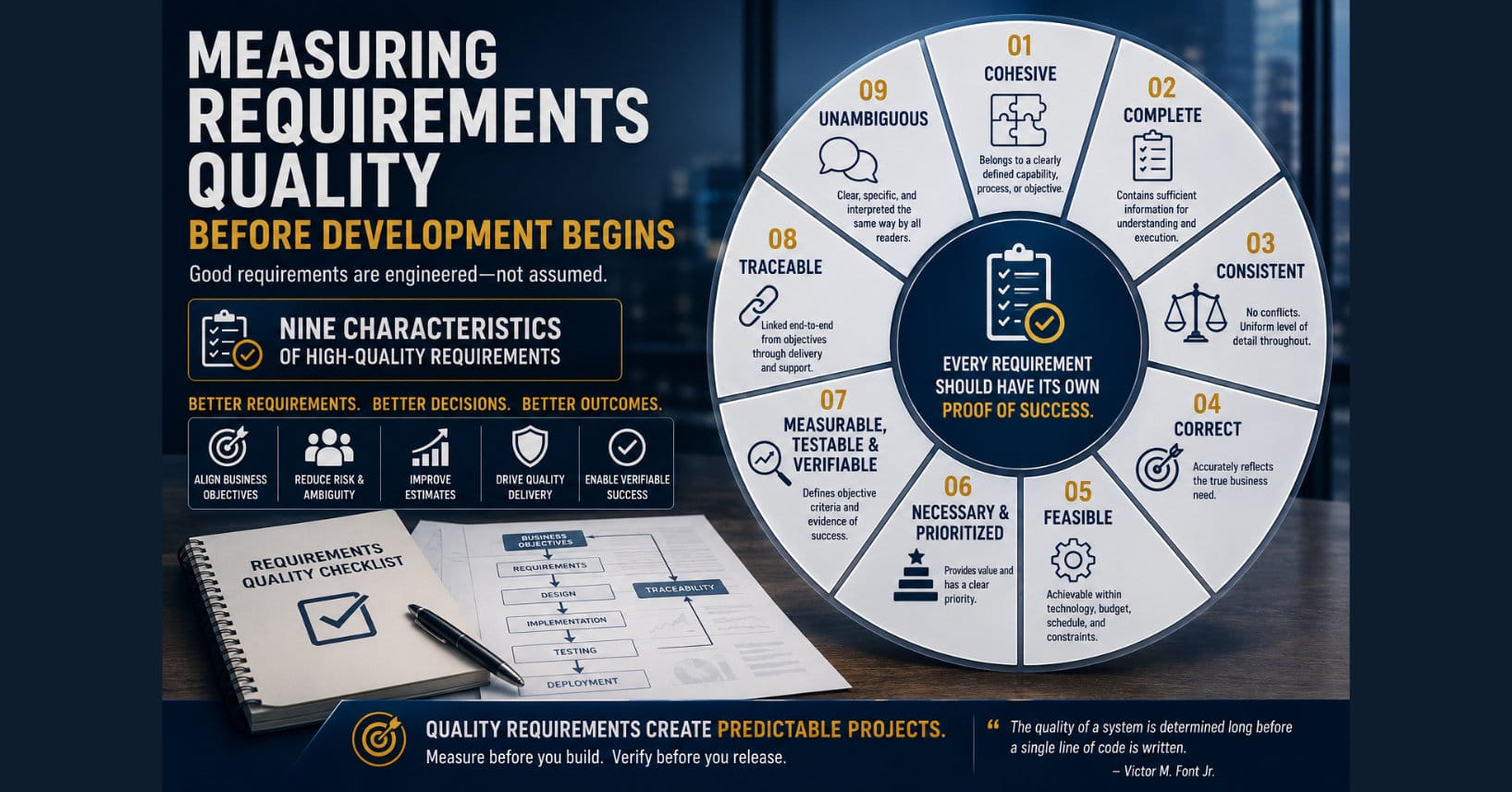
This article introduces nine characteristics of high-quality requirements: cohesive, complete, consistent, correct, feasible, necessary and prioritized, measurable/testable/verifiable, traceable, and unambiguous. It explains why requirements quality should be evaluated before development begins and how disciplined requirements reviews reduce ambiguity, improve decision-making, support traceability, and create more predictable software outcomes.
Building Better Software by Engineering Better Decisions
How do you know whether your requirements are actually good?
Most organizations answer that question after development begins.
Developers ask for clarification.
Architects identify inconsistencies.
Testers discover ambiguity.
Users reject completed functionality.
By then, requirements quality is no longer an academic discussion.
It has become an expensive project problem.
Mature organizations evaluate requirements before the first line of code is written.
Good requirements are engineered—not assumed.
Quality Is Not Measured by Document Length
Some requirements documents contain hundreds of pages.
Others fit comfortably on a few dozen.
Neither measurement says anything about quality.
A ten-page document containing clear, complete, and verifiable requirements is far more valuable than a three-hundred-page document filled with assumptions, ambiguity, and conflicting statements.
Quality is determined by characteristics—not page count.
Nine Characteristics of High-Quality Requirements
Over the years, many organizations have developed requirement verification checklists to improve project outcomes. One of the best-known public examples is the Requirements Verification Checklist published as part of the Texas Project Delivery Framework (Version 1.1, 2008).
While software engineering practices have evolved, the underlying quality characteristics remain remarkably relevant.
High-quality requirements should be:
Cohesive
Each requirement should belong to a clearly defined business capability, process, feature, or business objective.
Requirements should support a common purpose rather than becoming unrelated collections of ideas.
Complete
Requirements should contain sufficient information for architects, developers, testers, and stakeholders to understand what must be delivered.
Missing information inevitably becomes assumptions.
Consistent
Requirements should never contradict one another.
They should also maintain a consistent level of detail throughout the project.
Consistency reduces uncertainty and simplifies implementation.
Correct
Only the business can determine whether a requirement correctly represents the intended business outcome.
Technical teams implement requirements.
They do not validate business intent.
Feasible
Every requirement should be achievable within the project’s available technology, budget, schedule, and operational constraints.
Impossible requirements create impossible projects.
Necessary and Prioritized
Not every requirement carries equal importance.
Requirements should clearly communicate business value and implementation priority.
If every requirement is labeled “critical,” priorities no longer exist.
Measurable, Testable, and Verifiable
Requirements should define objective evidence of success.
Acceptance should never depend upon personal opinion.
Every requirement should answer a simple question:
How will we know this requirement has been satisfied?
Traceable
Requirements should be traceable from business objectives through architecture, implementation, testing, deployment, and future enhancement.
Traceability transforms documentation into organizational knowledge.
Unambiguous
Every reader should interpret the requirement exactly the same way.
Requirements should avoid subjective language, undefined terminology, and multiple possible interpretations.
Clarity reduces rework.
Ambiguity creates it.
Quality Reviews Should Be Collaborative
Requirements reviews should never become grammar inspections.
They should be engineering discussions.
Business leaders validate intent.
Architects evaluate design impact.
Developers assess implementation feasibility.
Testers evaluate acceptance criteria.
Compliance specialists identify regulatory obligations.
Every participant views the requirements from a different perspective.
Together, they produce higher-quality outcomes.
The Checklist Is Not the Goal
Some organizations mistakenly treat quality checklists as compliance exercises.
That misses the point entirely.
The objective is not checking boxes.
The objective is reducing uncertainty.
Every unanswered question eliminated during requirements analysis prevents multiple downstream questions during development, testing, deployment, and operations.
Good requirements create predictable projects.
Better Requirements Create Better Decisions
One of the greatest benefits of quality requirements is better decision-making.
Leadership understands exactly what is being approved.
Architects understand what must be designed.
Developers understand what must be implemented.
Testers understand what must be verified.
Auditors understand what evidence should exist.
Everyone operates from the same foundation.
That is the real purpose of requirements engineering.
Looking Ahead
Requirements quality cannot guarantee project success.
Poor requirements, however, almost guarantee project difficulty.
Evaluating requirements before development begins remains one of the least expensive and highest-value investments an organization can make.
The software industry spends enormous effort improving programming languages, development tools, testing frameworks, and deployment pipelines.
Perhaps the greatest opportunity still lies much earlier.
Building better requirements.
Because organizations rarely deliver software that exceeds the quality of the requirements from which it was built.
Requirements Reality
Requirements quality is measured before development begins—not after deployment exposes the mistakes.
Coming Next
Article 19—Building Systems That Outlive Their Original Requirements
Requirements evolve because businesses evolve. Next, we’ll explore how disciplined requirements engineering helps organizations build systems that adapt to changing business needs while continuing to deliver long-term value.