Digital Transformation Series | Article 7 of 8
Digital Transformation: Redesigning the Enterprise for Continuous Change
Summary
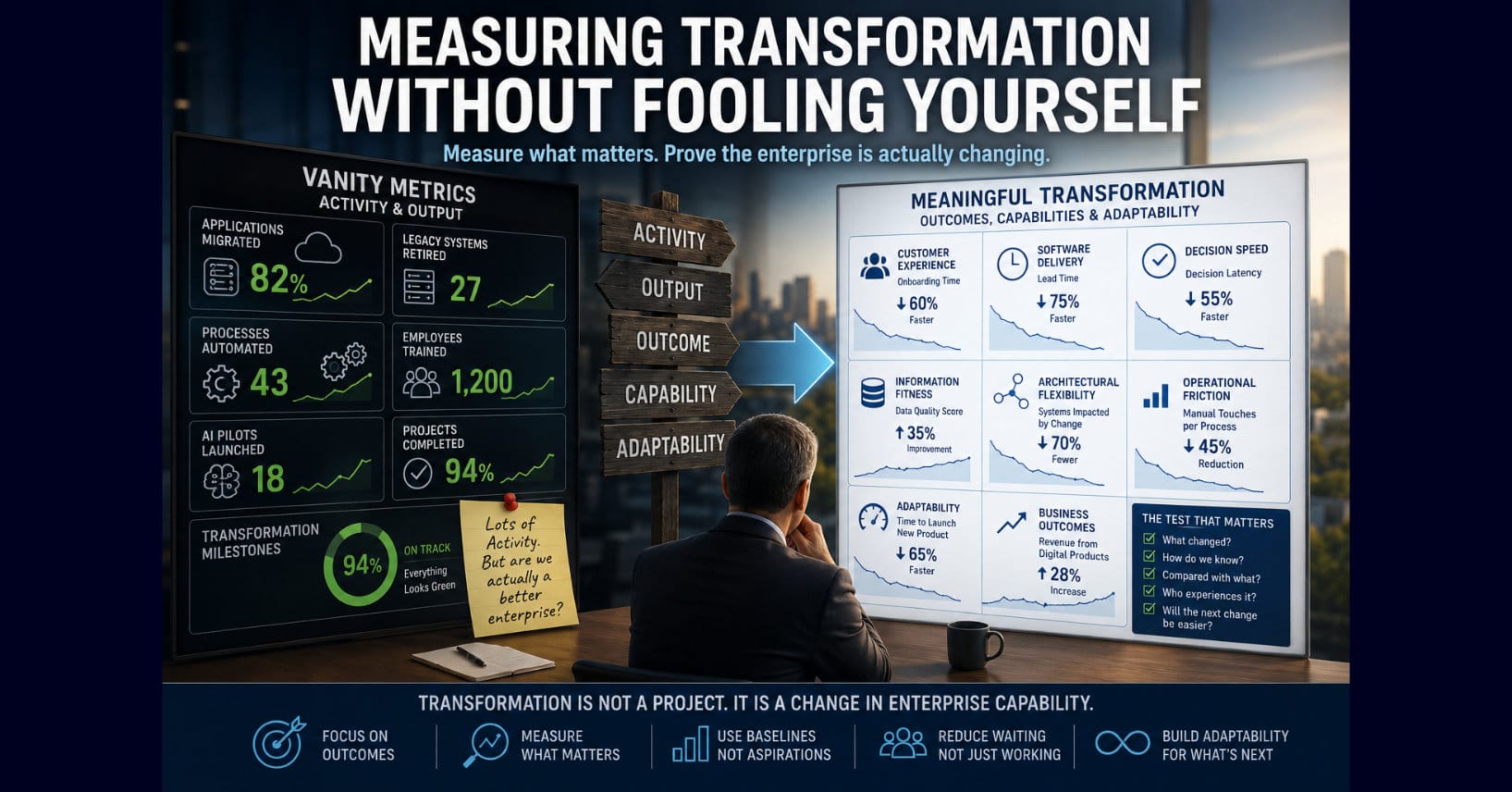
Digital transformation programs rarely lack metrics. Applications migrated, processes automated, employees trained, AI pilots launched, and projects completed can all demonstrate substantial activity while revealing little about whether the enterprise actually changed.
Measuring Transformation Without Fooling Yourself introduces a five-level measurement model: Activity → Output → Outcome → Capability → Adaptability. It explains why organizations need baselines, why elapsed time and waiting reveal operational friction, and how decision latency, complexity reduction, architectural change cost, information fitness, and software delivery performance provide stronger evidence of transformation.
The article also examines vanity metrics, composite scores, and the behavioral risks created when metrics become targets. It argues that transformation should ultimately be measured by sustained changes in enterprise capability—and whether the organization has become better at changing again.
The transformation dashboard looks excellent.
Eighty-two percent of applications have migrated to the cloud.
Twenty-seven legacy systems have been retired.
Forty-three processes have been automated.
Twelve hundred employees have completed Agile training.
Eighteen artificial intelligence pilots are underway.
The new data platform is operational.
The customer portal launched on schedule.
Ninety-four percent of transformation milestones are green.
Leadership reviews the dashboard.
The program appears successful.
Then someone asks:
Are we actually a better enterprise?
The room becomes quieter.
Customers still wait too long.
Software still takes months to reach production.
Employees still reconcile information manually.
Product launches still require coordination across dozens of teams.
Decision-making remains slow.
Operating costs have not materially changed.
The new platforms exist, but many old processes remain.
The transformation metrics were accurate.
They simply measured the wrong things.
This is one of the most difficult problems in digital transformation.
Organizations rarely suffer from a shortage of metrics.
They suffer from a shortage of metrics that reveal whether transformation actually occurred.
What Gets Measured Becomes the Transformation
Peter Drucker is frequently credited with saying, “What gets measured gets managed.” The exact attribution is disputed, but the management principle remains useful.
Metrics shape behavior.
If a transformation program measures applications migrated, teams will migrate applications.
If it measures employees trained, employees will be trained.
If it measures AI pilots launched, teams will launch AI pilots.
If it measures projects completed, projects will be completed.
Those activities may all be valuable.
The problem occurs when the proxy becomes the objective.
Cloud migration becomes transformation.
Agile adoption becomes transformation.
AI deployment becomes transformation.
Automation becomes transformation.
Application modernization becomes transformation.
The organization begins optimizing the transformation scorecard rather than the enterprise.
This is how a dashboard can become green while operational reality remains stubbornly red.
Five Levels of Transformation Measurement
A more useful transformation measurement model separates five different levels.
1. Activity
What work are we performing?
Examples:
Applications being migrated.
Employees being trained.
Processes being analyzed.
APIs being developed.
AI pilots being launched.
Automation initiatives underway.
Activity metrics tell leadership whether transformation work is happening.
They are useful for program management.
They do not demonstrate transformation.
2. Output
What did the work produce?
Examples:
A new cloud environment.
A customer portal.
An enterprise data platform.
A redesigned application.
A set of APIs.
An automated workflow.
An AI assistant.
Outputs demonstrate that initiatives delivered something tangible.
They still do not prove that enterprise performance changed.
3. Outcome
What changed because the output exists?
Examples:
Customer onboarding time declined.
Operating costs decreased.
Software releases became more frequent.
Error rates fell.
Customer abandonment declined.
Employee processing time decreased.
Outcomes begin measuring business consequences.
This is where transformation becomes more meaningful.
4. Capability
What can the enterprise now do that it could not do before?
Examples:
Launch a new product in six weeks rather than nine months.
Deploy software multiple times per day.
Integrate a newly acquired company in months rather than years.
Provide employees with trusted customer information in real time.
Automatically resolve routine transactions while escalating exceptions.
Introduce a new sales channel without rebuilding core systems.
Capability metrics reveal whether the enterprise itself changed.
5. Adaptability
Has the enterprise become better at changing again?
This is the most frequently overlooked level.
Can the next product launch happen faster?
Can the next acquisition be integrated more easily?
Can the next technology be adopted without another multiyear transformation program?
Can teams modify systems with fewer dependencies?
Can business processes evolve without extensive custom development?
Can new information sources be integrated more easily?
Transformation should not merely improve the current operating state.
It should improve the enterprise’s capacity for future change.
That is adaptability.
Activity Is Not the Enemy
It would be a mistake to conclude that activity metrics should disappear.
Executives still need to know whether projects are progressing.
Technology leaders need to know how many applications remain on obsolete infrastructure.
Program managers need schedules, budgets, milestones, and completion measures.
The issue is not whether activity should be measured.
The issue is whether activity is being mistaken for success.
A transformation dashboard should therefore connect the levels.
Activity → Output → Outcome → Capability → Adaptability
If the organization cannot explain how an activity contributes to that chain, leadership should question why it belongs in the transformation portfolio.
Measure the Before State
Another common measurement problem begins before the transformation starts.
Organizations announce objectives such as:
Improve customer experience.
Increase agility.
Become data-driven.
Accelerate innovation.
Reduce complexity.
Modernize operations.
Those are aspirations.
They are not baselines.
If leadership wants to demonstrate that customer onboarding improved, it needs to know how long onboarding took before the transformation.
If the objective is faster software delivery, measure current lead time.
If the objective is reducing operational friction, identify where work currently waits.
If the objective is better data quality, establish the current level of disagreement or remediation.
If the objective is application simplification, measure the existing portfolio and dependency structure.
Without a baseline, transformation success becomes subjective.
The organization knows it changed something.
It cannot demonstrate how much the enterprise improved.
Measure Time
One of the most powerful transformation measures is also one of the simplest.
Time.
How long does it take to onboard a customer?
How long does it take to release software?
How long does a routine decision wait for approval?
How long does it take to provision an environment?
How long does it take to introduce a product?
How long does it take to integrate a data source?
How long does it take to resolve a customer issue?
How long does it take to implement a regulatory change?
Time reveals friction.
More importantly, it is difficult to hide organizational complexity from elapsed time.
A process diagram may appear efficient.
A transformation dashboard may show green milestones.
But if a customer request still requires eleven days to complete, the operating model is telling you something.
Measure Waiting, Not Just Working
Elapsed time becomes even more valuable when divided into working time and waiting time.
Suppose a software feature takes sixty days from approval to production.
The team spends eight days actively working on it.
The remaining fifty-two days consist of queues, approvals, dependencies, environment requests, testing windows, and release scheduling.
Development productivity is not the primary problem.
Flow is.
The same principle applies outside software.
A customer onboarding process may require two hours of actual work spread across five business days.
A purchasing decision may require thirty minutes of analysis and three weeks of approvals.
A contract may require four hours of legal review but spend twelve days waiting in queues.
Transformation should reduce the ratio of waiting time to productive time.
This makes flow efficiency a useful enterprise transformation concept.
Where does work stop?
Why does it stop?
What dependency, policy, decision, system, or organizational boundary created the queue?
Removing those constraints produces transformation that people can actually experience.
Measure Decision Latency
Digital transformation frequently focuses on process speed while ignoring decision speed.
Yet many processes stop because someone must decide something.
Approve an exception.
Authorize spending.
Accept risk.
Release software.
Change a business rule.
Approve customer credit.
Select a supplier.
Resolve a dispute.
If information becomes instantaneous but decision authority remains slow, the enterprise does not become substantially faster.
This makes decision latency an important transformation metric.
How much time passes between the moment sufficient information exists to make a decision and the moment the decision is actually made?
That delay may reveal:
Unclear authority.
Excessive escalation.
Poor information.
Risk avoidance.
Committee dependencies.
Organizational boundaries.
Unnecessary approvals.
Transformation should not simply move information faster.
It should allow appropriate decisions to occur closer to the work.
Measure Friction
Not every important transformation measure belongs in a financial statement.
Operational friction is one example.
How many systems must an employee access to complete a task?
How many times is the same information entered?
How many manual reconciliations occur?
How many approvals does a routine transaction require?
How many teams must coordinate to release a software change?
How many spreadsheets compensate for missing system capabilities?
How many exceptions require human intervention?
How many customer interactions occur because the original process failed?
These measures describe the effort required to make the enterprise operate.
Friction is expensive even when the cost is distributed across dozens of departments and never appears as a transformation line item.
Reducing friction is one of the clearest signs that the operating model actually changed.
Measure Complexity Removed
Transformation programs are very good at measuring what they add.
New platforms.
New applications.
New APIs.
New automations.
New AI capabilities.
New teams.
New processes.
They are often less disciplined about measuring what disappeared.
Systems retired.
Interfaces eliminated.
Manual controls removed.
Duplicate databases consolidated.
Reports discontinued.
Approvals eliminated.
Spreadsheets retired.
Workarounds removed.
Vendors reduced.
Redundant platforms decommissioned.
This matters because adding new technology without removing old complexity can make the enterprise harder to operate.
A useful transformation metric is therefore complexity retired.
Not everything old should disappear.
But transformation should leave the enterprise with less unnecessary complexity than it inherited.
Measure Architecture Through Change Cost
Architecture can be difficult to represent on an executive dashboard.
Application counts and technical-debt inventories provide some visibility, but architecture’s most important consequence is the cost of change.
How many systems must be modified to introduce a new product?
How many teams must coordinate?
How many integrations are affected by a routine change?
How long does regression testing require?
How much custom work is necessary to connect a new capability?
How difficult is it to replace a vendor?
How many applications depend on a critical legacy component?
These measures translate architecture into business terms.
They reveal whether the enterprise is becoming easier or harder to change.
Architecture improvement should eventually appear as reduced change cost, fewer dependencies, shorter lead times, and greater optionality.
Measure Information Fitness
Article 5 introduced the concept of information fitness.
Transformation metrics should include it.
For strategically important information, ask:
Do we have agreed definitions?
Is ownership clear?
Are authoritative sources identified?
Is the information accessible when needed?
Is its quality appropriate for its intended use?
Can it be connected to related information?
Can we trace where it came from?
Can applications, analytics, automation, employees, and AI use it effectively?
These questions are especially important because an enterprise can build sophisticated digital platforms while its information remains unreliable.
Data volume is not transformation.
Information fitness is much closer.
Measure Software Delivery as Enterprise Performance
Article 6 argued that software delivery is an enterprise capability.
Transformation measurement should reflect that.
Useful measures include:
Lead time for changes.
Deployment frequency.
Change failure rate.
Time to restore service.
Environment provisioning time.
Automated test coverage where appropriate.
Percentage of delivery time spent waiting.
Dependency-related delays.
Technical debt consuming engineering capacity.
The objective is not to turn executives into engineering managers.
It is to recognize that software delivery speed increasingly determines enterprise response speed.
If strategic ideas require software implementation, then the time required to deliver software is part of the enterprise’s strategic latency.
Beware Vanity Metrics
Transformation programs are particularly susceptible to vanity metrics: measures that look impressive but provide limited evidence of enterprise improvement.
Number of AI use cases.
Number of Agile teams.
Percentage of workloads in the cloud.
Number of APIs created.
Number of employees trained.
Number of automated processes.
Number of applications modernized.
These metrics are not inherently useless.
The danger comes from interpreting scale of adoption as scale of transformation.
Ten AI capabilities that materially improve decisions may be more transformational than 200 pilots.
Twenty well-designed APIs that eliminate critical dependencies may matter more than 1,000 interfaces.
One redesigned process that removes days of customer friction may matter more than fifty superficial automations.
Transformation should not reward volume for its own sake.
It should reward meaningful changes in enterprise capability.
Beware Composite Scores
Executives understandably like summary measures.
A transformation maturity score of 3.7.
A digital readiness index of 82.
A modernization score of 74 percent.
These can be useful for communicating complex information.
They can also conceal it.
A composite score combines multiple measures into one number.
That means strong performance in one area can mathematically compensate for weakness in another.
An enterprise might score highly on cloud adoption and automation while remaining weak in software delivery, information quality, and architectural flexibility.
The overall score improves.
The underlying constraints remain.
Composite metrics should therefore be treated as navigation aids, not truth.
Leadership should always be able to drill into the conditions underneath the score.
Do Not Let Targets Destroy the Metric
Once a measure becomes a target, behavior changes around it.
If teams are rewarded for retiring applications, they may retire easy applications rather than strategically important ones.
If automation count becomes a target, teams may automate small tasks rather than redesign broken processes.
If cloud adoption percentage becomes a target, workloads may migrate even when migration creates little value.
If AI use cases become a target, pilots will proliferate.
This is a classic measurement problem.
The metric stops observing reality and starts shaping it.
Transformation leaders should therefore regularly ask:
What behavior is this metric encouraging?
A good metric does more than report progress.
It aligns behavior with the enterprise outcome the transformation is supposed to create.
Build a Transformation Scorecard Around Enterprise Questions
A useful executive transformation scorecard does not need hundreds of metrics.
It needs a small number of measures tied to important enterprise questions.
Customer
Are customers experiencing less friction?
Flow
Is work moving faster with less waiting?
Decision
Are appropriate decisions occurring faster and closer to the work?
Information
Is critical information becoming more trustworthy and usable?
Architecture
Is routine change becoming less dependent on coordinated system changes?
Software Delivery
Can ideas become safe production capabilities faster?
Complexity
What unnecessary systems, processes, dependencies, and workarounds have disappeared?
Economics
Are the expected financial or productivity outcomes appearing?
Adaptability
Is the next transformation becoming easier than the last?
These questions measure the enterprise rather than merely the transformation program.
Measure What Remains After the Program Ends
Transformation programs eventually close.
Consultants leave.
Transformation offices shrink.
Program dashboards disappear.
Executive attention moves elsewhere.
What remains?
That may be the ultimate transformation metric.
Did the enterprise retain stronger capabilities?
Did software delivery improve permanently?
Did information become more usable?
Did architecture become easier to change?
Did decision-making accelerate?
Did operational friction decline?
Did unnecessary complexity disappear?
Can the enterprise absorb the next technology more easily?
If the transformation capability disappears when the transformation program ends, the organization may have built a temporary program rather than a transformed enterprise.
The objective is not to become excellent at running transformation initiatives.
It is to become excellent at changing.
A Simple Transformation Test
Leadership teams can apply a straightforward test to every major transformation claim.
Ask five questions:
What changed?
Not what was implemented. What changed in the enterprise?
How do we know?
What evidence demonstrates the change?
Compared with what?
What was the baseline?
Who experiences the improvement?
Customers? Employees? Developers? Partners? Operations?
Will the next change be easier?
Did the transformation increase adaptability?
If the organization can answer all five clearly, it probably has meaningful evidence of transformation.
If the answers return primarily to project milestones and technology deployments, the dashboard may be measuring activity rather than change.
Executive Question
If we removed every technology implementation metric from our transformation dashboard, what evidence would remain that the enterprise actually transformed?
That question is intentionally uncomfortable.
It forces leadership to separate the things the organization installed from the capabilities the organization gained.
Because transformation is not ultimately measured by how much technology changed.
It is measured by how much the enterprise changed—and whether it became better at changing again.
Coming Next
Article 8: The Transformable Enterprise
Digital transformation is usually described as a journey toward a future state.
But in an environment of continuous technological, competitive, and organizational change, there may no longer be a stable destination.
The final article in this series will examine the transformable enterprise: an organization designed not merely to complete a transformation, but to continuously absorb change through adaptable operating models, modular architecture, usable information, persistent software capabilities, faster decisions, and organizational learning.
The objective is no longer to become transformed.
It is to become transformable.