Enterprise Requirements Series—Article 9
This article explains why software requirements should be viewed as contracts between business and technology rather than simple documentation. It explores how requirements establish mutual expectations, clarify business intent, define technical responsibilities, prevent silent disagreement, support change management, and strengthen trust throughout the System Development Life Cycle. The article argues that well-written requirements are professional commitments that guide architecture, development, testing, and acceptance.
Building Better Software by Engineering Better Decisions
Every software project depends on trust.
The business trusts technology to understand what needs to be built.
Technology trusts the business to explain what success means.
Executives trust the project team to deliver value.
Users trust the finished system to support their work.
That trust cannot rest on assumptions.
It must be written down, agreed upon, validated, and governed.
That is why requirements matter.
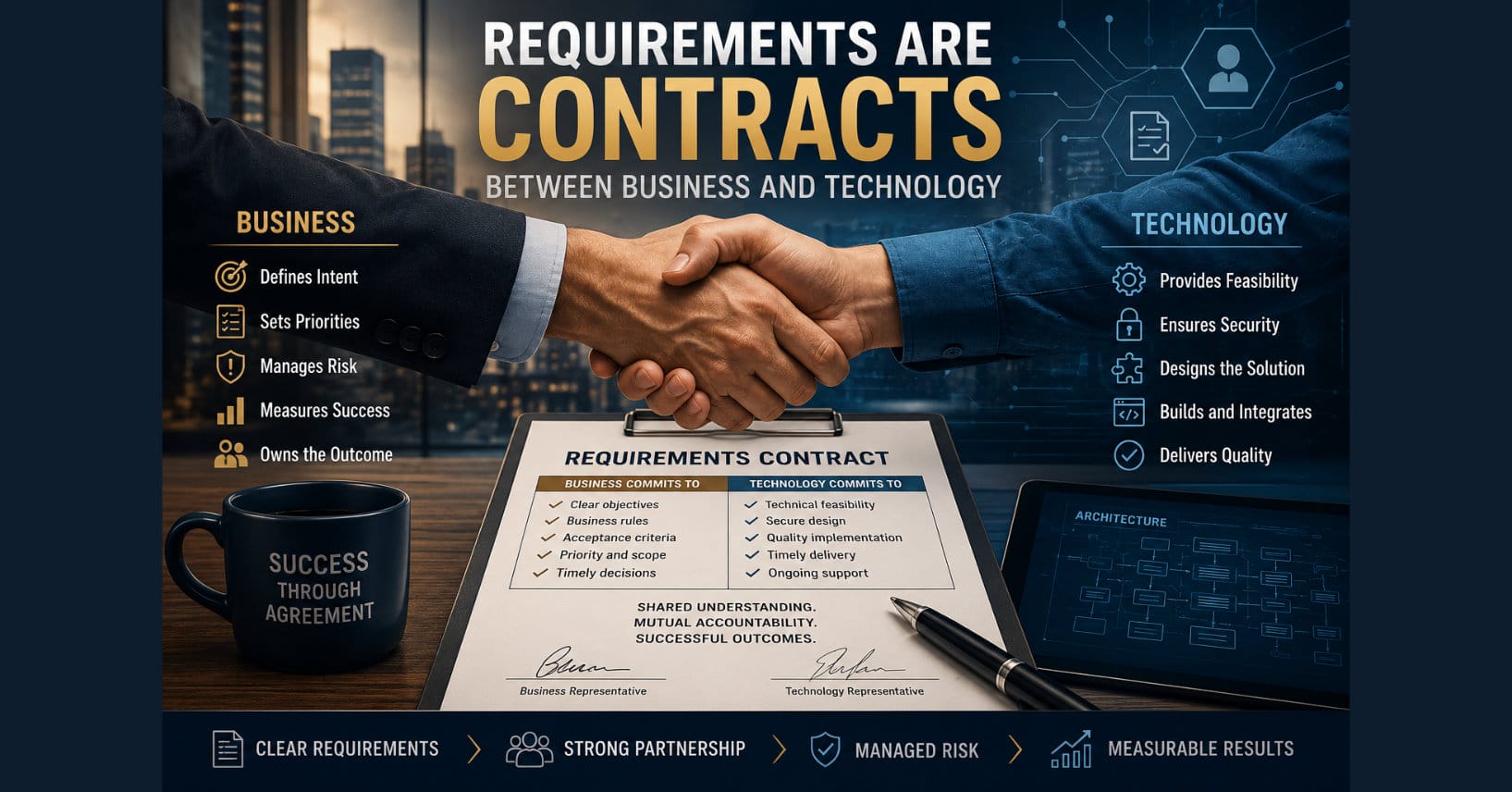
A requirement is more than a statement of desired functionality. It is a contract between business and technology.
Requirements Define Mutual Expectations
A good requirement establishes a shared understanding between the people who need a capability and the people responsible for delivering it.
The business is saying:
“This is what we need, this is why it matters, and this is how we will know it succeeded.”
Technology is saying:
“This is what we understand, this is what we will design, and this is what we will verify.”
When requirements are unclear, that contract fails before work begins.
The result is predictable.
The business believes one thing was requested.
Technology believes another thing was approved.
The delivered software becomes the evidence of that misunderstanding.
The Business Owns Intent
Technology teams can design, build, test, secure, and deploy systems.
They cannot invent business intent.
Only the business can define:
- What problem must be solved.
- Which outcome matters.
- Which rules apply.
- Which risks are acceptable.
- Which trade-offs leadership is willing to make.
- Which success criteria determine acceptance.
When business intent is missing, technology fills the gap with assumptions.
Those assumptions may be technically reasonable while still being business wrong.
Technology Owns Feasibility
A contract has obligations on both sides.
While the business owns intent, technology owns feasibility.
Technology leaders must determine whether the requirement can be implemented within available constraints, including:
- Architecture
- Security
- Data quality
- Infrastructure
- Integration complexity
- Budget
- Timeline
- Operational support
- Maintainability
A requirement that cannot be implemented responsibly is not ready for approval.
Technology should not passively accept requirements it knows are incomplete, contradictory, infeasible, or dangerous.
Good requirements require professional challenge.
Requirements Prevent Silent Disagreement
Many project failures are caused by silent disagreement.
The business assumes technology understands the need.
Technology assumes the business has approved the details.
Users assume their workflow was considered.
Compliance assumes regulatory obligations were included.
Leadership assumes the solution supports strategy.
Everyone assumes.
No one verifies.
Requirements convert assumptions into explicit agreements.
That is their contractual power.
A Contract Must Be Clear
No one would sign a business contract containing vague language such as:
“Deliver the product quickly.”
“Provide adequate support.”
“Ensure reasonable quality.”
“Make the service user-friendly.”
Yet software requirements often contain similar language.
A requirement contract must define measurable expectations.
It should clarify:
- What must happen.
- When it must happen.
- Who is involved.
- What rules apply.
- What exceptions exist.
- What evidence proves completion.
- Who has authority to approve change.
Clarity protects both sides.
A Contract Must Be Traceable
Contracts matter because they can be referenced later.
Requirements should work the same way.
When a question arises months into development, the team should be able to determine:
- Who requested the requirement.
- Who approved it.
- What business objective it supports.
- What business rule it implements.
- Which design decision depends on it.
- Which test case verifies it.
- What changed after approval.
Without traceability, requirements lose their contractual value.
They become memories, opinions, and meeting notes.
Change Requires Renegotiation
No serious contract assumes nothing will change.
Requirements should not assume that either.
Business conditions change.
Regulations change.
Leadership priorities change.
Customer expectations change.
Technology constraints change.
When a requirement changes, the agreement between business and technology must be revisited.
What changed?
Why did it change?
Who approved the change?
What is the impact?
What must be deferred, redesigned, retested, or revalidated?
Change control is not bureaucracy.
It is contract management for software decisions.
Requirements Protect the Relationship
Poor requirements damage trust.
The business begins to believe technology does not listen.
Technology begins to believe the business does not know what it wants.
Users begin to believe projects ignore reality.
Leaders begin to lose confidence in delivery.
Good requirements protect the relationship between business and technology by making expectations explicit before conflict appears.
They reduce blame.
They improve accountability.
They provide evidence.
They give everyone a shared reference point when difficult decisions must be made.
Requirements Are Professional Commitments
Requirements engineering is not clerical work.
It is the discipline of turning business intent into professional commitments.
Those commitments guide architecture.
They guide development.
They guide testing.
They guide acceptance.
They guide future change.
When requirements are treated casually, software delivery becomes negotiation after the fact.
When requirements are treated as contracts, software delivery becomes execution against a shared agreement.
Looking Ahead
Business and technology do not need more assumptions.
They need better agreements.
Requirements provide those agreements when they are clear, owned, testable, traceable, feasible, and governed.
The best requirements do not merely describe software.
They define the working relationship between the organization that needs value and the team responsible for delivering it.
That is why requirements are contracts between business and technology.
Requirements Reality
A requirement is not just something to build. It is an agreement about what success means.
Coming Next
Article 10—Designing Requirements That Can Survive Change
Requirements should not be written as though the business will stand still. Next, we’ll examine how to design requirements that remain useful as markets, regulations, priorities, and technology evolve.