Enterprise Requirements Series—Article 14
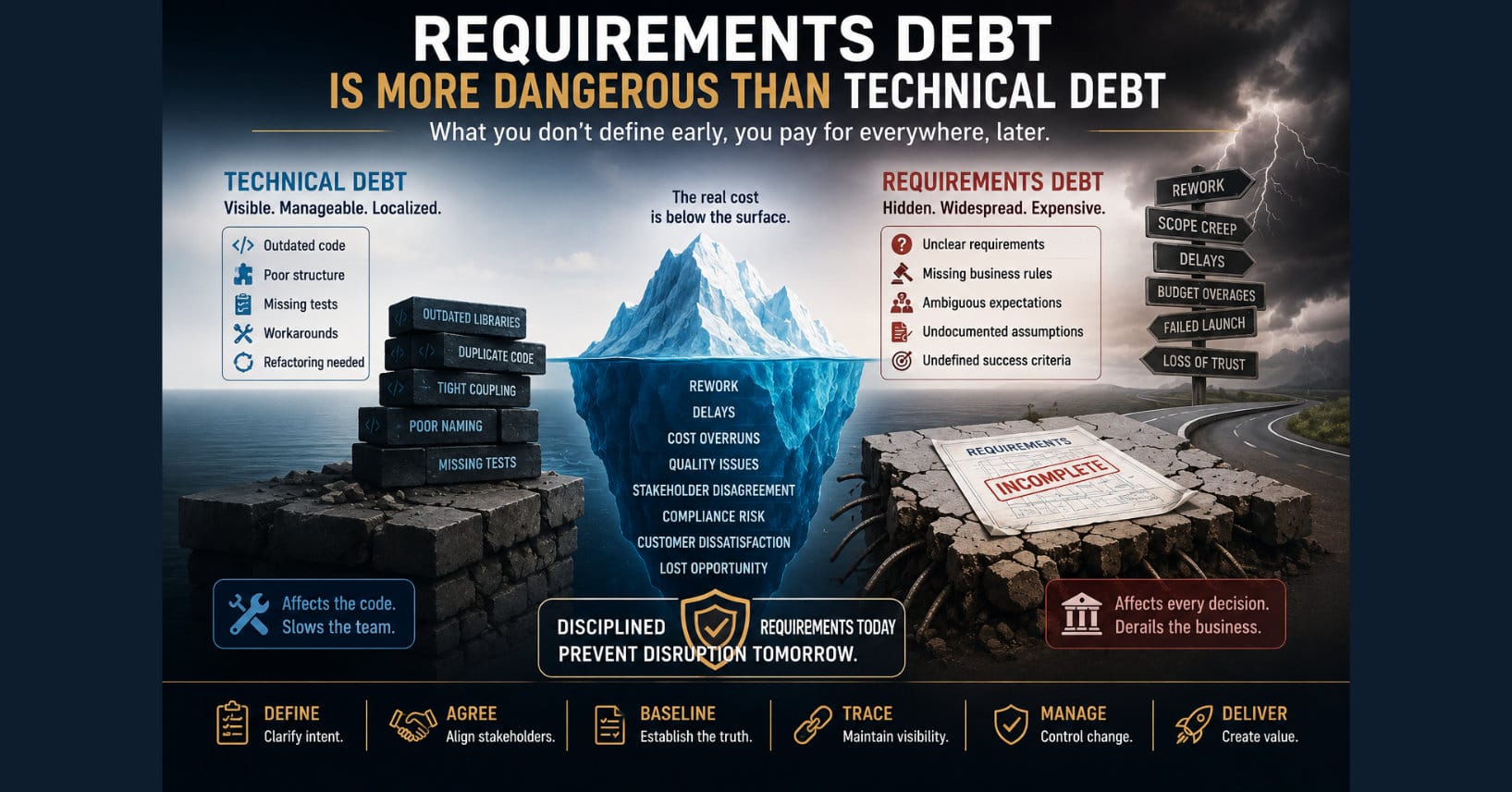
This article explains why requirements debt can be more dangerous than technical debt. While technical debt usually affects implementation quality, requirements debt misdirects the entire project by leaving business rules, success criteria, stakeholder expectations, assumptions, and ownership unresolved. The article shows how requirements debt compounds through rework, change requests, acceptance disputes, defects, delays, and budget overruns.
Ask software developers about technical debt and you’ll hear familiar concerns.
Building Better Software by Engineering Better Decisions
Outdated frameworks.
Duplicate code.
Poor naming conventions.
Tightly coupled components.
Missing automated tests.
Technical debt is real.
It deserves attention.
But there is another form of debt that often costs organizations even more.
Requirements debt.
Unlike technical debt, requirements debt begins before development ever starts.
Every missing requirement.
Every unresolved business rule.
Every ambiguous expectation.
Every undocumented assumption.
Every undefined success criterion.
They all become obligations that must eventually be repaid.
The only question is when—and at what cost.
Technical Debt Has a Beginning
Technical debt is created when developers make deliberate implementation trade-offs.
Perhaps a deadline is approaching.
Perhaps a temporary workaround is acceptable.
Perhaps a feature must ship before an optimization can be completed.
The debt is usually visible.
Teams know it exists.
Requirements debt is different.
Organizations often do not realize they have accumulated it until the software is already in production.
Requirements Debt Compounds Faster
Technical debt typically affects software quality.
Requirements debt affects everything.
Architecture.
Development.
Testing.
Documentation.
Training.
Operations.
Compliance.
Customer satisfaction.
Future enhancements.
One poorly defined requirement can generate dozens of downstream corrections across the entire System Development Life Cycle.
The earlier the mistake occurs, the farther its consequences travel.
Requirements Debt Looks Different
Requirements debt rarely appears as a line item on a project dashboard.
Instead, it disguises itself as:
- Endless clarification meetings.
- Repeated requirement revisions.
- Conflicting stakeholder expectations.
- Constant rework.
- Unexpected change requests.
- Acceptance disputes.
- Production defects.
- Schedule extensions.
- Budget overruns.
Organizations often treat these as isolated project problems.
In reality, they are frequently symptoms of requirements debt that was never recognized.
Every Assumption Accrues Interest
Financial debt grows through interest.
Requirements debt grows through assumptions.
When business questions remain unanswered, someone eventually answers them.
Developers.
Architects.
Testers.
Project managers.
Users.
None of those answers may reflect the business’s true intent.
Each assumption increases the likelihood of additional redesign, retesting, retraining, and operational disruption.
Interest accumulates quickly.
Debt Should Be Paid Early
The least expensive time to resolve a requirement is during requirements engineering.
The second least expensive time is during design.
After development begins, the cost rises.
After deployment, the cost often increases dramatically.
Organizations invest heavily in fixing technical debt while allowing requirements debt to continue growing beneath it.
Unfortunately, technical improvements cannot compensate for business decisions that were never properly defined.
Good Requirements Prevent Technical Debt
Many technical problems originate upstream.
Poor modularity may result from changing business rules.
Complex workflows may result from conflicting stakeholder expectations.
Duplicate logic may result from inconsistent requirements.
Excessive customization may result from undefined business priorities.
Requirements engineering does not eliminate every source of technical debt.
It eliminates many of the reasons technical debt is created in the first place.
Mature Organizations Measure Requirements Debt
Organizations measure code quality.
They measure defects.
They measure security vulnerabilities.
They should also monitor indicators of requirements debt, including:
- Requirements volatility.
- Clarification requests.
- Stakeholder disagreements.
- Traceability gaps.
- Rework effort.
- Acceptance failures.
- Business rule conflicts.
- Requirement approval delays.
These metrics reveal debt before it becomes crisis.
Evidence always appears before consequences.
Requirements Debt Is Organizational Debt
Requirements debt is not created by developers.
Nor is it created solely by business analysts.
It reflects organizational decisions.
Deferred conversations.
Incomplete analysis.
Rushed approvals.
Unresolved disagreements.
Weak governance.
Poor leadership.
Like every form of debt, someone eventually pays the bill.
The only uncertainty is who pays it—and when.
Looking Ahead
Technical debt deserves attention because it affects software quality.
Requirements debt deserves even greater attention because it affects every decision that follows.
Organizations that invest in better requirements discover something surprising.
They often reduce technical debt without writing a single line of better code.
That is because better software usually begins with better decisions.
Requirements engineering is where those decisions become clear.
Requirements Reality
Technical debt slows software. Requirements debt misdirects it. One affects implementation. The other affects everything.
Coming Next
Article 15—Every Failed Project Leaves Evidence
Projects rarely fail without warning. In the final article of this section, we’ll examine how failed projects leave measurable evidence long before they collapse—and how mature organizations recognize those warning signs early enough to change the outcome.