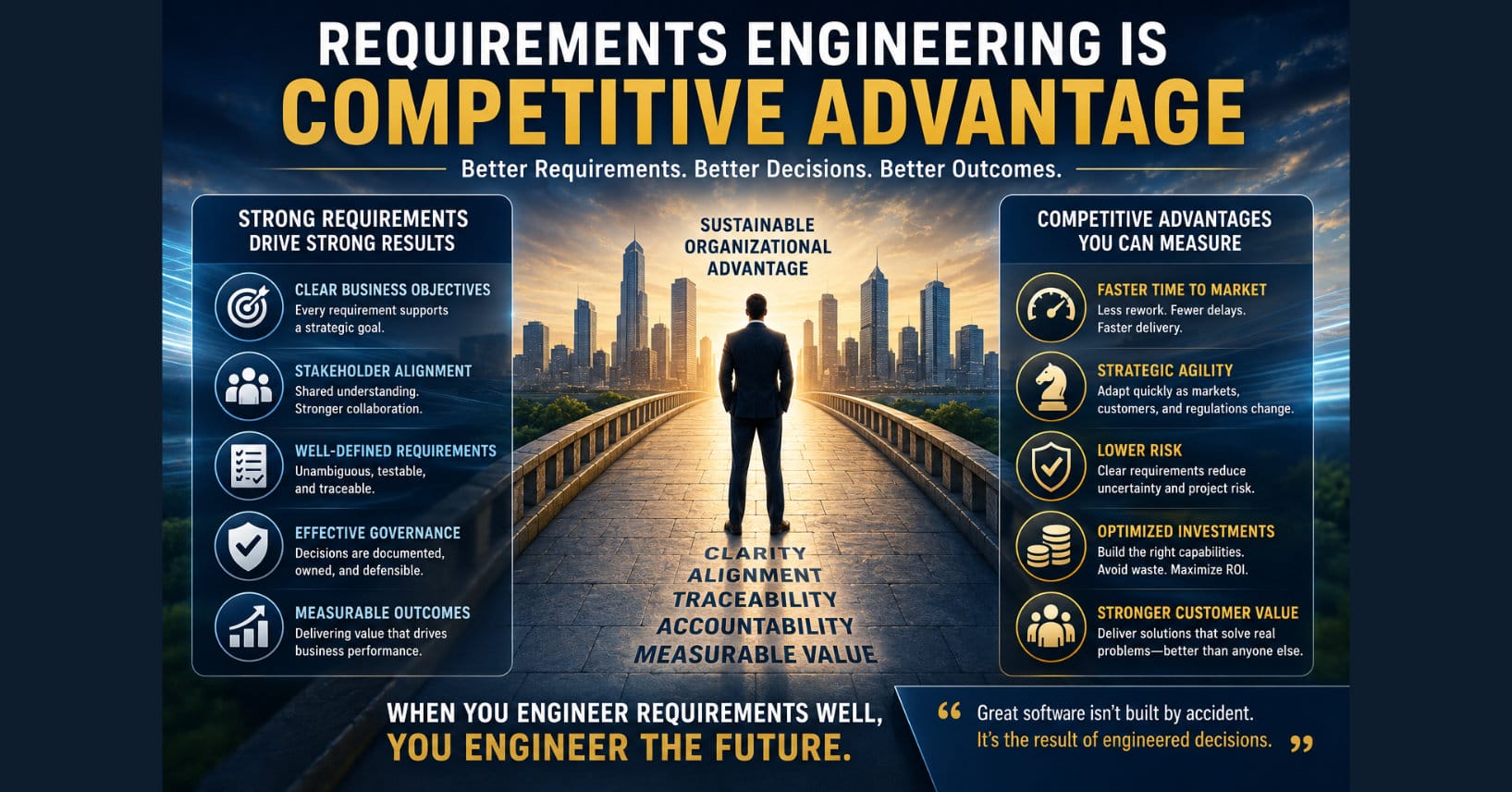
Enterprise Requirements Series—Article 20
This concluding article explains why requirements engineering is a strategic organizational capability rather than simply a software development activity. It demonstrates how disciplined requirements engineering improves decision-making, stakeholder alignment, governance, agility, risk management, and business outcomes, ultimately creating a sustainable competitive advantage that competitors cannot easily replicate.
Building Better Software by Engineering Better Decisions
Organizations rarely outperform their competitors because they write better code.
They outperform them because they make better decisions.
Those decisions determine:
- Which opportunities to pursue.
- Which risks to accept.
- Which capabilities to develop.
- Which investments to prioritize.
- Which technologies to adopt.
- Which customer problems to solve.
Every one of those decisions eventually becomes a requirement.
That is why requirements engineering is not simply a project discipline.
It is a competitive advantage.
Better Decisions Produce Better Software
Most organizations focus their software investments on development.
Faster programming.
Better frameworks.
Modern infrastructure.
Cloud platforms.
Artificial intelligence.
Those investments matter.
But software quality is determined long before developers begin writing code.
If organizations consistently make poor decisions about what should be built, no technology stack can compensate.
Requirements engineering improves those decisions.
Competitive Advantage Begins with Clarity
Successful organizations move faster because they spend less time correcting misunderstandings.
Business objectives are clear.
Stakeholders are aligned.
Business rules are documented.
Success criteria are measurable.
Ownership is established.
Priorities are understood.
Development teams build with confidence because uncertainty has already been reduced.
Clarity becomes speed.
Organizations Compete Through Capability
Customers rarely purchase software because it contains impressive features.
They purchase outcomes.
Reliable service.
Faster delivery.
Better security.
Regulatory confidence.
Improved customer experience.
Operational excellence.
Requirements engineering connects software investment directly to those organizational capabilities.
Capabilities create competitive advantage.
Features simply enable them.
Good Requirements Reduce Organizational Friction
Every ambiguous requirement creates friction.
Every missing business rule creates friction.
Every unresolved stakeholder disagreement creates friction.
Every undocumented assumption creates friction.
Friction slows projects.
It delays decisions.
It increases costs.
It reduces confidence.
Organizations with mature requirements engineering practices remove friction before implementation begins.
That advantage compounds over time.
Mature Organizations Learn Faster
Every project teaches valuable lessons.
Leading organizations capture those lessons and improve the way they engineer future requirements.
They identify recurring business problems.
They refine their business rules.
They strengthen traceability.
They improve stakeholder collaboration.
They enhance governance.
Learning becomes institutional rather than individual.
That is difficult for competitors to imitate.
Requirements Engineering Creates Strategic Agility
Markets change.
Customers change.
Technology changes.
Regulations change.
Organizations that understand their business requirements clearly can adapt more quickly because they understand what must change—and what must remain stable.
Requirements engineering reduces the uncertainty that often slows organizational change.
Agility is not simply moving faster.
It is changing confidently.
Requirements Create Defensible Decisions
Throughout this series, one principle has appeared repeatedly.
Evidence matters.
Requirements document intent.
Traceability preserves decisions.
Acceptance criteria define success.
Governance provides accountability.
Together they create evidence that supports leadership decisions.
Organizations that can explain why they built something adapt more effectively than organizations that can only explain how they built it.
Defensible decisions become sustainable advantages.
The Strongest Organizations Engineer Understanding
Software development is ultimately a communication problem.
Business leaders communicate strategy.
Requirements engineers communicate intent.
Architects communicate structure.
Developers communicate implementation.
Testers communicate evidence.
Operations communicate reliability.
The organizations that communicate most effectively consistently deliver better software because they understand one another before implementation begins.
Requirements engineering is where that understanding starts.
A Discipline Worth Mastering
Requirements engineering has never enjoyed the attention given to software architecture, programming languages, cloud computing, or artificial intelligence.
Perhaps that is exactly why it creates competitive advantage.
Organizations willing to master overlooked disciplines often outperform competitors chasing the latest technology trend.
The greatest software advantage rarely comes from writing more code.
It comes from writing better requirements.
Looking Back
This series began with a simple observation.
Developers rarely build the wrong software because they lack talent.
They build the wrong software because they receive the wrong requirements.
Since then, we’ve explored ambiguity, stakeholder alignment, ownership, business rules, contracts, change control, traceability, governance, requirements debt, quality, business objectives, adaptability, and organizational maturity.
Together they reveal a larger truth.
Requirements engineering is not documentation.
It is disciplined decision-making.
Organizations that master that discipline consistently deliver software that aligns with business objectives, adapts to change, reduces risk, strengthens governance, and creates lasting value.
That is not merely good engineering.
It is competitive advantage.
Requirements Reality
Organizations don’t gain competitive advantage by building more software. They gain it by consistently building the right software.