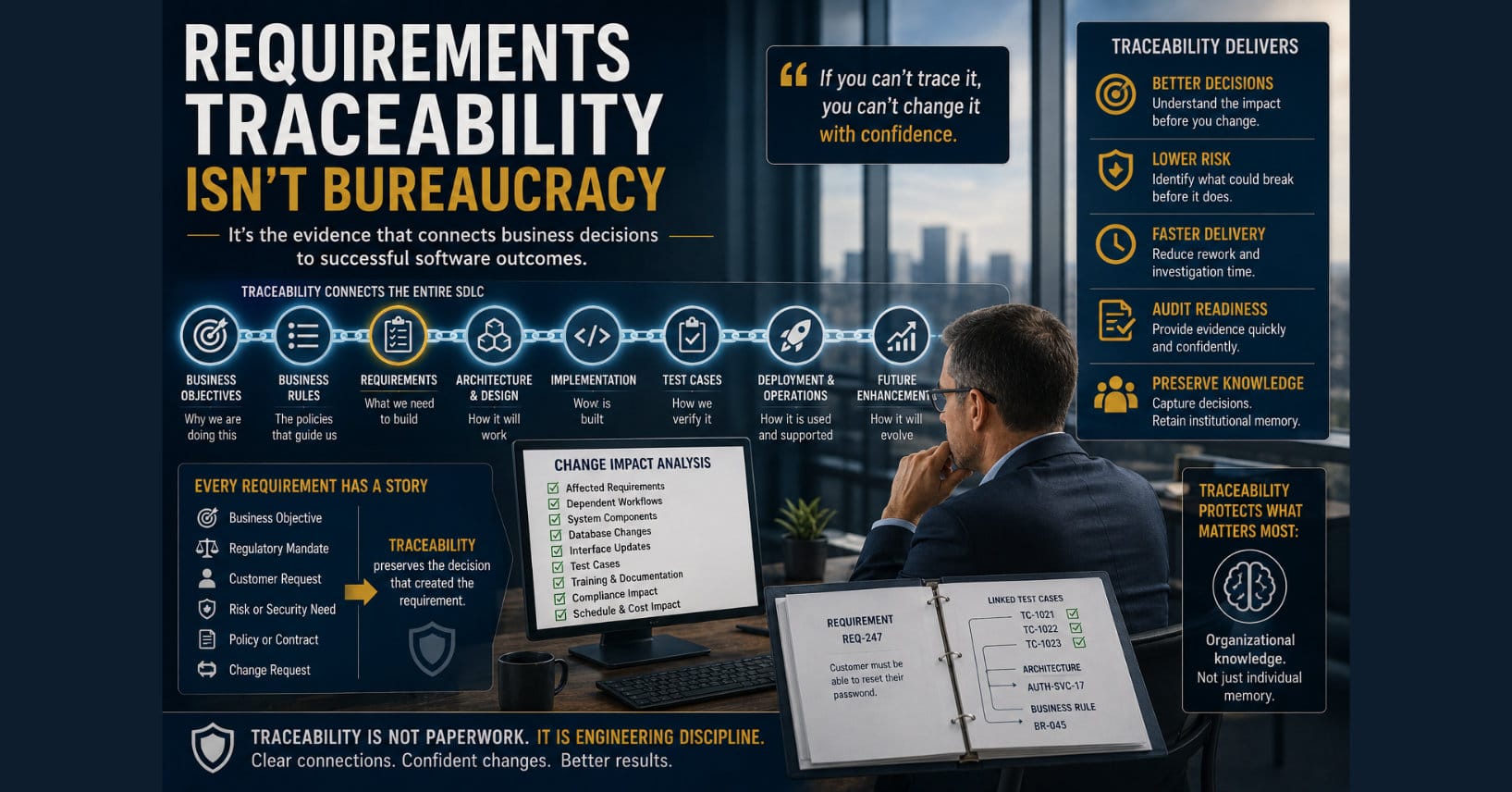
This article explains why requirements traceability is a strategic engineering discipline rather than administrative overhead. It demonstrates how traceability connects business objectives, business rules, requirements, architecture, implementation, testing, deployment, and future enhancements to preserve organizational knowledge, simplify change management, improve governance, and provide defensible evidence throughout the System Development Life Cycle.
Enterprise Requirements Series—Article 12
Building Better Software by Engineering Better Decisions
Mention the word traceability in a project meeting and someone will inevitably roll their eyes.
“It’s just more documentation.”
“It’s paperwork for auditors.”
“It slows development.”
Those reactions are understandable.
They are also wrong.
Traceability is not about producing more documentation.
It is about preserving organizational knowledge.
Without traceability, every project eventually begins asking the same expensive questions:
Why does this requirement exist?
Who approved it?
Which business objective does it support?
What happens if we change it?
Where is it implemented?
Which test cases verify it?
If those answers cannot be found quickly, the organization has already begun losing control of the project.
Every Requirement Has a Story
No requirement appears by accident.
Every requirement originates somewhere.
Perhaps it came from:
- A business objective.
- A regulatory mandate.
- A customer request.
- A contractual obligation.
- A security assessment.
- A risk analysis.
- A policy decision.
- A change request.
Traceability preserves that history.
Without it, requirements become isolated statements disconnected from the decisions that created them.
Traceability Connects the Entire SDLC
Many people think traceability simply links requirements to test cases.
That is only one part of the story.
True enterprise traceability connects:
Business objectives
↓
Business rules
↓
Requirements
↓
Architecture
↓
Design
↓
Implementation
↓
Test cases
↓
Deployment
↓
Operations
↓
Future enhancements
Every stage builds upon the decisions made before it.
Traceability ensures those relationships remain visible.
Change Without Traceability Is Guesswork
Imagine leadership proposes changing a single business rule.
Without traceability, the project team must investigate:
Which requirements reference the rule?
Which workflows depend upon it?
Which database structures are affected?
Which reports change?
Which interfaces require updates?
Which test cases must be rewritten?
Which training materials become obsolete?
Which compliance obligations are affected?
Without traceability, every answer requires investigation.
With traceability, the answers already exist.
Auditors Appreciate Traceability
One reason organizations associate traceability with compliance is that auditors frequently request evidence showing how business requirements were implemented.
That does not mean traceability exists for auditors.
Auditors simply benefit from it.
The organization benefits every day.
Project teams make better decisions.
Developers understand why software behaves the way it does.
Architects evaluate change more accurately.
Testers verify the correct functionality.
Operations teams understand system behavior.
Leadership gains confidence that technology continues supporting business objectives.
Traceability serves the business long before it serves an audit.
Traceability Protects Institutional Knowledge
Employees retire.
Consultants complete their engagements.
Project managers change positions.
Developers move to other organizations.
Unfortunately, undocumented decisions often leave with them.
Traceability transforms personal knowledge into organizational knowledge.
Future teams no longer depend upon remembering why a decision was made.
The evidence already exists.
That may be one of traceability’s greatest long-term benefits.
Modern Development Still Needs Traceability
Some organizations assume agile development eliminates the need for traceability.
It does not.
Whether requirements are documented as business requirements, user stories, backlog items, or product increments, organizations still need to understand:
Why the work exists.
Who requested it.
How success will be verified.
What business value it delivers.
What changes when it changes.
The development methodology may evolve.
The need for traceability does not.
Traceability Enables Better Leadership
Leadership decisions become significantly easier when requirements are traceable.
Executives can determine:
Which initiatives support strategic objectives.
Which regulatory obligations are satisfied.
Which capabilities remain incomplete.
Which requirements introduce the greatest risk.
Which projects provide the greatest business value.
Traceability transforms software portfolios into decision-support systems.
That is considerably more valuable than maintaining another spreadsheet.
Looking Ahead
Requirements traceability should never be viewed as administrative overhead.
It is an investment in clarity.
It protects organizational knowledge.
It reduces uncertainty.
It simplifies change.
It strengthens governance.
Most importantly, it ensures that every software capability can be connected to the business decision that justified its existence.
That is not bureaucracy.
That is engineering.
Requirements Reality
Traceability is not paperwork. It is evidence that today’s software still serves yesterday’s business decisions.
Coming Next
Article 13—Change Control Begins with Requirements
Effective change control doesn’t start with a change request—it starts with an approved requirements baseline. Next, we’ll examine why disciplined requirements engineering is the foundation of successful change management and how strong baselines make change predictable, governable, and defensible.