Enterprise Requirements Series—Article 11
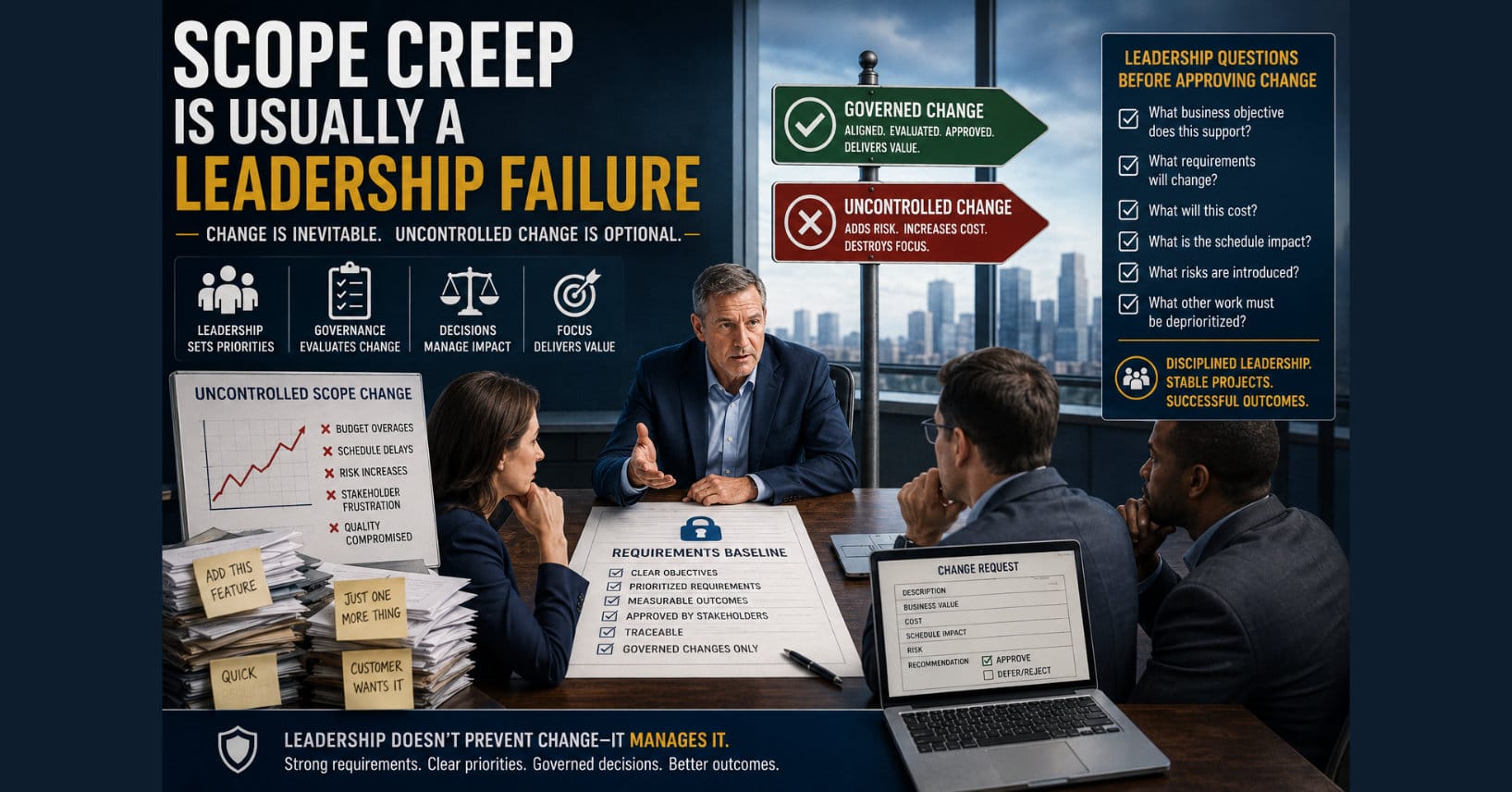
This article explains why scope creep is fundamentally a leadership issue rather than simply a requirements problem. It distinguishes legitimate business change from uncontrolled scope expansion, explores the importance of requirements baselines, governance, prioritization, and change evaluation, and argues that disciplined leadership—not rigid requirements—is what keeps enterprise projects focused, predictable, and aligned with business objectives.
Building Better Software by Engineering Better Decisions
Few phrases generate more frustration in software development than scope creep.
Projects fall behind schedule.
Budgets increase.
Deadlines slip.
Stakeholders become frustrated.
Eventually someone says:
“The requirements kept changing.”
While changing requirements certainly contribute to project difficulty, they are rarely the true cause of scope creep.
Most scope creep is not a requirements problem.
It is a leadership problem.
Scope Does Not Expand on Its Own
Requirements cannot add themselves to a project.
Someone requests the change.
Someone approves it.
Someone decides the project should include additional functionality.
Someone accepts the additional cost, schedule impact, and technical complexity.
Scope changes are decisions.
The real question is not whether scope changed.
The real question is whether the organization managed those decisions deliberately.
Change Is Not Scope Creep
One of the biggest misconceptions in project management is treating every change request as scope creep.
The two are not the same.
A legitimate business change may result from:
- New legislation
- Updated regulatory requirements
- Market conditions
- Customer feedback
- Cybersecurity threats
- Business acquisitions
- Organizational restructuring
Ignoring those changes would often create greater risk than implementing them.
Scope creep occurs when changes are introduced without disciplined evaluation, prioritization, and governance.
The problem is uncontrolled change—not change itself.
Leadership Defines Priorities
Requirements engineering helps organizations identify what should be built.
Leadership determines what should be built now.
Those are different decisions.
Projects become unstable when leaders cannot clearly answer questions such as:
- Which requirements are essential?
- Which can wait for a future release?
- Which no longer support business objectives?
- Which provide the greatest business value?
- Which introduce unacceptable risk?
Without clear priorities, every stakeholder believes their request deserves immediate attention.
Eventually, everything becomes “critical.”
Nothing actually is.
Every Change Carries a Cost
Adding a requirement is rarely limited to adding code.
A single change may require:
- Architectural modifications
- Database changes
- Interface updates
- Additional security controls
- New test cases
- Updated documentation
- User training
- Operational procedures
- Compliance reviews
The visible feature often represents only a small portion of the total effort.
Organizations that fail to evaluate these downstream impacts consistently underestimate the true cost of change.
Requirements Should Protect the Project
One purpose of requirements engineering is protecting projects from unnecessary instability.
Well-defined requirements establish a baseline against which proposed changes can be evaluated.
Instead of asking:
“Can we add this feature?”
Leadership should ask:
- What business objective does it support?
- What requirement changes?
- What existing requirement becomes unnecessary?
- What risks are introduced?
- What schedule impact should we expect?
- What other work must be deferred?
Those questions transform emotional decisions into informed decisions.
Governance Is the Difference
Successful organizations rarely prevent change.
They govern it.
Governance provides a structured process for evaluating proposed changes before implementation begins.
That process should determine:
- Business value
- Cost
- Risk
- Schedule impact
- Technical impact
- Regulatory implications
- Resource availability
The outcome may still be approval.
The difference is that approval becomes a conscious leadership decision rather than an impulsive reaction.
Requirements Baselines Matter
One reason projects lose control of scope is that no one knows what the approved requirements actually are.
Every project should establish a requirements baseline.
The baseline is not intended to prevent change.
It establishes a common point of reference.
Without a baseline, every discussion becomes subjective.
With a baseline, every proposed change becomes measurable.
Leadership can evaluate precisely what is changing, why it is changing, and what the consequences will be.
Strong Leadership Creates Stable Projects
Organizations often search for technical solutions to scope creep.
New project management software.
Better estimation techniques.
More detailed schedules.
Additional reporting.
Those tools are valuable.
None of them replace disciplined leadership.
Successful projects are led by executives and business leaders who understand that every additional requirement is a strategic decision with measurable consequences.
Requirements engineering provides visibility.
Leadership provides direction.
Both are essential.
Looking Ahead
Software projects succeed when organizations distinguish between necessary change and uncontrolled expansion.
Change is inevitable.
Scope creep is optional.
Requirements engineering creates clarity.
Governance creates discipline.
Leadership determines whether the organization has the courage to protect both.
Requirements Reality
Every new requirement should replace uncertainty—not create more of it.
Coming Next
Article 12—Requirements Traceability Isn’t Bureaucracy
Many organizations view traceability as paperwork. Next, we’ll examine why traceability is actually one of the most valuable tools for managing change, proving compliance, and protecting enterprise software investments.