AI Strategy Series | Article 2 of 20
Building the Intelligent Enterprise
Summary
Organizations frequently approach artificial intelligence by collecting use cases, evaluating technical feasibility, and launching pilot programs without first identifying the constraints limiting enterprise performance. This article challenges that approach and introduces a constraint-first AI investment model that connects strategic objectives, operational bottlenecks, root-cause analysis, technology selection, and measurable business outcomes. Drawing on the Theory of Constraints, it explains why improvements in individual task efficiency do not necessarily translate into enterprise value, how AI can shift bottlenecks rather than eliminate them, and why technology investments must address genuine business limitations. The article provides executives and technology leaders with a practical framework for prioritizing AI initiatives based on strategic impact rather than technological opportunity.
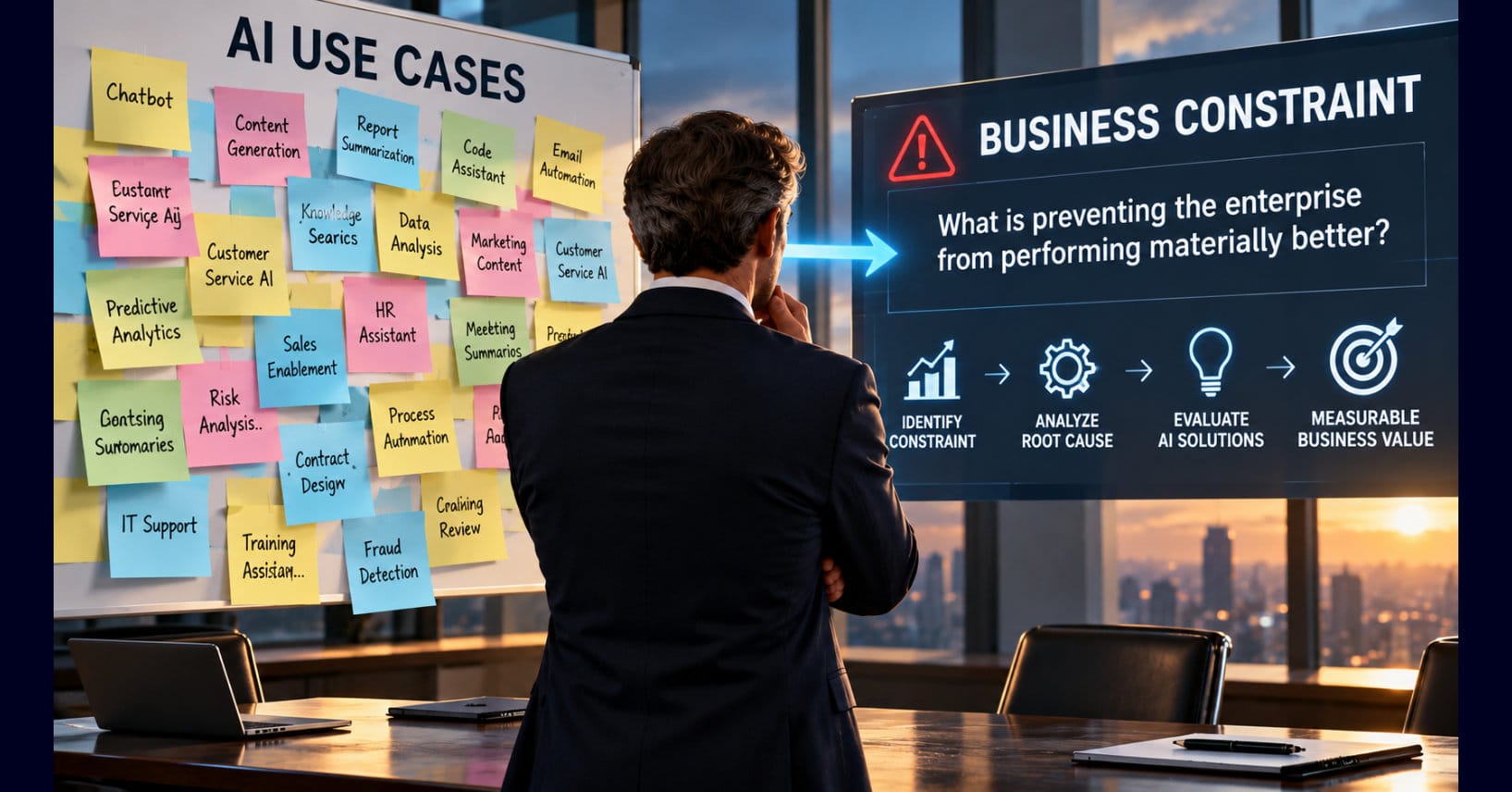
Enterprise leaders are asking the wrong question about artificial intelligence.
Across industries, organizations are conducting AI opportunity assessments, organizing innovation workshops, surveying employees, and assembling increasingly extensive inventories of potential AI use cases.
The exercise usually begins with a familiar question:
“Where could we use AI?”
It sounds reasonable. It encourages participation, generates ideas, and creates the appearance of strategic momentum.
It also starts the conversation in the wrong place.
The more consequential question is:
“What is preventing this enterprise from performing materially better, and could AI change that condition?”
The distinction is fundamental.
One approach begins with technology and searches for applications.
The other begins with business performance and determines whether technology can remove the constraints limiting it.
Both approaches may produce viable AI projects.
Only the second reliably connects AI investment to enterprise strategy.
As organizations move beyond experimentation, this distinction will increasingly separate those accumulating AI implementations from those building sustainable competitive advantage.
The Problem With Use-Case-First Thinking
The enterprise AI use-case workshop has become a familiar management exercise.
Representatives from business units gather to identify opportunities for automation, augmentation, analysis, and decision support.
Finance proposes automated reporting.
Human resources suggests employee service assistants.
Marketing identifies content generation opportunities.
Customer service recommends conversational AI.
Operations proposes predictive analytics.
IT identifies software development productivity improvements.
Within a few sessions, the organization has assembled dozens of ideas.
The resulting inventory is categorized by potential value, implementation complexity, technical feasibility, and estimated return on investment.
Management selects several promising candidates and authorizes pilot programs.
The process appears disciplined.
But an important question may never have been answered:
Which of these initiatives addresses a constraint that materially limits enterprise performance?
That omission matters because the ability to improve an activity does not establish that improving it will produce a meaningful business outcome.
Consider an organization that uses AI to reduce the time required to prepare management reports from four hours to thirty minutes.
That is a substantial improvement in task efficiency.
But what happens next?
If the reports still wait three days for management review, the overall decision cycle may remain unchanged.
If executives do not use the information to make different decisions, the improvement may have little operational consequence.
If employees simply fill the recovered time with additional reporting activities, the enterprise may not realize a measurable financial benefit.
The AI implementation worked.
The business constraint remained.
A successful AI use case is not necessarily a successful enterprise investment.
Business Constraints Determine the Value of Improvement
Every enterprise operates within constraints.
Some are physical.
Manufacturing capacity, transportation networks, facilities, and equipment establish limits on operational throughput.
Others are informational.
Employees cannot make decisions because relevant information is unavailable, inconsistent, fragmented, or difficult to interpret.
Some are organizational.
Work accumulates in approval queues, responsibilities overlap, decision authority is unclear, or specialized expertise is concentrated among too few individuals.
Others are economic.
Customer acquisition costs are too high. Service delivery requires excessive labor. Product development cycles are too long. Working capital remains tied up unnecessarily.
These constraints determine how effectively the organization converts its resources into business outcomes.
Improving activities that do not influence the limiting constraint may create local efficiency without materially improving enterprise performance.
This principle is closely associated with the Theory of Constraints, developed by Eliyahu M. Goldratt and articulated in The Goal.
The central insight is that the performance of a system is limited by its constraints, and improving a nonconstraining component does not necessarily improve the performance of the system as a whole.
That concept is particularly relevant to enterprise AI.
Artificial intelligence can dramatically accelerate individual activities.
But the economic value of that acceleration depends on whether it changes the performance of the larger system.
The strategic objective is not to make every task faster.
It is to identify which constraints are worth changing and determine whether AI can change them.
A Hypothetical Example: The Commercial Lending Bottleneck
Consider a regional financial institution seeking to increase commercial lending volume without proportionally increasing operating expenses.
Management identifies several potential AI applications.
A customer service assistant could answer common questions.
A generative AI tool could help relationship managers prepare correspondence.
An internal knowledge assistant could retrieve lending policies.
An intelligent document processing system could extract financial information from loan applications.
All four may provide value.
But suppose the institution examines its end-to-end commercial lending process and discovers that the principal constraint is the time required to complete credit analysis.
Applications routinely wait for analysts to assemble financial information, reconcile inconsistent documents, identify exceptions, and prepare credit recommendations.
The institution has sufficient demand.
Its relationship managers are productive.
Its lending policies are competitive.
But its credit analysis capacity limits how many qualified applications can move through the process.
That finding changes the AI conversation.
The strategic question is no longer which AI applications might be useful.
It becomes:
Can we materially increase credit analysis capacity without compromising underwriting quality or decision accountability?
That objective creates a more coherent investment hypothesis.
AI capabilities might extract information from financial statements, identify inconsistencies, assemble historical borrower context, prepare preliminary analyses, and flag exceptions requiring professional judgment.
The institution could then redesign the surrounding workflow to reduce unnecessary handoffs and concentrate analysts’ attention on decisions requiring expertise.
The business case would measure more than time saved on document preparation.
It would examine:
- Applications processed per analyst.
- End-to-end credit analysis cycle time.
- Quality and consistency of analytical outputs.
- Exception identification and resolution.
- Cost per completed credit analysis.
- Lending capacity and associated revenue opportunity.
Importantly, increasing credit analysis capacity would create enterprise value only if downstream approval, funding, and servicing processes could accommodate the additional volume.
Removing one constraint can expose another.
That is precisely why AI strategy must consider the enterprise as an interconnected system.
The Difference Between Activity and Throughput
One of the most persistent weaknesses in enterprise technology investment is the tendency to equate activity improvements with business outcomes.
AI makes that mistake particularly easy.
A model summarizes a document in seconds.
A developer produces code faster.
An analyst prepares a report more efficiently.
A customer service representative resolves certain inquiries with AI assistance.
These improvements are measurable and often impressive.
But enterprises do not exist to maximize the number of summaries produced, reports generated, or lines of code written.
They exist to create value through products, services, relationships, and operational capabilities.
The distinction becomes clearer when examining three levels of performance.
Task Efficiency
Task efficiency measures how effectively an individual activity is performed.
Examples include reducing document processing time, accelerating code generation, or automating data classification.
These measures establish whether an AI capability performs its immediate function.
They do not establish enterprise value.
Process Performance
Process performance measures how effectively a sequence of activities produces an operational result.
Examples include reducing customer onboarding time, accelerating product releases, improving claims processing throughput, or shortening financial close cycles.
At this level, the organization must consider dependencies, handoffs, exceptions, and downstream capacity.
An improvement in one activity may or may not improve the process.
Enterprise Outcomes
Enterprise outcomes measure whether process improvements affect the organization’s strategic and economic performance.
Examples include revenue growth, operating margin improvement, increased customer retention, greater market responsiveness, or improved capital efficiency.
These outcomes are the ultimate justification for significant AI investment.
The three levels are related, but they are not interchangeable.
Task efficiency creates potential. Process redesign converts potential into operational capability. Enterprise strategy determines whether that capability produces meaningful value.
An AI investment should establish the expected relationship among all three before implementation begins.
Not Every Constraint Is an AI Problem
Beginning with business constraints does not mean assuming AI is the appropriate solution.
In fact, one of the most important benefits of constraint-first analysis is that it can reveal when AI should not be used.
Suppose an organization experiences delays because managers must approve routine transactions.
The approvals follow well-defined rules, require little judgment, and involve structured information already available in enterprise systems.
The organization might propose an AI agent to evaluate transactions and recommend approval.
But the underlying problem may be unnecessary approval requirements.
Eliminating redundant approvals, clarifying decision authority, or implementing conventional rules-based automation could solve the problem more economically and reliably.
Adding AI would introduce complexity without creating corresponding value.
Similarly, consider a customer service operation struggling with inconsistent responses.
An AI assistant might help employees retrieve answers.
But if the organization’s policies are contradictory, outdated, or poorly maintained, the problem is not primarily the absence of intelligent retrieval.
It is the absence of authoritative information.
Deploying AI before correcting that condition may simply make inconsistent information easier to distribute.
The constraint-first approach requires leadership to consider alternative interventions.
Those alternatives may include:
- Eliminating unnecessary work.
- Simplifying business processes.
- Clarifying decision rights.
- Improving information quality.
- Integrating disconnected systems.
- Expanding capacity.
- Implementing conventional automation.
- Redesigning organizational responsibilities.
- Applying AI where its capabilities offer a genuine advantage.
This discipline prevents AI from becoming the default answer to every operational problem.
The objective is to remove the constraint, not to justify the technology.
Finding the Constraints That Matter
Identifying enterprise constraints requires more than asking executives where they experience frustration.
Organizational pain points are useful signals, but they are not always reliable indicators of strategic importance.
A highly visible problem may have limited economic consequences.
A less visible bottleneck may materially restrict growth, capacity, or profitability.
Leadership therefore needs a structured approach to constraint discovery.
1. Start With Strategic Outcomes
Begin with the enterprise objectives that matter most.
These might include increasing market share, improving operating margins, accelerating product development, expanding service capacity, or improving customer retention.
The objective should be specific enough to guide analysis.
For example, increasing customer onboarding capacity without proportionally increasing operating expenses provides a clearer analytical starting point than improving operational efficiency.
2. Map the Value-Creating Process
Identify the end-to-end process responsible for producing the desired outcome.
This requires examining work across organizational boundaries.
A customer onboarding process may involve sales, legal, compliance, operations, finance, and technology.
Each department may consider its own activities efficient while the overall process remains slow.
Mapping the process exposes dependencies that functional performance measures frequently conceal.
3. Identify Where Performance Is Limited
Look for persistent queues, excessive cycle times, capacity restrictions, rework, decision delays, inconsistent outputs, and dependencies on scarce expertise.
These conditions may indicate constraints.
However, a queue alone does not prove that a particular activity is the system’s limiting factor.
Leadership should validate suspected constraints using operational evidence.
The objective is to determine which limitation most directly restricts the desired business outcome.
4. Determine the Cause
Once a constraint is identified, examine why it exists.
Is information unavailable?
Does the work require extensive interpretation?
Are employees repeatedly reconciling inconsistent data?
Is specialized expertise scarce?
Are decisions delayed by unclear authority?
Does the process contain unnecessary approvals?
Different causes require different interventions.
AI may be highly effective at interpreting unstructured information or assisting with complex analytical work.
It may offer little advantage when the actual problem is a poorly designed approval process.
5. Evaluate Whether AI Changes the Economics
Only after understanding the constraint should the organization evaluate AI capabilities.
The assessment should determine whether AI can materially improve capacity, speed, quality, consistency, or decision effectiveness.
It must also account for implementation costs, operating costs, error handling, human oversight, and the changes required in surrounding processes.
The question is not simply whether AI can perform the activity.
It is whether using AI creates a superior economic and operational outcome compared with available alternatives.
A Constraint-First AI Investment Model
The analysis can be organized into a practical sequence:
Strategic Objective → Business Constraint → Root Cause → Intervention Options → AI Investment Hypothesis → Operating Model Changes → Measurable Outcome
Each stage answers a different question.
The strategic objective establishes what the enterprise intends to achieve.
The business constraint identifies what is preventing progress.
Root-cause analysis explains why the limitation exists.
Intervention analysis considers the available ways to address it.
The AI investment hypothesis explains how a specific AI capability might improve performance.
Operating-model analysis identifies the organizational and technical changes required to realize the benefit.
Outcome measurement determines whether the investment produced the expected result.
This model also introduces an important discipline: an AI investment hypothesis should be capable of being disproved.
For example:
If AI-assisted financial analysis reduces analyst preparation time by 40 percent while maintaining required quality standards, and the surrounding workflow can absorb the additional capacity, the institution expects to increase completed credit analyses per analyst by at least 20 percent.
That is a testable hypothesis.
It establishes assumptions, expected improvements, and the relationship between technical performance and business outcomes.
If the implementation fails to produce the expected improvement, management can investigate why.
Perhaps the model performs poorly on certain document types.
Perhaps analysts spend too much time verifying outputs.
Perhaps downstream approval capacity has become the new constraint.
Perhaps the original bottleneck was incorrectly identified.
Each finding provides useful information for revising the investment decision.
By contrast, a project justified primarily by the desire to introduce AI into credit analysis provides little basis for evaluating strategic success.
Why Use-Case Prioritization Often Fails
Many organizations use prioritization matrices to rank AI opportunities.
Common criteria include business value, technical feasibility, implementation effort, data readiness, and organizational risk.
These frameworks can be useful.
But they contain an important weakness when applied without strategic context.
They may favor projects that are easy to implement rather than projects that materially change enterprise performance.
A low-complexity AI assistant with modest productivity benefits may receive a higher score than a difficult initiative addressing a major operational constraint.
The organization then selects the easier project because it promises a faster demonstration of success.
There are legitimate reasons to begin with lower-risk implementations.
Early projects can develop technical expertise, validate architectural choices, improve organizational readiness, and expose implementation challenges.
But leadership must distinguish between projects selected to build capabilities and investments intended to deliver strategic outcomes.
Otherwise, the enterprise risks creating a portfolio of successful demonstrations that never produces significant transformation.
A more disciplined portfolio should recognize at least three distinct investment purposes.
Strategic transformation investments address constraints that materially affect enterprise performance.
Enabling capability investments establish architecture, data, integration, evaluation, and operational foundations needed to support future initiatives.
Exploratory investments test emerging capabilities, validate assumptions, and reduce uncertainty.
All three can be justified.
But they should not be evaluated as though they serve identical purposes.
A pilot that successfully validates a technical capability is not equivalent to an implementation that measurably improves enterprise performance.
Both may be successful on their own terms.
The mistake is confusing their objectives.
AI Can Move the Constraint Rather Than Remove It
Artificial intelligence introduces another challenge: it can improve one part of an enterprise process so dramatically that previously secondary limitations become dominant.
Consider a software development organization.
AI coding assistants increase the speed at which developers produce implementation candidates.
Management initially celebrates the productivity improvement.
But the organization soon experiences growing queues in code review, integration testing, security validation, and release management.
The development process has become faster at producing work than the surrounding delivery system can absorb.
The constraint has moved.
This does not mean the AI investment failed.
It means the enterprise must understand how the improvement changes the behavior of the larger system.
The same pattern can occur elsewhere.
AI-assisted sales prospecting may generate opportunities faster than sales teams can qualify them.
Automated document processing may increase transaction volume beyond the capacity of approval teams.
AI-generated marketing content may overwhelm legal review or distribution processes.
Automated customer interactions may increase escalations requiring specialized human intervention.
These are not necessarily reasons to avoid AI.
They are reasons to treat AI adoption as a systems problem rather than an isolated application deployment.
The value of accelerating one activity depends on what the enterprise can do with the additional capacity.
That principle should influence both investment sequencing and enterprise architecture.
The Architecture Implications
Constraint-first AI strategy has direct consequences for enterprise architecture.
A use-case-first organization often builds around individual applications.
Each initiative selects its own models, integration methods, data connections, orchestration components, and operational controls.
Over time, the enterprise accumulates overlapping capabilities and inconsistent implementation patterns.
A constraint-first approach encourages architecture to follow the capabilities the organization intends to improve.
If several strategically important processes depend on interpreting complex documents, the enterprise may benefit from shared document intelligence capabilities.
If multiple constraints involve fragmented organizational knowledge, investment in information architecture and authoritative knowledge services may provide greater leverage than separate departmental assistants.
If decision latency is a recurring limitation, event-driven integration, workflow orchestration, and decision-support architecture may become strategic priorities.
This does not mean every AI capability should be centralized.
It means architectural decisions should reflect enterprise requirements rather than the preferences of individual projects.
Shared capabilities should be developed where reuse creates meaningful value.
Specialized capabilities should remain differentiated where business requirements justify them.
The objective is an architecture that supports strategic execution without forcing every business problem into the same technical solution.
The Executive Question That Should Come First
Imagine two presentations to an executive investment committee.
The first begins:
We have identified 47 potential AI use cases across eight business functions. We recommend funding the 12 opportunities with the highest combined feasibility and value scores.
The second begins:
Our customer onboarding process is limiting growth. Demand exceeds our processing capacity, and expanding the workforce proportionally would undermine our operating margin objectives. We have identified three constraints responsible for most of the delay. Two can be addressed through process redesign and integration. The third may justify an AI investment.
Which presentation establishes a stronger foundation for an investment decision?
The first demonstrates that the organization has generated and evaluated ideas.
The second demonstrates that management understands a business problem and has identified a potential path to improving enterprise performance.
The second also makes the proposed investment easier to challenge constructively.
Executives can question the constraint analysis, evaluate alternative interventions, test the financial assumptions, and determine whether the expected outcome justifies the investment.
That is what strategic investment governance should accomplish.
The discussion moves beyond whether AI is innovative or technically feasible.
It becomes a disciplined examination of how the enterprise intends to improve.
The Executive Imperative
Enterprise leaders should resist the temptation to measure AI strategy by the size of the use-case portfolio.
A long list of opportunities does not necessarily indicate strategic maturity.
It may indicate that the organization has become proficient at identifying places where AI could be applied without determining where AI should be applied.
Before authorizing the next wave of AI initiatives, leadership should ask:
What business outcome are we trying to improve?
What constraint is preventing us from achieving it?
Why does that constraint exist?
Is AI the most effective intervention available?
What must change elsewhere in the enterprise for the improvement to create value?
How will we measure whether the constraint has actually been reduced?
These questions establish a more defensible connection between enterprise strategy and technology investment.
They also help distinguish genuinely transformative opportunities from projects that merely make existing activities more convenient.
Artificial intelligence offers extraordinary possibilities for improving how enterprises operate.
But possibility is not strategy.
Technology availability does not establish business necessity.
And successful implementation does not automatically produce enterprise value.
The organizations that benefit most from AI will increasingly be those that understand their own limitations well enough to know where intelligence can make a consequential difference.
Do not begin by asking where AI can be used. Begin by identifying what is holding the enterprise back.
Then determine whether AI belongs in the solution.
That is how an AI opportunity becomes a strategic investment.
References
Goldratt, Eliyahu M., and Jeff Cox. The Goal: A Process of Ongoing Improvement. Revised ed. Great Barrington, MA: North River Press, 2004.
Kaplan, Robert S., and David P. Norton. The Balanced Scorecard: Translating Strategy into Action. Boston: Harvard Business School Press, 1996.
Porter, Michael E. “What Is Strategy?” Harvard Business Review 74, no. 6 (November–December 1996): 61–78.
Womack, James P., and Daniel T. Jones. Lean Thinking: Banish Waste and Create Wealth in Your Corporation. Revised and updated ed. New York: Free Press, 2003.
Coming Next
Article 3 — The AI Use-Case Backlog Is Becoming a Strategic Liability
Enterprise AI opportunity inventories are growing faster than organizations can evaluate, implement, integrate, and operationalize them.
In the next article, we examine why an expanding AI use-case backlog can become a source of strategic fragmentation, architectural complexity, and investment inefficiency—and how executives can build an AI portfolio that prioritizes enterprise value rather than the accumulation of projects.