AI Strategy Series | Article 7 of 20
Building the Intelligent Enterprise
Summary
Retrieval-augmented generation (RAG) has become a popular approach to enterprise AI, enabling organizations to connect foundation models with internal documents, knowledge bases, and business information. While RAG can improve information retrieval and knowledge discovery, its technical capabilities should not be confused with a comprehensive enterprise AI strategy.
In Article 7 of the AI Strategy: Building the Intelligent Enterprise series, Victor M. Font Jr. examines the limitations of treating RAG as the foundation of enterprise AI transformation.
The article explains why semantic similarity does not establish information authority, why indexed document repositories are not automatically authoritative knowledge sources, and why RAG cannot replace enterprise integration, structured data access, business rules, or operational workflows.
It also explores the architectural requirements of agentic AI, the risks of proliferating disconnected RAG implementations, and the importance of evaluating retrieval systems against business outcomes rather than technical sophistication or response fluency.
A practical framework distinguishes five enterprise information requirements: knowledge retrieval, operational data access, semantic relationships, business rule enforcement, and workflow execution.
The central argument is that RAG should be treated as an architectural component whose value is determined by the business capabilities it enables—not as an enterprise AI strategy in itself.
Retrieval-augmented generation has become one of the most popular approaches to enterprise artificial intelligence.
Organizations are connecting large language models to document repositories, knowledge bases, customer records, and internal information systems.
The demonstrations are compelling.
An employee asks a question in natural language.
The system retrieves relevant information.
A foundation model generates a coherent response.
Information that previously required searching through multiple applications or documents becomes accessible through a conversational interface.
That is valuable.
But somewhere between the successful demonstration and the enterprise investment proposal, an important distinction is frequently lost.
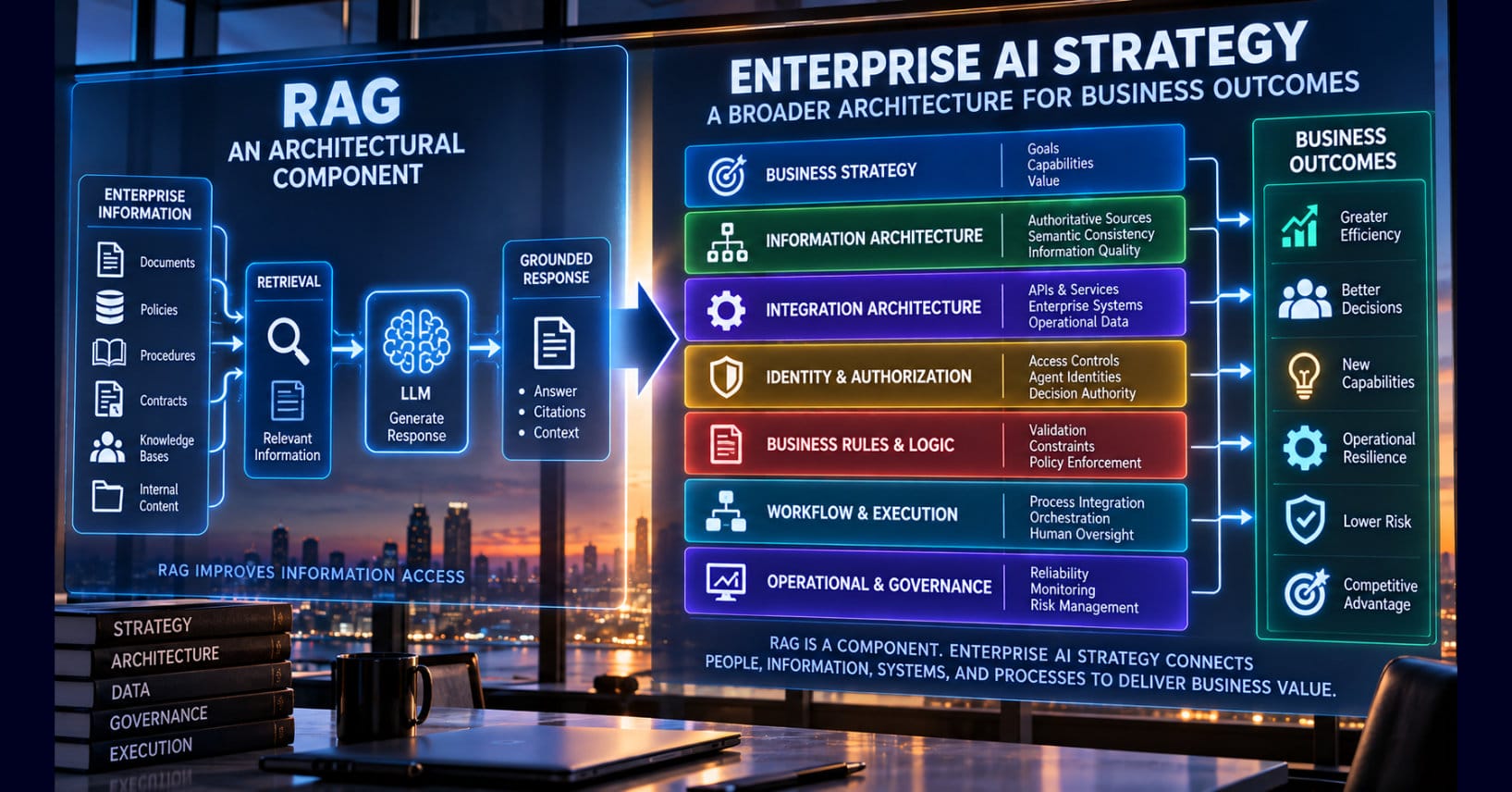
Retrieval-augmented generation is an architectural technique. It is not an enterprise AI strategy.
RAG can improve how AI systems access and use information. It can support knowledge discovery, document analysis, customer service, research, and many other applications.
But it does not independently establish which business capabilities the enterprise should develop, which decisions AI should influence, which processes should change, or how the organization will create sustainable competitive advantage.
Nor does it automatically resolve data quality, information authority, integration, operational resilience, or governance challenges.
An enterprise can deploy an excellent RAG implementation and still have no meaningful AI strategy.
The distinction matters because organizations risk mistaking a useful technical capability for a comprehensive approach to enterprise transformation.
Why RAG Became the Default Enterprise AI Architecture
The popularity of retrieval-augmented generation is understandable.
Foundation models possess extensive general capabilities, but they do not automatically know an organization’s current internal policies, customer relationships, operational procedures, contractual obligations, or proprietary information.
RAG provides a practical mechanism for incorporating relevant external information into a model’s response.
In a typical implementation, enterprise documents or other information sources are processed and indexed.
When a user submits a question, a retrieval component identifies potentially relevant information.
That information is supplied to the language model as additional context.
The model then generates a response informed by the retrieved material.
This approach offers several advantages.
It can provide access to information that was not included in the model’s original training.
It can reduce the need to retrain or fine-tune models whenever enterprise information changes.
It can support source attribution when implemented appropriately.
It can improve responses to questions requiring organization-specific knowledge.
And it can be deployed incrementally without replacing existing enterprise applications.
For many organizations, these characteristics make RAG an attractive starting point.
A company can connect a model to its policy repository and create an internal knowledge assistant.
A manufacturer can index equipment manuals and help technicians retrieve maintenance procedures.
A legal department can improve access to contractual information.
A customer service organization can retrieve relevant product documentation and service policies.
These applications may deliver measurable value.
The problem begins when leadership assumes that successfully retrieving enterprise information establishes the foundation for every subsequent AI capability.
It does not.
RAG solves a particular information access problem. Enterprise AI strategy addresses a much broader business transformation problem.
Retrieval Is Not the Same as Understanding
One of the most important limitations of RAG is the distinction between retrieving relevant information and understanding its organizational meaning.
Consider an enterprise with several documents describing customer refund policies.
One document contains the current corporate policy.
Another describes an earlier policy that has been superseded.
A third contains regional exceptions.
A fourth describes a temporary promotional arrangement.
A fifth is an internal training document that simplifies the rules for instructional purposes.
A retrieval system may identify all five documents as relevant to a question about refunds.
That does not mean all five documents carry equal authority.
The model may generate an answer using information from multiple sources.
The resulting response may be coherent and plausible.
It may also be operationally incorrect.
The underlying issue is not necessarily retrieval accuracy.
It is information authority.
Which document governs the decision?
Which policy applies to the customer?
Which regional exception is relevant?
Was the promotional arrangement still valid?
Does the training document accurately represent the controlling business rule?
These questions require information architecture and business context.
Similarity between a query and a document does not establish the document’s authority.
Nor does the presence of a citation guarantee that the cited information is correct, current, or applicable.
A RAG system can retrieve the right document for the wrong business context.
That distinction becomes increasingly consequential when AI outputs influence operational decisions.
The Enterprise Knowledge Base Is Not Automatically a Source of Truth
Organizations frequently describe RAG implementations as creating a unified enterprise knowledge base.
That language can be misleading.
A collection of indexed documents is not necessarily an authoritative representation of enterprise knowledge.
It may contain outdated information.
It may preserve contradictory definitions.
It may include incomplete procedures.
It may lack provenance.
It may contain documents whose owners have left the organization.
It may combine approved policies with drafts, informal notes, and obsolete guidance.
The indexing process does not resolve those conditions.
It makes the information searchable.
That is useful, but searchability and authority are different characteristics.
Consider a procurement organization that indexes supplier contracts, purchasing policies, and historical correspondence.
An employee asks whether a particular supplier qualifies for preferred pricing.
The retrieval system finds a contract amendment mentioning discounted rates.
However, the amendment applies only to a specific product category and expired several months earlier.
The model generates a response indicating that preferred pricing is available.
The answer may accurately reflect the retrieved text while misrepresenting the supplier’s current contractual status.
The enterprise has improved information retrieval without establishing reliable business interpretation.
This is why RAG must be supported by appropriate information architecture.
Relevant information needs sufficient metadata, classification, ownership, temporal context, and authority.
The retrieval process must also respect access restrictions and business applicability.
These capabilities do not emerge automatically from embedding documents into a vector database.
An indexed repository is not an enterprise source of truth merely because an AI model can query it.
The Difference Between Semantic Similarity and Business Authority
Many RAG implementations use vector embeddings to represent information in a form that supports similarity-based retrieval.
This can be highly effective for identifying conceptually related content.
A user asking about employee travel reimbursement may retrieve documents containing terms such as expenses, mileage, lodging, per diem, and corporate travel.
That flexibility is valuable.
But semantic similarity answers a different question from business authority.
Similarity asks:
Which information appears relevant to this request?
Authority asks:
Which information is valid, applicable, and controlling for this business purpose?
Those questions are related, but they are not interchangeable.
An outdated policy may be semantically similar to a current one.
An unauthorized draft may contain more detailed language than the approved version.
A regional procedure may closely resemble a global standard while containing important differences.
A historical contract may describe terms that no longer apply.
The retrieval architecture must account for these distinctions.
That may require filtering by document status, effective date, jurisdiction, business unit, product, customer, or other contextual attributes.
It may require authoritative metadata maintained outside the document itself.
It may require structured queries against operational systems rather than relying exclusively on semantic search.
In some cases, it may require deterministic business rules.
The correct architecture depends on the information and decisions involved.
The strategic lesson is straightforward.
Enterprise knowledge retrieval must distinguish relevance from authority.
Without that distinction, better retrieval can simply make unreliable information easier to consume.
RAG Does Not Replace Enterprise Integration
Another common misconception is that connecting AI to enterprise information eliminates the need for traditional integration architecture.
It does not.
RAG is primarily concerned with retrieving information to support generation.
Enterprise operations require more.
Consider an AI assistant helping a customer service representative resolve a billing dispute.
The assistant may retrieve policies and procedural guidance through RAG.
But resolving the dispute may also require retrieving current account balances, examining transaction histories, checking payment status, calculating adjustments, and updating the billing system.
Those activities depend on operational data and application services.
A vector index containing yesterday’s account information may not be appropriate for determining today’s balance.
A retrieved document cannot necessarily establish whether a payment has cleared.
A language model should not independently calculate a contractual adjustment when the enterprise maintains an authoritative calculation service.
And generating a recommendation does not update the underlying transaction system.
The application may require a combination of capabilities:
- RAG for policies and explanatory information.
- APIs for current operational records.
- Structured queries for authoritative business data.
- Business services for calculations and validation.
- Workflow integration for approvals and execution.
- Authorization controls for permitted actions.
RAG may be one component of the solution.
It is not the entire solution.
Enterprise AI requires an architecture that connects knowledge retrieval with authoritative data, business logic, and operational execution.
That architecture cannot be reduced to a vector database and a foundation model.
When Structured Data Is the Better Answer
Not every enterprise question should be answered through document retrieval.
Consider the question:
“What is our current inventory position for Product X across all distribution centers?”
The authoritative answer may reside in an inventory management system.
The application should retrieve current structured data through an appropriate interface.
It should not rely on a semantic search across documents describing inventory.
Similarly, questions involving account balances, transaction status, shipment locations, available credit, or current production capacity may require direct access to operational systems.
A language model may help interpret the user’s request and present the answer.
But the underlying facts should come from authoritative sources.
This distinction becomes especially important when accuracy, timeliness, and transactional consistency matter.
RAG is useful when the task requires retrieving and interpreting relevant knowledge.
Structured data access is often more appropriate when the task requires current, precisely defined operational facts.
Some applications require both.
The architectural decision should follow the information requirement.
It should not begin with the assumption that every enterprise information problem requires embeddings and semantic retrieval.
The Problem With Treating Every Document as Equal
Enterprise documents have different purposes.
A policy establishes organizational requirements.
A procedure describes how work should be performed.
A contract creates obligations between parties.
A technical specification defines system characteristics.
A meeting note records a discussion.
A draft captures work in progress.
A training document explains a concept.
A historical report describes past conditions.
These documents should not necessarily be treated as equivalent sources of authority.
Yet a simplistic RAG implementation may index them into the same retrieval environment without sufficient differentiation.
The system may then return whichever passages appear most relevant to the query.
This creates a risk of information flattening.
The distinctions that matter to the business are lost during retrieval.
An enterprise information architecture should preserve those distinctions.
Document classification, approval status, ownership, effective dates, applicability, and provenance may all influence whether retrieved information should be used.
The organization should also consider how documents are updated, superseded, or withdrawn.
If a policy changes, the retrieval environment must reflect that change.
If a document is no longer authoritative, the system should not continue presenting it as current guidance.
These are information lifecycle requirements.
They are not solved by selecting a more capable embedding model.
RAG Quality Cannot Be Measured by Fluency
One reason RAG implementations can appear more successful than they are is that language models produce convincing responses.
A well-written answer creates an impression of competence.
But fluency is not evidence of correctness.
A RAG system may retrieve irrelevant information and still generate a plausible response.
It may retrieve incomplete information and fill the gaps with unsupported assumptions.
It may cite a source that does not substantiate the conclusion.
It may combine statements from documents that apply to different circumstances.
It may fail to recognize that the available information is insufficient.
These failures require more than subjective evaluation.
Enterprises should establish evaluation methods appropriate to the application.
Relevant measures may include retrieval relevance, source authority, factual support, completeness, contextual applicability, and the system’s ability to recognize uncertainty.
For consequential applications, evaluation should also examine the business impact of incorrect answers.
An inaccurate response to a general employee question may create inconvenience.
An inaccurate interpretation of contractual obligations may create financial or legal exposure.
The acceptable level of uncertainty depends on the use case.
The objective is not to produce answers that sound authoritative. It is to produce answers that are supported by authoritative information.
RAG Is Becoming More Sophisticated, but the Strategic Distinction Remains
RAG architectures continue to evolve.
Organizations are experimenting with hybrid retrieval, combining semantic search with keyword-based approaches.
Reranking mechanisms can improve the selection of retrieved passages.
Metadata filtering can help distinguish documents by business context.
Knowledge graphs can represent relationships among entities and concepts.
Graph-based retrieval approaches can support questions requiring connections across multiple sources.
Agentic retrieval can dynamically select information sources and perform multiple retrieval steps.
These approaches may address limitations of simpler implementations.
They can improve retrieval quality and support more complex information requirements.
But they do not change the fundamental distinction between architecture and strategy.
A sophisticated retrieval system remains a technical capability.
Its strategic value depends on the business outcomes it enables.
An enterprise could deploy advanced hybrid retrieval, graph-based knowledge representations, and intelligent query planning without materially improving its competitive position.
Conversely, a relatively simple RAG implementation could create substantial value if it addresses an important business constraint.
The relevant question is not how sophisticated the retrieval architecture has become.
It is whether the architecture is appropriate for the business capability being developed.
Technical sophistication is not a substitute for strategic relevance.
The Agentic AI Problem: Retrieval Is Only the Beginning
The limitations of treating RAG as an enterprise AI strategy become more apparent as organizations deploy autonomous agents.
An AI assistant answering questions primarily needs to retrieve and interpret information.
An AI agent executing work requires additional capabilities.
It may need to determine which actions are appropriate.
It may need to interact with multiple applications.
It may need to maintain workflow state.
It may need to validate business rules.
It may need to request approval.
It may need to recover from errors.
It may need to document completed actions.
RAG can help the agent retrieve relevant knowledge.
It cannot independently provide all the mechanisms required for safe and reliable execution.
Consider an AI agent responsible for handling employee expense reimbursement requests.
RAG may retrieve the applicable expense policy.
But the agent must also determine whether the employee is eligible, validate submitted expenses, check transaction records, calculate reimbursement amounts, and interact with the financial system.
If the reimbursement exceeds an established threshold, the workflow may require approval.
If a transaction fails, the system must handle the exception.
If the policy changes, the agent must apply the correct version.
If an employee disputes the outcome, the organization may need to reconstruct the decision.
These requirements extend well beyond retrieval.
They involve information architecture, enterprise integration, identity and authorization, business process architecture, operational resilience, and evidence.
As discussed in Article 6, AI Readiness Is an Architecture Question, those capabilities determine whether AI can operate reliably at enterprise scale.
RAG is one component within that architecture.
It is not the architecture itself.
The Enterprise AI Architecture Should Follow the Business Capability
A more effective approach begins with the business outcome.
Suppose an organization wants to reduce the time required to resolve complex customer service cases.
The strategic objective is not to deploy RAG.
It is to improve service resolution.
Leadership should first examine the existing process.
Where do delays occur?
Which decisions require information that employees struggle to locate?
Which systems must be consulted?
Which business rules determine the appropriate resolution?
Which actions require authorization?
What constitutes a successful outcome?
Only then should the organization determine which AI capabilities are appropriate.
The resulting architecture may include RAG for policy retrieval.
It may include structured queries for customer information.
It may use APIs to access order and billing systems.
It may incorporate deterministic rules for eligibility calculations.
It may use a language model to interpret customer requests and generate explanations.
It may include workflow services for approvals and execution.
The architecture should reflect the business process.
The business process should not be redesigned merely to accommodate the capabilities of a preferred retrieval technology.
This is the difference between technology-led experimentation and strategy-led architecture.
The enterprise should not ask where it can deploy RAG. It should ask which business capabilities require intelligent information access and what architecture will support them.
A Practical Framework for Choosing the Right AI Information Architecture
Enterprise leaders can evaluate information requirements across five dimensions.
| Information Requirement | Primary Architectural Consideration | Potential Approach |
|---|---|---|
| Interpret policies, procedures, and documents | Relevant, authoritative knowledge retrieval | RAG with appropriate metadata and source controls |
| Retrieve current operational facts | Timeliness, precision, and source authority | APIs and structured data services |
| Understand relationships across entities | Semantic consistency and connected information | Knowledge graphs, semantic layers, or relational queries |
| Apply established business rules | Deterministic validation and enforceable constraints | Business rule engines and application services |
| Execute business processes | Authorization, workflow state, transaction integrity, and recovery | Workflow orchestration and enterprise integration |
These approaches are not mutually exclusive.
A single enterprise AI application may require several of them.
The purpose of the framework is to prevent the organization from treating one architectural technique as the answer to every information problem.
For example, a customer service agent might use RAG to retrieve policy guidance, structured APIs to obtain current account information, business rules to validate eligibility, and workflow services to execute an approved resolution.
The model coordinates interpretation and interaction.
The enterprise architecture supplies the authoritative information and operational mechanisms.
That division of responsibility can improve reliability, maintainability, and architectural flexibility.
The Hidden Cost of RAG Proliferation
As RAG becomes easier to implement, enterprises face another architectural challenge.
Different business units may independently create retrieval systems using the same underlying information.
Human resources indexes employee policies.
Legal indexes contracts.
Customer service indexes product documentation.
Operations indexes procedures.
Finance indexes accounting guidance.
Some separation may be appropriate because information sensitivity, access requirements, and business context differ.
But uncontrolled proliferation can create unnecessary duplication.
Multiple teams may independently process the same documents.
They may establish inconsistent metadata standards.
They may apply different access controls.
They may use incompatible retrieval evaluation methods.
They may maintain separate indexes containing different versions of the same information.
They may also establish independent relationships with AI platform vendors.
The result can be another generation of fragmented enterprise information infrastructure.
This does not mean every organization needs one centralized RAG platform.
Centralization can introduce its own constraints.
Instead, enterprise architecture should identify which capabilities benefit from reuse.
Shared document ingestion services, metadata standards, identity integration, evaluation methods, and information lifecycle mechanisms may reduce duplication.
Business-specific retrieval environments can still exist where justified.
The objective is to establish architectural coherence without preventing legitimate experimentation.
A collection of disconnected RAG applications is not an enterprise knowledge strategy. It may simply be a new collection of information silos.
The CIO’s Strategic Responsibility
CIOs should resist the temptation to measure enterprise AI progress primarily by the number of assistants, retrieval systems, or AI applications deployed.
Those metrics may demonstrate activity.
They do not necessarily demonstrate strategic value.
A more useful evaluation asks whether AI investments improve business capabilities.
Are employees resolving customer problems more effectively?
Are operational decisions becoming faster and more accurate?
Are information access costs declining?
Are business processes becoming more adaptable?
Are new capabilities being created that competitors cannot easily reproduce?
Is the enterprise developing reusable architectural assets?
These questions connect AI investments to enterprise outcomes.
They also help distinguish between technologies that enable strategy and technologies that have become substitutes for strategy.
RAG should be evaluated as an architectural option within a broader enterprise AI portfolio.
It may be the right choice for many applications.
It may be unnecessary for others.
And it may need to operate alongside structured data services, business rules, knowledge graphs, integration platforms, and workflow systems.
The CIO’s responsibility is to ensure that these architectural decisions support business strategy rather than allowing individual technologies to dictate the direction of enterprise transformation.
The Boardroom Question
Imagine management presenting an enterprise AI initiative.
The organization has implemented a RAG platform.
Thousands of documents have been indexed.
Employees can ask questions in natural language.
The demonstrations are impressive.
Management describes the initiative as the foundation of the enterprise AI strategy.
A director asks:
“Which business capabilities have improved because of this investment, and what can the enterprise now do that it could not do before?”
That question changes the discussion.
It moves attention from technical implementation to business outcomes.
The organization may have improved access to internal information.
That is a legitimate benefit.
But has it reduced service resolution times?
Improved operational decisions?
Lowered compliance costs?
Accelerated product development?
Enabled new customer capabilities?
Created reusable information services?
The answers determine whether the investment is strategically meaningful.
The board should also understand whether the platform depends on authoritative information, appropriate access controls, and sustainable architecture.
Indexing more documents is not necessarily evidence of greater business value.
Neither is increasing the number of AI-generated answers.
The measure of enterprise AI progress is not how much information the model can retrieve. It is what the enterprise can accomplish with that information.
The Executive Imperative
Retrieval-augmented generation is an important technology.
It provides a practical mechanism for connecting foundation models to enterprise information.
It can improve knowledge discovery, accelerate research, support employees, and enable valuable applications.
But RAG does not establish business priorities.
It does not define enterprise capabilities.
It does not determine decision authority.
It does not resolve conflicting business definitions.
It does not guarantee information quality or source authority.
It does not replace application integration.
And it does not provide the complete operational architecture required for autonomous AI agents.
Those responsibilities belong to enterprise strategy, information architecture, data governance, enterprise architecture, and operational management.
The strategic response is not to abandon RAG.
It is to place RAG in its proper architectural context.
Start with the business constraint.
Identify the information and decisions required to address it.
Determine which sources are authoritative.
Evaluate whether retrieval, structured data access, semantic relationships, business rules, or workflow integration are appropriate.
Then select the technologies that best support the intended outcome.
Some enterprise AI applications will depend heavily on RAG.
Others will use it selectively.
Still others may not require it at all.
That is how architecture should work.
The enterprise AI strategy defines the business capabilities the organization intends to create. RAG is one of the technologies that may help create them.
Confusing those responsibilities risks turning an architectural technique into a strategic destination.
And the intelligent enterprise will not be built by connecting every document repository to a language model.
It will be built by establishing the information, integration, decision, and execution capabilities required to transform how the organization operates.
Stop treating RAG as an enterprise AI strategy. Start treating it as an architectural component whose value must be demonstrated through business outcomes.
References
Gao, Yunfan, Yun Xiong, Xinyu Gao, Kangxiang Jia, Jinliu Pan, Yuxi Bi, Yi Dai, Jiawei Sun, and Haofen Wang. “Retrieval-Augmented Generation for Large Language Models: A Survey.” arXiv, 2023. Revised 2024. https://arxiv.org/abs/2312.10997.
Lewis, Patrick, Ethan Perez, Aleksandra Piktus, Fabio Petroni, Vladimir Karpukhin, Naman Goyal, Heinrich Küttler, et al. “Retrieval-Augmented Generation for Knowledge-Intensive NLP Tasks.” Advances in Neural Information Processing Systems 33 (2020): 9459–74. https://arxiv.org/abs/2005.11401.
National Institute of Standards and Technology. Artificial Intelligence Risk Management Framework (AI RMF 1.0). NIST AI 100-1. Gaithersburg, MD: U.S. Department of Commerce, January 2023. https://doi.org/10.6028/NIST.AI.100-1.
National Institute of Standards and Technology. Artificial Intelligence Risk Management Framework: Generative Artificial Intelligence Profile. NIST AI 600-1. Gaithersburg, MD: U.S. Department of Commerce, July 2024. https://doi.org/10.6028/NIST.AI.600-1.
The Open Group. The TOGAF Standard, 10th Edition. Reading, UK: The Open Group, 2022. https://www.opengroup.org/togaf.
World Wide Web Consortium. PROV-O: The PROV Ontology. W3C Recommendation, April 30, 2013. https://www.w3.org/TR/prov-o/.
Coming Next
Article 8 — Build, Buy, or Assemble? The AI Decision Has Changed
Enterprise technology leaders have long evaluated whether to build software internally or purchase commercial solutions.
Artificial intelligence complicates that decision.
Organizations can now combine foundation models, managed AI services, commercial applications, open-source components, proprietary data, and internally developed orchestration capabilities.
The result is a new sourcing landscape in which the most important decision may not be whether to build or buy, but which capabilities the enterprise should own, control, integrate, or obtain from external providers.
In the next article, we examine how AI changes traditional sourcing decisions and why architectural flexibility, strategic differentiation, and long-term operating economics must shape the enterprise’s approach.