AI Strategy Series | Article 15 of 20
Building the Intelligent Enterprise
Summary:
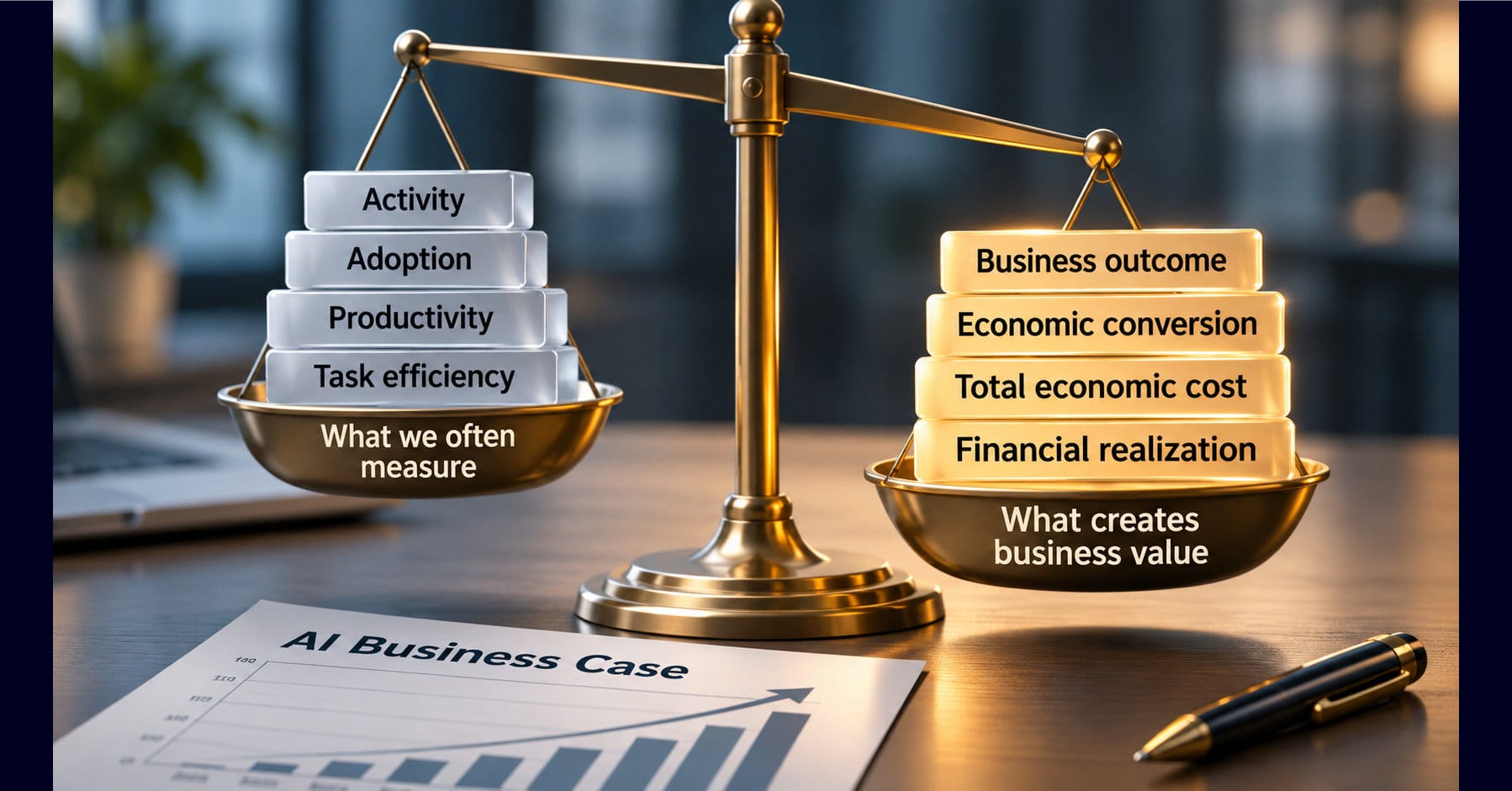
Enterprise AI investments are frequently justified through adoption rates, automated tasks, employee productivity improvements, and theoretical labor savings. Although these measurements provide useful operational information, they do not necessarily establish financial return or sustainable enterprise value.
In Article 15 of the AI Strategy Series, Building the Intelligent Enterprise, Victor M. Font Jr. examines why conventional AI business cases often measure the wrong outcomes and how organizations can develop more defensible approaches to investment evaluation.
The article introduces the AI Economic Conversion Model, which traces five stages from technical capability and operational improvement through business outcomes, economic conversion, and verified financial realization.
It examines four principal mechanisms through which AI can create economic value: cost reduction, revenue growth, risk reduction, and capital and capacity efficiency. Particular attention is given to the distinction between theoretical employee time savings and financial benefits that an organization can actually capture.
The article also addresses the complete economic cost of enterprise AI, including technology infrastructure, ongoing operations, governance, assurance, and organizational transformation. It explains why successful pilot results cannot automatically establish production-scale financial returns and why organizations must distinguish AI-generated improvements from changes that would have occurred without the investment.
A seven-dimensional enterprise AI investment scorecard provides a framework for evaluating strategic alignment, operational performance, economic conversion, total costs, risk and assurance, financial realization, and investment adaptability.
An illustrative financial model demonstrates how verified economic benefits, recurring operating expenses, and initial implementation costs contribute to a defensible investment assessment.
The article concludes by examining the responsibilities of the CFO, CIO, business executives, and board of directors in establishing financial accountability, validating benefits, and determining when AI investments should be scaled, redesigned, or discontinued.
The central argument is that an AI business case should not merely demonstrate that artificial intelligence makes work faster. It should establish whether AI makes the enterprise more economically valuable.
The artificial intelligence business case has a measurement problem.
Organizations are investing billions of dollars in AI capabilities while frequently evaluating those investments using metrics that were never designed to establish enterprise economic value.
They measure how many employees use AI.
They measure how many hours employees report saving.
They measure how many documents AI generates, how many customer inquiries chatbots resolve, and how many workflows contain automated activities.
They calculate theoretical labor savings by multiplying estimated time reductions by fully loaded employee compensation.
Then they present those numbers as evidence of return on investment.
There is a fundamental problem with this approach.
Activity is not economic value. Efficiency is not necessarily financial return. And theoretical capacity is not the same as realized business benefit.
An organization can deploy AI successfully, achieve widespread employee adoption, improve individual productivity, and still fail to produce a meaningful improvement in operating margin, revenue growth, customer retention, or return on invested capital.
That does not necessarily mean the technology failed.
It may mean the organization never established a credible mechanism for converting AI capabilities into economic results.
In Article 11, The AI Productivity Paradox Is Coming, I examined why time saved by employees does not automatically become financial value.
This article addresses the next question.
What should an enterprise AI business case actually measure?
The answer requires moving beyond conventional technology justification and treating AI investment as a business operating-model decision.
The Business Case That Looks Better Than It Is
Consider a hypothetical professional services organization with 2,000 employees.
Management introduces an AI assistant that helps employees prepare reports, summarize documents, conduct research, and draft client communications.
After six months, the organization reports the following results:
- 85% of employees actively use the AI assistant.
- Employees estimate that they save five hours per week.
- Internal satisfaction surveys indicate strong acceptance.
- Document preparation times have declined.
- The technology has been deployed across every major business function.
The initiative appears successful.
Management calculates the theoretical value of the productivity improvement.
Assume 48 working weeks annually and a fully loaded labor cost of $80 per hour.
The calculation is straightforward:
2,000 employees × 5 hours × 48 weeks × $80 = $38.4 million.
Management announces that AI has generated $38.4 million in annual productivity value.
But what has actually changed?
The organization still employs 2,000 people.
Its compensation expense remains substantially unchanged.
Client billing arrangements have not been modified.
Revenue per employee has not increased.
Operating margins remain flat.
Project delivery times have improved in some areas, but the organization has not established whether those improvements increased billable capacity or customer retention.
Meanwhile, the company is paying for AI subscriptions, integration services, security controls, governance, training, and additional infrastructure.
The $38.4 million calculation represents a theoretical valuation of employee time.
It does not establish $38.4 million in realized economic benefit.
The business case has confused productive capacity with financial return.
This distinction is central to understanding why enterprise AI investments can appear successful operationally while remaining economically unproven.
The Five Numbers That Dominate AI Business Cases
Most enterprise AI business cases emphasize a familiar collection of metrics.
Each can provide useful information.
None independently establishes financial value.
1. Adoption Rates
Adoption measures how widely a capability is being used.
It can help management determine whether employees are engaging with an investment.
But adoption does not establish that the investment is beneficial.
Employees may use AI to generate content that requires extensive correction.
They may accelerate activities that contribute little to business performance.
They may use AI for tasks that were never significant constraints on organizational capacity.
High adoption can coexist with negligible financial impact.
Adoption is an implementation indicator, not an economic outcome.
2. Hours Saved
Time savings are among the most frequently cited AI benefits.
They are also among the easiest to misinterpret.
Suppose AI reduces a recurring task from 60 minutes to 30 minutes.
The organization has achieved a 50% reduction in task execution time.
That is a legitimate operational improvement.
But the economic value depends on what happens next.
Does the employee complete additional revenue-generating work?
Does the organization reduce overtime?
Does the process require fewer external contractors?
Does the improved capacity allow the business to handle additional demand without increasing headcount?
Or does the employee simply have more time available within an unchanged operating model?
The same efficiency improvement can produce dramatically different financial outcomes.
3. Tasks Automated
Automation volume measures how much activity technology performs.
But automating a task does not necessarily eliminate its underlying business cost.
An automated task may still require human review, exception handling, quality assurance, or regulatory documentation.
Automation may also introduce new activities involving monitoring, validation, escalation, and incident management.
A workflow that previously required three manual steps may become a workflow with one automated step and four oversight requirements.
The correct question is not how many tasks were automated.
It is whether the complete process became more effective and economically valuable.
4. Cost per AI Transaction
Organizations increasingly calculate the cost of individual AI interactions.
They examine model inference costs, token consumption, API charges, and infrastructure utilization.
These measurements are necessary for financial control.
However, a low-cost AI transaction is not inherently valuable.
An AI-generated recommendation costing two cents may create substantial value if it improves a consequential business decision.
The same transaction may create a costly problem if it produces an incorrect recommendation that requires remediation.
Unit cost matters only in relation to the quality and economic contribution of the resulting business outcome.
5. Employee Satisfaction
Employee satisfaction can influence adoption, retention, and organizational acceptance.
Those are legitimate considerations.
But employee enthusiasm does not establish financial return.
An AI capability may make work more convenient without improving the organization’s competitive position.
The business case must distinguish the employee experience from the economic performance of the enterprise.
Both matter.
They are not interchangeable.
The Missing Link: Economic Conversion
The central weakness in many AI business cases is the absence of an explicit economic conversion mechanism.
An AI capability creates an operational change.
That operational change must produce a business outcome.
The business outcome must then generate a measurable economic benefit.
These are separate stages.
Consider the following progression:
AI capability → Operational improvement → Business outcome → Economic realization
An AI assistant might reduce document preparation time.
That improvement might increase the number of client engagements a team can support.
The additional capacity might allow the organization to accept more work without proportional increases in staffing.
That additional work might produce higher contribution margin.
Only at that final stage has the organization demonstrated a financial return.
Each transition requires evidence.
The enterprise cannot assume that because the first stage occurred, the remaining stages will follow automatically.
The AI Economic Conversion Model
| Stage | Management Question | Illustrative Measurement |
|---|---|---|
| AI capability | What new capability has been introduced? | Deployment, availability, functional performance |
| Operational improvement | What changed in how work is performed? | Task time, error rate, throughput, rework |
| Business outcome | What improved for the business or customer? | Delivery time, service quality, conversion, capacity |
| Economic conversion | How does the outcome produce financial value? | Avoided expense, incremental contribution, retained revenue |
| Financial realization | What benefit has actually been captured? | Verified cash flow, operating margin, net economic benefit |
This model changes the business case.
Instead of beginning with an AI capability and assigning a financial value to its expected activity, management begins with a measurable business constraint and identifies how AI can improve the economics of that constraint.
The difference is significant.
One approach justifies technology.
The other justifies business investment.
Four Ways AI Can Create Economic Value
Enterprise AI investments can produce economic value through several mechanisms.
Four deserve particular attention.
1. Cost Reduction
AI can reduce operating expenses when its capabilities allow the organization to eliminate or avoid identifiable costs.
Examples include:
- Reduced spending on external services.
- Lower overtime expense.
- Reduced rework and error correction.
- Avoided infrastructure or operational costs.
- Lower transaction processing expenses.
- Reduced future hiring requirements when demand increases.
The last example requires particular care.
Avoided future costs can be economically meaningful, but they should not be presented as realized cash savings unless the avoided expense is supported by a credible baseline and would otherwise have occurred.
A company that processes more transactions without hiring additional employees may achieve genuine operating leverage.
But that value must be measured against a defensible forecast of demand, staffing requirements, and alternative operating costs.
2. Revenue Growth
AI can improve revenue generation by increasing the organization’s ability to acquire, serve, or retain customers.
Potential mechanisms include:
- Faster response to qualified sales opportunities.
- Improved customer retention.
- Better pricing decisions.
- Increased conversion rates.
- Faster delivery of revenue-generating services.
- Greater capacity to serve additional customers.
Revenue growth must be evaluated using appropriate financial measures.
An additional million dollars in revenue does not necessarily represent a million dollars in economic value.
Management must consider incremental delivery costs, customer acquisition costs, and contribution margin.
A business case that counts gross revenue without accounting for the costs required to generate it can substantially overstate AI’s economic contribution.
3. Risk Reduction
AI may reduce the frequency, severity, or duration of certain operational and financial risks.
Examples include improved fraud detection, faster identification of security incidents, more consistent quality assurance, and earlier detection of operational anomalies.
Risk reduction can be economically significant.
However, its valuation requires disciplined assumptions.
An organization should not claim that AI prevented a multimillion-dollar incident merely because the technology detected a suspicious event.
Risk benefits should be evaluated using defensible estimates of exposure, likelihood, consequence, and control effectiveness.
Expected loss reduction can support investment decisions, but it should remain distinguishable from verified financial savings.
Risk-adjusted benefits are not equivalent to realized cash returns.
4. Capital and Capacity Efficiency
AI may allow an organization to generate greater output from its existing resources.
This can improve capital productivity and operating leverage.
Examples include:
- Increased production without equivalent capital investment.
- Higher transaction volume using existing infrastructure.
- Better utilization of specialized personnel.
- Reduced working capital requirements.
- Faster completion of revenue-producing projects.
These benefits can be particularly important because they may improve enterprise economics without requiring immediate workforce reductions.
However, management must demonstrate that the additional capacity has been used productively.
Unused capacity is an operational opportunity.
Utilized capacity that improves financial performance is an economic result.
Why Labor Savings Are So Frequently Overstated
Labor productivity deserves special attention because it dominates many AI investment justifications.
Suppose a company employs 500 analysts.
AI reduces the time required for a recurring analytical task by 40%.
Management calculates the equivalent number of full-time employees represented by the saved hours.
It then multiplies that number by average compensation.
The resulting figure becomes the projected annual benefit.
This calculation can be useful for estimating capacity.
But it does not automatically establish savings.
There are at least four reasons.
First, employee work is not always divisible into interchangeable units.
Saving 20 minutes across multiple activities does not necessarily create a contiguous block of time that can be converted into additional productive work.
Second, organizations may need to retain the same workforce to meet service requirements, preserve expertise, or manage unpredictable demand.
Third, AI-generated work may introduce new review and supervisory responsibilities.
Fourth, management may choose to reinvest the available capacity into quality improvement, customer service, innovation, or risk management rather than reduce expenses.
These outcomes may be strategically valuable.
But their economic effects must be evaluated independently.
A financial business case must identify the mechanism by which labor capacity becomes financial benefit.
That mechanism may be reduced expense, avoided hiring, additional profitable output, or another measurable outcome.
Without it, the organization is assigning a dollar value to time without demonstrating that the enterprise can capture that value.
AI Changes the Cost Structure, Not Just the Productivity Equation
Traditional software investments often involve relatively predictable licensing, implementation, and maintenance expenses.
AI introduces a more variable cost structure.
The total cost of enterprise AI can include:
- Model licensing and subscriptions.
- Token consumption and inference charges.
- Cloud infrastructure and computational resources.
- Data preparation and information integration.
- Retrieval systems and supporting architecture.
- Identity, access management, and security controls.
- Model evaluation and testing.
- Human review and exception handling.
- Monitoring, observability, and incident response.
- Governance, assurance, and audit evidence.
- Workforce training and organizational change.
- Vendor management and contractual oversight.
- Model replacement, migration, and architectural adaptation.
Some expenses are fixed.
Others increase with utilization, workflow complexity, or the volume of automated decisions.
This distinction matters because an AI application can appear inexpensive during a pilot and become substantially more costly at enterprise scale.
An application processing 1,000 requests per day may have an attractive unit cost.
But production deployment may introduce larger prompts, additional retrieval operations, repeated model calls, human validation, and exception processing.
The complete cost of delivering a reliable business outcome may be much higher than the cost of a single model interaction.
The Total Economic Cost of AI
A credible business case should account for four cost categories.
| Cost Category | Components | Financial Consideration |
|---|---|---|
| Technology | Models, infrastructure, APIs, integrations | Fixed and variable operating expenses |
| Operations | Monitoring, validation, exception handling, support | Ongoing service delivery costs |
| Governance | Security, compliance, assurance, evidence, oversight | Cost of controlled and accountable operation |
| Transformation | Process redesign, training, organizational change | Investment required to realize business value |
The purpose is not to discourage investment.
It is to prevent management from comparing a comprehensive estimate of benefits against an incomplete estimate of costs.
The Unit of Measurement Should Be the Business Outcome
One of the most consequential changes in AI investment evaluation is selecting the correct unit of analysis.
Organizations often measure AI at the level of the user, model, task, or application.
Those measurements are operationally useful.
But enterprise economic value is frequently realized at the level of the business process, service, customer relationship, or organizational capability.
Consider customer service.
A company deploys an AI agent capable of handling routine customer inquiries.
Management reports that the agent resolves 60% of incoming inquiries without human intervention.
That is an automation metric.
It does not establish whether the customer service operation has improved economically.
A more complete evaluation would examine:
- Total cost per successfully resolved customer issue.
- Customer satisfaction and retention.
- First-contact resolution.
- Repeat contacts and reopened cases.
- Escalation frequency.
- Human intervention costs.
- Resolution accuracy.
- Compliance and service quality.
- Changes in staffing requirements.
- The financial consequences of errors.
An AI agent might resolve a large number of simple inquiries while transferring the most difficult cases to human employees.
The remaining human workload could become more complex and expensive.
If the organization measures only automated resolution rates, it may miss that shift.
The correct economic unit is not the AI interaction.
It is the successfully delivered customer outcome, including the complete cost of achieving it.
This principle applies across the enterprise.
For procurement, measure the economics of the purchasing process.
For software development, measure delivery performance, quality, and total lifecycle cost.
For finance, measure transaction accuracy, closing efficiency, control effectiveness, and operating expense.
For cybersecurity, measure defensible changes in risk exposure and response performance.
For professional services, measure profitable delivery capacity, client outcomes, and contribution margin.
The business outcome must become the primary measurement boundary.
The Counterfactual Problem: Would the Improvement Have Happened Anyway?
There is another weakness in many AI business cases.
They attribute improvements to AI without establishing whether those improvements would have occurred in its absence.
Suppose an organization introduces an AI capability and subsequently observes a 15% reduction in processing time.
Management credits the improvement to AI.
But during the same period, the company also standardized workflows, eliminated redundant approvals, improved employee training, and upgraded its underlying systems.
How much of the improvement was attributable to AI?
The answer matters.
Without a credible comparison, the business case may assign AI benefits that were actually produced by broader operational changes.
This is the counterfactual problem.
A disciplined evaluation should establish what would likely have happened without the investment.
Possible approaches include:
- Comparing similar business units with and without AI.
- Using phased deployment to evaluate differences.
- Measuring performance against an appropriate historical baseline.
- Controlling for demand, staffing, process, and seasonal changes.
- Conducting structured experiments where practical.
- Documenting other initiatives that may influence results.
Not every enterprise AI investment can support a randomized controlled experiment.
But every material investment should establish a reasonable method for distinguishing AI’s contribution from unrelated operational improvements.
Otherwise, management risks treating correlation as financial evidence.
The Difference Between a Pilot Business Case and a Production Business Case
AI pilots are valuable for evaluating technical feasibility, usability, and potential business benefits.
They are not necessarily reliable predictors of enterprise-scale economics.
A pilot may operate under favorable conditions.
It may involve enthusiastic employees, carefully selected use cases, limited transaction volumes, and unusually attentive technical support.
Production introduces different conditions.
Demand increases.
Exceptions become more varied.
Integration dependencies expand.
Security and governance requirements become more consequential.
Operational support must become repeatable.
Model behavior must be monitored over time.
The organization may also discover that the workflows selected for the pilot were not representative of broader enterprise operations.
A pilot that demonstrates a 30% task-level efficiency improvement cannot automatically support a business case assuming the same improvement across every business function.
The organization must account for differences in work complexity, information quality, human supervision, and process maturity.
Three Distinct Investment Decisions
Enterprise AI governance should distinguish among three investment decisions.
Experimentation: Is the capability technically feasible, sufficiently reliable, and potentially valuable?
Production deployment: Can the capability operate safely, economically, and consistently within the business process?
Enterprise scaling: Can the organization reproduce the benefits across additional operations while preserving financial performance and control effectiveness?
Each stage requires different evidence.
An approved pilot should not become an implicit authorization for unlimited production expansion.
Nor should successful deployment in one business function establish that scaling elsewhere will produce equivalent returns.
Investment authority should remain connected to demonstrated performance and changing economic assumptions.
The AI Business Case Needs a Benefits Realization Owner
A recurring governance problem emerges when technology leaders are held responsible for delivering AI capabilities while business leaders are not explicitly accountable for capturing their economic value.
The CIO may successfully deploy the platform.
The technology team may achieve reliability, security, and adoption targets.
The project may be delivered on schedule and within budget.
But the expected financial benefits may depend on decisions outside the CIO’s authority.
A business executive may need to redesign staffing arrangements.
A process owner may need to eliminate redundant activities.
Finance may need to revise resource allocations.
Sales leadership may need to change how additional capacity is converted into revenue.
Human resources may need to redesign roles and performance expectations.
Without these decisions, the technical implementation can succeed while the economic case remains unrealized.
This is why every material AI investment needs an accountable business owner.
Not merely an executive sponsor.
Not merely a technology project manager.
An individual with sufficient authority to make or coordinate the operating-model decisions necessary to capture the intended benefits.
Five Accountability Questions
Before approving an AI investment, leadership should establish:
- Who owns the business outcome?
- Who has authority to redesign the affected process?
- Who is responsible for converting operational improvements into economic value?
- Who validates the financial results?
- Who can recommend reducing, redesigning, or terminating the investment if its assumptions no longer hold?
These questions connect AI strategy to enterprise governance.
They also prevent a common failure in which benefits are projected during approval but become nobody’s responsibility after implementation.
Building an AI Investment Scorecard That Measures Value
An enterprise AI scorecard should provide management and boards with a coherent view of investment performance.
It should not become a dashboard filled with disconnected technical metrics.
A practical scorecard can be organized into seven dimensions.
Enterprise AI Investment Scorecard
| Dimension | Core Question | Illustrative Measures |
|---|---|---|
| Strategic alignment | Does the investment address a material business constraint? | Business objective, constraint severity, strategic contribution |
| Operational performance | Has the underlying process improved? | Cycle time, throughput, accuracy, rework |
| Economic conversion | Are operational gains becoming financial benefits? | Avoided expense, incremental margin, productive capacity utilization |
| Total economic cost | What does the complete AI-enabled service cost? | Technology, operations, governance, transformation |
| Risk and assurance | Is the capability operating within authorized limits? | Control effectiveness, exceptions, incidents, verified remediation |
| Financial realization | Has the investment delivered measurable economic returns? | Net benefits, cash flow, payback, risk-adjusted NPV |
| Investment adaptability | Do the original assumptions still justify continued investment? | Performance variance, changing costs, termination triggers |
These dimensions should be evaluated together.
An AI capability that delivers strong financial results while creating unacceptable operational or regulatory exposure is not necessarily a successful investment.
Likewise, a well-controlled AI capability that produces no meaningful business value may not justify continued funding.
The objective is to establish a balanced view of economic performance, operational effectiveness, and governance.
A Better Financial Model for AI Investment
A credible AI financial model should begin with incremental cash flows rather than theoretical labor valuations.
At its simplest:
Net Economic Benefit = Verified Incremental Benefits − Total Incremental Costs
For a multiyear investment, management should consider the timing of cash flows, uncertainty, and the organization’s cost of capital.
Net present value provides one useful method.
Where:- I0 represents the initial investment.
- Bt represents incremental economic benefits in period t.
- Ct represents incremental operating and support costs in period t.
- r represents the discount rate.
- n represents the evaluation period.
The challenge is not the formula.
The challenge is establishing credible assumptions for the benefits and costs.
An Illustrative AI Investment
Consider a hypothetical enterprise AI deployment with the following annualized estimates after implementation:
| Financial Component | Annual Amount |
|---|---|
| Avoided external service expense | $1,200,000 |
| Incremental contribution margin from additional capacity | $900,000 |
| Verified reduction in rework expense | $400,000 |
| Total annual economic benefits | $2,500,000 |
| AI licensing and infrastructure | ($650,000) |
| Monitoring, evaluation, and operations | ($350,000) |
| Governance and assurance | ($200,000) |
| Ongoing training and support | ($150,000) |
| Total annual operating costs | ($1,350,000) |
| Annual net operating benefit | $1,150,000 |
Assume the organization also incurred an initial implementation and transformation investment of $2 million.
The recurring annual net benefit is $1.15 million, before taxes and other adjustments.
Under a simplified assumption of constant annual net benefits, the undiscounted payback period would be approximately 1.74 years after benefits begin.
That is a more meaningful financial assessment than claiming the investment generated $10 million in value because employees reported saving a certain number of hours.
However, even this model requires scrutiny.
Were the external service expenses actually eliminated?
Is the additional contribution margin attributable to AI?
Have the reductions in rework expense been verified?
Do the operating costs include the complete production service?
Are the benefits sustainable?
Could model pricing, demand, or regulatory requirements change the economics?
A defensible business case must answer these questions.
Financial precision is not the same as financial validity.
AI Investment Should Be Managed as a Portfolio
Individual AI projects may appear attractive when evaluated independently.
But enterprise leadership must also consider how AI investments interact across the organization.
Multiple business units may purchase overlapping capabilities.
Different teams may build redundant integrations.
Separate AI platforms may introduce unnecessary operating costs.
A locally successful application may create enterprise-wide information governance problems.
Meanwhile, investments with modest departmental returns may enable substantial benefits across several business capabilities.
This is a portfolio management problem.
The enterprise needs to evaluate AI investments based on their combined strategic and economic contribution.
Portfolio Decisions Should Include Four Categories
Scale: Investments demonstrating reliable operational performance, defensible financial benefits, and acceptable risk.
Improve: Investments with credible value potential but identifiable weaknesses in execution, cost, adoption, or operating-model integration.
Reposition: Investments whose original use case is no longer compelling but whose capabilities may support a more valuable business objective.
Terminate: Investments that no longer satisfy established economic, strategic, or governance criteria.
The fourth category is particularly important.
Organizations frequently establish approval criteria for new investments without establishing equivalent criteria for discontinuing existing ones.
An AI investment should not receive indefinite funding simply because the technology works or the original business case was persuasive.
The assumptions supporting approval must remain subject to review.
That includes changes in model pricing, technical performance, business demand, regulatory obligations, and alternative investment opportunities.
A disciplined portfolio process recognizes that stopping an investment can be a successful governance decision.
Why the CFO Must Be Part of AI Strategy
AI strategy is frequently framed as a collaboration among the CEO, CIO, CTO, and business leadership.
The CFO must be an equally important participant.
Not simply because AI requires funding.
Because AI changes how enterprises create, measure, and capture economic value.
The CFO’s role should extend beyond reviewing project budgets.
Finance should help establish:
- Standards for valuing productivity improvements.
- Rules for recognizing avoided costs.
- Methods for validating incremental revenue and contribution margin.
- Consistent treatment of implementation and operating expenses.
- Appropriate discount rates and risk assumptions.
- Financial baselines and benefits realization procedures.
- Portfolio-level investment performance measures.
- Criteria for continued funding or termination.
This creates a common economic language across business and technology functions.
Without it, departments may report AI benefits using incompatible assumptions.
One division may count theoretical employee time savings.
Another may count avoided future hiring.
A third may count gross revenue influenced by AI.
A fourth may count reduced exposure to hypothetical risks.
Management then aggregates these figures into an enterprise AI value report.
The resulting total may be impressive.
It may also be economically incoherent.
The CFO should ensure that benefits are classified consistently, supported by evidence, and not counted multiple times.
The CIO’s Responsibility Is Changing
The CIO remains central to enterprise AI investment decisions.
But the CIO’s contribution should not be limited to technical feasibility, platform selection, and implementation delivery.
AI architecture increasingly determines the economics of business operations.
Model selection affects inference cost.
Integration design affects process efficiency.
Information architecture affects output quality.
Identity and authorization design affect operational risk.
Observability affects reliability and support expense.
Vendor decisions affect portability and future switching costs.
The CIO must therefore understand how architectural choices influence the complete economic performance of AI-enabled business capabilities.
This creates a stronger connection between enterprise architecture and financial strategy.
A technically sophisticated architecture is not necessarily economically optimal.
A low-cost architecture is not necessarily operationally appropriate.
The correct design balances performance, reliability, security, governance, adaptability, and total economic value.
Enterprise AI architecture should be evaluated as an economic operating capability, not merely a technology implementation.
The Board Should Stop Asking How Much AI Is Being Used
Boards need meaningful visibility into AI investments.
But dashboards dominated by adoption rates, deployment counts, and automation volumes can create a misleading impression of progress.
Those measures indicate activity.
They do not establish that management is creating sustainable enterprise value.
Directors should ask more consequential questions.
Which material business constraints are AI investments intended to address?
What measurable economic outcomes were established before approval?
How much of the reported value represents realized financial benefit rather than theoretical capacity?
What is the complete cost of operating and governing the AI capabilities?
Who owns benefits realization?
How does management distinguish AI-generated improvements from other operational changes?
Which investments are underperforming?
What conditions would trigger redesign, reduced funding, or termination?
And how does management know that the enterprise’s AI portfolio is producing better risk-adjusted returns than alternative uses of capital?
These questions do not require directors to become AI engineers.
They require directors to exercise disciplined oversight of capital allocation, enterprise performance, and management accountability.
The same principles that govern other material investments should apply to artificial intelligence.
AI does not deserve an exemption from economic scrutiny because its capabilities are impressive.
The Boardroom Question
If management reports that artificial intelligence has saved the enterprise millions of employee hours, can it demonstrate how those hours were converted into lower expenses, increased contribution margin, improved cash flow, or another measurable economic benefit?
If the answer is no, the board is looking at a productivity estimate—not evidence of financial return.
The Executive Imperative
Enterprise leaders should redesign AI business cases around economic conversion rather than technology activity.
That requires a disciplined sequence.
First, identify the business constraint. Establish the operational or economic problem the investment is intended to address.
Second, define the desired business outcome. Specify what must improve and how that improvement will be measured.
Third, establish the economic conversion mechanism. Explain how the operational improvement will produce financial or other defensible enterprise value.
Fourth, calculate the complete cost. Include technology, operations, governance, assurance, and transformation.
Fifth, establish a credible baseline. Determine how performance will be compared against what would otherwise have occurred.
Sixth, assign accountable ownership. Ensure a business executive has authority to implement the changes required to realize benefits.
Seventh, define continuation and termination criteria. Establish what evidence will justify scaling, redesigning, or discontinuing the investment.
Eighth, verify the results. Require Finance and the responsible business function to validate realized outcomes.
This approach will not make every AI investment successful.
It will make the difference between successful and unsuccessful investments much easier to establish.
And that is an essential capability for any organization allocating substantial capital to artificial intelligence.
Conclusion: The AI Business Case Must Become an Economic Argument
The enterprise AI market has no shortage of demonstrations showing what the technology can do.
Organizations can generate documents faster, analyze information more efficiently, automate routine interactions, and deploy increasingly autonomous agents.
Those capabilities are real.
Their economic value is not automatic.
The next phase of enterprise AI strategy will require greater discipline in distinguishing technical achievement from business performance.
Leaders must move beyond measuring usage, automation, and theoretical time savings.
They must establish how AI changes the economics of business processes, customer relationships, operating capacity, and enterprise risk.
They must understand the complete cost of operating AI at scale.
They must assign accountability for converting operational improvements into measurable outcomes.
And they must be prepared to discontinue investments whose economic assumptions no longer hold.
The organizations that create sustainable AI value will not necessarily be those deploying the greatest number of models or agents.
They will be those capable of identifying where AI changes the economics of the enterprise—and capturing that value through deliberate operating-model decisions.
The AI business case should not prove that artificial intelligence makes work faster.
It should prove that artificial intelligence makes the enterprise more valuable.
References
Brynjolfsson, Erik, Daniel Rock, and Chad Syverson. “Artificial Intelligence and the Modern Productivity Paradox: A Clash of Expectations and Statistics.” In The Economics of Artificial Intelligence: An Agenda, edited by Ajay Agrawal, Joshua Gans, and Avi Goldfarb, 23–57. Chicago: University of Chicago Press, 2019.
Brynjolfsson, Erik, Danielle Li, and Lindsey R. Raymond. “Generative AI at Work.” The Quarterly Journal of Economics140, no. 2 (2025): 889–942.
Davenport, Thomas H., and Nitin Mittal. All-in on AI: How Smart Companies Win Big with Artificial Intelligence. Boston: Harvard Business Review Press, 2023.
International Organization for Standardization and International Electrotechnical Commission. ISO/IEC 42001:2023: Information Technology—Artificial Intelligence—Management System. Geneva: ISO, 2023.
National Institute of Standards and Technology. Artificial Intelligence Risk Management Framework (AI RMF 1.0). NIST AI 100-1. Gaithersburg, MD: NIST, 2023. https://doi.org/10.6028/NIST.AI.100-1.
National Institute of Standards and Technology. Artificial Intelligence Risk Management Framework: Generative Artificial Intelligence Profile. NIST AI 600-1. Gaithersburg, MD: NIST, 2024. https://doi.org/10.6028/NIST.AI.600-1.
Organisation for Economic Co-operation and Development. OECD Employment Outlook 2023: Artificial Intelligence and the Labour Market. Paris: OECD Publishing, 2023. https://doi.org/10.1787/08785bba-en.
Coming Next
Article 16: When AI Makes Intelligence Cheap, What Becomes Valuable?
Artificial intelligence is rapidly reducing the cost of generating information, producing analysis, and performing many forms of knowledge work.
But when capabilities that once differentiated organizations become widely accessible, the foundations of competitive advantage begin to change.
The next article examines what becomes strategically valuable when intelligence itself becomes increasingly abundant—and why judgment, trusted information, execution capability, and organizational learning may matter more than access to AI technology.