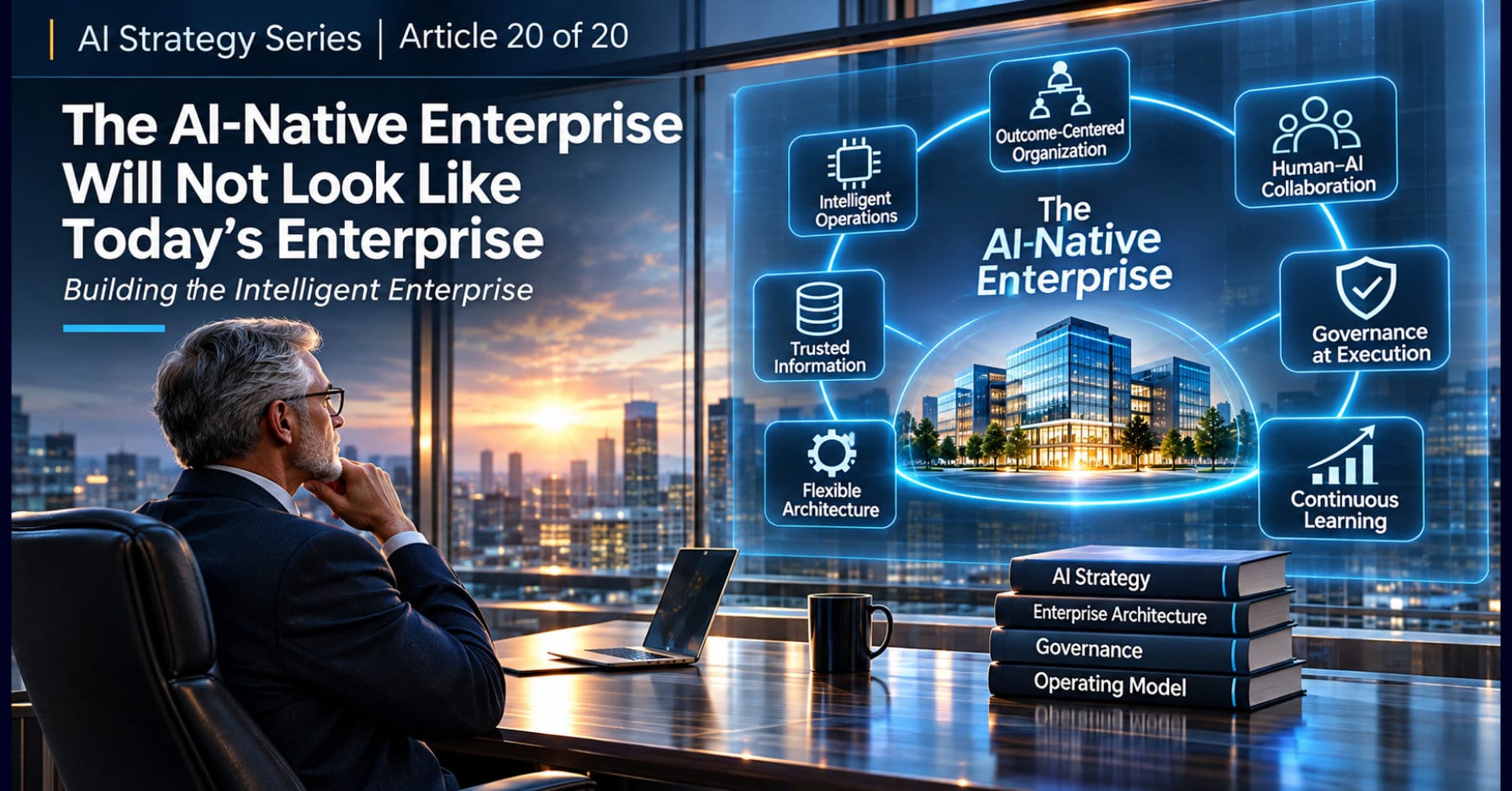
AI Strategy Series | Article 20 of 20
Building the Intelligent Enterprise
Summary
The AI-native enterprise will not emerge simply by deploying more artificial intelligence applications. It will require organizations to reconsider how they structure work, distribute decision authority, govern information, coordinate human and machine capabilities, and measure enterprise performance.
This concluding installment of the 20-part AI Strategy Series distinguishes an AI-enabled enterprise from an AI-native enterprise. While the former introduces AI into existing organizational structures and processes, the latter redesigns those structures and processes around intelligent capabilities, business outcomes, and accountable execution.
The article examines the architectural foundations of this transformation, including trusted information, explicit decision rights, AI orchestration, technical enforcement, operational evidence, outcome assurance, and organizational learning. It explains why governance must become an operational capability rather than a collection of policies applied after deployment.
A central theme is the distinction between task optimization, process redesign, and operating-model transformation. Faster individual tasks do not automatically produce financial value or sustainable competitive advantage. Enterprise leaders must evaluate whether AI changes the economics, adaptability, and effectiveness of the organization itself.
The article also establishes the responsibilities of boards, CEOs, CIOs, business executives, data governance leaders, CISOs, CFOs, and assurance functions in designing and operating the AI-native enterprise.
The series concludes with a strategic proposition: the organizations that succeed with AI will not necessarily be those that deploy the most advanced models. They will be those that build enterprises capable of making better decisions, executing them responsibly, learning from outcomes, and continuously improving their operating capabilities.
For most of the modern enterprise era, organizations have been designed around a fundamental constraint: human beings possess limited capacity to collect information, interpret it, coordinate decisions, and execute work.
Management hierarchies emerged to distribute responsibility. Departments specialized to concentrate expertise. Enterprise applications organized transactions around defined business functions. Reporting structures moved information upward, while decisions and instructions moved downward.
Technology improved the efficiency of this arrangement without fundamentally changing its design.
Enterprise resource planning systems integrated transactions. Customer relationship management systems organized commercial activity. Business intelligence platforms accelerated reporting. Workflow automation reduced repetitive administrative work.
Yet the underlying organizational assumption remained largely intact.
People would continue to perform most of the interpretation, coordination, and decision-making required to operate the enterprise.
Artificial intelligence is beginning to challenge that assumption.
AI systems can increasingly interpret information, identify patterns, generate recommendations, coordinate workflows, and execute authorized actions across applications. Some of these capabilities remain unreliable or unsuitable for consequential decisions without substantial human oversight. Nevertheless, their trajectory introduces a strategic question that extends far beyond technology adoption.
What should an enterprise look like when intelligence is no longer constrained primarily by the number of people available to perform cognitive work?
The answer will not be a conventional organization with more AI applications.
It will be a different organizational architecture.
And the companies that understand this distinction will have an advantage over those that continue inserting artificial intelligence into operating models designed for an earlier era.
1. The Enterprise We Know Was Built Around Human Constraints
Consider the fundamental structure of a traditional enterprise.
Information enters through customers, suppliers, employees, applications, and external markets.
Operational systems record transactions.
Employees interpret those records.
Managers coordinate decisions across teams.
Executives establish priorities, resolve conflicts, and allocate resources.
The organization then executes its decisions through established business processes.
This arrangement is not inherently inefficient. It evolved to address genuine coordination and accountability requirements.
However, its architecture reflects the economic realities of human information processing.
Human attention is scarce.
Specialized expertise is expensive.
Communication introduces delays.
Organizational boundaries create coordination costs.
Managers have limited spans of control.
Knowledge is distributed unevenly.
These constraints influence nearly every aspect of enterprise design, including organizational charts, approval hierarchies, departmental boundaries, reporting cycles, and application architectures.
An AI-native enterprise begins by reconsidering which of these constraints remain necessary.
It does not assume that human judgment is obsolete.
Instead, it asks where human judgment creates indispensable value—and where the enterprise can redesign information processing, coordination, and execution around appropriately governed artificial intelligence.
This is an architectural question before it is a staffing question.
2. AI-Native Is Not the Same as AI-Enabled
The distinction between an AI-enabled enterprise and an AI-native enterprise is essential.
An AI-enabled organization adds artificial intelligence to existing operations.
An AI-native organization designs its operating model around the capabilities, limitations, and governance requirements of artificial intelligence.
These are fundamentally different strategies.
| Dimension | AI-Enabled Enterprise | AI-Native Enterprise |
|---|---|---|
| Organizational design | Existing structures supplemented by AI | Structures reconsidered around outcomes and decision authority |
| Business processes | AI automates selected activities | Processes redesigned around coordinated human and AI execution |
| Information architecture | AI accesses existing information environments | Trusted information and provenance become foundational services |
| Decision-making | AI supports established decision workflows | Decision rights explicitly allocate human and machine authority |
| Technology architecture | AI applications added to the portfolio | AI capabilities integrated into enterprise architectural services |
| Governance | Policies applied to AI deployments | Governance requirements embedded in operational execution |
| Performance measurement | Adoption, productivity, and automation | Business outcomes, economic value, adaptability, and assurance |
| Organizational learning | Improvements managed through periodic initiatives | Validated learning incorporated into continuous operating processes |
The AI-enabled enterprise asks:
Where can we use AI to make existing work faster?
The AI-native enterprise asks:
If we were designing this organization today, knowing what artificial intelligence can and cannot do, would we structure the work this way?
That second question is far more consequential.
It challenges established assumptions about organizational design, management responsibilities, technology investment, and the relationship between human expertise and machine capability.
It also creates the possibility of substantial resistance.
Existing structures are not merely technical arrangements. They distribute budgets, authority, status, and accountability.
Redesigning them requires executive leadership, not simply technology implementation.
3. The Organizing Principle Will Shift From Functions to Outcomes
Traditional enterprises are commonly organized around functions.
Sales generates demand.
Marketing develops markets and supports acquisition.
Operations delivers products and services.
Finance manages financial resources and reporting.
Technology operates digital infrastructure.
Risk and compliance establish requirements and oversee adherence.
Each function contributes to enterprise performance, but the customer experiences the combined result.
A customer does not purchase a successful departmental handoff.
A customer purchases an outcome.
The AI-native enterprise will increasingly organize execution around these end-to-end outcomes rather than treating functional boundaries as the natural boundaries of work.
Consider an order-to-cash process.
In a conventional enterprise, the process may involve sales operations, credit assessment, inventory management, fulfillment, billing, collections, and customer service.
Each function operates through specialized systems, policies, and management structures.
An AI-native operating model could coordinate much of the information exchange and routine execution across those functions through integrated AI capabilities.
A governed AI system might:
- Validate an order against contractual and commercial requirements.
- Identify relevant inventory and fulfillment constraints.
- Evaluate credit exposure against approved policies.
- Recommend an appropriate fulfillment plan.
- Route material exceptions to authorized decision-makers.
- Initiate permitted transactions across operational systems.
- Monitor fulfillment and financial outcomes.
- Preserve evidence of decisions, actions, and exceptions.
The objective is not necessarily to eliminate the participating departments.
It is to reduce unnecessary fragmentation between them.
The enterprise can establish accountable ownership of the end-to-end business outcome while retaining specialized expertise, independent controls, and clearly defined decision rights.
The emerging organizational unit may be less about who performs a particular activity and more about who owns the outcome produced by a coordinated system of people, AI capabilities, and operational controls.
That shift has implications for budgeting, performance management, workforce development, and executive accountability.
It also requires something many enterprises lack today: a coherent understanding of how their business processes actually operate across organizational boundaries.
4. Decision Authority Will Become an Explicit Architectural Component
The conventional enterprise often embeds decision authority in organizational position.
A manager can approve an expenditure because the manager holds a particular role.
An employee can access information because the employee belongs to an authorized department.
A specialist can authorize a process exception because established policies recognize that specialist’s responsibilities.
These arrangements are frequently implemented through application permissions, workflow approvals, and informal organizational practices.
Agentic AI makes this implicit approach increasingly difficult to defend.
An AI agent does not possess legitimate business authority merely because it can technically perform an action.
Technical capability and organizational authorization are different things.
An AI-native enterprise must explicitly define the relationship between them.
A useful model separates five elements.
| Element | Governing Question |
|---|---|
| Business purpose | Why is the action necessary? |
| Decision authority | Who or what is permitted to make the decision? |
| Execution boundaries | What actions, information, and resources are permitted? |
| Intervention authority | Who can suspend, override, or revoke the delegation? |
| Accountability and evidence | Who answers for the outcome, and how can the decision be reconstructed? |
Consider an AI agent authorized to issue customer credits.
A technically functional agent might calculate a credit amount and update a customer account.
A governable agent must operate under a more complete delegation.
The business must determine which circumstances justify a credit, the applicable financial limits, the evidence required, the exceptions that demand human approval, and the individual accountable for the policy.
Technology must then enforce those requirements.
That may include transaction limits, cumulative exposure monitoring, identity controls, authorization checks, escalation workflows, expiration conditions, and immediate revocation mechanisms.
The enterprise must also retain sufficient evidence to establish what occurred and why the action was permitted.
This is the difference between an automated transaction and an authorized business decision.
In an AI-native enterprise, decision authority becomes part of the operating architecture rather than an assumption hidden inside organizational structure.
That architectural change will be among the most important developments in enterprise governance.
5. Information Architecture Will Become More Important, Not Less
There is a tempting assumption that increasingly capable AI models will compensate for poor enterprise information management.
They will not reliably do so.
An AI system can generate a persuasive response from incomplete, outdated, contradictory, or unauthorized information.
The sophistication of the model does not establish the authority of its sources.
An AI-native enterprise therefore requires information architecture that addresses questions extending beyond data accessibility.
Which information is authoritative?
Who owns its meaning?
Where did it originate?
Under what conditions may it be used?
How current is it?
What restrictions apply to its disclosure or processing?
Can a decision be reconstructed from the information available when it was made?
These questions become particularly important when AI systems participate in consequential operational decisions.
For example, an AI agent evaluating a supplier contract may encounter several versions of an agreement.
One may be an unsigned draft.
Another may be an executed agreement.
A third may be an amendment that supersedes selected provisions.
A retrieval system can locate all three.
But locating documents is not the same as establishing contractual authority.
The enterprise must provide the information architecture necessary to distinguish authoritative records from historical or superseded material.
This requires metadata, provenance, version control, ownership, retention rules, and enforceable information-use policies.
As discussed earlier in this series, proprietary data does not automatically create a competitive advantage.
Its strategic value depends on whether the enterprise can convert it into trustworthy decisions and superior outcomes.
The AI-native enterprise will treat information authority as operational infrastructure.
6. Enterprise Architecture Will Evolve From Application Integration to Intelligence Coordination
Most established enterprise architectures were designed around applications.
Applications manage defined business capabilities.
Integration platforms exchange information between them.
Identity systems control access.
Data platforms consolidate and distribute records.
Monitoring tools observe technical operations.
AI introduces a new architectural requirement.
The enterprise must coordinate intelligent capabilities that can interpret information, select actions, invoke tools, and interact with multiple systems.
This does not eliminate existing applications.
It changes the way capabilities are composed.
A possible AI-native architecture includes the following layers.
| Architectural Layer | Essential Function |
|---|---|
| Business objectives | Establish intended outcomes and operating constraints |
| Information authority | Provide trusted, contextual, appropriately governed information |
| Decision authority | Define legitimate permissions, delegations, and escalation |
| AI capability | Generate analyses, recommendations, plans, or authorized actions |
| Orchestration | Coordinate human, AI, and application activities |
| Technical enforcement | Apply access controls, execution limits, and intervention mechanisms |
| Operational execution | Perform transactions through enterprise systems |
| Evidence and observability | Preserve decision context, actions, exceptions, and outcomes |
| Outcome assurance | Verify business performance, compliance, and control effectiveness |
| Organizational learning | Incorporate validated improvements into future operations |
These layers describe logical responsibilities, not necessarily separate products or platforms.
Some may be implemented through existing enterprise services. Others may require new technical capabilities.
The critical issue is architectural coherence.
An enterprise that independently deploys hundreds of AI agents without shared identity, information authority, policy enforcement, observability, and lifecycle management may create a fragmented environment that is difficult to control.
It could reproduce the integration problems of earlier enterprise technology generations—while adding systems capable of initiating actions.
The CIO’s responsibility will be to establish the technical architecture that makes intelligent capabilities interoperable, reliable, and governable.
Business leadership must determine what those capabilities are authorized to accomplish.
The architecture must connect the two.
7. Governance Will Move Closer to the Point of Execution
Traditional governance frequently operates through periodic activities.
Policies are approved.
Risk assessments are completed.
Controls are documented.
Committees review exceptions.
Auditors examine evidence after the fact.
These mechanisms remain important, but they are insufficient when AI systems can execute consequential actions at machine speed.
The AI-native enterprise will require governance controls that operate much closer to the moment of decision and execution.
Consider a purchasing agent.
A governance policy may state that purchases above a defined threshold require additional authorization.
That policy becomes operationally meaningful only when the system can identify the relevant threshold, determine the applicable authority, prevent unauthorized execution, route exceptions, and preserve the resulting evidence.
The distinction is straightforward.
A policy describes what should happen. An enforceable control determines what is permitted to happen.
The AI-native enterprise will increasingly connect governance requirements to executable technical controls.
Examples include:
- Policy-based authorization of AI actions.
- Transaction and cumulative exposure limits.
- Restricted access to sensitive information.
- Human approval for consequential exceptions.
- Time-bound delegation of agent permissions.
- Continuous monitoring of agent behavior.
- Automatic suspension when defined conditions are violated.
- Preservation of decision and execution evidence.
This does not mean governance becomes entirely automated.
Human judgment remains necessary to establish legitimate objectives, interpret legal obligations, determine risk appetite, approve delegations, and resolve exceptional circumstances.
The purpose of technical enforcement is to ensure that approved governance decisions remain effective during actual operations.
An AI-native enterprise cannot depend on governance documents that have no reliable connection to the systems they are intended to govern.
8. The Human Role Will Shift Toward Judgment, Authority, and Accountability
Discussions about AI-native organizations often become discussions about workforce reduction.
That is too narrow a perspective.
The more significant question is how the composition of human work changes when AI can perform an expanding range of cognitive activities.
Some routine tasks may be automated.
Some professional roles may become more productive.
Some existing positions may be redesigned or consolidated.
New responsibilities may emerge around AI supervision, assurance, integration, evaluation, and organizational learning.
The precise effects will vary by industry, occupation, technology capability, and business model.
However, several categories of human responsibility are likely to remain strategically important.
Establishing legitimate objectives
AI can help analyze alternatives, but determining what an enterprise should pursue requires organizational purpose, stakeholder judgment, and accountable leadership.
Exercising consequential judgment
High-impact decisions may involve uncertainty, ethical considerations, competing obligations, and consequences that cannot be reduced to a technical optimization objective.
Authorizing delegated action
Someone must establish what AI systems may do, under which conditions, and with what limits.
Managing exceptional circumstances
AI systems may encounter situations outside their validated operating conditions.
Human intervention must remain available where the consequences justify it.
Evaluating outcomes
Technical success does not necessarily establish business success.
Leaders must determine whether AI-enabled operations produce the intended results.
Accepting accountability
Organizations cannot assign their legal, fiduciary, or ethical obligations to a software system.
The AI-native enterprise must therefore redesign human roles deliberately.
It should not simply remove tasks from existing jobs and assume the remaining organizational structure will continue functioning.
It must preserve the development of professional judgment, institutional knowledge, and leadership capability.
A company that automates every entry-level analytical activity without developing alternative learning pathways may weaken its future supply of experienced professionals.
The workforce strategy must account for both immediate productivity and long-term organizational capability.
9. Management Will Shift From Supervising Activity to Governing Outcomes
Many management practices were developed around the need to coordinate human activity.
Managers assign work.
They monitor progress.
They resolve routine conflicts.
They consolidate reports.
They communicate priorities.
They evaluate employee performance.
Some of these activities can be supported or partially performed by AI.
That creates an opportunity to reconsider the management function.
In an AI-native enterprise, effective management may place greater emphasis on:
- Defining measurable business outcomes.
- Establishing legitimate decision boundaries.
- Allocating resources and authority.
- Supervising consequential exceptions.
- Evaluating operational and financial results.
- Developing human judgment and organizational capability.
- Ensuring that automated operations remain accountable.
This could support broader managerial spans of responsibility in some environments.
But broader spans of responsibility are not automatically better.
They must be supported by reliable information, clear decision rights, effective exception handling, and controls appropriate to the risks involved.
An executive who receives hundreds of AI-generated recommendations has not necessarily gained management capacity.
The executive may simply have acquired a faster source of unresolved decisions.
The objective is to reduce unnecessary coordination work while improving the quality and accountability of decisions.
The future management advantage will not come from supervising more automated activity. It will come from governing better outcomes with less organizational friction.
10. The AI-Native Enterprise Must Become a Learning Enterprise
In Article 18, The AI Advantage Will Come From Learning Speed, I argued that the durable advantage of artificial intelligence will depend increasingly on how quickly an organization can convert operational experience into validated improvement.
That principle becomes foundational in the AI-native enterprise.
AI systems may generate observations, identify anomalies, and recommend changes.
But organizational learning requires more.
The enterprise must interpret evidence, authorize improvements, implement changes, validate their effects, and incorporate successful practices into normal operations.
The process can be represented as a recurring cycle:
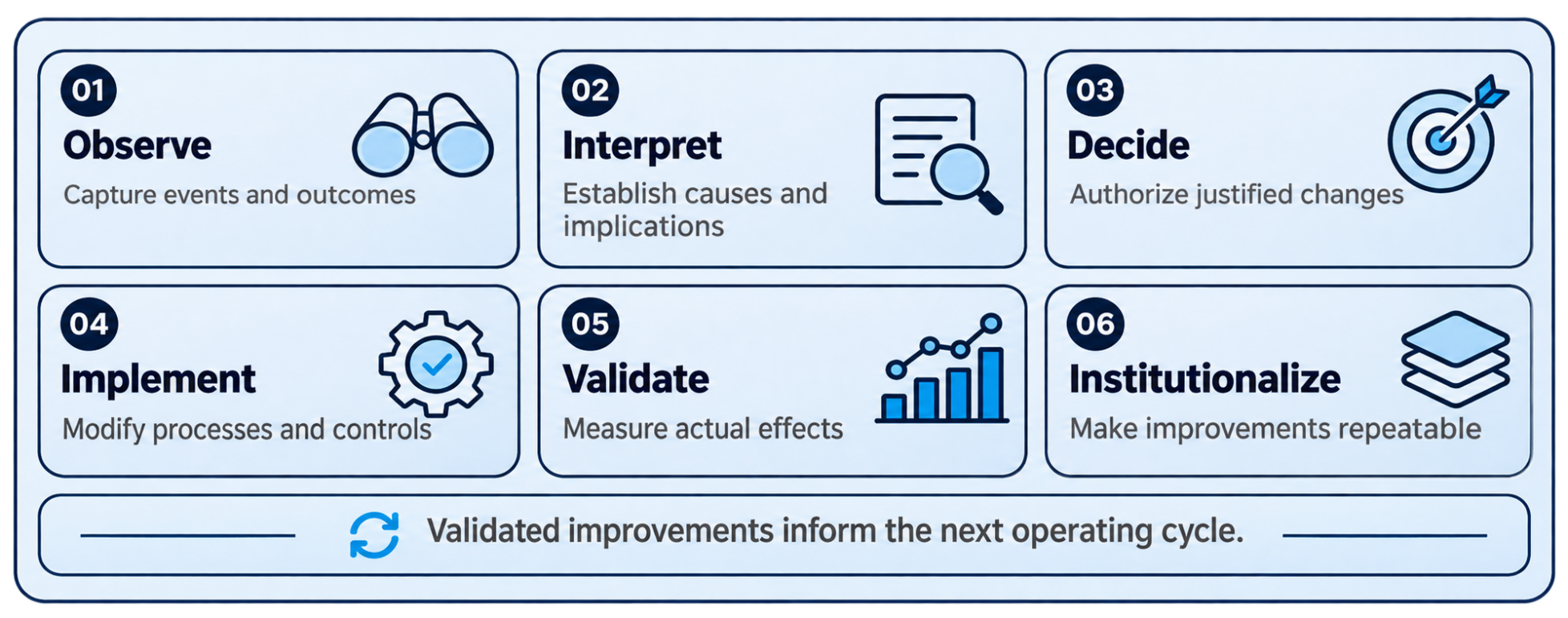
An AI-native enterprise should be able to answer several questions about this cycle.
How quickly does it detect material changes?
How long does it take to establish a credible explanation?
Where do decisions become delayed?
How rapidly can approved improvements be implemented?
How reliably are outcomes validated?
How effectively are lessons incorporated into reusable capabilities?
The organization that performs these activities consistently may develop a compounding advantage.
Each successful improvement strengthens the processes, controls, and institutional knowledge available for subsequent decisions.
However, speed must not come at the expense of validity.
An enterprise that rapidly institutionalizes incorrect conclusions may become more efficient at repeating mistakes.
The objective is not simply faster adaptation.
It is faster, evidence-based adaptation within legitimate governance boundaries.
11. Economic Value Will Depend on Redesign, Not Deployment
The financial implications of AI-native transformation require particular attention.
A company can deploy sophisticated AI capabilities without realizing meaningful economic value.
It may improve employee productivity while leaving operating costs unchanged.
It may increase automation while creating expensive new monitoring and assurance requirements.
It may reduce transaction processing time without improving customer outcomes or financial performance.
These are familiar problems from earlier technology transformations.
The AI-native enterprise must connect architectural and organizational changes to measurable economic outcomes.
Consider three levels of transformation.
| Transformation Level | Example | Economic Question |
|---|---|---|
| Task optimization | AI reduces the time required to prepare a report | Does the saved time produce measurable value? |
| Process redesign | AI coordinates reporting, analysis, and exception handling | Does the redesigned process reduce cost, improve quality, or accelerate decisions? |
| Operating-model transformation | The enterprise changes how decisions, accountability, and execution are organized | Does the new operating model create a sustainable economic advantage? |
The distinction is important.
Task optimization may create capacity.
Process redesign may convert that capacity into measurable operational improvements.
Operating-model transformation may change the enterprise’s cost structure, responsiveness, scalability, or ability to generate value.
Not every AI initiative needs to transform the operating model.
Some targeted applications may deliver excellent returns.
However, an enterprise strategy that never progresses beyond isolated task optimization may fail to capture the larger opportunities associated with AI-native design.
Financial evaluation must include the full economic cost of the transformation.
That includes technology, integration, operations, governance, workforce development, process redesign, transition costs, and ongoing assurance.
The CFO should verify financial value.
Business owners should demonstrate operational outcomes.
The CIO should establish the technical economics and sustainability of the architecture.
The executive committee should determine whether the combined investment advances enterprise strategy.
No single function can credibly establish the entire value case independently.
12. The Transition Will Be Evolutionary, Not a Single Replacement
It would be a mistake to assume that enterprises can simply abandon their existing operating models and rebuild themselves around AI.
Most organizations have substantial investments in established systems, contractual relationships, regulatory obligations, business processes, and workforce capabilities.
These cannot be replaced overnight.
Nor should they be.
The practical transition to AI-native operations will be incremental, governed, and selective.
Some business capabilities will be suitable for substantial redesign.
Others will require careful augmentation.
Certain consequential decisions may remain predominantly human.
Legacy systems may continue to serve as authoritative transaction platforms while AI capabilities provide new coordination and intelligence services.
A useful transition model contains five stages.
- Establish architectural and governance foundationsDefine enterprise AI principles, authoritative information sources, decision rights, technical standards, accountability, and evidence requirements.
- Identify high-value end-to-end processesPrioritize processes where fragmented information, coordination delays, repeated decisions, and operational friction create measurable business constraints.
- Redesign bounded operating capabilitiesIntroduce AI within clearly defined processes, with explicit authority, intervention mechanisms, outcome measures, and accountable owners.
- Validate business and control performanceEvaluate economic results, operational reliability, human oversight, exceptions, and evidence quality before expanding delegated authority.
- Scale proven architectural patternsReuse successful capabilities, shared services, governance controls, and learning mechanisms across additional business domains.
This approach avoids two extremes.
The first is deploying AI everywhere without sufficient architectural discipline.
The second is attempting to design an ideal future enterprise before delivering any operational value.
The better strategy is to build reusable enterprise capabilities through controlled, measurable transformation.
An AI-native enterprise emerges through repeated architectural and operating-model decisions.
It is not created by purchasing a particular platform.
13. A New Enterprise Operating Model Requires a New Accountability Model
The more deeply AI participates in enterprise operations, the more important it becomes to distinguish responsibility for technology from accountability for business outcomes.
An AI-native enterprise requires an explicit allocation of executive responsibilities.
| Executive or Governance Function | Principal Accountability |
|---|---|
| Board of directors | Oversight of enterprise strategy, material risks, and executive accountability |
| CEO and executive committee | Enterprise AI strategy, operating-model transformation, and cross-functional priorities |
| Business executives | Authorized business decisions, process outcomes, and value realization |
| CIO | Enterprise AI architecture, integration, technical enforcement, and operational reliability |
| CDO and data governance | Information ownership, quality, authority, and permitted use |
| CISO | Cybersecurity risk management, security requirements, and security assurance |
| CAIO, where appointed | Assigned AI strategy coordination, capability standards, and governance responsibilities |
| CFO | Investment economics, financial oversight, and verification of realized value |
| General Counsel and compliance | Legal interpretation, regulatory obligations, and compliance requirements |
| Human resources and business leadership | Workforce transformation, capability development, and organizational change |
| Internal audit or independent assurance | Independent evaluation of governance, risk management, and controls |
The precise allocation will vary with organizational size, regulatory requirements, and executive structure.
The governing principle should remain consistent.
Authority must be assigned deliberately, accountability must remain identifiable, and technical systems must enforce approved boundaries.
The enterprise should not rely on ambiguous collective ownership when an AI-enabled process produces a consequential outcome.
Shared participation is not a substitute for accountable leadership.
14. The Evidence Architecture of the AI-Native Enterprise
A conventional enterprise may document important decisions through meeting minutes, approval records, project artifacts, and operational logs.
An AI-native enterprise will need more integrated evidence capabilities.
Consider a material decision executed through an AI-enabled process.
To reconstruct that decision, the organization may need to establish:
- The business objective being pursued.
- The information available at the time.
- The provenance and authority of that information.
- The applicable policies and decision permissions.
- The AI system, model, and relevant configuration involved.
- The identity and scope of the authorized agent or user.
- The action recommended, approved, or executed.
- Any exceptions, overrides, or interventions.
- The resulting operational and business outcomes.
- The evaluation and corrective actions that followed.
These records may reside across several systems.
The challenge is not merely collecting logs.
It is preserving the relationships necessary to explain how an authorized business decision became an operational action and produced a particular result.
This is the architectural problem addressed by Evidentiary Architecture™.
The central proposition is that evidence should be designed into governance and operational systems rather than assembled only when an audit, investigation, or incident occurs.
For the AI-native enterprise, this becomes especially significant.
An organization may operate thousands of AI-assisted decisions and automated actions.
Manually reconstructing their legitimacy after the fact may be impractical.
Evidence generation must therefore become a deliberate architectural capability.
That does not mean preserving every possible technical detail indefinitely.
Retention, privacy, proportionality, and legal requirements must govern what is recorded and how long it is maintained.
The objective is to preserve sufficient, trustworthy evidence to support accountability, assurance, investigation, and organizational learning.
The AI-native enterprise must be able to explain not only what its intelligent systems did, but why those actions were authorized and whether they achieved their intended outcomes.
15. What the Board Should Expect From an AI-Native Strategy
Boards should be cautious when management describes an organization as AI-native.
The term can become another technology label without corresponding organizational substance.
A credible AI-native strategy should demonstrate more than model deployment, employee adoption, or an expanding inventory of AI agents.
Directors should expect evidence that management is addressing fundamental enterprise design questions.
Is the operating model changing?
Can management identify processes and organizational arrangements that have been redesigned around measurable outcomes rather than merely supplemented with AI tools?
Are decision rights explicit?
Can the enterprise distinguish human authority, delegated AI authority, technical permissions, and retained business accountability?
Is information trustworthy?
Are authoritative sources, ownership, provenance, and permitted information uses sufficiently established for consequential AI operations?
Are technical controls enforceable?
Can the organization demonstrate effective access restrictions, transaction limits, exception handling, suspension, and revocation?
Are the economics credible?
Can management connect AI-enabled changes to measurable financial and operational results after accounting for the full cost of implementation and operation?
Is the enterprise learning?
Does the organization systematically convert operational evidence into validated process, control, and capability improvements?
Can decisions be reconstructed?
Does management possess sufficient evidence to explain how consequential AI-enabled decisions were authorized, executed, and evaluated?
These questions shift oversight away from technology adoption alone.
They direct attention toward organizational capability, legitimate authority, sustainable economics, and demonstrable control.
That is the appropriate board-level perspective.
16. The Competitive Divide Will Be Architectural
Artificial intelligence capabilities are becoming increasingly accessible through commercial platforms, cloud services, enterprise applications, and open technology ecosystems.
Although significant differences in model quality, cost, reliability, and specialized capability remain, access to a powerful model alone may become a less durable source of differentiation for many enterprises.
The more consequential advantage may arise from how organizations combine intelligence with their own operating capabilities.
Consider two hypothetical companies with access to comparable AI technology.
Company A deploys AI across departments.
Employees use assistants.
Managers introduce automated reporting.
Individual teams experiment with agents.
Productivity improves in selected activities.
But business processes, decision rights, information authority, and accountability remain largely unchanged.
Company B approaches AI as an enterprise architecture and operating-model transformation.
It establishes shared information services.
It defines decision authority.
It redesigns selected end-to-end processes.
It implements enforceable controls.
It measures realized economic outcomes.
It preserves operational evidence.
And it systematically incorporates validated improvements into future operations.
Both organizations may possess similar AI capabilities.
Their enterprise capabilities will not be equivalent.
Company B may be better positioned to scale successful practices, control operational exposure, and adapt to changing conditions.
Its advantage would not reside solely in the intelligence of its models.
It would reside in the architecture of the enterprise using them.
This distinction also explains why purchasing more sophisticated AI technology does not automatically produce superior organizational performance.
Competitive advantage will depend increasingly on the enterprise’s ability to turn accessible intelligence into coordinated, accountable, and continuously improving business capability.
17. The Executive Imperative: Design the Enterprise You Intend to Become
The transition to AI-native operations will require choices that extend beyond the CIO’s authority.
The CEO must establish strategic direction.
Business executives must reconsider processes and decision rights.
The CFO must establish credible economic measures.
The CDO must strengthen information governance.
The CISO must address changing security exposures.
Legal and compliance leadership must interpret applicable obligations.
Human resources must support workforce redesign.
The CIO must provide the architectural and operational foundation.
And the board must exercise appropriate oversight.
A practical executive agenda should begin with eight actions.
1. Define the future operating principles. Establish how human and AI capabilities should contribute to business outcomes, including the limits of delegated authority.
2. Identify organizational constraints. Determine where information fragmentation, unnecessary coordination, slow decisions, and legacy process design restrict enterprise performance.
3. Prioritize outcome-centered transformation. Select end-to-end business capabilities where redesign offers credible economic or operational value.
4. Establish architectural coherence. Create reusable information, identity, integration, AI orchestration, enforcement, observability, and evidence capabilities.
5. Assign decision rights and accountability. Distinguish legitimate business authority from technical execution permissions.
6. Redesign workforce and management responsibilities. Preserve essential human judgment, develop new competencies, and align incentives with enterprise outcomes.
7. Measure economic and operational performance. Evaluate realized value, reliability, risk, and adaptability rather than relying on adoption or activity metrics.
8. Institutionalize organizational learning. Use validated evidence to improve processes, controls, architecture, and decision-making continuously.
These actions should not be treated as a one-time transformation checklist.
They represent an ongoing discipline of enterprise design.
As AI capabilities evolve, the organization will need to reconsider which activities should be automated, which decisions require human authority, and which architectural controls remain appropriate.
The AI-native enterprise is not a static destination.
It is an operating model designed to adapt responsibly.
18. Boardroom Takeaway
The board should not ask management merely how much artificial intelligence the organization has deployed.
It should ask whether the enterprise is becoming structurally more capable because of that investment.
Are business processes becoming more coherent?
Are decisions improving?
Are accountable leaders retaining appropriate authority?
Are technical controls enforceable?
Are economic benefits being realized?
Can the organization explain and defend consequential AI-enabled actions?
Is it learning faster without sacrificing reliability or governance?
These questions distinguish an AI adoption program from an enterprise transformation strategy.
The board’s responsibility is not to design the technical architecture.
It is to ensure that management has established a credible strategy, assigned appropriate accountability, addressed material risks, and can demonstrate whether the transformation is producing sustainable enterprise value.
Conclusion: The Future Enterprise Must Be Designed, Not Merely Automated
Throughout this series, one principle has remained consistent:
Artificial intelligence is not an enterprise strategy by itself.
A roadmap is not a strategy.
A use-case backlog is not a business model.
A sophisticated model is not an operating architecture.
A successful pilot is not evidence of enterprise readiness.
A productivity improvement is not automatically an economic return.
An AI agent’s technical capability is not legitimate decision authority.
And deploying artificial intelligence across an existing organization does not automatically create an AI-native enterprise.
The transformation requires a more fundamental reconsideration of how the organization creates value.
Information must become trustworthy and usable.
Decision rights must become explicit.
Processes must be designed around outcomes.
Technology must support coordinated execution.
Governance must operate where consequential actions occur.
Evidence must connect decisions to results.
Human expertise must be directed toward judgment, authority, innovation, and accountability.
And organizational learning must become a continuous operating capability.
The enterprise of the future may still have departments, executives, employees, applications, and established governance structures.
But their relationships, responsibilities, and operating assumptions may be substantially different.
The most successful organizations will not necessarily be those that automate the greatest number of tasks.
They will be those that understand which organizational constraints artificial intelligence can remove, which responsibilities must remain human, and how to design an enterprise that converts intelligence into sustainable economic and operational advantage.
The AI-native enterprise will not look like today’s enterprise because it will no longer need to be organized around all the same constraints.
The challenge for executive leadership is to recognize that opportunity before the existing operating model becomes the greatest obstacle to realizing it.
References
Brynjolfsson, Erik, Daniel Rock, and Chad Syverson. “Artificial Intelligence and the Modern Productivity Paradox: A Clash of Expectations and Statistics.” In The Economics of Artificial Intelligence: An Agenda, edited by Ajay Agrawal, Joshua Gans, and Avi Goldfarb, 23–57. Chicago: University of Chicago Press, 2019. https://doi.org/10.7208/chicago/9780226613475.003.0001.
Davenport, Thomas H., and Nitin Mittal. All-in on AI: How Smart Companies Win Big with Artificial Intelligence. Boston: Harvard Business Review Press, 2023.
International Organization for Standardization and International Electrotechnical Commission. ISO/IEC 42001:2023: Information Technology—Artificial Intelligence—Management System. Geneva: ISO, 2023.
National Institute of Standards and Technology. Artificial Intelligence Risk Management Framework (AI RMF 1.0). NIST AI 100-1. Gaithersburg, MD: NIST, 2023. https://doi.org/10.6028/NIST.AI.100-1.
National Institute of Standards and Technology. Artificial Intelligence Risk Management Framework: Generative Artificial Intelligence Profile. NIST AI 600-1. Gaithersburg, MD: NIST, 2024. https://doi.org/10.6028/NIST.AI.600-1.
Organisation for Economic Co-operation and Development. OECD Employment Outlook 2023: Artificial Intelligence and the Labour Market. Paris: OECD Publishing, 2023. https://doi.org/10.1787/08785bba-en.
Senge, Peter M. The Fifth Discipline: The Art and Practice of the Learning Organization. Revised and updated ed. New York: Doubleday, 2006.
Weill, Peter, and Jeanne W. Ross. IT Governance: How Top Performers Manage IT Decision Rights for Superior Results. Boston: Harvard Business School Press, 2004.
Series Closing Note
AI Strategy Series | 20 of 20 — Series Conclusion
This article concludes Building the Intelligent Enterprise, a twenty-part examination of artificial intelligence as an enterprise strategy, architecture, governance, operating-model, and economic transformation challenge.
The series began by distinguishing AI strategy from an AI roadmap. It examined business constraints, use-case prioritization, decision authority, data governance, enterprise architecture, technology sourcing, vendor dependencies, workforce transformation, economic value, competitive differentiation, organizational learning, and executive accountability.
It concludes with the proposition that connects those subjects:
The greatest strategic opportunity presented by artificial intelligence is not simply to make the existing enterprise more efficient. It is to design an enterprise capable of operating, governing, and learning in fundamentally better ways.