Data Governance Series | Article 6 of 20
Governing the Information That Drives the Enterprise
Summary
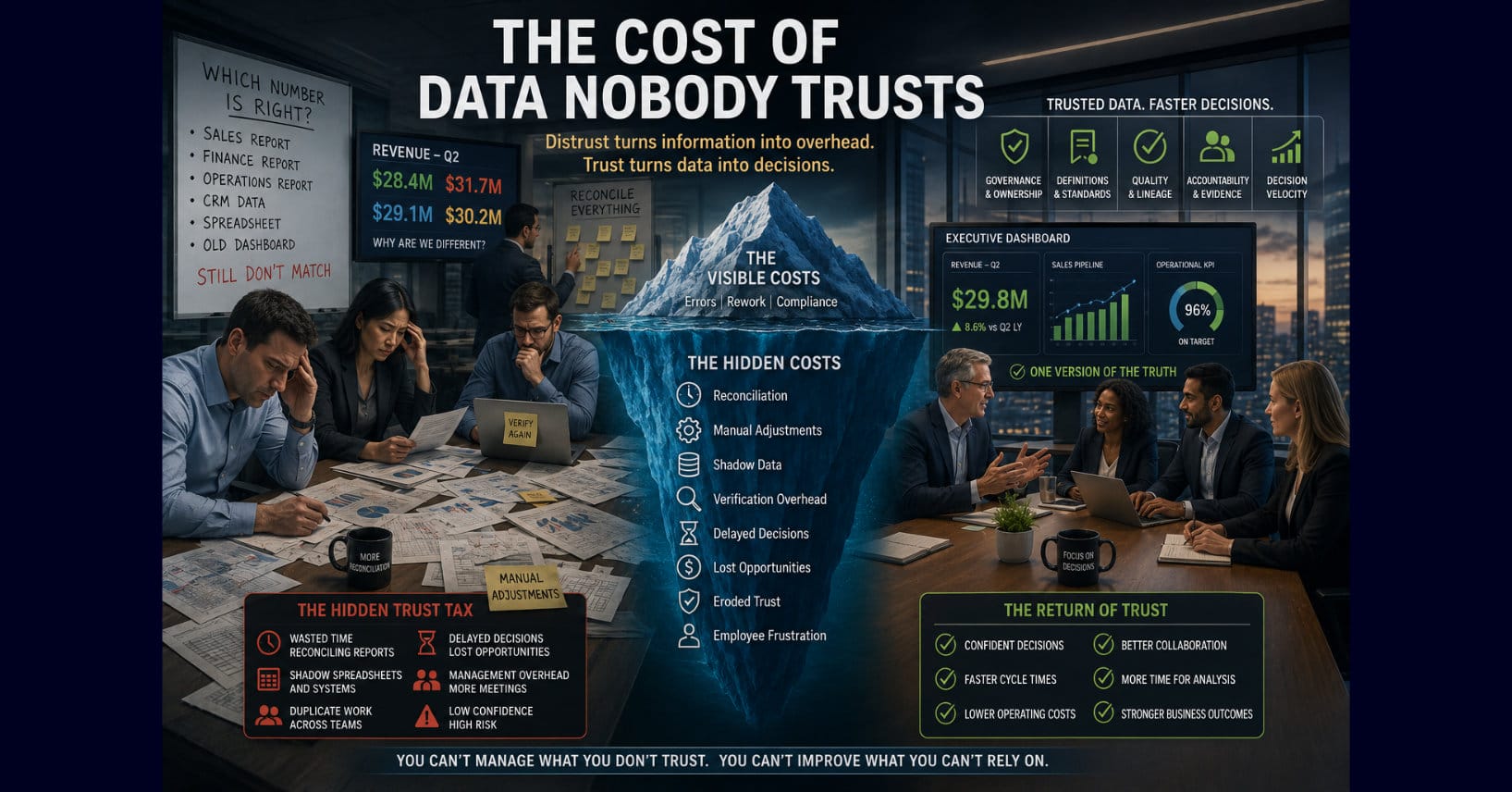
The cost of poor data extends far beyond incorrect records and visible data-quality failures. When employees do not trust enterprise information, they compensate through manual reconciliation, shadow spreadsheets, duplicate analysis, additional meetings, repeated verification, and delayed decisions.
This article examines the hidden economic impact of data distrust and introduces the concept of the enterprise “trust tax.” It explores how low-trust information environments create shadow systems, increase analytics costs, slow decision velocity, generate management overhead, and undermine the value of automation.
The article also examines the implications for AI. Organizations that automate processes using poorly governed data may simply relocate human effort from performing work to verifying machine-generated results. Strong data governance reduces this trust tax by establishing authoritative sources, shared definitions, quality thresholds, lineage, provenance, visible exceptions, controlled change, and evidence.
There is a particular kind of meeting that occurs in almost every sufficiently complex organization.
Someone presents a number.
Someone else says:
“That doesn’t match what I have.”
A second report appears.
Then a spreadsheet.
Someone asks which system the first number came from.
Another person explains that Finance calculates the metric differently.
Operations says its number is more current.
Sales says the CRM is missing several transactions.
Someone mentions that the executive dashboard refreshes overnight.
Another person promises to reconcile everything after the meeting.
The decision that was supposed to be made is postponed.
Nothing technically failed.
Every system may have operated exactly as designed.
But the enterprise experienced a data failure anyway.
It did not trust its own information.
That distrust has a cost.
And in many organizations, the cost is substantially larger than anything appearing on the data governance budget.
Distrust Is an Operating Expense
Organizations usually calculate the cost of poor data by looking for visible failures.
Incorrect invoices.
Duplicate payments.
Returned shipments.
Compliance violations.
Customer-service errors.
Failed integrations.
Bad reports.
Those costs matter.
But data distrust creates another category of expense that is harder to see because it appears as ordinary work.
Employees reconcile spreadsheets.
Analysts validate reports before distributing them.
Managers request additional confirmation.
Finance rebuilds numbers supplied by other departments.
Executives delay decisions.
Teams maintain parallel data stores.
Employees manually check automated outputs.
Meetings are scheduled to resolve discrepancies.
Reports include disclaimers.
People ask colleagues which system they should believe.
Each activity seems reasonable in isolation.
Collectively, they form a trust tax on the enterprise.
The organization is paying people to compensate for information they do not trust.
The Reconciliation Economy
In low-trust data environments, reconciliation becomes a business process.
Sometimes an entire unofficial economy develops around it.
Data moves from an operational system into a warehouse.
An analyst exports it into Excel.
Finance adds adjustments.
Operations maintains a separate workbook.
Someone creates a pivot table to reconcile the two.
The reconciled number is copied into PowerPoint.
An executive asks for supporting detail.
Another analyst reconstructs the calculation.
By the time the information reaches the decision-maker, the organization may have spent hours—or days—establishing confidence in a number that supposedly came from governed enterprise systems.
This work is rarely categorized as a data-quality expense.
It appears as analyst time.
Management time.
Financial planning.
Reporting.
Operations.
Administrative effort.
Meeting time.
The cost is distributed across the organization, which makes it easy to underestimate.
The enterprise may spend millions on data platforms while spending even more in human labor compensating for a lack of trust in their outputs.
Shadow Systems Are Often Trust Systems
Shadow IT is usually discussed as a technology governance problem.
Employees create unauthorized applications, spreadsheets, databases, or workflows outside approved systems.
That certainly creates risk.
But organizations should ask why those shadow systems appeared.
Sometimes the answer is convenience.
Sometimes speed.
Sometimes bureaucracy.
And sometimes trust.
An analyst maintains a spreadsheet because the official report is routinely wrong.
A department creates its own database because enterprise definitions do not reflect operational reality.
A manager keeps a private workbook because the dashboard changes unexpectedly.
Finance maintains manual adjustments because source systems cannot represent important exceptions.
Employees build shadow systems because they need information they believe.
From their perspective, the workaround solves a business problem.
From the enterprise perspective, however, every workaround creates another version of reality.
Now there are more copies.
More transformations.
More undocumented logic.
More dependencies.
More opportunities for disagreement.
Distrust creates shadow data.
Shadow data creates fragmentation.
Fragmentation creates more distrust.
The organization enters a reinforcing cycle.
The Most Expensive Number Is the One Nobody Believes
An incorrect number can be corrected.
A number nobody trusts creates a different problem.
It requires verification before use.
That friction affects decision velocity.
Consider an executive evaluating whether to increase production.
If the demand forecast is trusted, the organization can evaluate the business decision.
If the forecast is not trusted, the conversation changes.
Where did the data come from?
Was the latest sales pipeline included?
Are cancellations reflected?
Did the acquisition data load correctly?
Does Finance agree with Sales?
Which forecast model generated this?
Before leadership can decide what to do, it must first decide whether the information describing reality is credible.
That is decision latency.
And decision latency has economic consequences.
Opportunities expire.
Risks remain unresolved.
Resources sit idle.
Projects wait.
Competitors move.
The cost of low-trust data is therefore not limited to wrong decisions.
It includes decisions made too slowly because the organization must repeatedly establish whether its information can be believed.
Trust Is Not the Same as Accuracy
A dataset can be accurate and still not be trusted.
This distinction matters.
Trust is partly technical.
But it is also institutional.
Employees learn from experience.
If a dashboard has been wrong repeatedly, fixing the underlying defect does not instantly restore confidence.
If a report changes without explanation, users become cautious.
If definitions vary across departments, people begin asking which version applies.
If data-quality problems disappear without visible remediation, employees may assume they are merely hidden.
Trust therefore depends upon more than accuracy.
It depends upon consistency.
Transparency.
Provenance.
Predictability.
Clear definitions.
Visible ownership.
Reliable controls.
And evidence that problems are corrected when discovered.
Trust is accumulated behavior.
So is distrust.
Data Distrust Creates Verification Work
When employees do not trust information, they develop verification behaviors.
They compare the dashboard against yesterday’s spreadsheet.
They call someone in Finance.
They check the source application.
They download the raw data.
They perform their own calculation.
They ask whether anyone else has seen the discrepancy.
For consequential decisions, some verification is appropriate.
Governance should never demand blind faith in a system.
The problem emerges when verification becomes routine because the organization’s normal information products are not considered dependable.
At that point, employees are performing manual assurance that the enterprise’s governance system should have provided.
This can be measured.
Organizations can ask:
How much time do employees spend validating information before using it?
How often are reports manually reconciled?
How many recurring meetings exist primarily to resolve data discrepancies?
How many executive metrics require offline adjustments?
How many business processes rely on spreadsheets because official systems are not trusted?
Those questions begin to reveal the economic footprint of distrust.
Conflicting Metrics Create Political Data
When authoritative definitions are weak, data can become political.
Different functions select the numbers that best represent their perspective.
Sales uses one revenue figure.
Finance uses another.
Operations reports one service level.
Customer support calculates it differently.
Marketing defines an active customer one way.
Product defines it another.
Meetings stop being discussions about business performance and become negotiations over measurement.
That is dangerous.
The organization begins debating whose data is correct rather than what the data means.
In the worst cases, metrics become organizational territory.
Changing a definition threatens someone’s performance target.
Designating an authoritative source affects another department’s reporting.
Correcting a denominator changes a KPI.
At that point, data governance becomes inseparable from management governance.
Someone must have authority to establish enterprise meaning even when the decision is inconvenient.
Otherwise, competing versions of reality persist because resolving them has organizational consequences.
Distrust Increases the Cost of Analytics
Analytics environments are particularly vulnerable to the trust tax.
A data scientist may spend substantial time finding, profiling, cleaning, reconciling, and validating data before meaningful analysis can begin.
Analysts frequently describe this as part of the job.
To some extent, it is.
But organizations should distinguish legitimate analytical preparation from recurring compensation for weak governance.
If every new analysis requires rediscovering:
what a field means;
which source is authoritative;
whether values are complete;
which transformations occurred;
whether duplicates exist;
whether historical definitions changed;
and who can answer questions about the dataset,
then the organization is repeatedly purchasing knowledge it should already possess.
Metadata, lineage, ownership, definitions, and quality evidence reduce that cost.
Governance makes analytics reusable.
Without it, every analytical project begins with archaeology.
AI Makes Trust More Complicated
Artificial intelligence introduces a new trust problem.
Employees may trust AI outputs too much.
Or not at all.
Both conditions create risk.
If enterprise AI retrieves information from poorly governed sources, employees may receive polished answers built upon conflicting, outdated, or non-authoritative data.
The linguistic confidence of the output can conceal the weakness of the underlying information.
That creates false trust.
The opposite problem occurs when employees encounter enough incorrect AI answers that they stop trusting the system.
Now every output requires manual verification.
The organization purchased automation but created another reconciliation process.
The productivity case begins to erode.
This means enterprise AI needs more than model accuracy.
It needs information trust architecture.
Users should be able to understand, where appropriate:
what sources informed an answer;
whether those sources are authoritative;
how current they are;
whether material limitations exist;
whether the output contains generated inference;
and what level of human review is required.
AI trust cannot be separated from data trust.
The Automation Paradox
Automation promises to reduce human effort.
Poor data governance can produce the opposite result.
Suppose an organization automates a process that previously required 100 hours of manual work each week.
The automation reduces direct processing time to 20 hours.
Excellent.
But employees do not trust the output.
They spend 35 hours reviewing exceptions, checking results, reconciling records, and correcting errors.
The organization technically automated 80 hours of work.
It actually saved 45.
If managers continue measuring only automated transactions, they may conclude the program is more successful than it really is.
This is the automation paradox:
The less employees trust automated information, the more human labor is required to supervise the automation intended to remove human labor.
AI can amplify this effect.
An organization may deploy an AI assistant to save employee time while failing to measure how much time employees spend validating what the assistant produces.
Trust determines whether automation generates leverage or merely relocates work.
Distrust Creates Management Overhead
Low-trust data also changes management behavior.
Leaders request more reports.
More validation.
More meetings.
More status updates.
More explanations.
More supporting detail.
This can look like managerial caution.
Sometimes it is.
But repeated demands for additional information may indicate that leadership does not trust the organization’s normal information channels.
The enterprise responds by producing more data.
That can make the problem worse.
More reports create more definitions.
More extracts.
More transformations.
More opportunities for inconsistency.
The solution to low information trust is not necessarily more information.
It is more trustworthy information.
The Cost of Delayed Decisions
Organizations often focus on the cost of bad decisions.
They should also measure the cost of delayed ones.
Suppose a business opportunity worth $2 million requires a decision within ten days.
Leadership spends seven days reconciling conflicting forecasts.
The opportunity closes before the organization acts.
No data-quality incident appears on a dashboard.
No incorrect transaction occurred.
No regulator complained.
The enterprise simply moved too slowly.
Data distrust contributed to the loss.
The same phenomenon appears in risk management.
A cybersecurity issue remains unresolved while teams debate asset inventories.
A supply-chain response is delayed while departments reconcile inventory levels.
A financial decision waits for competing forecasts to be validated.
An acquisition team spends additional weeks reconciling operational data.
Decision latency is difficult to attribute.
But it is real.
And in high-velocity environments, trust becomes a competitive capability.
Trust Has a Governance Architecture
Organizations sometimes treat trust as cultural.
It is partly cultural.
But enterprise data trust can also be designed.
A trustworthy information environment typically includes:
Clear ownership — Someone is accountable for consequential data.
Authoritative sources — Users know which source governs which purpose.
Shared definitions — Business meaning is explicit.
Quality thresholds — Acceptable conditions are defined according to consequence.
Lineage — Material information can be traced to its origin and transformations.
Provenance — Users can understand where information came from.
Visible exceptions — Known limitations are disclosed rather than hidden.
Controlled change — Definitions and transformations do not change without governance.
Evidence — The organization can demonstrate that controls and reviews occurred.
These capabilities reduce the need for individual employees to create their own trust mechanisms.
That is where governance produces economic value.
Measure the Trust Tax
The trust tax will not appear automatically in a financial statement.
Organizations need to look for it.
Useful indicators may include:
- hours spent reconciling recurring reports;
- number of manual adjustments to executive metrics;
- percentage of reports requiring offline validation;
- duplicate analytical work across business units;
- number of shadow spreadsheets supporting critical processes;
- time spent resolving conflicting definitions;
- decision delays attributable to data uncertainty;
- percentage of automated outputs requiring manual verification;
- AI outputs requiring correction because of source-data problems;
- recurring data disputes escalated to management; and
- employee confidence in authoritative information sources.
None of these measures is perfect.
Together, however, they expose something traditional data-quality dashboards often miss.
The cost of poor governance is not merely the number of defective records.
It is the amount of organizational effort required to compensate for them.
Data Trust Is an Enterprise Asset
Trustworthy data creates leverage.
Employees move faster.
Analysts spend more time analyzing and less time reconciling.
Executives spend more time deciding and less time debating the numbers.
Automation requires less supervision.
AI outputs become easier to evaluate.
Cross-functional collaboration improves because teams share a common informational foundation.
Governance becomes less visible precisely because fewer people need to compensate for its absence.
That is an important point.
The best data governance may not create more governance activity.
It may eliminate unnecessary business activity.
Fewer reconciliation meetings.
Fewer shadow spreadsheets.
Fewer duplicate reports.
Fewer arguments over definitions.
Fewer manual corrections.
Fewer delayed decisions.
Those are governance outcomes too.
From Trust to Decision Velocity
The economic chain becomes clear:
Governance → Data Quality → Information Trust → Decision Velocity → Business Outcomes
Strong governance does not guarantee that every decision will be correct.
It does something more fundamental.
It allows leaders to spend their time evaluating the business decision rather than first determining whether the information describing the business can be believed.
That distinction becomes increasingly valuable as organizations operate faster and AI accelerates information production.
The enterprise that cannot trust its data will not become faster simply because it deploys faster technology.
It may merely generate uncertainty more quickly.
Boardroom Takeaway
Data distrust is not an abstract data-management concern.
It is an operating expense.
Organizations pay for it through reconciliation, duplicated analysis, shadow systems, manual verification, management overhead, delayed decisions, and lost opportunities.
Executives should therefore look beyond traditional data-quality metrics and ask how much organizational effort is being spent compensating for information that employees do not trust.
The leadership question is:
“How much are we paying people to verify information our enterprise systems are supposed to make trustworthy?”
The answer may reveal one of the largest hidden costs in the organization’s data environment.
Because the cost of bad data is not limited to what happens when someone believes it.
Sometimes the greater cost comes from what happens when nobody does.
Coming Next
Article 7: Metadata Is Becoming Governance Infrastructure
Metadata has traditionally been treated as documentation about data: definitions, labels, classifications, schemas, and technical attributes.
That role is changing.
As enterprise information moves across cloud platforms, analytics environments, APIs, AI systems, and automated workflows, metadata increasingly determines whether people and machines can understand what information means, where it came from, whether it is authoritative, how it may be used, and what governance requirements apply.
The next article examines why metadata is moving from the margins of data management into the control plane of the governed enterprise.