Data Governance Series | Article 2 of 20
Governing the Information That Drives the Enterprise
Summary
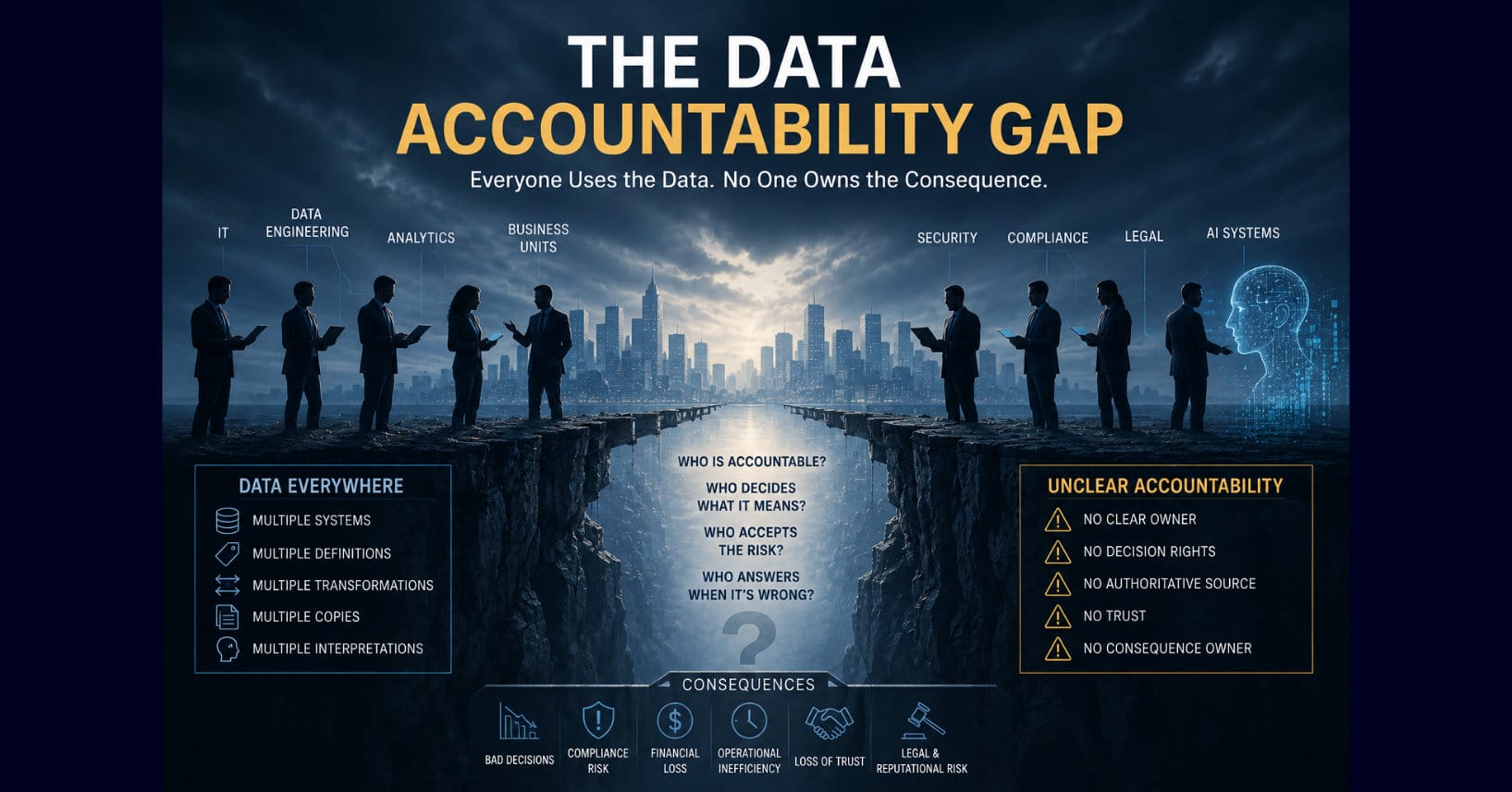
Modern enterprises distribute responsibility for data across IT, data engineering, security, privacy, compliance, analytics, business units, vendors, and increasingly AI systems. Yet when consequential data is inaccurate, outdated, contradictory, or misused, organizations often struggle to identify who ultimately answers for the outcome.
This article examines the Data Accountability Gap and distinguishes operational responsibility from genuine accountability. It explains why assigning data owners is insufficient without explicit decision rights, why accountability should correspond to business consequence, and how AI extends the accountability chain from data through models, decisions, actions, and outcomes.
The article argues that mature data governance requires organizations to connect ownership with authority, establish escalation and risk-acceptance responsibilities, and preserve evidence demonstrating who made consequential data decisions and why.
Most enterprises can tell you where their data resides.
Far fewer can tell you who is ultimately accountable for what that data means, whether it can be trusted, how it may be used, and what happens when it is wrong.
That distinction exposes one of the most persistent weaknesses in modern data governance:
The Data Accountability Gap.
Organizations have become remarkably good at distributing responsibility for data.
Database administrators maintain it.
Data engineers move it.
Security teams protect it.
Privacy teams regulate its use.
Business analysts interpret it.
Application owners generate it.
Data stewards document it.
Compliance teams monitor requirements around it.
Executives consume it.
AI systems increasingly retrieve, summarize, classify, and act upon it.
Yet when consequential data is inaccurate, contradictory, outdated, improperly used, or misunderstood, accountability can suddenly become remarkably difficult to locate.
Everyone touched the data.
Nobody owned the consequence.
That is the accountability gap.
Responsibility Is Not Accountability
The terms responsibility and accountability are often used interchangeably.
They should not be.
Responsibility concerns who performs an activity.
Accountability concerns who ultimately answers for the outcome.
Several people may be responsible for maintaining a critical dataset. There should still be someone with sufficient authority to answer for whether that dataset is fit for its intended business purpose.
This distinction matters because modern data environments distribute responsibility across increasingly complex technology and organizational ecosystems.
Consider customer data.
The CRM team may maintain the application.
Marketing may define customer segments.
Finance may determine revenue attribution.
Security may establish access controls.
Privacy may establish permissible processing requirements.
Analytics may transform the data for reporting.
A data engineering team may move it into a warehouse.
An AI platform may later retrieve portions of it to answer employee questions.
Every group has responsibilities.
But who is accountable for the enterprise definition of “customer”?
Who determines which system is authoritative?
Who decides whether the information is sufficiently accurate for a particular decision?
Who approves a new use?
Who accepts the risk when known quality problems remain unresolved?
Who answers when an AI system uses that data incorrectly?
Those questions are harder.
They are also where governance begins.
The Problem With Distributed Ownership
Modern enterprises are built around distributed systems.
Data governance therefore cannot depend on the assumption that one person controls everything associated with a dataset.
That would be unrealistic.
The problem is not distributed responsibility.
The problem is distributed responsibility without explicit decision authority.
An organization may have dozens of people responsible for different aspects of a dataset while leaving critical governance decisions undefined.
When that happens, decisions migrate toward whoever happens to be closest to the immediate problem.
A developer decides which field should be treated as authoritative.
An analyst determines how conflicting records should be reconciled.
A project manager approves a new integration.
A vendor configures a default retention period.
An AI implementation team decides which repositories a retrieval system may search.
None of these decisions necessarily reflect negligence.
Quite often, competent people are simply filling governance vacuums because the organization has not established who possesses the authority to decide.
The resulting architecture may function technically while remaining ambiguous organizationally.
That ambiguity accumulates.
Eventually, it becomes risk.
The Spreadsheet Everyone Trusts
Nearly every mature organization has some version of the spreadsheet everyone trusts.
The official system contains the data.
The warehouse contains the data.
The reporting platform contains the data.
But somewhere there is also a spreadsheet maintained by someone who understands how the numbers actually work.
That spreadsheet may contain corrections.
Mappings.
Exceptions.
Manual adjustments.
Definitions that were never incorporated into the source system.
Institutional knowledge encoded in formulas that perhaps only one employee fully understands.
Executives may trust the spreadsheet more than the enterprise platform because experience has demonstrated that it produces the number they expect.
This is not merely a technology problem.
It is evidence of an accountability problem.
Why was the authoritative business logic allowed to migrate outside the governed system?
Who owns those adjustments?
Who validates them?
Who approves changes?
What happens when the employee maintaining the spreadsheet leaves?
If leadership relies upon the output, then the organization has implicitly assigned authority to an artifact that may have little formal governance around it.
Shadow data environments often emerge because formal systems fail to satisfy operational needs.
But once those environments begin influencing consequential decisions, governance must follow them.
Data Ownership Often Exists Only on Paper
Many organizations have addressed accountability by establishing data owners and data stewards.
That is an important step.
But assigning titles does not automatically establish accountability.
A data catalog may identify Jane Smith as the owner of Customer Master Data.
What exactly does Jane own?
Can she reject a proposed integration?
Can she require remediation when quality falls below an acceptable threshold?
Can she determine which source is authoritative?
Can she prohibit an AI system from using the dataset?
Can she require changes to business processes that generate poor-quality data?
Can she approve exceptions?
Can she accept residual risk?
If the answer to most of those questions is no, Jane may not actually be the data owner.
She may simply be the person whose name appears in the catalog.
Ownership without decision rights is administrative labeling.
Governance requires authority.
Accountability Must Follow Consequence
Not every dataset requires the same governance structure.
An internal list of office supply inventory does not necessarily need executive ownership.
Financial reporting data does.
Patient data does.
Customer identity data may.
Safety-critical operational data certainly can.
Data used to train or ground consequential AI systems increasingly will.
The level of accountability should therefore correspond to the consequence of the decisions the data supports.
This suggests a different approach to data classification.
Organizations traditionally classify data primarily according to sensitivity:
Public.
Internal.
Confidential.
Restricted.
That remains necessary, particularly for cybersecurity and privacy.
But governance requires another dimension:
Decision consequence.
What happens if this data is wrong?
What happens if it is outdated?
What happens if it is incomplete?
What happens if it is interpreted incorrectly?
What happens if an automated system acts upon it?
What happens if an executive relies upon it?
What happens if the organization must later defend the decision?
Those questions help determine the level of governance required.
The Accountability Chain
One useful model is to think about accountability as a chain rather than a single assignment.
For consequential enterprise data, the organization should be able to trace:
Source → Owner → Stewardship → Transformation → Consumption → Decision → Outcome
Each stage introduces different responsibilities.
The source establishes where the information originated.
Ownership establishes who has decision authority over its meaning and permissible use.
Stewardship establishes who maintains defined governance practices.
Transformation establishes how the data was modified.
Consumption identifies the systems, people, and models using it.
Decision identifies what business judgment or automated action depended upon it.
Outcome identifies what happened as a result.
When those connections are visible, governance becomes operational.
When they are invisible, accountability fragments.
The organization may know who maintains the database without knowing who answers for the decision the database ultimately influenced.
AI Extends the Accountability Chain
Artificial intelligence makes this problem substantially more complicated.
Traditional analytics generally produces information for a human to interpret.
AI can increasingly participate in the interpretation itself.
An enterprise AI assistant may retrieve data from multiple repositories, synthesize it, infer relationships, generate recommendations, and present the result in language that appears authoritative.
Agentic systems can go further by initiating actions.
That introduces a new accountability chain:
Data → Model → AI Output → Human or Automated Decision → Action → Outcome
Who is accountable when something goes wrong?
The data owner?
The model provider?
The AI platform team?
The employee who accepted the recommendation?
The executive who authorized deployment?
The vendor whose system generated the output?
The answer will depend on the circumstances.
But “the AI did it” cannot become an accountability model.
Organizations must define decision authority before automated systems begin exercising it.
Otherwise, AI does not eliminate the accountability gap.
It widens it.
Data Owners Need Explicit Decision Rights
A mature governance model should define what data ownership actually permits and requires.
Depending on the data and its business consequence, those decision rights may include authority over:
- authoritative source designation;
- business definitions and semantic standards;
- acceptable quality thresholds;
- classification requirements;
- permissible business uses;
- access criteria;
- retention requirements;
- sharing with third parties;
- AI access and consumption;
- exception approval;
- remediation priorities; and
- residual risk acceptance.
Not every data owner should exercise every one of these authorities independently.
Privacy, cybersecurity, legal, compliance, records management, and business leadership may have overlapping or superior authority depending on the issue.
That is precisely why the governance model must make the boundaries explicit.
The objective is not to create a data dictator.
It is to eliminate ambiguity about who can decide what.
Committees Do Not Automatically Create Accountability
Organizations often create governance councils to resolve these issues.
Councils can be valuable.
They can also become places where accountability disappears into collective discussion.
A committee reviews a problem.
Everyone provides input.
A consensus emerges.
The meeting ends.
Six months later, someone asks why the decision was made.
The answer is:
“The governance committee approved it.”
Which person accepted the risk?
Which evidence supported the decision?
Which alternatives were considered?
Who was responsible for implementation?
When was the decision supposed to be reviewed?
The minutes may not say.
Collective governance still requires identifiable decision authority.
A governance council can advise, challenge, coordinate, and approve according to defined authority.
But consequential decisions should still produce an accountable decision record.
Otherwise, governance activity exists without governance evidence.
Accountability Requires Evidence
This brings us to an important distinction.
It is not enough to assign accountability.
The enterprise must be able to demonstrate it.
For consequential data, evidence might include:
- documented ownership;
- accepted decision rights;
- approved definitions;
- authoritative source designation;
- quality thresholds;
- lineage records;
- exception decisions;
- remediation actions;
- access approvals;
- AI-use approvals;
- periodic reviews; and
- risk acceptance decisions.
This creates something more valuable than a governance chart.
It creates a record of governance actually occurring.
When regulators, auditors, customers, boards, insurers, or litigators eventually ask how a consequential decision was made, the organization should not have to reconstruct accountability from email threads and employee recollection.
The evidence should already exist.
The Executive Question Changes
Executives traditionally ask:
Who owns the data?
That question is becoming insufficient.
A better set of questions is:
Who has authority to determine what this data means?
Who determines whether it is sufficiently trustworthy for this decision?
Who can approve or reject its use?
Who accepts the risk when known deficiencies remain?
Who answers for the outcome when the data influences a consequential decision?
These questions expose whether accountability is real or merely documented.
They also force the organization to connect data governance with operational governance.
That connection will become increasingly important as AI moves from experimentation into business processes.
Closing the Gap
The Data Accountability Gap does not exist because organizations lack intelligent people.
It exists because enterprise data evolved faster than the governance structures surrounding it.
Systems became distributed.
Cloud platforms multiplied.
SaaS applications proliferated.
Analytics expanded.
Data pipelines became more complex.
Third parties became embedded in business processes.
And now AI systems are consuming information across boundaries that were never designed with machine reasoning in mind.
Organizations responded by distributing responsibility.
The next step is to reconnect that responsibility to authority and consequence.
That means identifying consequential data.
Defining ownership.
Establishing decision rights.
Connecting accountability to business decisions.
Recording governance actions.
And preserving evidence.
Because eventually, someone will ask:
Who was accountable for this?
A mature enterprise should not need an investigation to discover the answer.
Boardroom Takeaway
The most important data governance question is not who maintains the data.
It is who answers for its use and consequences.
Executives and boards should expect clear accountability for data supporting consequential business decisions, including defined ownership, explicit decision rights, authoritative sources, escalation paths, and evidence that governance actually occurred.
The question leadership should ask is:
“For the data driving our most consequential decisions, can we identify who has the authority to decide—and who is accountable when that decision is wrong?”
If the answer requires a meeting to determine, the accountability gap already exists.
Coming Next
Article 3: Data Ownership Without Decision Rights Is an Illusion
Organizations frequently claim to have solved data accountability by assigning data owners. But ownership means little when those owners lack the authority to determine how data is defined, governed, used, corrected, or restricted. The next article examines what real data ownership requires—and why a name in a data catalog is not enough.