Data Governance Series | Article 4 of 20
Governing the Information That Drives the Enterprise
Summary
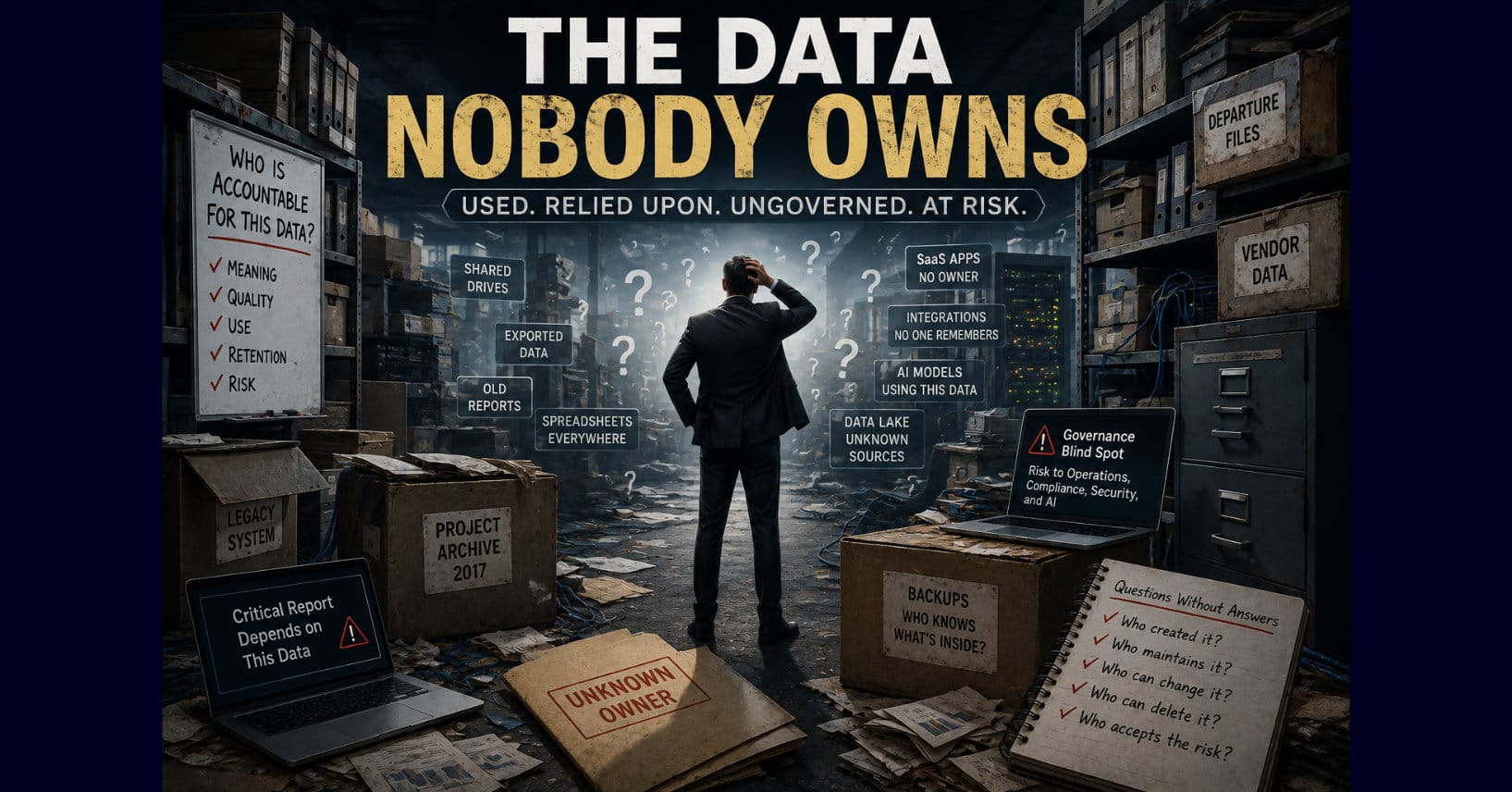
Orphaned data is not merely abandoned information. The greater governance risk is data that remains operationally important after accountability for its meaning, quality, use, retention, and risk has disappeared.
This article examines how organizational change, legacy systems, SaaS adoption, integrations, spreadsheets, derived datasets, and employee turnover create ownerless information. It distinguishes technical system ownership from genuine data ownership and explores how transformations can create new information assets requiring their own accountability.
The article also examines an emerging challenge: AI systems that generate summaries, classifications, inferences, scores, and other persistent information that subsequently becomes enterprise data. Organizations must discover consequential orphaned information, trace its dependencies, and make explicit decisions to assign, transfer, archive, or dispose of it before unmanaged data becomes operational, cybersecurity, regulatory, or AI risk.
Some of the most dangerous data in an enterprise is not necessarily the most sensitive.
It is the data nobody owns.
It may sit in a shared drive.
Live inside an old application.
Move through an integration nobody remembers building.
Feed an executive dashboard.
Populate a spreadsheet used every Monday morning.
Reside in a SaaS platform purchased by a business unit.
Flow into a data lake from a system that was retired three years ago.
Or quietly become part of the knowledge retrieved by an enterprise AI assistant.
People still use it.
Systems still depend upon it.
Decisions may still be made from it.
But ask who is accountable for its meaning, quality, permissible use, retention, or continued existence, and the answer becomes unclear.
That is orphaned data.
And as enterprise information environments become more distributed, automated, and AI-enabled, orphaned data is becoming a governance risk organizations can no longer afford to ignore.
Orphaned Does Not Mean Unused
The phrase “orphaned data” can sound like abandoned information.
Sometimes it is.
A former employee’s files remain on a server.
An application is retired but its database is preserved.
A project ends and leaves behind a collection of spreadsheets, exports, and reports.
Those are familiar examples.
But the more consequential form of orphaned data is different.
It is still being used.
An operations team may rely on it.
A report may query it.
An API may expose it.
A downstream application may consume it.
An analyst may transform it.
An AI system may retrieve it.
The problem is not that the data has been forgotten.
The problem is that accountability for it has been forgotten while dependency upon it remains.
That combination is far more dangerous.
How Data Becomes Orphaned
Organizations rarely decide deliberately to create ownerless data.
It emerges through normal enterprise change.
A department creates a dataset for a temporary project.
The project becomes permanent.
The employee who created it leaves.
The dataset remains.
A company acquires another company.
Systems are integrated.
Some data is migrated.
Some is mapped.
Some is copied.
Some remains in legacy platforms because moving it is too difficult.
Years later, employees still depend upon those platforms.
A business unit purchases a SaaS application using its own budget.
Data accumulates.
The original sponsor changes roles.
The vendor relationship continues.
Nobody revisits ownership.
An integration copies information from one system to another.
The source has an owner.
The destination has an application owner.
But nobody explicitly owns the transformed dataset between them.
A data science team creates a derived dataset.
It combines information from five governed sources.
Each source has an owner.
The derived product does not.
A spreadsheet begins as an analyst’s workaround.
It becomes the trusted source for a recurring executive report.
The analyst becomes the de facto owner without ever receiving formal authority or accountability.
These scenarios are ordinary.
That is precisely why the risk is easy to underestimate.
Organizational Change Creates Governance Debris
Enterprises change continuously.
People leave.
Departments reorganize.
Applications are replaced.
Companies merge.
Vendors change.
Projects end.
Responsibilities move.
Data often does not.
It persists.
Over time, organizations accumulate what might be called governance debris: information assets whose technical existence survived the organizational structures that originally governed them.
The application may still function.
The database may still be backed up.
The integration may still run every night.
From an operational perspective, nothing appears broken.
But the governance context has disappeared.
Who approves changes?
Who validates definitions?
Who decides whether the information remains necessary?
Who determines whether retention requirements have been satisfied?
Who accepts quality risk?
Who authorizes new uses?
The system can continue operating for years without those questions being answered.
Until something goes wrong.
The Difference Between System Ownership and Data Ownership
One reason orphaned data persists is that organizations confuse application ownership with data ownership.
Someone owns the system.
Therefore, the organization assumes someone owns the data.
Those are not necessarily the same thing.
An application owner may be accountable for availability, functionality, upgrades, vendor management, or technical operations.
That person may have no authority to determine what the information means or how it may legitimately be used.
Similarly, infrastructure teams may host databases without owning the business information stored within them.
Cloud teams may manage storage without owning the files.
Security teams may protect access without owning the business purpose.
IT can know exactly where the data resides while the enterprise remains unable to answer who governs it.
Technical custody is not business ownership.
That distinction becomes increasingly important as data moves across systems.
Derived Data Creates New Ownership Questions
One of the most overlooked sources of orphaned data is transformation.
Suppose five governed datasets are combined to produce a sixth.
The source data has owners.
Who owns the new dataset?
The answer is not automatically “all five owners.”
The derived dataset may introduce new meaning.
New assumptions.
New classifications.
New quality risks.
New business uses.
New consequences.
Consider a customer-risk score created from transaction history, demographic information, service interactions, fraud indicators, and external data.
Each source may be individually governed.
But the resulting score is a new information asset.
Someone must be accountable for how it is calculated, what it means, where it may be used, what limitations apply, and what happens when it is wrong.
The same issue arises with analytics.
Aggregations.
Data products.
Machine-learning features.
Knowledge graphs.
AI embeddings.
Inferences.
Scores.
Predictions.
Governance cannot stop at the source data.
New information can create new accountability requirements.
The AI Orphan Problem
Artificial intelligence adds another category of information that organizations are only beginning to confront.
AI systems can generate information that did not previously exist.
Summaries.
Classifications.
Recommendations.
Predictions.
Extracted entities.
Inferred relationships.
Risk scores.
Synthetic content.
Agent-generated records.
Who owns those outputs?
More importantly, who governs them once other systems begin treating them as data?
Imagine an AI system summarizes a customer interaction.
That summary is written into the CRM.
Another system later retrieves it.
An analyst includes it in a customer profile.
A second AI system uses the profile as context.
The original AI-generated summary has now become enterprise data.
Who is accountable for its accuracy?
What is its provenance?
Should it be labeled as machine-generated?
Can it be corrected?
Should the original source material be preserved?
How long should the inference remain valid?
Can another AI system treat it as authoritative?
Without explicit governance, AI can create orphaned data at machine speed.
The problem is no longer merely discovering forgotten information.
It is preventing automated systems from continuously producing information whose accountability is undefined.
Shared Drives Are Governance Archaeology Sites
Shared drives, collaboration platforms, and document repositories deserve particular attention.
They often contain years of organizational history.
Policies.
Draft policies.
Superseded procedures.
Presentations.
Reports.
Contracts.
Meeting notes.
Project documentation.
Exports.
Spreadsheets.
Reference materials.
Copies of copies.
The information may remain accessible long after its original business context has disappeared.
Humans often navigate this ambiguity using institutional knowledge.
Employees know which folder matters.
They recognize an outdated template.
They remember that the spreadsheet labeled “Final” was actually replaced by “Final_v3_Approved.”
AI does not possess that institutional memory unless the organization encodes it.
Connect an AI retrieval system to an unmanaged repository and decades of governance ambiguity can suddenly become machine-accessible context.
The organization has not solved its information problem.
It has automated access to it.
The Hidden Risk of “Read Only”
Organizations sometimes underestimate orphaned data because nobody is changing it.
“It is read only.”
That may reduce integrity risk.
It does not eliminate governance risk.
Read-only data can still be:
misinterpreted;
outdated;
incorrect;
inappropriately disclosed;
retained beyond requirements;
used outside its intended purpose;
combined with other information;
fed into analytics;
retrieved by AI;
or relied upon for consequential decisions.
A dataset does not need write access to cause harm.
It merely needs someone—or something—to trust it.
Orphaned Data Creates Security Risk
Ownerless data also creates a cybersecurity problem.
Security teams can protect information effectively only when the organization understands its value, sensitivity, and purpose.
If ownership is unclear, classification may be unclear.
If classification is unclear, controls may be inappropriate.
Old repositories may retain permissions inherited from years of organizational change.
Former project groups may still possess access.
Service accounts may continue authenticating.
APIs may remain enabled.
Third-party integrations may still retrieve information.
Backups may preserve data indefinitely.
Security teams can discover technical exposures.
But they cannot independently determine whether the information should still exist.
That requires business governance.
Orphaned Data Creates Privacy and Regulatory Risk
Retention is another major concern.
Organizations frequently preserve information because deletion feels riskier than keeping it.
Storage is inexpensive.
Deletion can seem irreversible.
So data accumulates.
But indefinite retention creates its own exposure.
Privacy requirements may establish deletion obligations.
Contracts may impose restrictions.
Litigation may expand discovery burdens.
Security incidents may expose information that no longer served a legitimate business purpose.
AI systems may retrieve information whose original context or permissible use has expired.
The fundamental governance question is:
Who has authority to say this data is no longer needed?
If nobody owns the information, nobody may feel authorized to delete it.
The default becomes preservation.
And “keep everything” quietly becomes the organization’s retention policy.
Orphaned Data Creates Operational Risk
Sometimes the risk is simpler.
Nobody knows how something works.
A report depends on a dataset.
The dataset depends on an integration.
The integration depends on a legacy application.
The legacy application depends on a service account.
The employee who understood the chain retired four years ago.
Everything still works.
Until Tuesday morning.
Then it does not.
The organization discovers that a business-critical process depended upon an information asset whose ownership, lineage, and operational dependencies were never formally documented.
This is where data governance and operational resilience intersect.
If data supports a critical business process, ownership is not optional.
Discovery Is the First Challenge
Organizations cannot govern orphaned data they do not know exists.
Discovery therefore becomes foundational.
Traditional inventories are useful but often incomplete.
A mature discovery process should examine more than databases and registered applications.
It should include:
- cloud storage;
- shared drives;
- collaboration platforms;
- SaaS environments;
- data warehouses and lakes;
- integration platforms;
- APIs;
- analytics environments;
- business intelligence systems;
- spreadsheets supporting recurring processes;
- legacy applications;
- archives;
- backups where appropriate;
- AI knowledge sources;
- vector databases;
- model training and evaluation datasets;
- derived data products; and
- machine-generated information.
The objective is not simply to produce the largest possible catalog.
It is to identify information with meaningful business consequence.
Follow the Dependencies
One of the most effective ways to identify important orphaned data is to work backward from consequential decisions and business processes.
Ask:
What information supports this process?
Where does it come from?
What transformations occur?
What systems consume it?
Who determines what it means?
Who determines whether it is sufficiently reliable?
Who can authorize changes?
Who can authorize deletion?
If the chain reaches a dataset for which those questions have no clear answer, the organization may have found an orphan.
This approach is more practical than attempting to govern every file equally.
Follow the consequence.
Then follow the data.
Every Orphan Needs a Disposition
Discovering orphaned data does not mean every dataset needs a new permanent owner.
Some data should be assigned.
Some should be consolidated.
Some should be archived.
Some should be corrected.
Some should be migrated.
Some should be restricted.
Some should be deleted.
Some should be formally declared obsolete.
The important point is that someone with appropriate authority makes the disposition decision.
An orphaned-data review might produce four basic outcomes:
Assign — The data remains operationally important and receives an accountable owner.
Transfer — Ownership moves to the domain now responsible for the business purpose.
Archive — The data must be preserved but should no longer participate in normal operational use.
Dispose — The data no longer has sufficient business, legal, regulatory, or historical justification for continued retention.
This turns orphan discovery into governance action.
Ownership Must Survive Organizational Change
The best solution is not simply finding today’s orphaned data.
It is preventing tomorrow’s.
Ownership should therefore be part of enterprise change management.
When an employee with data ownership responsibilities leaves, ownership should transfer.
When a business unit reorganizes, affected data domains should be reviewed.
When an application is retired, the disposition of its data should be explicit.
When a vendor relationship ends, retained data and integrations should be addressed.
When a merger occurs, ownership conflicts should be reconciled.
When a new data product is created, ownership should be established before production use.
When an AI system creates persistent information, accountability for those outputs should be defined.
Data ownership should move with organizational reality.
Otherwise, every transformation program leaves behind another layer of governance debris.
Evidence Matters Here Too
Organizations should be able to demonstrate how significant orphaned-data risks were resolved.
That evidence may include:
- discovery records;
- business dependency analysis;
- ownership assignments;
- ownership transfers;
- classification decisions;
- retention determinations;
- archive decisions;
- deletion approvals;
- exception approvals;
- risk acceptance;
- AI-use restrictions; and
- remediation completion.
This is particularly important when data is deleted.
Organizations often preserve information because they fear being unable to explain why it was removed.
A governed disposition process solves that problem.
The organization can demonstrate that deletion was not arbitrary.
It was authorized.
A New Governance Question
For years, data governance programs have asked:
Who owns our critical data?
That remains important.
But modern enterprises should add another question:
What consequential data do we depend upon that nobody owns?
The answer may reveal more risk than the ownership register.
Because governed data tends to receive attention.
Ownerless data lives in the spaces between governance structures.
Between applications.
Between departments.
Between vendors.
Between transformations.
Between old systems and new ones.
Between human processes and AI systems.
Those spaces are multiplying.
Boardroom Takeaway
Orphaned data is not merely abandoned information.
The greater risk is information that remains operationally important while accountability for it has disappeared.
Executives should expect management to identify consequential data without clear ownership, understand the business processes and AI systems that depend upon it, and make explicit decisions to assign, transfer, archive, or dispose of it.
The leadership question is:
“What data does this enterprise depend upon that nobody is accountable for?”
If the organization has never asked, the answer is unlikely to be zero.
Coming Next
Article 5: Data Quality Is a Governance Outcome
Organizations spend enormous amounts of time cleaning data, correcting records, building quality dashboards, and establishing validation rules. Yet persistent data-quality problems frequently originate somewhere else: unclear ownership, weak process controls, conflicting definitions, and absent decision authority.
The next article examines why data quality should be understood not merely as a technical characteristic, but as an outcome produced by the governance system surrounding the data.