Data Governance Series | Article 19 of 20
Governing the Information That Drives the Enterprise
Summary
Organizations have invested heavily in cloud platforms, data lakes, catalogs, analytics, and artificial intelligence. Yet technological sophistication does not necessarily mean the enterprise is ready to rely upon its information.
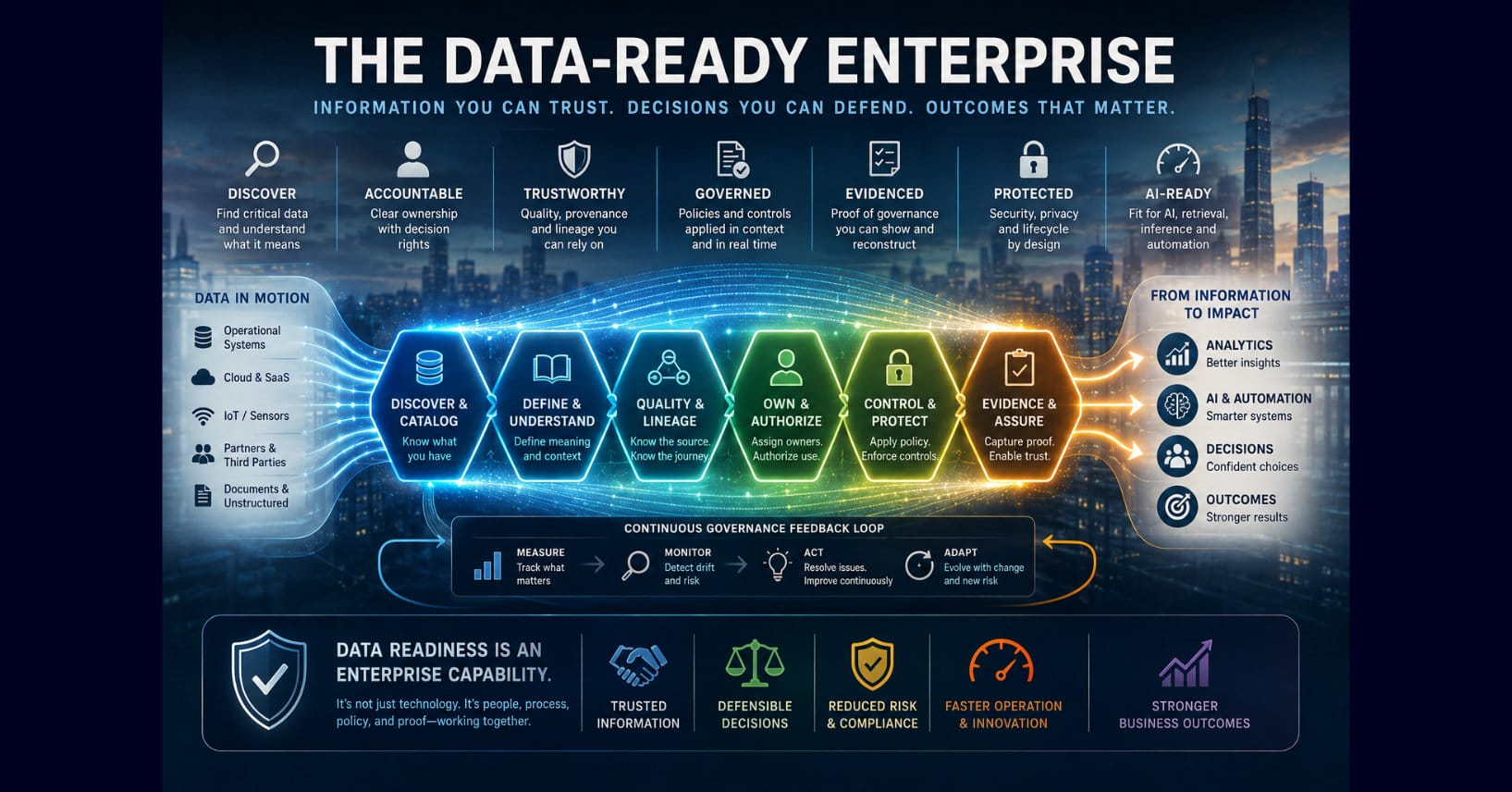
“The Data-Ready Enterprise” brings together the governance principles developed throughout the Data Governance Series and defines data readiness as an enterprise capability rather than a technology condition. A data-ready organization can discover and understand critical information, establish accountability and authority, determine fitness for purpose, trace provenance and lineage, govern third-party dependencies, control information throughout its lifecycle, and demonstrate that governance actually operated.
The article also examines how AI raises the standard for readiness. RAG, generative AI, and agentic systems require machine-readable governance context covering authority, quality, provenance, classification, purpose, lifecycle, AI-use permissions, and evidence. Data readiness therefore becomes foundational infrastructure for trustworthy enterprise AI.
The central principle is that data readiness is not measured by how much information an organization possesses or how quickly it can process it. It is demonstrated by whether trustworthy, appropriately governed information can move from source to consequential use without extraordinary manual reconciliation, institutional memory, or governance intervention.
Every enterprise wants to become data-driven.
Many now want to become AI-driven.
Fewer have asked whether they are actually data-ready.
The distinction matters.
An organization can have:
a modern cloud data platform;
a sophisticated data lakehouse;
an enterprise data catalog;
advanced analytics;
hundreds of dashboards;
machine learning models;
generative AI;
data scientists;
data engineers;
data governance committees;
and an impressive technology budget
without having information sufficiently governed for consequential use.
Technology can make data available.
It cannot automatically make data trustworthy.
A data-ready enterprise is not defined by how much information it possesses or how quickly it can process it.
It is defined by whether the organization can reliably discover, understand, trust, govern, trace, protect, and use information without requiring extraordinary manual effort every time a consequential decision must be made.
That is a much higher standard.
Data Availability Is Not Data Readiness
The enterprise technology industry has spent decades making information more available.
Databases centralized it.
Data warehouses consolidated it.
Business intelligence visualized it.
Cloud platforms scaled it.
Data lakes accumulated it.
APIs distributed it.
Catalogs made it discoverable.
AI made it conversational.
Each innovation improved access.
But access is only one dimension of readiness.
Suppose an executive asks:
“What is our customer retention rate?”
The enterprise produces four answers.
Finance has one.
Sales has another.
Marketing has another.
The AI assistant confidently provides a fourth.
All four can access data.
The organization is not data-ready.
Availability without authority creates ambiguity.
The Real Test Happens at Decision Time
Data readiness becomes visible when someone needs to make a consequential decision.
Can the organization quickly determine:
which information is authoritative;
what the information means;
where it came from;
how current it is;
what quality state exists;
who owns it;
what transformations occurred;
which restrictions apply;
whether third-party data contributed;
whether AI-generated information is present;
and what evidence supports reliance?
If answering those questions requires:
emails;
meetings;
spreadsheet reconciliation;
calls to analysts;
manual research;
institutional memory;
and a little corporate archaeology,
the organization may have excellent data technology.
It does not yet have a data-ready operating model.
Data Readiness Is an Enterprise Capability
Organizations often treat data readiness as a technical condition.
Is the data clean?
Is the schema correct?
Is the pipeline running?
Can the API reach it?
Can the model consume it?
Those questions matter.
But enterprise data readiness is broader.
It includes:
governance;
accountability;
semantics;
quality;
provenance;
lineage;
classification;
security;
privacy;
retention;
third-party dependencies;
evidence;
and decision authority.
That makes data readiness an organizational capability.
Technology enables it.
Governance makes it dependable.
The Data-Ready Enterprise Knows What It Has
Readiness begins with visibility.
The enterprise should know what significant information assets exist.
Not every temporary file.
Not every transient system object.
But the information that materially supports:
operations;
financial reporting;
customer relationships;
regulatory obligations;
risk management;
analytics;
AI;
and consequential decisions.
Unknown data cannot be governed reliably.
This is why discovery and cataloging remain foundational.
But as this series has established, inventory is only the beginning.
Knowing that data exists does not tell us whether it deserves to be trusted.
It Knows What the Data Means
Data readiness requires semantic clarity.
Consider a common business term:
Customer.
Does that mean:
anyone in the CRM;
someone who has purchased within twelve months;
an active account;
a contracted organization;
an individual end user;
a billing entity;
or a household?
Different systems may legitimately use different definitions.
The governance problem arises when those definitions are treated as interchangeable.
A data-ready enterprise makes meaning explicit.
Critical terms have:
defined semantics;
context;
ownership;
approved calculations;
and known relationships.
AI makes this even more important.
A human analyst may notice that two systems define “active customer” differently.
A model may simply combine them.
Semantic governance becomes machine reasoning infrastructure.
It Knows Who Is Accountable
Article 3 argued that data ownership without decision rights is an illusion.
The data-ready enterprise moves beyond assigning names.
Accountable owners have authority.
They can:
approve definitions;
establish quality requirements;
authorize appropriate uses;
review classifications;
accept exceptions;
resolve conflicts;
approve retention decisions;
and determine whether data is suitable for consequential use.
Ownership is observable through decisions.
This matters because unresolved data problems often persist not because nobody notices them, but because nobody has clear authority to resolve them.
Readiness requires accountability before the crisis.
It Knows Which Data Is Authoritative
Modern enterprises contain copies everywhere.
Data warehouses.
Data lakes.
Reports.
Spreadsheets.
Exports.
SaaS applications.
Shared drives.
Email attachments.
AI knowledge bases.
Archives.
Backups.
The problem is not merely duplication.
It is authority.
Which version should be used?
A data-ready enterprise can distinguish:
authoritative;
approved;
draft;
reference;
superseded;
archived;
and obsolete information.
Those states should increasingly be machine-readable.
Because an AI system cannot reliably respect authority if authority exists only in human convention.
It Knows Whether the Data Is Fit for Purpose
Article 5 established that data quality is a governance outcome.
The data-ready enterprise does not ask whether data is generically “good.”
It asks whether the data is sufficiently good for the intended use.
That means quality is connected to consequence.
A dataset may be appropriate for:
exploratory analysis
while inappropriate for:
regulatory reporting.
It may support:
human-assisted research
while being unsuitable for:
automated decision-making.
Quality thresholds should therefore follow use.
The organization needs to know:
what quality is required;
what quality currently exists;
what exceptions are active;
and who accepted the residual risk.
That is readiness.
It Can Trace Where Data Came From
Trust requires provenance.
The enterprise should know whether important information was:
observed;
reported;
derived;
or generated.
Those categories are not epistemically equivalent.
A customer-provided fact differs from a third-party estimate.
A sensor reading differs from an analyst’s calculation.
A deterministic calculation differs from an AI inference.
A data-ready enterprise preserves those distinctions.
It does not allow machine-generated conclusions to quietly become indistinguishable from observed facts.
It Can Trace What Happened to the Data
Provenance explains origin.
Lineage explains movement and transformation.
The data-ready enterprise needs both.
For consequential information, the organization should be able to reconstruct:
source;
transformations;
business rules;
manual adjustments;
integrations;
derived datasets;
analytics;
AI processing;
and downstream decisions.
This creates the chain of custody discussed in Article 8.
Without lineage, organizations may know what number they have without understanding how it became that number.
That is not readiness.
That is dependency without visibility.
It Governs Third-Party Data as Its Own Risk
Article 15 established an important principle:
Governance follows reliance.
The data-ready enterprise understands its external information dependencies.
It knows:
which third parties provide critical data;
where those providers obtain it;
what quality is required;
what contractual restrictions apply;
how current it is;
whether attributes are observed or inferred;
which systems consume it;
and which decisions depend upon it.
The source may be external.
Reliance is internal.
A data-ready enterprise does not confuse vendor approval with data assurance.
It Controls the Information Lifecycle
Data readiness is not merely about acquiring information.
It includes knowing when information should stop being operational.
Article 14 examined why retention is becoming an AI risk.
The data-ready enterprise distinguishes between:
information that must be retained;
information that may be retrieved;
information that may influence current decisions;
information that may train models;
information that may be used by AI;
and information that must remain preserved but operationally dormant.
That distinction becomes increasingly important as semantic retrieval makes old information discoverable again.
Archived does not automatically mean harmless.
If AI can retrieve it, the information can become active again.
It Understands AI Context
Enterprise AI changes the meaning of information access.
Article 13 examined what happens when sensitive data becomes AI context.
A user may legitimately access multiple information sources individually.
AI can combine those sources and infer something more sensitive than any one source contains.
The data-ready enterprise therefore governs more than access.
It increasingly governs:
retrieval;
combination;
inference;
purpose;
persistence;
and action.
Permission to access information does not automatically imply permission to infer from it.
That distinction becomes essential as AI moves from answering questions to taking actions.
It Treats RAG as Governance Infrastructure
Retrieval-augmented generation is often described as an AI architecture.
It is also a runtime data governance architecture.
Every retrieval asks, implicitly:
Which information is relevant?
Which information is authoritative?
Which version is current?
May this user access it?
May this AI use it?
May these sources be combined?
Is the information sufficiently trustworthy?
Does the purpose permit the use?
A data-ready enterprise does not leave all of those decisions to semantic similarity.
Retrieval must increasingly become policy-aware.
Relevance alone is not governance.
It Knows What AI Created
AI is adding another category to the enterprise information environment.
Machine-generated data.
Summaries.
Classifications.
Scores.
Recommendations.
Inferences.
Extracted attributes.
Predictions.
Drafts.
Agent records.
Some will be ephemeral.
Others will enter operational systems and become persistent enterprise information.
The data-ready enterprise preserves provenance.
It knows:
what the machine generated;
which model generated it;
what source information contributed;
whether a human reviewed it;
what confidence or limitations apply;
and whether the output may be reused as future AI context.
Otherwise, inference can gradually become institutional fact.
It Has Evidence That Governance Operated
Article 16 moved the series from governance documentation to governance evidence.
The data-ready enterprise can demonstrate:
ownership exercised;
quality controls executed;
classifications reviewed;
retention rules applied;
exceptions accepted;
third-party data assessed;
AI uses authorized;
and consequential decisions governed.
This matters because policies describe what should happen.
Evidence demonstrates what did happen.
Readiness therefore includes reconstructability.
If a significant decision is challenged, the enterprise should not have to begin an archaeological expedition through email, meeting notes, spreadsheets, and people’s memories.
The evidence should already exist.
Its Catalog Is Becoming an Evidence System
Article 17 extended that principle into architecture.
The data-ready enterprise does not view the data catalog merely as a searchable inventory.
The catalog becomes a trust interface.
It connects data to:
owners;
definitions;
quality;
provenance;
lineage;
policies;
controls;
exceptions;
retention;
third parties;
AI systems;
decisions;
and evidence.
Not every record must physically reside in the catalog.
The architecture can remain federated.
What matters is that the relationships can be reconstructed.
The enterprise moves from knowing about its data to demonstrating why reliance is justified.
It Measures Outcomes, Not Just Activity
Article 18 warned against governance dashboards that look mature while measuring administrative activity.
The data-ready enterprise still measures:
catalog coverage;
ownership assignment;
training;
quality rules;
issues;
and policy implementation.
But it does not stop there.
It also measures:
ownership exercise;
evidence coverage;
evidence freshness;
quality recurrence;
exception debt;
governance drift;
decision latency;
reconciliation effort;
authoritative-source adoption;
AI data readiness;
governed data coverage;
and decision reconstruction.
The measurement question becomes:
What is becoming better because governance exists?
That is a much stronger test.
It Reduces Human Reconciliation
One of the clearest signs of data readiness is what employees no longer need to do.
They spend less time:
finding data;
arguing about definitions;
reconciling reports;
checking whether documents are current;
asking who owns information;
validating obvious quality problems;
searching for provenance;
and reconstructing decisions after the fact.
This does not eliminate human judgment.
It removes avoidable uncertainty.
Governance should make good decisions easier.
If employees constantly need heroic effort to determine which information can be trusted, the organization is compensating manually for weak information architecture.
It Makes Governance Part of the Flow of Work
Immature governance sits beside operations.
People do the work.
Then governance asks them to document it.
Fill out the form.
Update the spreadsheet.
Send the attestation.
Record the decision.
Capture the evidence.
That model does not scale well.
A data-ready enterprise increasingly designs governance into operational workflows.
When an owner approves a definition, evidence is created.
When a quality control executes, evidence is created.
When access is granted, purpose is recorded.
When an exception is accepted, the decision is captured.
When data is disposed, the event is preserved.
When AI retrieves information, governance context travels with it.
Governance becomes part of the architecture rather than an administrative overlay.
It Makes Governance Machine-Readable
Human-readable policy remains necessary.
Machine-speed operations require more.
Systems increasingly need to understand:
classification;
authority;
ownership;
quality;
provenance;
lifecycle;
purpose;
AI-use permission;
retention;
exceptions;
and decision thresholds.
This governance context needs to become structured enough for systems to evaluate.
That enables controls to operate at the moment information is used.
The enterprise begins moving from:
Policy as Documentation
to:
Policy as Executable Governance
That is an important characteristic of data readiness.
It Knows What It Does Not Know
One of the strongest signs of maturity is visible uncertainty.
Provenance: Unknown.
Owner: Unassigned.
Quality: Not measured.
Classification: Pending.
AI use: Undetermined.
Third-party methodology: Unverified.
Retention status: Unresolved.
Immature organizations often hide these conditions behind default values or incomplete inventories.
A data-ready enterprise makes uncertainty visible.
Unknown is a legitimate governance state.
It tells the organization where judgment, investigation, or control is required.
False certainty is more dangerous.
It Governs Proportionately
Not every dataset deserves the same governance burden.
A low-risk internal reference dataset should not require the same evidentiary architecture as information supporting:
financial reporting;
clinical decisions;
employment decisions;
regulatory obligations;
cybersecurity response;
customer eligibility;
or autonomous AI actions.
The data-ready enterprise governs proportionately to consequence.
Higher-consequence uses require stronger:
quality;
provenance;
lineage;
evidence;
ownership;
controls;
monitoring;
and reconstructability.
This prevents governance from becoming bureaucracy.
The objective is not maximum control.
It is sufficient control.
Data Readiness Can Be Measured
Organizations can begin measuring enterprise data readiness across several dimensions.
For example:
Visibility
Do we know which critical data assets exist?
Meaning
Are critical definitions clear and governed?
Accountability
Are owners assigned and exercising authority?
Authority
Can systems identify approved and authoritative information?
Quality
Is information fit for its intended use?
Provenance
Do we know where consequential information came from?
Lineage
Can we trace how it moved and changed?
Lifecycle
Do we know whether information is current, historical, archived, or obsolete?
Third-Party Assurance
Can we justify reliance on external data?
AI Readiness
Is data appropriately governed for machine retrieval, inference, and action?
Evidence
Can governance operation be demonstrated?
Decision Reconstruction
Can consequential decisions be explained after the fact?
Those dimensions provide a much richer picture than asking whether the organization has a modern data platform.
The Architecture of a Data-Ready Enterprise
Taken together, the operating model begins to look like:
Data Sources
↓
Discovery and Metadata
↓
Ownership and Semantics
↓
Quality, Provenance, and Lineage
↓
Classification, Access, and Lifecycle
↓
Policy and Controls
↓
Evidence and Assurance
↓
Analytics and AI
↓
Decision
↓
Action
↓
Outcome
↓
Feedback and New Evidence
The important point is not the exact sequence.
It is the continuity.
Governance does not stop when the data enters the analytics platform.
It follows information into decisions and outcomes.
Readiness Is Not a Destination
No enterprise will reach a state where every piece of information is perfectly governed.
Nor should that be the objective.
Businesses change.
Systems change.
Vendors change.
Regulations change.
Data changes.
AI capabilities change.
New information sources appear.
New decisions create new requirements.
Data readiness is therefore a maintained condition.
It requires continuous:
discovery;
measurement;
evidence;
review;
adaptation;
and governance.
The enterprise must be able to absorb change without losing control of what its information means or why it can be trusted.
The AI Test Is Revealing Data Maturity
AI is becoming an unusually effective test of enterprise data readiness.
Organizations are discovering problems that existed long before generative AI:
duplicate information;
obsolete documents;
unclear ownership;
inconsistent definitions;
poor quality;
unknown provenance;
broken lineage;
uncontrolled access;
weak retention;
and shadow repositories.
AI did not create these conditions.
It made them operationally visible.
That is useful.
Organizations should resist treating every AI data problem as a new AI problem.
Often, AI is revealing an old governance problem at machine speed.
The Competitive Advantage Is Governable Information
As AI capabilities become increasingly accessible, access to models will become less differentiating.
Many enterprises will use similar:
foundation models;
cloud platforms;
AI assistants;
agent frameworks;
and development tools.
The differentiator will increasingly become the information environment surrounding them.
Which organization has:
better-governed data;
clearer semantics;
stronger provenance;
more reliable quality;
better evidence;
more executable policy;
and greater confidence in automated decisions?
AI capability can be purchased.
Governable enterprise information is much harder to replicate.
It is built over time.
Boardroom Takeaway
Executives should stop asking whether the enterprise has enough data.
Most organizations have more than enough.
The more important question is whether the organization has built the governance, architecture, accountability, evidence, and controls necessary to use that information reliably.
Leadership should ask:
“If we needed to make a consequential decision tomorrow—human or AI-assisted—could we quickly identify the right information, establish why it is trustworthy, understand its limitations, determine whether its use is permitted, and reconstruct afterward why we relied upon it?”
If the answer is yes, the organization is becoming data-ready.
If the answer requires extraordinary manual effort, institutional memory, spreadsheet reconciliation, and emergency meetings, the technology may be ready.
The enterprise is not.
A data-ready enterprise does not merely possess information.
It has created the conditions under which information can be trusted enough to act.
Coming Next
Article 20: The Governed Intelligence Enterprise
The series began with a simple argument: data governance is no longer merely a data problem.
Nineteen articles later, the implications reach much further.
Data now flows through analytics, third parties, retrieval systems, AI models, agents, automated workflows, and enterprise decisions. Governance must increasingly travel with it.
The final article brings the series together around the emerging enterprise model: an organization in which data, AI, decisions, actions, and evidence operate as one governed information system.
The destination is not simply better data governance.
It is governed intelligence.