Enterprise Requirements Series—Article 16
This article distinguishes software features from business capabilities and explains why mature organizations write requirements around business outcomes instead of functionality. It demonstrates how capability-driven requirements improve enterprise architecture, strategic alignment, and long-term business value by focusing on measurable organizational performance rather than individual software features.
Building Better Software by Engineering Better Decisions
One of the fastest ways to recognize an immature requirements discussion is by listening to the questions being asked.
“What features do we need?”
“Can we add another report?”
“Can we build a dashboard?”
“Can we automate this screen?”
These questions focus on software.
Successful organizations begin somewhere else.
“What business capability are we trying to create?”
The distinction matters.
Organizations buy, build, and maintain software to create business capabilities—not to accumulate features.
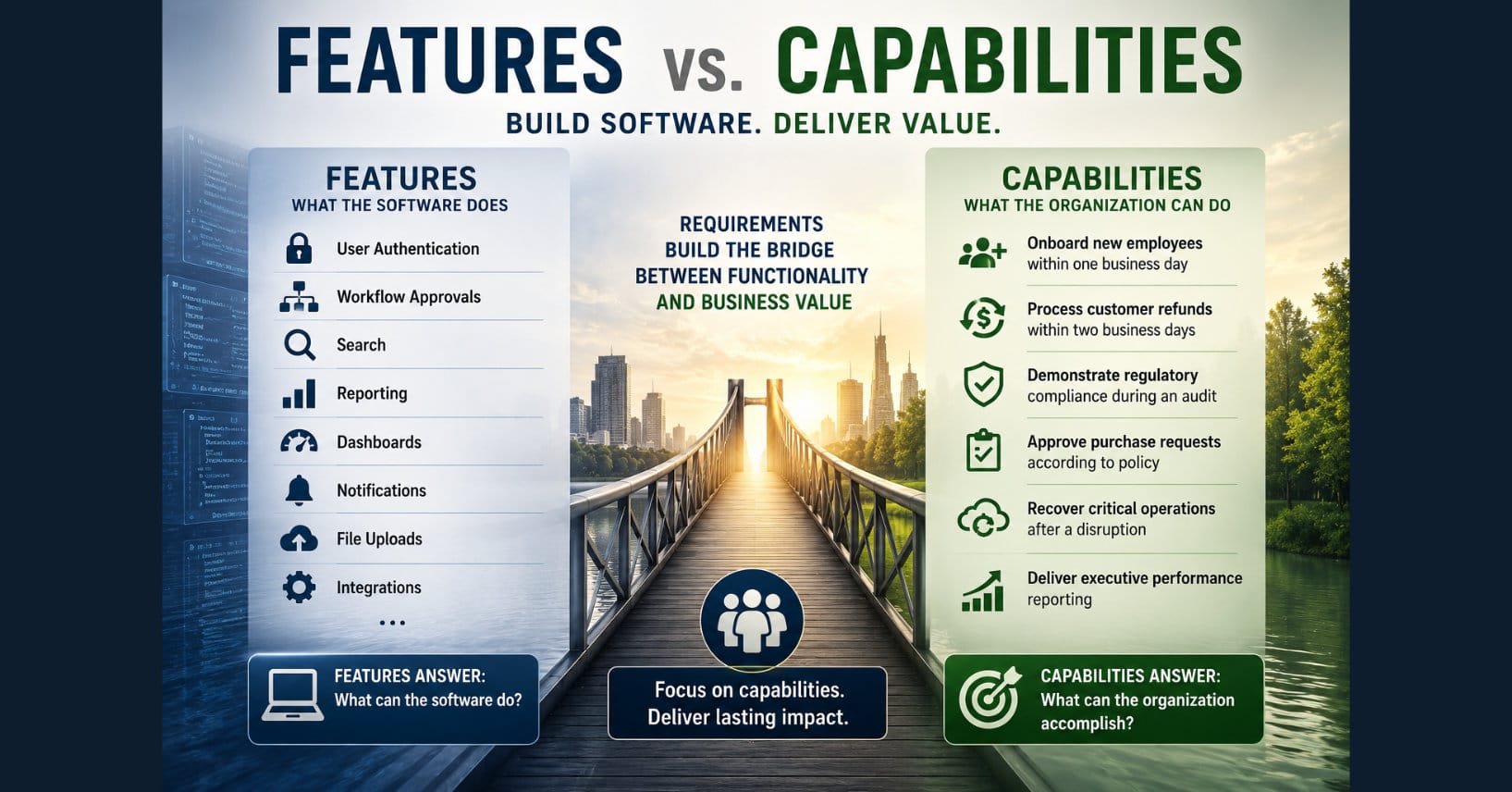
A Feature Is What the Software Does
Features describe functionality.
Examples include:
- User authentication
- Workflow approvals
- Search
- Reporting
- Dashboards
- Notifications
- File uploads
Features are visible.
They are easy to demonstrate.
They often appear in product brochures and software demonstrations.
They answer a technical question:
What can the software do?
A Capability Is What the Organization Can Do
Capabilities describe business outcomes.
Examples include:
- Onboard new employees within one business day.
- Process customer refunds within two business days.
- Demonstrate regulatory compliance during an audit.
- Approve purchase requests according to organizational policy.
- Recover critical operations after a disruption.
- Deliver executive performance reporting.
Capabilities answer a different question:
What can the organization accomplish because the software exists?
That distinction changes everything.
Organizations Do Not Measure Features
Imagine presenting the following project update to an executive board.
“We completed twelve new reports, three dashboards, two integrations, and a notification engine.”
The response is predictable.
“So what?”
Now consider a different update.
“We reduced customer onboarding time by 60 percent.”
“We eliminated manual compliance reporting.”
“We cut invoice processing from five days to one.”
Those are capabilities.
Executives invest in capabilities because capabilities produce measurable business value.
Features are simply one way to achieve them.
Requirements Should Describe Capability First
Requirements discussions often begin with proposed solutions.
“We need another dashboard.”
“We need artificial intelligence.”
“We need a mobile app.”
Perhaps.
Perhaps not.
A better first question is:
What business capability is currently missing?
Once the capability is understood, technology can determine the most appropriate solution.
Beginning with features often limits creativity.
Beginning with capabilities encourages engineering.
Capabilities Endure Longer Than Features
Technology evolves quickly.
Today’s modern feature may become tomorrow’s legacy functionality.
Business capabilities tend to remain remarkably stable.
Organizations have always needed to:
- Serve customers.
- Manage financial transactions.
- Protect sensitive information.
- Comply with regulations.
- Make informed decisions.
- Coordinate business processes.
The methods change.
The capabilities remain.
Requirements anchored to enduring capabilities are significantly more resilient than requirements tied to specific technical features.
Architecture Supports Capabilities
Enterprise architecture is frequently evaluated by the number of systems it supports.
A better measure is the number of business capabilities it enables.
Architectural decisions should strengthen the organization’s ability to:
- Adapt to change.
- Deliver services.
- Manage information.
- Reduce operational risk.
- Improve decision-making.
- Support future growth.
Technology exists to enable capability.
Capability should never be constrained by unnecessary technology decisions.
Features Without Capability Create Complexity
Organizations sometimes celebrate software releases filled with new functionality.
Months later, users continue relying on spreadsheets.
Manual workarounds persist.
Operational bottlenecks remain.
Why?
Because features were delivered.
Capabilities were not.
Software becomes valuable only when functionality changes how the organization performs its work.
Anything less is simply additional complexity.
Capability Thinking Improves Requirements
When requirements begin with business capabilities, important questions naturally emerge.
- What business outcome are we trying to achieve?
- How will we measure success?
- Which business rules govern this capability?
- Which stakeholders depend upon it?
- What risks are reduced?
- Which strategic objective does it support?
These questions produce stronger requirements than simply asking which feature should be built next.
Looking Ahead
Software projects become more successful when organizations stop measuring functionality and start measuring capability.
Features matter.
They are how software behaves.
Capabilities matter more.
They are why software exists.
Requirements engineering creates the bridge between business capability and technical implementation.
Organizations that understand the difference consistently deliver solutions that create lasting business value rather than temporary technical accomplishments.
Requirements Reality
Features describe software. Capabilities describe business value. Requirements should always begin with value.
Coming Next
Article 17—Why Every Requirement Should Support a Business Objective
Every requirement consumes time, money, and organizational attention. Next, we’ll explore why every requirement should be traceable to a business objective before it is approved.