Data Governance Series | Article 12 of 20
Governing the Information That Drives the Enterprise
Summary
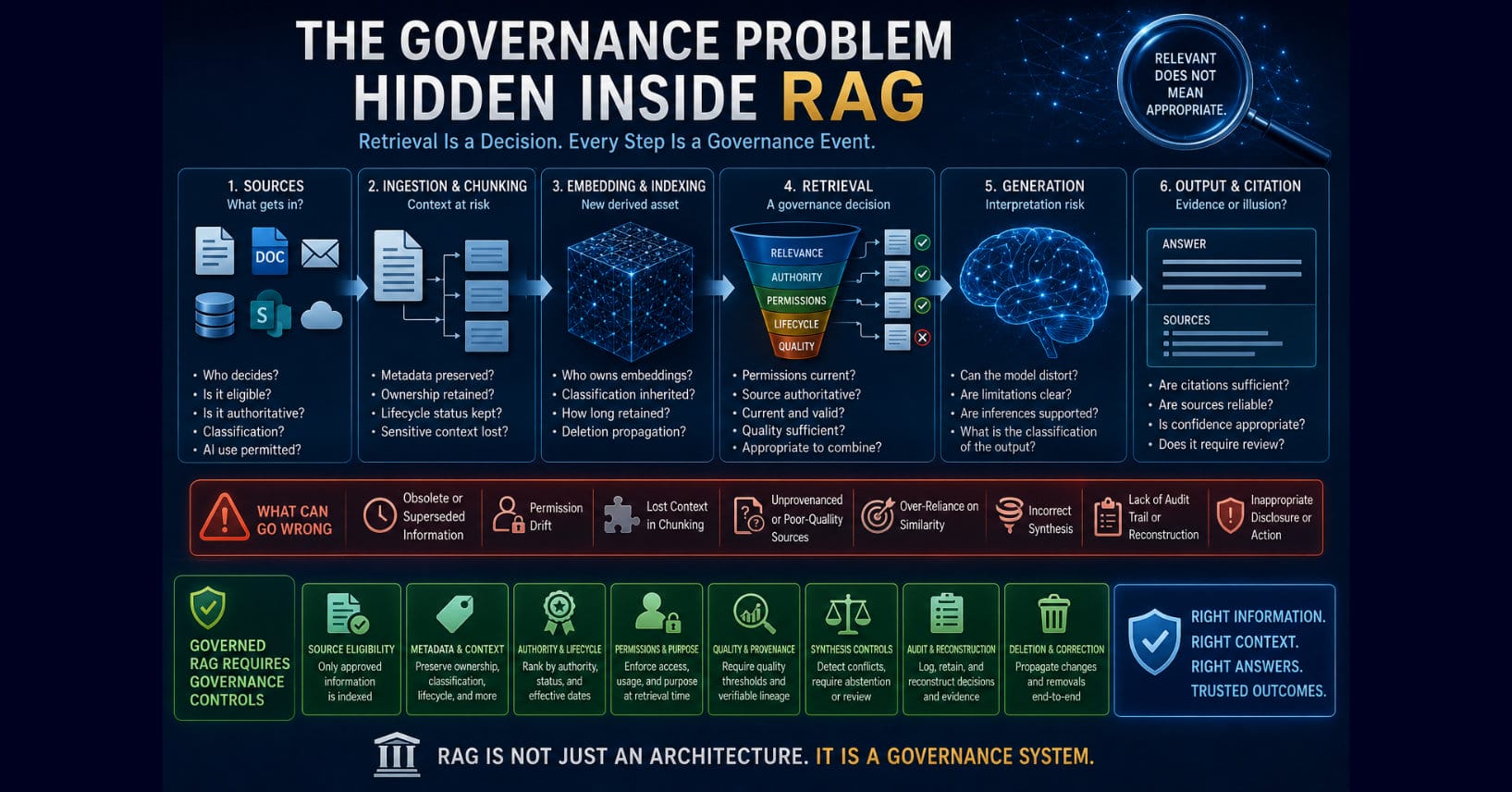
Retrieval-augmented generation is rapidly becoming one of the primary ways enterprises connect artificial intelligence to proprietary information. Although RAG is typically discussed as an AI architecture, its ingestion, indexing, retrieval, generation, and lifecycle processes contain significant governance decisions.
This article examines the governance problem hidden inside RAG. Source selection determines what information becomes eligible to influence AI. Chunking can separate content from critical governance context. Embeddings create new derived information assets. Permission changes can create access drift, while semantic relevance can elevate obsolete, unapproved, or low-quality information over authoritative sources.
The article also explores aggregation risk, provenance, citations, deletion and correction propagation, historical reconstruction, and decision lineage. For consequential AI uses, governed RAG must evaluate more than semantic similarity. It must consider authority, permissions, lifecycle status, quality, provenance, purpose, classification, and whether sufficient evidence exists to answer at all.
Retrieval-augmented generation appears deceptively simple.
Take enterprise information.
Index it.
Let an AI system retrieve relevant content.
Give that content to a language model.
Generate an answer.
This architecture has become one of the primary ways organizations connect generative AI to proprietary knowledge.
It solves an important problem.
Instead of expecting a general-purpose model to know the organization’s policies, procedures, products, contracts, technical documentation, customer information, and institutional knowledge, the enterprise can retrieve relevant information at runtime.
The model gets context.
The user gets a better answer.
The organization keeps its knowledge closer to the source.
Technically elegant.
Governance is considerably more complicated.
Which information should be indexed?
Who decides?
Which version is authoritative?
What happens when a document is superseded?
What metadata survives ingestion?
What happens to permissions when content is broken into chunks?
Can two individually permissible pieces of information become sensitive when combined?
What happens when a source document is deleted?
Does its embedding disappear?
Can the organization reconstruct exactly what information influenced an answer six months later?
These are not peripheral implementation details.
They determine whether the AI system is actually operating on governed information.
RAG contains a governance architecture whether the enterprise designs one or not.
Retrieval Is a Decision
The word “retrieval” sounds mechanical.
A query arrives.
The system finds similar content.
But every retrieval effectively makes a decision:
This information should influence the answer.
That decision can be consequential.
Suppose an employee asks:
“What is our current policy for approving international travel?”
The RAG system retrieves:
the current approved policy;
an older policy;
a draft revision;
meeting notes discussing possible changes;
and an FAQ written before the latest policy update.
All five documents may be semantically relevant.
Only one may be authoritative.
Similarity is not governance.
The retrieval system must somehow distinguish information that matches the question from information that should be allowed to influence the answer.
That distinction is where the hidden governance problem begins.
The Problem Starts Before Retrieval
Governance does not begin when the user submits a prompt.
It begins when information enters the RAG environment.
An organization must decide what gets indexed.
Entire repositories?
Selected folders?
Approved documents?
Email?
Chat messages?
Contracts?
Policies?
Customer records?
Technical documentation?
Meeting transcripts?
Personal files?
Archived material?
Third-party content?
AI-generated documents?
The easiest engineering approach may be to connect the system to everything users can already access.
That can create an enormous governance surface.
Information that previously required deliberate discovery suddenly becomes semantically searchable and synthesizable.
A forgotten document on page 87 of a search result may never have mattered operationally.
RAG can retrieve it instantly because one paragraph happens to resemble the user’s question.
AI changes the practical accessibility of information.
Governance must account for that change.
Indexing Is a Governance Decision
Every indexing decision implicitly answers:
This information is eligible to become AI context.
Organizations should not treat that as a purely technical determination.
A document may be accessible to employees but inappropriate for AI retrieval.
A repository may contain historical material.
Drafts.
Privileged communications.
Sensitive investigations.
Unverified notes.
Third-party licensed content.
Documents subject to retention holds.
Information whose original business purpose has expired.
Machine-generated content.
The question is therefore not merely:
“Can the AI index this?”
It is:
“Should this information be eligible to influence AI-generated output?”
That requires ownership and decision rights.
Chunking Can Destroy Governance Context
RAG systems commonly divide documents into smaller chunks before creating embeddings.
This improves retrieval.
It can also separate content from context.
Imagine a policy containing:
Title.
Owner.
Approval date.
Effective date.
Classification.
Jurisdiction.
Policy body.
Exceptions.
Supersession notice.
The document is chunked.
A paragraph describing a requirement becomes one vectorized unit.
The chunk may retain the text but lose important context:
Was this policy approved?
Is it still current?
Which jurisdiction does it apply to?
Was this section an exception?
Who owns the policy?
Did another document supersede it?
A semantically excellent chunk can become governance-poor information.
This is why metadata preservation during chunking matters.
The RAG pipeline should not merely preserve words.
It should preserve enough governance context to interpret those words correctly.
Embeddings Create a New Information Asset
Vector embeddings are often treated as technical artifacts.
Governance should treat them more carefully.
An embedding is derived from source information.
It exists because the enterprise transformed content into a machine-usable representation.
That raises lifecycle questions.
Who owns the embedding?
What classification applies?
Does it inherit restrictions from the source?
How long should it be retained?
What happens when the source is deleted?
What happens when consent is withdrawn?
What happens when a legal hold applies?
What happens when the source classification changes?
Can the embedding reveal sensitive characteristics about the source?
Can it be transferred to another environment?
Can it be used by another AI application?
The enterprise has created a new derived information asset.
Data governance applies.
Permissions Can Drift
Many RAG architectures attempt to preserve source permissions.
That is essential.
It is also more difficult than it appears.
Suppose an employee had access to a document when it was indexed.
Two months later, their access is removed.
Does the retrieval layer recognize the change immediately?
What if the document moved?
What if group membership changed?
What if the source repository was decommissioned?
What if the user can retrieve a chunk through the vector store even though the source application would now deny access?
Authorization must remain synchronized.
Otherwise, the RAG system can create a parallel access environment whose permissions gradually diverge from the source.
That is governance drift.
Permission to Read Is Not Permission to Synthesize
There is another problem.
Traditional access control usually determines whether a person may view a particular object.
RAG changes the nature of the interaction.
The AI can retrieve information from multiple objects and synthesize them into something new.
Suppose an employee can legitimately access:
Document A.
Document B.
Document C.
Individually, none reveals particularly sensitive information.
Combined, they expose a confidential strategy.
The employee technically had permission to read all three.
Did the enterprise intend to make the combined inference immediately available?
This is sometimes called an aggregation problem.
AI makes aggregation inexpensive.
Governance therefore needs to consider not merely object-level access but the consequences of synthesis.
Retrieval Can Create New Sensitivity
Information sensitivity is not always static.
Two Internal datasets may produce a Confidential inference when combined.
Public information plus internal information may reveal something Restricted.
A set of ordinary customer attributes may enable inference of a sensitive characteristic.
Several operational documents may reveal a security weakness when synthesized.
This creates a difficult governance problem:
The output classification may be more restrictive than the classification of any individual input.
Traditional RAG architectures may not detect that.
The system retrieves permitted information.
The model generates a new answer.
The answer creates new sensitivity.
Governance must extend through generation, not stop at retrieval.
Authoritative Sources Need Priority
RAG systems frequently rank results according to semantic relevance.
Governed RAG needs additional ranking signals.
Authority should matter.
Consider two documents.
Document A is the current approved cybersecurity standard.
Document B is a three-year-old presentation explaining the previous standard.
Document B happens to contain language more similar to the user’s question.
A similarity-only system may rank Document B first.
That is technically defensible.
Governance says it is wrong.
Authoritative status, effective dates, approval state, source hierarchy, quality, and provenance may need to influence retrieval ranking.
The most similar answer is not necessarily the most trustworthy answer.
Supersession Must Be Machine-Readable
Enterprises are full of historical information.
That history often needs to be preserved.
Deleting every obsolete document is neither practical nor desirable.
The problem is distinguishing historical information from current authority.
Humans understand labels such as:
Superseded.
Archived.
Draft.
Expired.
For Reference Only.
AI systems need those states represented in ways retrieval logic can use.
A superseded policy might remain searchable for historical analysis while being excluded from questions asking about current requirements.
An expired contract may remain available to Legal but should not automatically inform current commercial guidance.
Governance does not necessarily require deletion.
It requires status.
Freshness Is Not the Same as Authority
RAG implementations sometimes prioritize recent information.
That helps.
But newest does not mean authoritative.
A policy draft created yesterday may be newer than the approved policy issued six months ago.
A meeting transcript may discuss a future change.
A recent email may contain one employee’s interpretation.
A current web page may not yet reflect an approved standard.
Freshness is one governance signal.
Authority is another.
The system needs both.
Provenance Must Survive Retrieval
When an AI system answers a question, users may need to understand the evidentiary basis.
Which sources influenced the answer?
Were they authoritative?
Were they current?
Were they internal or external?
Did any contain AI-generated information?
Were they retrieved directly or through an intermediate summary?
What transformations occurred?
This is where provenance becomes operational.
A citation alone may not be enough.
A citation tells the user where text came from.
Provenance helps establish what kind of source it was and why it deserved to influence the answer.
For consequential use cases, that distinction matters.
Citations Can Create False Confidence
Citations are increasingly used to make AI outputs appear trustworthy.
They are useful.
They can also create false assurance.
An answer can cite:
an obsolete document;
a low-quality source;
an unauthorized copy;
a draft;
a third-party article;
or an AI-generated summary.
The presence of a citation proves little about governance.
Users may see three citations and conclude:
“This answer is grounded.”
Perhaps it is.
But grounded in what?
Governed RAG needs source quality and authority, not merely source references.
The Model Can Distort Retrieved Evidence
Even if retrieval is perfect, generation introduces another governance layer.
The model may:
summarize incorrectly;
omit a qualification;
combine incompatible statements;
overgeneralize;
infer something not explicitly supported;
or present uncertainty with excessive confidence.
The retrieved evidence may be governed.
The generated interpretation may not faithfully represent it.
This means organizations need to distinguish:
retrieval assurance from generation assurance.
Retrieval assurance asks whether appropriate evidence was supplied.
Generation assurance asks whether the model used that evidence appropriately.
Both matter.
The Prompt Is Part of the Governance Chain
System prompts and orchestration instructions influence how retrieved information is interpreted.
A prompt may tell the model:
prioritize internal sources;
cite evidence;
refuse when evidence is insufficient;
distinguish policy from guidance;
identify conflicting sources;
avoid unsupported inference;
or require human review for certain topics.
Those instructions are part of the governance architecture.
They should therefore be controlled.
Versioned.
Tested.
Approved where appropriate.
Monitored.
A consequential AI answer is not produced merely by data plus model.
It may depend on:
Data + Metadata + Retrieval Logic + Ranking + Prompt + Model + Policy Rules
Governance must understand the chain.
RAG Needs Abstention
One of the most important capabilities in governed RAG is the ability not to answer.
Enterprise AI is often optimized for helpfulness.
Governance sometimes requires restraint.
Suppose:
no authoritative source exists;
retrieved sources conflict;
the relevant policy has expired;
quality is below threshold;
the user lacks sufficient authorization;
provenance is uncertain;
or the question requires professional judgment beyond the system’s approved role.
The correct response may be:
I cannot provide a reliable answer from the available governed information.
That is not an AI failure.
It is a governance success.
A system that always answers may be less trustworthy than one that knows when evidence is insufficient.
Deletion Is Harder Than It Looks
Suppose a source document must be deleted.
Perhaps retention expired.
A customer exercised a privacy right.
A contract ended.
A record was corrected.
Legal required removal.
Deleting the original file may not remove every derived artifact.
The RAG environment may contain:
chunks;
embeddings;
cached retrieval results;
generated summaries;
logs;
conversation history;
evaluation datasets;
and downstream copies.
The enterprise needs to understand what deletion means across the information lifecycle.
This is where lineage becomes essential.
If the source disappears, what derived artifacts must also be removed or updated?
Without lineage, deletion can become an assertion rather than a demonstrable state.
Corrections Need Propagation
Deletion is not the only lifecycle problem.
What happens when information is corrected?
A policy contains an error.
The source is updated.
Has the RAG index refreshed?
Were old embeddings replaced?
Are cached summaries still circulating?
Did generated content based on the old policy enter another knowledge base?
Did an AI agent already write derived information into an operational system?
Correction propagation is a governance capability.
As AI creates more derived information, correcting the source may no longer correct the enterprise.
The error may already have descendants.
Historical Reconstruction Matters
Imagine a regulator asks:
“Why did your AI system provide this recommendation on March 12?”
The organization reviews the current RAG environment.
The source documents have changed.
The index has been rebuilt.
The model has been upgraded.
The prompt has changed.
Ranking logic has been adjusted.
One document was deleted.
Another was superseded.
Today’s environment cannot explain March 12.
For consequential uses, organizations may need sufficient historical evidence to reconstruct:
the query;
user context;
source permissions;
retrieved chunks;
source versions;
metadata;
ranking;
prompt version;
model version;
generated output;
human review;
and subsequent action.
That is not ordinary logging.
It is decision evidence.
RAG Creates Decision Lineage
This connects RAG to the broader lineage argument from Article 8.
Traditional data lineage might show:
Document Repository → Vector Store → AI Application.
Useful.
Decision lineage needs more:
Source → Chunk → Embedding → Retrieval → Prompt Context → Model Output → Human/Automated Decision → Action
For consequential AI, that chain may become necessary for assurance, incident response, audit, regulatory review, and internal accountability.
The RAG pipeline becomes part of the enterprise decision architecture.
Third-Party RAG Complicates Accountability
Many organizations will not build every component themselves.
A vendor may provide:
the embedding model;
vector database;
retrieval engine;
reranker;
language model;
or complete RAG platform.
Outsourcing the technology does not eliminate the governance questions.
The enterprise still needs to understand:
what information is sent;
where it is processed;
whether it is retained;
whether it is used for training;
how permissions are enforced;
what logs exist;
how deletion works;
how source citations are generated;
what model changes occur;
and what evidence can be retrieved later.
A vendor can operate the RAG stack.
The enterprise still owns the consequences of using the answers.
RAG Governance Is Continuous
A one-time AI risk assessment is not enough.
RAG environments change constantly.
Documents are added.
Documents are deleted.
Permissions change.
Policies expire.
Owners leave.
Metadata changes.
Data quality changes.
Models are upgraded.
Prompts are revised.
Retrieval algorithms change.
New repositories are connected.
The risk profile changes with them.
RAG governance therefore needs continuous signals.
Examples include:
percentage of indexed content with accountable owners;
percentage with authoritative status;
percentage with current lifecycle metadata;
permission synchronization failures;
retrievals from superseded sources;
answers based on conflicting evidence;
percentage of responses with verified provenance;
index refresh latency;
orphaned embeddings;
unresolved deletion propagation;
and high-consequence answers requiring human review.
Governance becomes observable.
Govern the Retrieval Layer
The RAG architecture should increasingly contain explicit governance controls.
Depending upon consequence, these may include:
source eligibility rules;
metadata requirements;
authority ranking;
lifecycle filtering;
permission synchronization;
purpose restrictions;
quality thresholds;
provenance preservation;
classification-aware retrieval;
synthesis controls;
abstention rules;
citation requirements;
human-review triggers;
logging;
historical reconstruction;
and deletion propagation.
The exact architecture will vary.
The principle is consistent.
The retrieval layer cannot remain governance-neutral.
It is making decisions about what evidence an AI system is allowed to see.
The Architecture Should Ask More Than “Relevant?”
A traditional retrieval pipeline might ask:
Is this chunk relevant to the query?
A governed retrieval pipeline increasingly needs to ask:
Is it relevant?
Is the user authorized?
Is the source eligible?
Is it authoritative?
Is it current?
Is its quality sufficient?
Is its provenance known?
Is AI use permitted?
Is this purpose permitted?
Can it be combined with the other retrieved information?
Does the resulting answer require a stronger classification?
Is human review required?
Is the evidence sufficient to answer?
That is a very different retrieval architecture.
It is also a much more governable one.
Boardroom Takeaway
Executives do not need to understand vector embeddings, similarity scores, chunking strategies, or reranking algorithms.
They do need to understand that connecting enterprise AI to proprietary information creates a new governance layer.
RAG determines what information an AI system can retrieve, combine, interpret, and present as evidence.
If the underlying content lacks ownership, authoritative status, lifecycle controls, classification, provenance, or synchronized permissions, the AI system inherits those weaknesses.
Leadership should ask:
“When our AI answers a consequential question, can we demonstrate that it used the right information—not merely information that looked relevant?”
That is the governance problem hidden inside RAG.
Because retrieval is not simply a search function.
It is the moment the enterprise decides what information is allowed to influence artificial intelligence.
Coming Next
Article 13: When AI-Generated Data Becomes Enterprise Data
An AI-generated answer may exist for only a few seconds.
But what happens when the output is saved?
A summary enters the CRM. A classification enters a data warehouse. An agent creates a case record. A model-generated recommendation becomes part of a customer file.
At that moment, generated output becomes enterprise data.
The next article examines what happens when AI-created information enters the enterprise information lifecycle—and why ownership, provenance, classification, retention, correction, and authority must follow it.