Data Governance Series | Article 20 of 20
Governing the Information That Drives the Enterprise
Summary
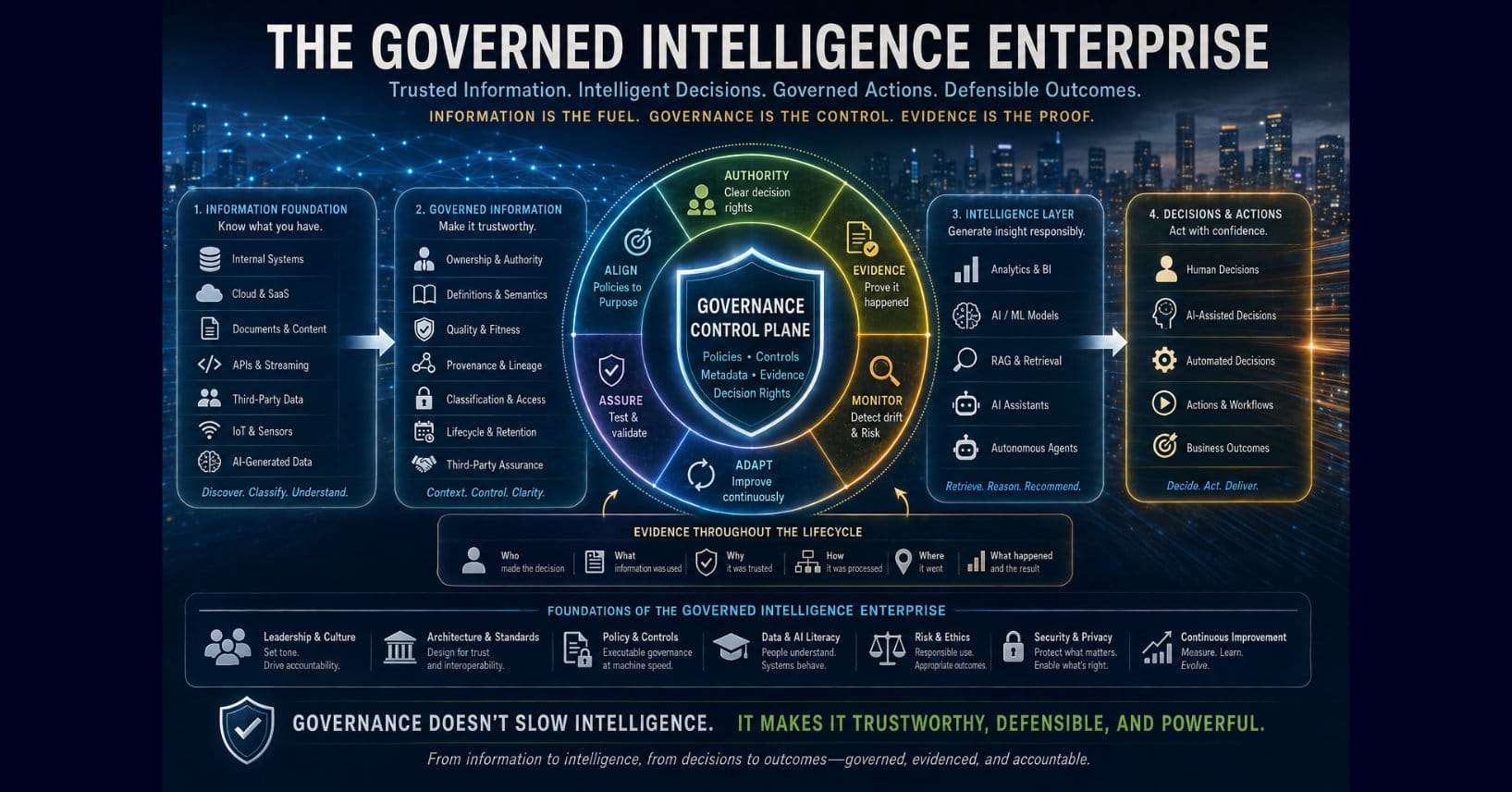
The final article in the Data Governance Series brings twenty articles together around an emerging enterprise model: the Governed Intelligence Enterprise.
As data moves through analytics, third parties, RAG systems, AI models, agents, automated workflows, decisions, and actions, the traditional boundaries between data governance, information governance, AI governance, technology governance, risk management, and decision governance are beginning to converge.
“The Governed Intelligence Enterprise” examines how governance must follow information throughout this increasingly intelligent operating environment. Ownership becomes decision authority. Quality becomes a runtime condition. Metadata becomes control infrastructure. Lineage becomes a chain of custody from source to outcome. Provenance becomes an epistemic control. Retention becomes intelligence lifecycle governance. RAG becomes runtime governance. AI-generated information enters the enterprise governance loop, while policies increasingly become machine-readable and executable constraints.
The article also introduces the emerging information governance control plane and evidence graph as architectural foundations for connecting data, people, policies, controls, AI systems, decisions, actions, and outcomes.
The destination is not perfect data or perfect AI. It is an enterprise capable of demonstrating that the intelligence driving consequential decisions comes from information it understands, trusts, is permitted to use, can trace, and can defend.
This series began with a simple argument:
Data governance is no longer a data problem.
Twenty articles later, the reason should be clear.
Data no longer sits quietly inside databases waiting for analysts to use it.
It moves.
It is copied.
Combined.
Transformed.
Enriched.
Purchased.
Retrieved.
Embedded.
Summarized.
Inferred from.
Fed into artificial intelligence.
Converted into recommendations.
Used by agents.
Turned into decisions.
And increasingly, turned directly into actions.
The traditional boundaries between data management, information governance, AI governance, technology governance, risk management, and decision governance are beginning to collapse.
The enterprise is becoming an intelligence system.
That means governance must evolve with it.
The destination is not merely better data governance.
It is the Governed Intelligence Enterprise.
From Data to Intelligence
For decades, enterprise information architecture could be understood as a relatively straightforward progression:
Data → Information → Analysis → Decision → Action
Humans performed much of the interpretation.
Systems stored information.
Reports presented it.
Analysts explained it.
Executives decided.
Operations acted.
Artificial intelligence is changing that architecture.
A modern enterprise may increasingly operate like this:
Data → Retrieval → AI Interpretation → Recommendation → Decision → Action → New Data
With agentic AI, the chain can become even tighter:
Data → AI → Action
And every action produces additional information that can feed the next cycle.
The enterprise is no longer merely processing data.
It is creating continuous loops of machine-assisted intelligence.
Governance designed primarily for static information repositories cannot adequately govern that environment.
Governance Must Follow the Information
One principle has appeared repeatedly throughout this series:
Governance cannot stop at the system boundary.
Information moves across:
- databases;
- cloud platforms;
- SaaS applications;
- APIs;
- documents;
- spreadsheets;
- data lakes;
- vector stores;
- AI models;
- agents;
- third-party services;
- and business workflows.
If governance exists only where the information originated, it weakens as the information moves.
The Governed Intelligence Enterprise takes a different approach.
Governance context travels with—or remains persistently linked to—the information.
That context may include:
- ownership;
- authority;
- classification;
- quality;
- provenance;
- lineage;
- retention;
- permitted use;
- AI-use permissions;
- decision restrictions;
- exceptions;
- and evidence.
Governance becomes part of the information architecture.
Ownership Becomes Decision Authority
Early in this series, we examined the problem with data ownership.
Assigning someone’s name to a dataset does not create governance.
Authority does.
The Governed Intelligence Enterprise connects ownership to decision rights.
An accountable owner can determine:
- what the data means;
- what quality is required;
- which source is authoritative;
- who may use it;
- whether AI may retrieve it;
- whether models may train on it;
- what exceptions are acceptable;
- how long it should remain operational;
- and whether it is appropriate for consequential decisions.
Ownership becomes observable through decisions.
That matters because machine-speed operations cannot depend upon ambiguous accountability.
Quality Becomes a Runtime Condition
Traditional data quality programs often measure information after it has been created.
The Governed Intelligence Enterprise moves quality closer to the moment of use.
Before information supports a consequential action, systems may need to know:
- What quality threshold does this use require?
- What quality state currently exists?
- When was it measured?
- What exceptions are active?
- Is the data sufficiently current?
- Should automation proceed?
- Should human review be required?
- Should an alternative source be used?
Quality stops being merely a reporting metric.
It becomes a runtime governance condition.
Metadata Becomes Control Infrastructure
Article 7 argued that metadata is becoming governance infrastructure.
That becomes foundational in the Governed Intelligence Enterprise.
Systems cannot enforce governance concepts they cannot interpret.
Terms such as:
- Authoritative.
- Superseded.
- Restricted.
- AI Retrieval Permitted.
- Training Prohibited.
- Human Review Required.
- Historical Only.
- Generated by AI.
- Provenance Unverified.
- Quality Exception Active.
must increasingly become machine-readable.
Metadata stops being merely descriptive.
It helps determine what systems are allowed to do.
Lineage Becomes the Chain of Custody
As decisions become more automated, lineage becomes more important.
The enterprise needs to understand not merely where data moved, but how information became a decision.
The chain may look like:
Source → Transformation → Dataset → Retrieval → Model → Output → Human Decision → Action → Outcome
Or:
Source → Transformation → Agent → Action → Outcome
For consequential decisions, the organization should be able to traverse that chain backward.
What information was used?
- Which version?
- What transformations occurred?
- Which model interpreted it?
- What output was generated?
- Who reviewed it?
- What action followed?
That is no longer merely data lineage.
It is decision lineage.
Provenance Becomes an Epistemic Control
Article 9 introduced an important distinction.
Enterprise information may be:
Observed.
- Reported.
- Derived.
- Generated.
Those are not equivalent claims about reality.
The Governed Intelligence Enterprise preserves those distinctions.
A sensor measurement should not silently become equivalent to an AI inference.
A third-party estimate should not become indistinguishable from a verified internal fact.
A machine-generated classification should not acquire authority simply because it was stored in a CRM.
Provenance helps systems and humans understand:
What kind of claim is this information making, and what evidence supports that claim?
That is an epistemic control.
It governs not merely where information came from, but why it deserves belief.
Third-Party Data Remains Your Problem
Modern enterprises depend heavily upon information they did not create.
The Governed Intelligence Enterprise treats external information as part of its own decision architecture.
It asks:
- Where did this data originate?
- How was it collected?
- Was it observed, reported, derived, or generated?
- How current is it?
- What quality evidence exists?
- What contractual restrictions apply?
- What AI uses are permitted?
- What happens when the provider changes methodology?
- Which decisions depend upon it?
The principle from Article 15 remains:
Governance follows reliance.
The source may belong to someone else.
The decision does not.
Retention Becomes Intelligence Lifecycle Governance
Data retention once focused heavily on storage, records obligations, privacy, and litigation.
AI changes the consequence of keeping information.
Anything retained may become future AI context.
A superseded policy can reappear.
An old employee record can influence an inference.
Historical data can shape a recommendation.
Archived information can become operational again through semantic retrieval.
The Governed Intelligence Enterprise therefore distinguishes:
Must Retain
from:
May Retrieve
May Infer From
May Train On
May Use for Current Decisions
May Use for Automated Action
These are different governance states.
Retention becomes intelligence lifecycle governance.
Sensitive Data Becomes Sensitive Context
Traditional access control asks:
Can this person access this object?
AI introduces another question:
What may the system infer by combining the information that person can access?
This matters because multiple individually permitted sources can produce a highly sensitive conclusion.
Financial data.
HR records.
Email.
Security information.
Legal documents.
Executive communications.
Operational records.
AI can synthesize relationships across them faster than humans ever could.
The Governed Intelligence Enterprise therefore governs:
- access;
- purpose;
- combination;
- inference;
- persistence;
- and action.
Permission to see is not automatically permission to infer.
RAG Becomes Runtime Governance
Retrieval-augmented generation is often treated as an AI implementation pattern.
Governance reveals what it actually represents.
Every retrieval is a governance decision.
Should this source be indexed?
Is this version authoritative?
Is it current?
May this user access it?
May the AI use it for this purpose?
Can it be combined with these other sources?
Does its classification permit the use?
Is provenance sufficient?
Is quality adequate?
Is the document historical?
Has it been superseded?
Semantic relevance cannot answer those questions.
The Governed Intelligence Enterprise makes retrieval policy-aware.
RAG becomes part of the governance architecture.
AI-Generated Information Enters the Governance Loop
Artificial intelligence does not merely consume enterprise information.
It produces it.
Summaries.
Scores.
Classifications.
Recommendations.
Predictions.
Extracted attributes.
Inferred relationships.
Reports.
Agent records.
Some of those outputs disappear.
Others enter enterprise systems.
Once stored, they may become future inputs.
The cycle becomes:
Governed Data → AI → Generated Information → Enterprise System → Future AI Context
Without persistent provenance, the enterprise may eventually lose the distinction between:
what it observed
and
what a machine inferred.
The Governed Intelligence Enterprise preserves that distinction.
Machine-generated information remains machine-generated information even after it becomes an enterprise record.
AI Governance and Data Governance Converge
This series has repeatedly demonstrated why AI governance cannot remain separate from data governance.
A model can be approved.
The vendor can be assessed.
Security can be reviewed.
Human oversight can be established.
Monitoring can be enabled.
And the AI system can still make poor decisions because the information underneath it is:
obsolete;
conflicting;
unowned;
poor quality;
incorrectly classified;
inappropriately retained;
missing provenance;
or unauthorized for the intended use.
AI governance asks whether the intelligence system is controlled.
Data governance asks whether the information feeding that system is trustworthy and appropriately used.
At enterprise scale, those become parts of the same governance problem.
Policies Become Executable
Traditional governance depends heavily upon human-readable policy.
Policies remain necessary.
But machine-speed systems need machine-enforceable governance.
A policy might say:
“Superseded procedures must not be used as current operational guidance.”
For a human, that is understandable.
For AI, the architecture must translate the requirement into something enforceable:
Document Status: Superseded
Operational Use: Prohibited
Historical Retrieval: Permitted
Current-Answer Retrieval: Prohibited
AI Training: Restricted
The Governed Intelligence Enterprise moves from:
Policy as Instruction
toward:
Policy as Executable Constraint
That is a significant architectural evolution.
Evidence Becomes a Native Output
Article 16 argued that governance needs evidence, not merely policies.
The Governed Intelligence Enterprise designs evidence into operations.
When an owner approves a definition, evidence is created.
When a quality rule executes, evidence is created.
When a classification changes, evidence is created.
When an exception is accepted, evidence is created.
When AI retrieves sensitive information, evidence is created.
When an agent acts, evidence is created.
When a retention rule disposes of information, evidence is created.
The objective is not bureaucratic recordkeeping.
It is continuous reconstructability.
The enterprise increasingly documents itself as it operates.
The Catalog Becomes an Evidence System
Article 17 extended this concept into the data catalog.
The traditional catalog tells us:
what data exists;
what it means;
who owns it;
where it resides;
and where it flows.
The evidence system adds:
what controls operated;
which quality state existed;
what provenance supports reliance;
which exceptions were active;
which AI systems used the data;
what decisions were made;
and what evidence supports the governance state.
The catalog evolves from a discovery tool into a trust interface.
Eventually, it may become part of an enterprise evidence graph connecting:
Data → People → Policies → Controls → AI → Decisions → Actions → Outcomes
That is the architecture of governed intelligence.
Measurement Shifts Toward Outcomes
Article 18 warned against dashboards that measure governance activity while creating false confidence.
The Governed Intelligence Enterprise measures whether governance changes outcomes.
Not merely:
owners assigned;
policies published;
issues closed;
training completed;
catalog entries created.
But:
ownership exercised;
quality recurrence reduced;
evidence coverage improved;
exception debt reduced;
governance drift detected;
decision latency decreased;
reconciliation effort reduced;
AI data readiness improved;
governed data coverage increased;
decision reconstruction accelerated;
and data-related losses reduced.
Governance measurement moves from:
What did we do?
to:
What became better?
The Enterprise Becomes Observable
A powerful property emerges when governance context and evidence become structured.
The enterprise becomes more observable.
Leadership can ask:
Which critical datasets currently lack active ownership?
Which consequential AI systems depend upon third-party data with weak provenance?
Which quality exceptions are influencing automated decisions?
Which Restricted information is being retrieved by AI?
Which retention failures leave obsolete information operationally accessible?
Which decisions cannot currently be reconstructed?
Which governance controls are drifting?
These questions can increasingly be answered from connected evidence rather than manual investigation.
Governance becomes visible.
The Enterprise Becomes More Adaptive
Governed does not mean rigid.
In fact, stronger governance can make the enterprise more adaptive.
Why?
Because change becomes safer.
A new AI system can be evaluated against known data dependencies.
A new dataset can inherit governance requirements.
A vendor change can trigger impact analysis.
A classification change can propagate downstream.
A quality failure can restrict automated use.
A new regulation can be mapped to affected information.
A model upgrade can trigger reassessment of relevant controls.
The enterprise can change quickly because it understands what the change affects.
Governance becomes an enabler of controlled adaptation.
Human Judgment Does Not Disappear
The Governed Intelligence Enterprise is not an autonomous corporation.
Human judgment remains essential.
Governance must determine where humans are required.
High-consequence decisions may require:
review;
challenge;
approval;
override;
or escalation.
The purpose of machine-readable governance is not to eliminate human judgment.
It is to make human judgment better informed and more deliberately placed.
Automation should handle what can be reliably controlled.
Humans should remain accountable where consequence, uncertainty, ethics, or ambiguity requires judgment.
Decision Rights Become More Important, Not Less
As AI becomes capable of recommending and executing actions, organizations need clearer decision rights.
Who may authorize the model?
Who determines which data it may use?
Who establishes acceptable quality?
Who can approve automated action?
Who accepts exceptions?
Who can override the AI?
Who is accountable when the system acts incorrectly?
Who can stop it?
Technology can automate execution.
It cannot resolve ambiguous accountability.
The more autonomous systems become, the more explicit human authority must become.
The Control Plane Is Emerging
Across this series, several capabilities have repeatedly appeared:
metadata;
catalogs;
lineage;
provenance;
identity;
classification;
quality;
policy engines;
records management;
AI inventories;
decision records;
and evidence.
Today, these capabilities often exist in separate platforms.
Over time, enterprises will increasingly connect them into what can be understood as an information governance control plane.
This control plane will help answer:
What information exists?
What does it mean?
Who owns it?
Where did it come from?
Can it be trusted?
Who may use it?
For what purpose?
May AI retrieve it?
May AI infer from it?
May an agent act upon it?
What evidence must be preserved?
That is the technical foundation of governed intelligence.
The Evidence Graph Is the Institutional Memory
Organizations traditionally depend heavily upon human institutional memory.
Who remembers why this system works this way?
Who knows why this dataset is trusted?
Who remembers why the exception was approved?
Who knows which vendor supplied the original data?
Who remembers what the board was told?
People leave.
Memory fades.
Context disappears.
An evidence graph preserves relationships among:
information;
decisions;
authority;
controls;
exceptions;
actions;
and outcomes.
It becomes a durable institutional memory.
That capability will become increasingly valuable as AI accelerates organizational change.
Governed Intelligence Is a Competitive Capability
Governance is often discussed primarily as risk reduction.
That is incomplete.
Governed intelligence can improve performance.
When information is trustworthy:
decisions happen faster.
When ownership is clear:
problems are resolved faster.
When provenance is known:
uncertainty becomes visible.
When quality is measurable:
automation becomes safer.
When policies are executable:
controls operate at machine speed.
When evidence is automatic:
assurance becomes less expensive.
When AI uses governed information:
confidence in automation increases.
Governance can reduce friction.
That is an economic advantage.
The AI Advantage Will Shift
Today, organizations compete partly on access to AI capabilities.
That advantage will narrow.
Foundation models will become broadly available.
Agent frameworks will mature.
Cloud providers will commoditize infrastructure.
AI assistants will become standard enterprise technology.
The differentiator will increasingly become what surrounds the model.
The quality of enterprise information.
The clarity of semantics.
The strength of provenance.
The reliability of lineage.
The maturity of decision rights.
The ability to execute policy.
The availability of evidence.
The capacity to trust automation.
The enterprise with the most advanced model will not necessarily have the strongest intelligence capability.
The enterprise with the most governable information may.
Trust Becomes Architectural
Trust has traditionally been treated partly as a human judgment.
Do I trust this report?
Do I trust this source?
Do I trust this model?
The Governed Intelligence Enterprise begins making the basis of trust explicit.
Trust becomes supported by:
known ownership;
verified provenance;
measured quality;
complete lineage;
current lifecycle status;
appropriate authorization;
controlled use;
and sufficient evidence.
This does not make trust absolute.
Nothing does.
It makes trust explainable.
That is critical for consequential decisions.
Defensibility Becomes Continuous
Traditional defensibility is often retrospective.
Something happens.
An auditor arrives.
A regulator asks questions.
Litigation begins.
An incident occurs.
The organization starts assembling evidence.
The Governed Intelligence Enterprise moves toward continuous defensibility.
Evidence is created as decisions occur.
Governance state is observable.
Lineage is preserved.
Authority is recorded.
Exceptions are documented.
AI use is traceable.
Actions are connected to outcomes.
The enterprise does not wait until challenged to determine what happened.
It already knows.
The Architecture Is Recursive
One final characteristic matters.
The Governed Intelligence Enterprise is recursive.
Actions create new data.
New data changes the information environment.
AI interprets that information.
Decisions follow.
Outcomes create evidence.
Evidence informs future governance.
The cycle becomes:
Data → Intelligence → Decision → Action → Outcome → Evidence → Governance → New Data
That loop can improve the enterprise.
Or amplify its errors.
Governance determines which direction becomes more likely.
What the Board Should Expect
Boards do not need to manage metadata, catalogs, embeddings, lineage platforms, or RAG pipelines.
They do need assurance that the enterprise understands and governs the intelligence driving consequential decisions.
Board-level questions should increasingly include:
What information do our most consequential decisions depend upon?
How much of that information is appropriately governed?
Which AI systems influence material decisions or actions?
Can management demonstrate why the underlying information is trustworthy?
Where are significant provenance, quality, ownership, or lifecycle gaps?
What third-party information dependencies create material risk?
Can consequential AI-assisted decisions be reconstructed?
Where is automation operating without sufficient evidence?
How does management know governance controls are effective?
These are not technical questions.
They are oversight questions.
The Executive Question
For management, the central question becomes:
Can the enterprise move from information to action without losing accountability, context, control, or evidence along the way?
That is the test.
If data becomes detached from provenance, governance weakens.
If AI becomes detached from data governance, governance weakens.
If decisions become detached from evidence, governance weakens.
If automation becomes detached from accountability, governance weakens.
The Governed Intelligence Enterprise keeps those relationships connected.
Boardroom Takeaway
The future enterprise will not merely be data-driven.
It will be increasingly intelligence-driven.
Information will flow through humans, analytics, AI models, agents, automated workflows, and external systems before becoming decisions and actions.
Governance must therefore evolve beyond managing data as a static asset.
Leadership should ask:
“Can we demonstrate that the intelligence driving our most consequential decisions is built from information we understand, trust, are permitted to use, can trace, and can defend?”
That is the standard.
Not perfect data.
Not perfect AI.
Not perfect decisions.
But an enterprise capable of demonstrating that information was governed, intelligence was controlled, authority was clear, evidence was sufficient, and consequential actions were defensible.
That is the Governed Intelligence Enterprise.
Series Conclusion
This series began with data governance.
It ends with enterprise intelligence.
Along the way, we examined:
accountability;
ownership;
orphaned data;
quality;
trust;
metadata;
lineage;
provenance;
AI governance;
RAG;
sensitive context;
retention;
third-party data;
evidence;
catalogs;
measurement;
and enterprise readiness.
These were never separate problems.
They are different views of the same architecture.
The enterprise runs on information.
AI increasingly interprets that information.
Decisions increasingly depend upon that interpretation.
Actions increasingly follow at machine speed.
Evidence determines whether those actions can be understood and defended.
The organizations that succeed will not be those that simply accumulate the most data or deploy the most AI.
They will be the organizations that can connect:
Information → Trust → Intelligence → Authority → Decision → Action → Evidence
without losing governance along the way.
That is where data governance is heading.
And that is where governed intelligence begins.