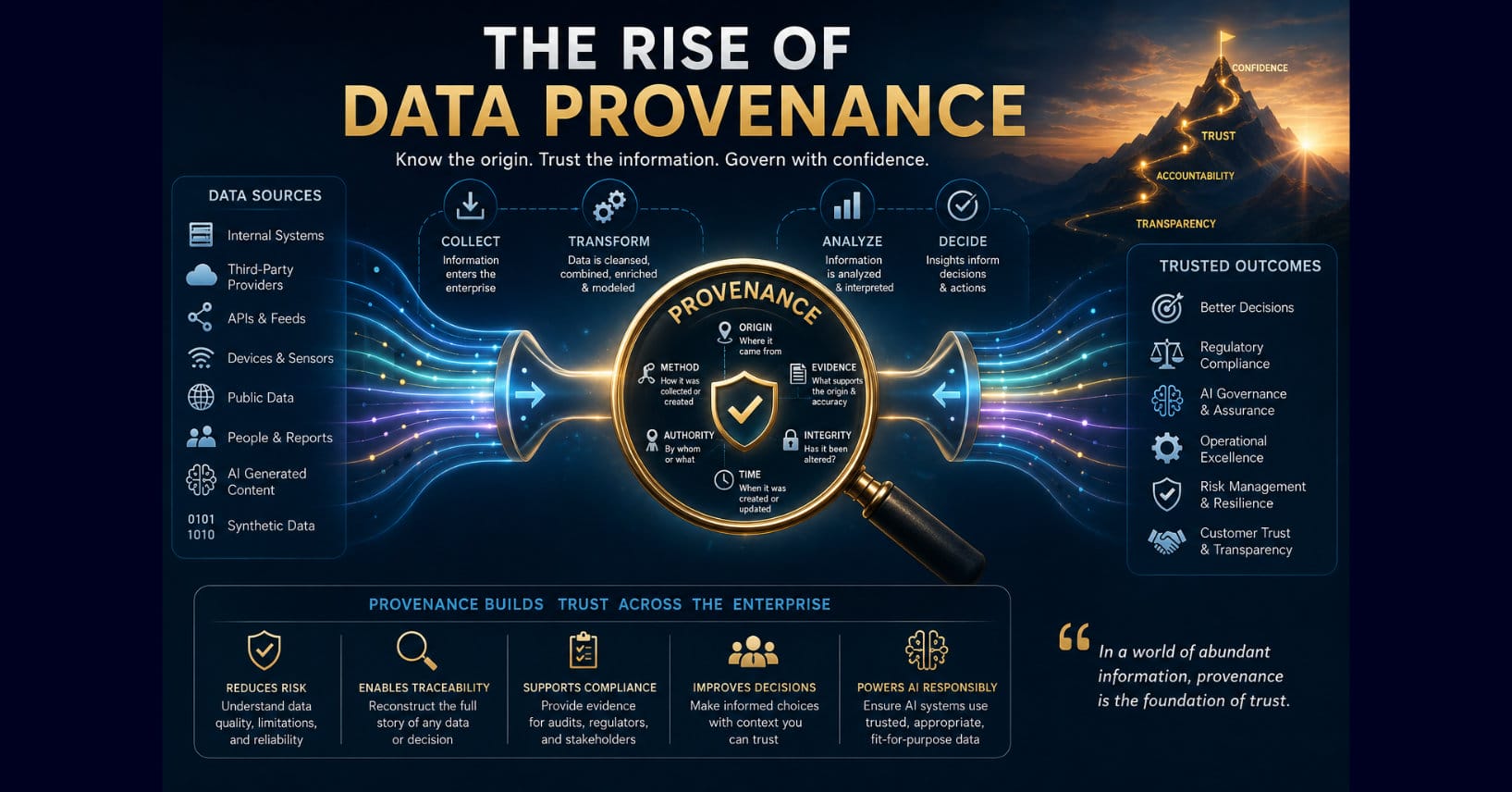
Data Governance Series | Article 9 of 20
Governing the Information That Drives the Enterprise
Summary
Enterprise information increasingly originates outside traditional systems—from third-party providers, APIs, sensors, public datasets, synthetic data generators, AI platforms, and machine-produced inferences. As information becomes easier to create and combine, knowing where it came from becomes increasingly important.
This article examines the rise of data provenance and distinguishes it from data lineage. While lineage describes the path information traveled and the transformations it experienced, provenance establishes its origin, creation method, authority, authenticity, and evidentiary basis.
The article also explores why enterprises must preserve distinctions among observed, reported, derived, generated, and synthetic information. AI makes this particularly important because machine-generated inferences can be persisted into ordinary enterprise systems and gradually acquire the appearance of authoritative facts. Strong provenance enables organizations to evaluate information according to its intended use, preserve uncertainty where necessary, strengthen AI assurance, and demonstrate why consequential information deserves to be trusted.
For most of the enterprise computing era, organizations operated under a relatively comfortable assumption.
If data was inside an enterprise system, someone probably knew where it came from.
Customer records came from the CRM.
Financial transactions came from the ERP platform.
Employee information came from HR.
Inventory came from operational systems.
Documents came from employees.
Reports came from analysts.
The origin might not always have been perfectly documented, but the information environment was largely bounded by recognizable systems and organizational processes.
That world is disappearing.
Enterprises now consume information from cloud services, APIs, data brokers, business partners, sensors, public datasets, contractors, third-party intelligence providers, AI platforms, synthetic data generators, and machine-produced inferences.
Employees copy information from external sources into enterprise systems.
AI assistants generate summaries that become business records.
Models classify customers.
Agents create content.
Third-party datasets are blended with internal information.
Synthetic records are used for testing and training.
Documents can be generated in seconds with no obvious indication of whether a human, a machine, or both created them.
The enterprise increasingly knows what information it possesses without necessarily knowing enough about where that information originated.
That changes the governance question.
It is no longer sufficient to ask:
“Where did this data travel?”
Organizations must increasingly ask:
“Why should we trust where it came from?”
That is the domain of data provenance.
And provenance is rapidly becoming foundational to enterprise trust.
Lineage and Provenance Are Not the Same
Data lineage and data provenance are closely related.
They are not identical.
Lineage describes the path.
Provenance establishes the origin and evidentiary context.
Lineage asks:
Where did this information come from?
Where did it go?
What transformations occurred?
Which systems touched it?
Provenance goes deeper:
Who or what originally created it?
Under what process?
Using what method?
From which source?
Under whose authority?
With what validation?
At what time?
Under what conditions?
Can the origin be authenticated?
Has the information been altered?
What evidence supports the claim that this is what we believe it to be?
A lineage diagram may show:
Third-Party Feed → Data Lake → Analytics Platform → Executive Dashboard.
Useful.
Provenance asks:
Who is the third party?
How did they obtain the data?
What contractual rights permit its use?
How frequently is it updated?
What validation does the provider perform?
Has the enterprise independently tested its reliability?
Does the provider combine other sources?
Are AI-generated inferences included?
Can the organization distinguish observed facts from derived conclusions?
That is a different level of trust.
The Enterprise Data Supply Chain Is Expanding
Modern organizations increasingly operate data supply chains.
Information enters from outside.
It is combined with internal information.
It is transformed.
Enriched.
Analyzed.
Modeled.
Republished.
Shared.
Used by AI.
Converted into decisions.
This resembles other supply chains.
Organizations care where physical components originate because provenance affects quality, security, regulatory compliance, resilience, and authenticity.
A manufacturer may need to know where a critical component was produced.
A pharmaceutical company needs confidence in ingredient sources.
A food company tracks suppliers.
Cybersecurity teams evaluate software supply chains.
Enterprise information deserves similar scrutiny.
If a critical business decision depends upon external data, the origin of that data becomes part of the organization’s risk environment.
The enterprise may not have created the information.
It still owns the consequences of relying upon it.
“The Vendor Provided It” Is Not Provenance
Organizations frequently outsource data collection.
That can be entirely appropriate.
But outsourcing collection does not outsource accountability.
Suppose a company purchases market intelligence from a third-party provider.
The data influences a major investment decision.
Leadership later discovers that some of the information was estimated rather than observed.
The provider disclosed this in technical documentation.
Nobody inside the enterprise noticed.
Was the data wrong?
Perhaps not.
Was its provenance understood?
Clearly not.
“The vendor provided it” identifies the immediate supplier.
It does not establish the evidentiary basis of the information.
Governance requires organizations to understand provenance proportionate to consequence.
For low-risk uses, vendor reputation may be sufficient.
For consequential uses, the enterprise may need substantially more.
Observed, Reported, Derived, and Generated Are Different
One of the most useful provenance distinctions is the nature of the information itself.
Consider four values:
Observed — A sensor directly recorded a temperature.
Reported — A customer stated their annual income.
Derived — A system calculated lifetime customer value from transaction history.
Generated — An AI model produced a probability that the customer will churn.
All four may appear as fields in a database.
They are not epistemically equivalent.
One represents direct measurement.
One represents a person’s assertion.
One represents a deterministic calculation.
One represents a probabilistic inference.
If the enterprise stores them without preserving those distinctions, downstream users may treat them as equally factual.
They are not.
Provenance tells the organization what kind of claim a data value represents.
That distinction becomes critical as AI-generated information proliferates.
AI Is Creating an Origin Problem
Generative AI has dramatically reduced the cost of creating information.
That creates enormous opportunity.
It also creates an origin problem.
A document appears in an enterprise repository.
Who wrote it?
A human?
An AI system?
A human using AI?
Which model?
Which source material?
Was the content reviewed?
Was it approved?
Was it generated from authoritative enterprise information?
Was external information involved?
Did the model infer facts that were never present in the source?
These questions may matter very little for a brainstorming document.
They may matter enormously for a policy, customer communication, regulatory submission, legal analysis, financial report, safety procedure, or executive recommendation.
The enterprise therefore needs a way to distinguish content based on origin and production method.
AI-generated information should not automatically be considered untrustworthy.
But neither should machine generation disappear from the record.
Origin is governance context.
AI Inferences Can Become Facts by Accident
Consider a customer record.
An AI system analyzes interactions and assigns:
Customer sentiment: Negative
That classification is an inference.
The system writes it into the CRM.
Six months later, another application retrieves the record.
It sees:
Customer Name.
Account Status.
Revenue.
Sentiment: Negative.
Unless provenance is preserved, the inference now looks like an ordinary attribute.
A second AI model uses it.
An analyst includes it in a segmentation model.
A customer-retention workflow treats it as fact.
The inference has acquired authority through persistence.
Nobody deliberately promoted it from prediction to fact.
The database did.
This is a subtle but significant governance problem.
Machine-generated conclusions need provenance that survives persistence.
Otherwise, the enterprise gradually loses the distinction between what it observed and what a model inferred.
Synthetic Data Complicates Trust Further
Synthetic data introduces another provenance challenge.
Synthetic datasets can be extremely valuable.
They can support software testing.
Model development.
Privacy-preserving analytics.
Simulation.
Training.
Scenario analysis.
But synthetic information must remain distinguishable from observed information.
Suppose a synthetic dataset is used to develop an AI model.
The model later supports a consequential decision.
What should the enterprise know about the synthetic data?
How was it generated?
Which real-world distributions informed it?
What assumptions were embedded?
What populations may be underrepresented?
What limitations were identified?
Which generator and version produced it?
Was it validated against real-world conditions?
The fact that data is synthetic does not make it invalid.
It means its provenance matters differently.
Provenance Is About Claims
At its core, provenance helps answer a deceptively simple question:
What kind of claim is this information making, and what evidence supports that claim?
A bank balance makes a claim about money held at a particular point in time.
A sensor reading makes a claim about a physical condition.
A customer statement makes a claim about something the customer reported.
An analyst forecast makes a claim about a possible future.
An AI classification makes a probabilistic claim.
A synthetic record may make no claim about a real individual at all.
Without provenance, systems may flatten these distinctions into values.
Governance needs to preserve them.
Provenance Should Travel With the Data
Like other governance metadata, provenance becomes fragile when information moves.
A model produces a risk score.
The originating system knows:
which model generated it;
which model version;
which inputs were used;
when the inference occurred;
and what confidence level applied.
The score is exported.
Only the number travels.
Risk Score: 82
The context disappears.
Another system imports it.
Months later, nobody can explain why the score was 82.
The enterprise preserved the output.
It lost the evidence supporting the output.
This is why provenance needs portability.
Where practical, consequential information should retain—or remain reliably linked to—the metadata necessary to understand its origin.
Provenance Has a Time Dimension
Origin alone is not enough.
Time matters.
A source that was trustworthy two years ago may no longer be.
A vendor may change methodology.
A dataset may change ownership.
An API may begin incorporating additional sources.
A model may be upgraded.
A sensor may be recalibrated.
A business definition may change.
A document may be superseded.
Provenance therefore needs historical context.
For consequential information, the enterprise may need to establish:
What source existed at the time?
What methodology was active?
What model version generated the output?
What validation status applied?
What contractual rights existed?
What quality limitations were known?
What review had occurred?
Provenance is not merely where information came from.
It is where it came from at the time the enterprise relied upon it.
External Data Requires Provenance Due Diligence
Third-party data deserves governance similar to other critical suppliers.
Questions may include:
Who created the information?
How was it collected?
How often is it updated?
What validation occurs?
What known limitations exist?
Does the provider use subcontractors?
Does the dataset contain inferred or generated information?
What rights does the organization have to use it?
Can it be used for AI training?
Can it support automated decisions?
Can it be redistributed?
What happens when the relationship ends?
How are corrections communicated?
Can historical versions be reconstructed?
These questions will not be necessary for every data purchase.
Governance should remain proportional to consequence.
But “we licensed the dataset” should not be mistaken for “we understand the dataset.”
Provenance Supports AI Assurance
AI assurance depends heavily upon provenance.
Suppose an AI system produces a consequential recommendation.
To evaluate the recommendation, an organization may need to understand:
the information used;
the origin of that information;
whether it was authoritative;
whether any inputs were themselves AI-generated;
which model generated the recommendation;
which model version was active;
what retrieval process occurred;
whether external sources were included;
and what human review followed.
This creates a layered provenance chain.
An AI output may be based on another AI-generated summary, which was derived from a dataset containing third-party inferences, which originated from multiple external providers.
Without provenance, that complexity becomes invisible.
The final output appears singular.
Its evidentiary basis may be anything but.
Content Authenticity Will Matter More
Generative AI also creates a broader authenticity challenge.
Enterprises increasingly need to determine whether digital content is authentic.
Was this document actually issued by the claimed organization?
Was this image altered?
Was this audio generated?
Was this executive communication legitimate?
Was this dataset modified after publication?
Technical standards for content credentials and cryptographic authenticity will likely play an increasing role.
But technology alone will not solve the governance problem.
An authentic document can still be outdated.
A cryptographically verified dataset can still be low quality.
A legitimately generated AI output can still be inappropriate for a particular use.
Provenance strengthens trust.
It does not replace judgment.
Provenance Needs Confidence Levels
Not every origin can be proven with equal certainty.
Some provenance is directly verified.
Some is asserted by a trusted provider.
Some is documented manually.
Some is inferred.
Some is unknown.
Governance should preserve those distinctions.
A provenance model might classify origin evidence as:
Verified — Origin established through technical or authoritative evidence.
Attested — Origin asserted by an accountable party or trusted provider.
Documented — Origin recorded through an approved process.
Inferred — Origin estimated from available evidence.
Unknown — Origin cannot be reliably established.
The labels themselves are less important than the concept.
Organizations should not present uncertain provenance with the same confidence as verified provenance.
Unknown Provenance Is Itself Information
One of the most important governance improvements is simply admitting when origin is unknown.
Enterprises often contain legacy datasets for which nobody can fully reconstruct provenance.
That does not automatically mean the data must be discarded.
It means the uncertainty should be visible.
The organization can then decide whether the information is appropriate for a particular use.
Unknown provenance may be acceptable for exploratory analysis.
It may be unacceptable for regulatory reporting.
It may be tolerable for low-risk AI experimentation.
It may be inappropriate for automated eligibility decisions.
Governance does not require certainty everywhere.
It requires uncertainty to be visible where consequence matters.
Provenance and Trust Are Not Binary
This leads to a broader point.
Trust should not be binary.
Information is not simply trusted or untrusted.
Trust is contextual.
An externally sourced dataset may be sufficiently trustworthy for market research but not for financial reporting.
An AI-generated summary may be appropriate for internal orientation but not for contractual interpretation.
A customer-reported value may be acceptable for personalization but not for underwriting.
A synthetic dataset may be excellent for testing but inappropriate for measuring actual customer behavior.
Provenance allows organizations to make those distinctions.
It provides the context needed to determine whether information is fit for purpose.
Provenance Becomes Part of the Governance Graph
In the previous article, I described lineage as the enterprise chain of custody.
Provenance strengthens that chain by establishing confidence in its origin.
Combined with metadata, ownership, quality, and decision rights, provenance contributes to a broader governance graph.
The enterprise can connect:
information;
origin;
creator;
system;
owner;
classification;
lineage;
quality;
authority;
model;
decision;
action;
and outcome.
This allows governance questions that would otherwise be extremely difficult to answer.
Which decisions depend upon third-party data with uncertain provenance?
Which AI systems consume machine-generated information?
Which executive reports contain externally sourced estimates?
Which regulatory processes depend upon vendor data?
Which persistent data fields originated as AI inferences?
Those are increasingly important questions.
Evidence Is the Difference
Ultimately, provenance is about evidence.
It is easy to claim:
“This data came from an authoritative source.”
Provenance asks:
What evidence supports that claim?
It is easy to say:
“This report was generated from approved data.”
Provenance asks:
Can we demonstrate which data and which versions?
It is easy to say:
“This AI output was based on enterprise information.”
Provenance asks:
Which information, from where, under what conditions, and with what transformations?
This is where data governance becomes defensible.
Governance stops relying on assertions and begins relying on evidence.
Boardroom Takeaway
Executives should expect the importance of data provenance to increase as enterprise information ecosystems incorporate more third-party data, AI-generated content, synthetic information, machine-produced inferences, and external intelligence.
For consequential uses, knowing that information exists is no longer sufficient.
Leadership should expect the organization to understand where important information originated, what kind of claim it represents, how its origin was established, and what evidence supports trusting it for the intended purpose.
The leadership question is:
“For the information driving our most consequential decisions, can we demonstrate why we trust where it came from?”
If the answer is merely, “That’s what the system says,” provenance is weak.
If the answer is, “That’s what the vendor gave us,” provenance may be incomplete.
If nobody knows whether a value was observed, reported, derived, or generated, provenance may already have been lost.
The enterprise of the AI era will not merely need more data.
It will need data whose origins can be understood.
Because as information becomes easier to create, knowing where it came from becomes more valuable.
That is the rise of data provenance.
Coming Next
Article 10: Data Governance Meets AI Governance
Data governance and AI governance are often treated as separate disciplines.
That separation is becoming increasingly artificial.
AI systems consume governed data, create new information, generate inferences, influence decisions, and sometimes act upon those decisions automatically.
The next article examines where data governance ends, where AI governance begins, and why enterprises increasingly need a unified governance architecture connecting the two.