Digital Transformation Series | Article 3 of 8
Digital Transformation: Redesigning the Enterprise for Continuous Change
Summary
Organizations often respond to transformation by restructuring departments, creating new executive roles, and redrawing reporting relationships. But changing the organization chart does not necessarily change how the enterprise operates.
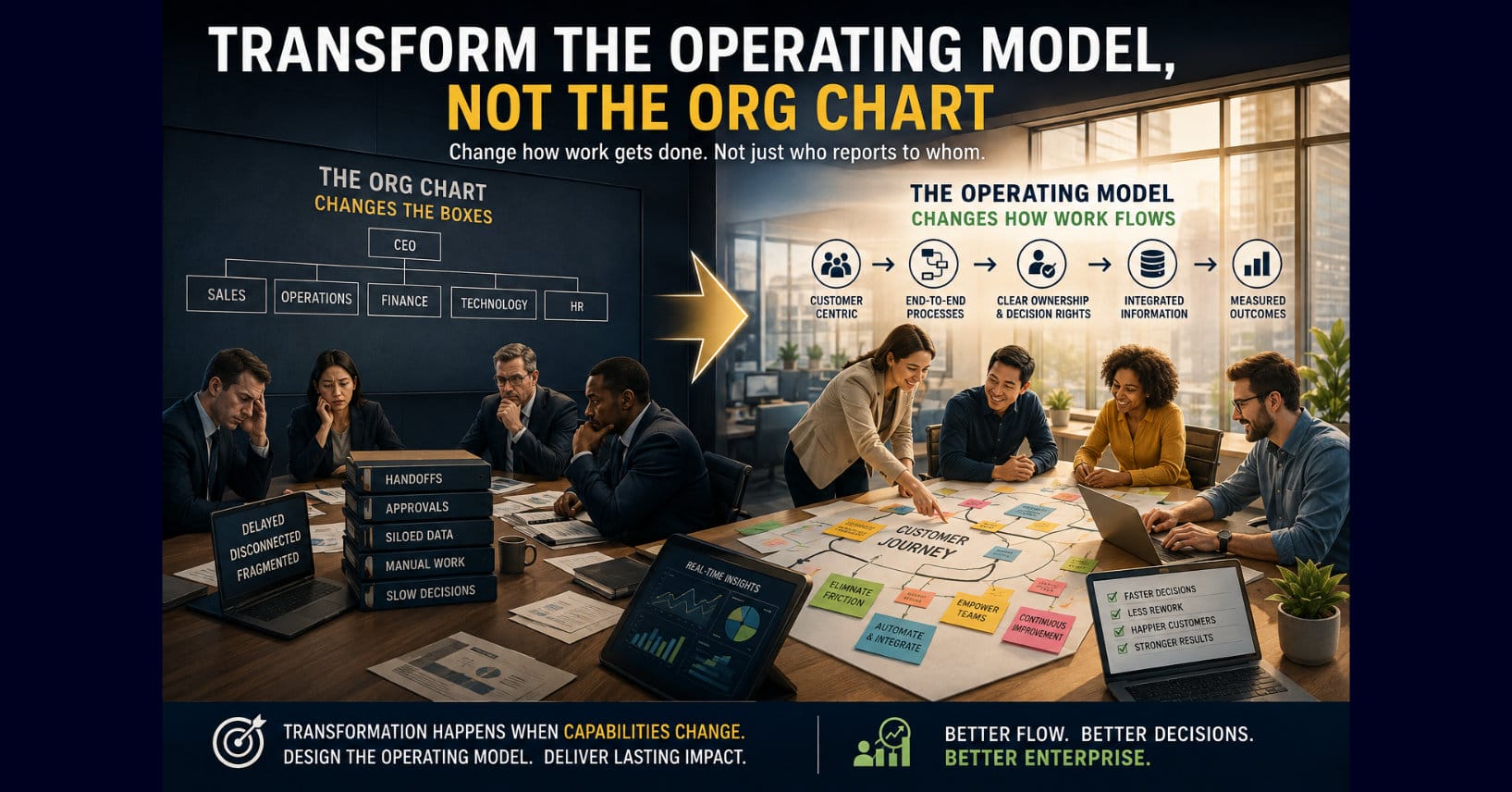
Transform the Operating Model, Not the Org Chart examines why genuine digital transformation occurs within the operating model: enterprise capabilities, workflows, decision rights, information flows, accountability, technology platforms, funding mechanisms, and organizational interfaces.
The article explores end-to-end capability ownership, product-oriented delivery, shared platforms, bounded autonomy, organizational incentives, and the ways legacy operating decisions eventually become encoded in enterprise software. It argues that leaders should first design how the enterprise needs to work and only then determine which organizational structure best supports that model.
When organizations need to change, one of the first instincts is often to reorganize.
Reporting lines move.
Business units merge.
New executive positions appear.
Departments are renamed.
Centers of excellence are created.
Technology teams are consolidated or distributed.
A Chief Digital Officer may be appointed. A transformation office may be established. Product organizations may replace project organizations on the corporate diagram.
Several months later, a new organizational chart appears.
It looks different.
But the enterprise may operate almost exactly as it did before.
The same decisions require the same approvals.
The same information crosses the same organizational boundaries.
The same teams wait for the same dependencies.
The same processes move through the same handoffs.
The same systems constrain the same business capabilities.
The boxes changed.
The operating model did not.
That distinction is fundamental to digital transformation.
Reorganization changes who reports to whom. Transformation changes how the enterprise works.
The Org Chart Is Not the Enterprise
Organizational charts are useful.
They identify reporting relationships, management responsibilities, organizational units, and formal authority.
But they provide only a partial representation of how an enterprise operates.
A customer request does not move neatly through an organizational chart.
Neither does a software release.
Neither does an insurance claim, mortgage application, supply-chain disruption, product launch, cybersecurity incident, or acquisition.
Real work moves horizontally across organizations that are usually managed vertically.
A customer transaction might cross sales, finance, operations, technology, legal, risk, and customer service.
A new digital product might require product management, software engineering, architecture, security, infrastructure, data, procurement, finance, and compliance.
The organization chart shows where those people report.
It does not show how effectively they work together.
That is where the operating model becomes important.
What Is an Operating Model?
An operating model describes how an organization converts strategy into execution.
It defines the mechanisms through which work actually happens.
Depending on the enterprise, that includes:
- Enterprise capabilities
- Business processes
- Decision rights
- Roles and accountability
- Information flows
- Technology platforms
- Organizational interfaces
- Funding mechanisms
- Performance measures
- Governance structures
- External partners and suppliers
The operating model connects organizational structure to operational reality.
Two companies can have nearly identical organizational charts and radically different operating models.
One may allow product teams to deploy software independently several times per day.
Another may require coordination across eight departments and a monthly release committee.
One may provide employees with integrated customer information in real time.
Another may require employees to retrieve information from six systems and reconcile it manually.
One may allow frontline employees to resolve routine customer issues immediately.
Another may escalate the same decisions through several management levels.
The organizational structures may appear similar.
The enterprise capabilities are not.
Why Reorganizations Are So Attractive
Reorganizations provide something transformation desperately needs: visible evidence of action.
Leadership can announce a new structure.
Responsibilities can be reassigned.
Executives can be appointed.
Teams can be moved.
New organizational charts can be published.
The change is tangible.
Operating-model transformation is harder.
Changing a reporting relationship may take weeks.
Changing the way a cross-functional business capability operates may take months or years.
It can require process redesign, application modernization, data integration, policy changes, automation, new skills, architectural changes, revised incentives, and different decision rights.
That work is less visible.
It is also where most of the transformation value resides.
This creates another opportunity for transformation theater.
The enterprise looks different organizationally while behaving the same operationally.
Follow the Work, Not the Boxes
A useful way to examine an operating model is to follow work from beginning to end.
Consider customer onboarding.
The organization chart may show separate departments for sales, operations, finance, compliance, customer service, and technology.
But the customer does not experience those departments.
The customer experiences the onboarding capability.
From the customer’s perspective, the enterprise is one system.
If onboarding requires information to pass sequentially through six departments, each with separate systems, queues, approvals, and data requirements, the operating model becomes visible.
Perhaps sales collects customer information.
Operations reenters part of it.
Finance validates another portion.
Compliance performs a review.
Customer service waits for confirmation.
Technology systems exchange some information automatically while employees move the rest manually.
Each department may be operating efficiently according to its own metrics.
Yet the customer waits five days.
Optimizing individual departments will not necessarily solve the problem.
The capability crosses the boundaries between them.
Digital transformation therefore requires leaders to look horizontally across the enterprise.
Where does work wait?
Where does information stop?
Where is data entered twice?
Where does ownership change?
Where are decisions escalated?
Where do systems require human reconciliation?
Where does one team’s efficiency create another team’s delay?
Those questions expose the operating model far more effectively than an organizational chart.
Decision Rights Are Part of the Architecture
Transformation discussions often focus heavily on process and technology while overlooking decision rights.
Yet many enterprise delays are decision delays.
Who can approve a customer exception?
Who can authorize a production deployment?
Who can select a technology standard?
Who can change a business rule?
Who can accept operational risk?
Who can retire an application?
Who can approve access to enterprise data?
If every meaningful decision requires escalation, technology can accelerate the workflow only until it reaches the decision boundary.
Then everything waits.
This is why automation alone does not guarantee speed.
A process that contains unnecessary approvals remains structurally slow even after the surrounding steps are digitized.
Sometimes digital transformation requires a technology change.
Sometimes it requires changing who is authorized to say yes.
That can be considerably harder.
Technology can be purchased.
Authority must be redesigned.
Accountability Must Follow Capability
Traditional organizational accountability tends to follow departments.
Marketing owns marketing.
Finance owns finance.
Technology owns technology.
Operations owns operations.
But enterprise capabilities frequently span all of them.
Who owns customer onboarding?
Who owns order fulfillment?
Who owns product launch?
Who owns employee onboarding?
Who owns the customer information lifecycle?
Who owns the end-to-end software delivery capability?
When ownership is fragmented, organizations often discover that everyone owns part of the process but nobody owns the outcome.
Each department can meet its performance targets while the overall capability performs poorly.
That is a structural problem.
Digital transformation increasingly requires end-to-end accountability for capabilities that cross organizational boundaries.
This does not mean eliminating functional organizations.
Functions provide important expertise, professional development, standards, and economies of scale.
But capability ownership must coexist with functional ownership.
Someone must be accountable for how the whole system performs.
Otherwise, the customer becomes the integration layer between departments.
Information Flows Reveal the Real Enterprise
Information architecture is another critical component of the operating model.
Organizations frequently design their systems around organizational boundaries.
Sales has its applications.
Finance has its applications.
Operations has its applications.
Customer service has its applications.
Human resources has its applications.
Over time, the enterprise accumulates multiple representations of customers, products, employees, suppliers, assets, contracts, and transactions.
The organizational structure becomes embedded in the information environment.
Then leadership attempts to create an integrated digital experience on top of fragmented information.
The result is predictable.
Interfaces improve.
Portals become more attractive.
Mobile applications become more sophisticated.
But behind the experience, employees and systems continue reconciling conflicting information.
This is why digital transformation cannot be limited to the user interface.
A digital front end attached to a fragmented operating model simply gives customers a better-looking window into organizational complexity.
Real transformation follows the information through the enterprise and redesigns how it is created, owned, shared, and consumed.
That subject will become increasingly important later in this Enterprise Content Strategy when we turn specifically to Information Architecture and Data Governance.
Product Thinking Changes the Operating Model
One of the most significant operating-model shifts occurring in enterprise technology is the movement from temporary projects toward persistent product and platform teams.
Traditional project models organize people around a defined initiative.
The project receives funding.
A temporary team forms.
Requirements are gathered.
The system is delivered.
The project closes.
People move elsewhere.
But the software remains.
Someone must operate it.
Someone must improve it.
Someone must address technical debt.
Someone must respond when customer needs change.
Someone must integrate the next technology.
A product-oriented operating model treats software and digital capabilities as persistent enterprise assets rather than temporary deliverables.
Teams maintain responsibility beyond initial implementation.
That changes incentives.
Maintainability matters more.
Architecture matters more.
Automation matters more.
Operational performance matters more.
Customer feedback becomes continuous rather than concentrated around a project lifecycle.
This is not simply an Agile practice.
It is an operating-model decision.
And it has consequences for funding, accountability, architecture, staffing, governance, and performance measurement.
Shared Platforms Can Remove Organizational Friction
Operating-model transformation also involves identifying capabilities that should not be rebuilt independently by every business unit or application team.
Identity is an example.
So are payments, notifications, observability, integration, data access, developer tooling, and increasingly AI services.
When every team solves these problems independently, the enterprise accumulates duplication and inconsistency.
Shared platforms can convert common technical requirements into reusable enterprise capabilities.
A product team should not need to assemble infrastructure from scratch every time it wants to deploy a new service.
A business unit should not need to negotiate custom integrations every time it needs customer information.
A development team should not need a multistep ticket process simply to obtain a standard environment.
Well-designed platforms reduce the organizational coordination required to perform routine work.
That is an important transformation principle:
The best operating models remove dependencies rather than becoming more efficient at managing them.
Beware the Centralization-Decentralization Pendulum
Enterprises have spent decades swinging between centralization and decentralization.
Technology becomes centralized to improve control and reduce duplication.
Business units complain that centralized IT is too slow.
Technology becomes decentralized to improve responsiveness.
Duplication increases.
Standards diverge.
Costs rise.
Integration becomes difficult.
Technology is centralized again.
The cycle repeats.
Digital transformation should not simply choose one side of this pendulum.
A more effective model separates what must be shared from what should remain autonomous.
Enterprise platforms, security foundations, identity, core data, architectural principles, and common engineering capabilities may benefit from standardization.
Customer experiences, product decisions, local workflows, and business-specific capabilities may require greater autonomy.
The objective is not maximum centralization or maximum decentralization.
It is bounded autonomy.
Teams should be able to move independently within an enterprise environment deliberately designed to make the safe, interoperable, scalable path the easiest path.
That is an operating-model problem as much as a technology problem.
Incentives Can Defeat the Best Transformation Design
Organizations behave according to incentives.
If business leaders are measured entirely on departmental performance, they will optimize their departments.
If technology leaders are measured primarily on cost reduction, they will optimize technology costs.
If project managers are measured on delivery dates, they will optimize project completion.
If developers are measured on feature output, they will optimize feature delivery.
None of those behaviors is irrational.
But collectively, they may undermine enterprise transformation.
A transformation strategy can call for collaboration while performance systems reward local optimization.
It can call for platform reuse while budgets encourage business units to build independently.
It can call for technical quality while project schedules reward shortcuts.
It can call for product ownership while funding remains tied to annual projects.
When incentives contradict the operating model, incentives usually win.
Transformation therefore requires alignment among structure, accountability, funding, measurement, and technology.
Changing only one produces friction with the others.
The Operating Model Is Embedded in Software
There is another reason operating-model transformation is difficult.
Years of organizational decisions eventually become encoded in enterprise systems.
Approval hierarchies become workflow rules.
Departmental boundaries become access controls.
Manual handoffs become integrations.
Policies become business logic.
Reporting structures become data permissions.
Legacy processes become application functionality.
The software estate therefore contains an accumulated history of how the enterprise once decided to operate.
Changing the organization chart does not automatically change any of it.
This is why apparently simple organizational changes can generate enormous technology work.
The operating model is not merely documented in process diagrams.
It is implemented in software.
That makes architecture a critical constraint on transformation—and it is where the next article in this series will take us.
A Practical Operating-Model Test
Leadership teams evaluating transformation can examine six dimensions:
1. Capability
What must the enterprise be able to do differently?
2. Flow
How does work move from beginning to end, and where does it stop?
3. Decision
Who has authority to make the decisions required to keep work moving?
4. Information
Does trusted information move with the work, or must people retrieve and reconcile it?
5. Accountability
Who owns the performance of the entire capability rather than individual departmental steps?
6. Enablement
Do technology platforms, funding models, incentives, and organizational structures make the desired behavior easier or harder?
Together, these provide a much richer picture of transformation than the organization chart.
They show how the enterprise actually works.
Do Not Reorganize Around the Problem
Sometimes organizational restructuring is necessary.
Transformation may require different teams, leadership roles, reporting relationships, or organizational boundaries.
The mistake is assuming those changes constitute the transformation.
They do not.
A new organization chart should be the consequence of an operating-model decision, not a substitute for one.
First determine how the enterprise needs to operate.
Determine which capabilities matter.
Design how work should flow.
Establish appropriate decision rights.
Define accountability.
Design information flows.
Identify shared platforms.
Remove unnecessary dependencies.
Align incentives and funding.
Then ask what organizational structure best supports that model.
That reverses the sequence many enterprises follow.
Instead of drawing new boxes and hoping behavior changes, design the behavior and then determine which boxes are necessary.
Executive Question
If we kept our current organization chart but redesigned how decisions, information, accountability, and work move across it, how much transformation could we accomplish without reorganizing at all?
The answer may reveal whether the organizational structure is truly the constraint—or simply the most visible thing available to change.
Digital transformation does not happen because the boxes moved.
It happens when the enterprise works differently.
Coming Next
Article 4: Architecture Is the Constraint Nobody Sees
Transformation strategies often describe where the enterprise wants to go without asking whether the existing technology estate can actually get there.
Legacy systems, tightly coupled applications, integration complexity, technical debt, and decades of architectural decisions can impose an invisible ceiling on transformation.
In Article 4, we will examine why transformation cannot move faster than the architecture supporting it can safely change—and why architecture often becomes visible only when the enterprise tries to do something new.