AI Strategy Series | Article 19 of 20
Building the Intelligent Enterprise
Summary
Artificial intelligence is redefining the CIO’s role, but expanding technology responsibility must not become an excuse for transferring enterprise-wide business accountability to IT.
In Article 19 of the AI Strategy Series, Victor M. Font Jr. examines what the CIO should own in an AI-enabled enterprise and distinguishes technical accountability from business decision authority, risk governance, and financial value realization.
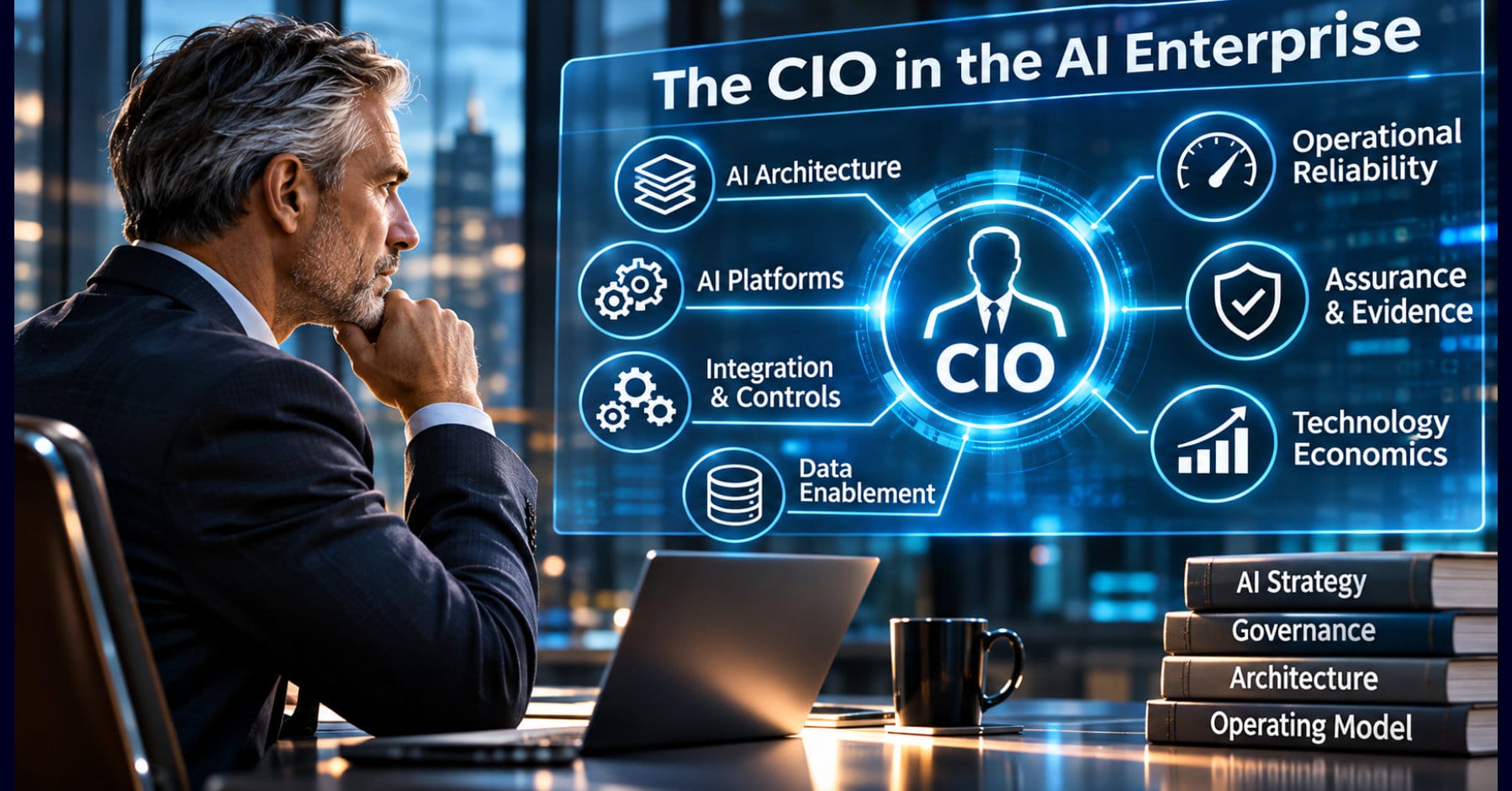
The article identifies seven core CIO responsibilities: enterprise AI architecture, AI technology platforms, integration and execution controls, technical data enablement, operational reliability, technical assurance and evidence, and technology portfolio economics.
It explains why business executives must retain ownership of strategic priorities, process redesign, delegated decision authority, and operational outcomes. Data governance, cybersecurity, legal compliance, financial oversight, and independent assurance likewise require clearly designated accountable authorities.
Particular attention is given to agentic AI, where the CIO’s organization must translate approved business permissions into enforceable technical boundaries, including transaction limits, access restrictions, escalation procedures, revocation mechanisms, and evidence preservation.
The article also presents an architectural accountability model, an executive responsibility matrix, and measurable indicators for evaluating CIO performance across AI integration, reliability, governance enforcement, lifecycle management, and technology economics.
The central argument is that the CIO should not become the default owner of every AI outcome. Instead, the CIO must ensure that enterprise AI capabilities are architecturally coherent, operationally dependable, technically controllable, economically sustainable, and capable of producing defensible evidence.
Successful enterprise AI governance requires distributed executive accountability supported by a unified, enforceable technology architecture.
For decades, the Chief Information Officer has been responsible for ensuring that enterprise technology supports business operations, enables strategic initiatives, and manages information-related risks.
Artificial intelligence is changing the scope of that responsibility.
The CIO is no longer being asked merely to provide technology that helps employees perform their work. Increasingly, the CIO must establish the technological and architectural conditions under which intelligent systems can participate in business processes, generate recommendations, and execute authorized actions.
That is a fundamentally different responsibility.
Traditional enterprise systems primarily processed transactions according to predefined business rules. AI-enabled systems can interpret information, evaluate alternatives, generate recommendations, and, when granted appropriate permissions, initiate operational activity.
The distinction matters because the consequences of technology decisions increasingly extend into the enterprise’s decision-making structure.
An AI agent that can approve a routine transaction, initiate a supplier payment, modify a customer record, or trigger an operational workflow is not simply another software application.
It is a technology-enabled participant in an enterprise operating model.
The CIO must therefore confront a question that cannot be answered by traditional IT management practices alone:
What should the CIO own when enterprise technology begins participating in decisions and actions previously performed by people?
The answer is neither everything nor nothing.
The CIO should own the architecture, integration, technical controls, operational reliability, and technology assurance necessary for enterprise AI to function safely and effectively.
Business leaders must retain accountability for business outcomes and the authority delegated within their functions.
Boards and executive leadership must establish the governance expectations within which those responsibilities operate.
The challenge is designing an operating model in which these boundaries are explicit, enforceable, and supported by evidence.
The CIO’s Traditional Mandate Is No Longer Sufficient
The CIO’s responsibilities have evolved considerably over the past several decades.
Early enterprise IT leadership concentrated on infrastructure, computing resources, telecommunications, application development, and operational support.
As technology became more deeply embedded in business operations, CIOs assumed broader responsibility for enterprise architecture, cybersecurity coordination, data platforms, digital transformation, technology investment, and business enablement.
Artificial intelligence represents another expansion, but it differs from earlier technology transitions in an important respect.
AI introduces systems capable of influencing or executing decisions, not merely processing information.
Consider the progression.
A traditional enterprise resource planning system records a purchase order and applies established validation rules.
An analytics platform identifies purchasing trends and provides reports to management.
A predictive model estimates future purchasing requirements.
A generative AI system recommends alternative suppliers, evaluates contractual considerations, and drafts purchasing decisions.
An authorized AI agent may go further by initiating supplier communications, preparing purchase orders, or executing permitted transactions through connected enterprise systems.
Each stage increases the system’s potential influence over business activity.
The final stage introduces questions that extend beyond application functionality:
- Who authorized the agent to act?
- Which business decisions may it make independently?
- What information may it access and rely upon?
- Which transactions require human approval?
- What happens when the agent encounters an exception?
- Who can suspend or revoke its authority?
- How will the organization reconstruct what occurred?
- Who remains accountable for the business outcome?
These questions cannot be answered solely through system configuration.
They require coordinated decisions involving business leadership, enterprise architecture, cybersecurity, risk management, legal counsel, finance, and executive governance.
The CIO has a central role in making those decisions operationally enforceable.
But that does not mean the CIO should own every decision the technology makes possible.
The Critical Distinction: Technology Authority Versus Business Authority
One of the most consequential mistakes an enterprise can make is confusing responsibility for a technology platform with authority over the business activities conducted through that platform.
A CIO may own the enterprise AI platform.
That does not automatically give the CIO authority to determine credit policy, approve insurance claims, establish clinical treatment protocols, authorize supplier expenditures, or decide which employees should be hired.
Those are business decisions governed by legitimate organizational authority.
AI does not eliminate that distinction.
It makes the distinction more important.
Consider an AI agent deployed within a procurement function.
The CIO’s organization may be responsible for ensuring that the agent:
- Authenticates securely.
- Accesses only approved systems and information.
- Operates within technically enforced permissions.
- Maintains reliable transaction records.
- Supports monitoring, intervention, and suspension.
- Meets established availability and recovery requirements.
The Chief Procurement Officer, or another authorized business executive, remains responsible for determining:
- Which purchasing decisions may be delegated.
- The financial limits of that delegation.
- Which suppliers and purchasing categories are permitted.
- When additional approvals are required.
- Which exceptions require human judgment.
- What business outcomes constitute acceptable performance.
Finance may establish expenditure controls.
Legal may determine contractual restrictions.
Risk management may establish exposure tolerances.
The CIO’s responsibility is to ensure that the approved operating requirements can be translated into functioning technology controls.
The business owns the authority. The CIO owns the technical means through which that authority is enforced.
This principle should become foundational to enterprise AI governance.
It also prevents a dangerous organizational pattern: treating the technology department as the default owner of decisions simply because those decisions are increasingly executed through technology.
Seven Responsibilities the CIO Should Own
The AI enterprise requires a more precise definition of CIO accountability.
Rather than expanding the CIO’s mandate indiscriminately, organizations should establish clear ownership across seven foundational responsibilities.
| CIO Responsibility | Primary Accountability | Required Enterprise Outcome |
|---|---|---|
| Enterprise AI architecture | Architectural coherence and interoperability | AI capabilities integrate into the enterprise without creating uncontrolled fragmentation |
| AI technology platforms | Shared technical services and platform operations | Reliable, scalable, governed AI infrastructure |
| Integration and execution controls | Secure connections between AI and operational systems | AI actions remain within approved technical boundaries |
| Technical data enablement | Data access mechanisms, integration, and technical enforcement | Authorized AI systems receive appropriate, traceable information |
| AI operational reliability | Availability, performance, monitoring, recovery, and change management | AI-enabled operations remain dependable and controllable |
| Technical assurance and evidence | Demonstrable implementation and operation of technology controls | Management can verify how AI systems operated |
| Technology portfolio economics | Architecture-related costs, dependencies, and lifecycle management | Sustainable AI investments and controlled technology exposure |
These responsibilities form the technical foundation of an intelligent enterprise.
They do not replace business ownership, enterprise risk governance, or board oversight.
They make those functions operationally possible.
1. The CIO Should Own Enterprise AI Architecture
Enterprise architecture has always been concerned with the relationship between business capabilities, information, applications, technology, and organizational change.
AI increases the importance of those relationships.
Without architectural discipline, enterprise AI adoption can rapidly produce disconnected platforms, duplicated capabilities, inconsistent information access, fragmented identity controls, and overlapping vendor dependencies.
The result may be an organization with numerous AI applications but no coherent AI operating capability.
A department purchases an AI assistant.
Another implements a specialized agent platform.
A third develops custom retrieval-augmented generation capabilities.
A fourth connects a commercial AI service directly to an operational database.
Each initiative may appear reasonable when evaluated independently.
Collectively, however, they can create substantial architectural risk.
The CIO should establish an enterprise AI architecture that defines how intelligent capabilities interact with the organization’s existing technology environment.
That architecture should address at least six concerns.
Architectural boundaries
Which AI capabilities belong in shared enterprise platforms, and which should remain within specialized business applications?
Integration standards
How will models, agents, APIs, enterprise applications, event streams, and operational workflows communicate?
Identity and authorization
How will AI systems authenticate, receive permissions, and demonstrate that actions were performed within approved boundaries?
Information access
How will AI systems obtain authoritative, relevant, and permitted information without bypassing established data controls?
Observability
How will the enterprise monitor model behavior, agent activity, system interactions, exceptions, and operational outcomes?
Lifecycle management
How will AI capabilities be evaluated, updated, replaced, suspended, or retired?
These are architectural decisions with enterprise-wide consequences.
They should not be determined independently by every department purchasing an AI product.
The CIO does not need to approve every individual AI use case.
The CIO does need to ensure that approved use cases operate within a coherent architectural environment.
Enterprise AI architecture should enable distributed innovation without creating distributed technological disorder.
2. The CIO Should Own the Technical AI Platform, Not the Enterprise AI Strategy Alone
A growing number of organizations are establishing centralized AI platforms.
These platforms may provide model access, inference services, retrieval infrastructure, agent orchestration, evaluation capabilities, monitoring, security integration, and common development tools.
Centralization can reduce duplication and improve technical consistency.
But a centralized platform is not the same thing as an enterprise AI strategy.
The platform answers questions such as:
How will AI capabilities be delivered?
Which technical services should be shared?
How will approved models be accessed?
What operational controls will apply?
How will consumption and performance be measured?
Enterprise strategy answers different questions:
Which business constraints should AI address?
Where should the organization invest?
Which operating capabilities should be redesigned?
What decisions should AI be authorized to support or execute?
Which business outcomes justify continued investment?
The CIO should lead the architecture and operation of the shared technical platform.
Enterprise AI strategy should be established through executive leadership, with meaningful participation from business, finance, technology, risk, and governance functions.
This distinction matters because technology platforms naturally encourage adoption.
Business strategy must determine whether adoption produces value.
An organization can achieve excellent platform utilization while generating disappointing economic returns.
That is not necessarily a platform failure.
It may be a strategy or operating-model failure.
The CIO should be accountable for the technical platform’s performance and economics.
Business sponsors should be accountable for converting its capabilities into measurable business outcomes.
3. The CIO Should Own Technical Enforcement of Delegated Authority
This may become one of the most important responsibilities of the modern CIO.
As AI agents gain access to operational systems, enterprises must translate business authority into enforceable technical permissions.
Traditional access management answers questions such as:
Who can access a system?
Which records may a user view?
What functions may a service execute?
Agentic AI introduces additional dimensions.
An agent may be permitted to perform a function only under particular circumstances.
For example, a procurement agent might be authorized to:
- Purchase approved supplies from designated vendors.
- Operate within a defined expenditure limit.
- Use only approved purchasing data.
- Escalate unusual pricing or contractual exceptions.
- Execute transactions only during an approved delegation period.
- Stop operating when a risk threshold is reached.
The authorization is conditional.
It depends on the transaction, context, business purpose, risk exposure, and validity of the delegation.
A technical permission to access a purchasing API is therefore insufficient.
The enterprise must distinguish between the ability to execute a transaction and the authority to execute that transaction.
The CIO should ensure that the technical environment can enforce the distinction.
The AI Authority Enforcement Model
| Control Dimension | Business Governance Responsibility | CIO Technical Responsibility |
|---|---|---|
| Decision scope | Define permitted business decisions | Enforce approved action boundaries |
| Financial exposure | Establish transaction and cumulative limits | Implement limits and exposure monitoring |
| Information authority | Determine permitted data uses | Enforce access and processing restrictions |
| Exception handling | Define escalation and approval requirements | Implement routing, suspension, and approval controls |
| Delegation duration | Approve validity and expiration | Enforce expiration and revocation |
| Accountability | Assign responsible business owners | Preserve identity, authorization, and execution records |
| Intervention | Determine who may stop an activity | Provide effective suspension and containment mechanisms |
This division of responsibility is essential.
The CIO should not independently decide whether an AI agent may spend $50,000 on behalf of procurement.
The CIO should ensure that an approved $50,000 limit can be enforced, monitored, and revoked.
There is also an important technical qualification.
Not every business rule can be reliably enforced through a model prompt.
High-consequence constraints should be implemented through appropriate deterministic controls, authorization services, workflow gates, transaction limits, and other mechanisms outside the model’s discretionary reasoning.
An instruction telling an agent not to exceed its authority is not equivalent to a system preventing it from doing so.
The CIO’s obligation is to make delegated authority enforceable, not merely documented.
4. The CIO Should Own Technical Data Enablement, While Business Owners Retain Data Authority
Artificial intelligence increases the strategic value of enterprise information.
It also increases the consequences of poor data governance.
AI systems may retrieve, combine, summarize, transform, and act upon information originating from numerous sources.
The technical ability to access information does not establish that the information is authoritative, accurate, appropriate, or legally permitted for the intended use.
The CIO should own the technical architecture that makes governed information available to approved AI systems.
This includes data integration, access infrastructure, metadata services, technical lineage, identity enforcement, retrieval systems, and relevant platform controls.
However, business data owners must retain responsibility for the meaning, legitimacy, and business authority of their information.
Consider a customer profitability model.
The CIO’s organization may ensure that the AI system can securely retrieve the relevant financial, customer, and operational data.
Finance must determine which profitability measures are authoritative.
Sales leadership may define the business context in which recommendations will be used.
Legal and privacy functions may establish restrictions on particular categories of information.
Risk management may determine whether the resulting recommendations require additional review.
The CIO enables the controlled information flow.
The business determines what the information means and how it may legitimately influence decisions.
This distinction becomes especially important in retrieval-augmented generation and agentic workflows.
A retrieval system can return a document successfully without establishing that the document is current, authoritative, or applicable.
An AI agent can combine information from several systems without establishing that the combination is permitted.
Technical integration is necessary.
It is not sufficient.
The CIO should ensure that the architecture can carry information provenance, access restrictions, classification, and relevant authority metadata into AI-enabled workflows.
AI-ready data is not merely accessible data. It is information whose use can be justified and governed.
5. The CIO Should Own AI Operational Reliability and Controllability
Traditional IT operations emphasize availability, performance, security, resilience, recovery, and service management.
Those responsibilities remain essential.
However, AI-enabled systems introduce additional operational considerations.
Model outputs may vary.
Dependencies may change.
External providers may update their services.
Agent workflows may interact with multiple applications.
A seemingly minor change in a model, tool definition, prompt, data source, or integration can alter downstream behavior.
The CIO should therefore establish an AI operational management capability that extends established IT disciplines.
AI Operational Control Requirements
| Operational Domain | Required Capability |
|---|---|
| Availability | Monitor service health, dependencies, and continuity |
| Performance | Measure latency, throughput, reliability, and resource consumption |
| Behavioral monitoring | Detect material deviations from expected system behavior |
| Change management | Evaluate and control changes to models, prompts, tools, and integrations |
| Incident management | Identify, contain, investigate, and recover from AI-related operational failures |
| Intervention | Suspend, restrict, or revoke AI execution capabilities |
| Recovery | Restore dependable operations, including approved manual alternatives |
| Dependency management | Monitor external providers, services, and critical integrations |
| Evaluation | Test technical behavior against defined acceptance criteria |
| Evidence preservation | Retain relevant operational records for investigation and assurance |
The concept of controllability deserves particular attention.
An AI system should not be considered operationally mature merely because it performs successfully under normal conditions.
The organization must also know whether it can intervene when conditions change.
Can the agent be stopped?
Can its permissions be revoked immediately?
Can a workflow be redirected to a human operator?
Can an erroneous transaction be reversed where the underlying business process permits reversal?
Can the organization identify which actions occurred before suspension?
Can operations continue if the AI provider becomes unavailable?
These are operational architecture questions.
The CIO should ensure that the organization can answer them through tested capabilities rather than assumptions.
For consequential AI systems, the ability to stop an action may be as important as the ability to initiate one.
6. The CIO Should Own Technical Assurance Evidence, Not the Entire Governance Judgment
Organizations increasingly need to demonstrate that their AI systems operate within approved requirements.
Policies alone cannot establish that.
A governance committee may approve a delegation of authority.
A risk assessment may identify required controls.
A business owner may accept a defined operational exposure.
But management still needs evidence that the technology implemented those requirements correctly and continued to enforce them.
The CIO should own the technical evidence generated by the systems under the CIO’s responsibility.
This includes evidence of:
- Approved configurations and deployed versions.
- Identity and authorization enforcement.
- Data access and relevant information provenance.
- Model and agent execution activity.
- Technical policy evaluations and control decisions.
- Exceptions, interventions, and suspensions.
- Operational testing and evaluation results.
- System changes and associated approvals.
- Incidents, recovery actions, and control remediation.
However, technical evidence does not independently establish that the underlying business decision was appropriate.
A system log may prove that an agent executed an approved transaction.
It does not necessarily prove that the transaction was commercially justified.
An authorization record may demonstrate that a permission existed.
It does not necessarily establish that the delegation was prudent.
A successful technical evaluation may demonstrate compliance with defined test conditions.
It does not establish that the business achieved its intended economic outcome.
This distinction is central to effective AI assurance.
The Governance-to-Evidence Chain
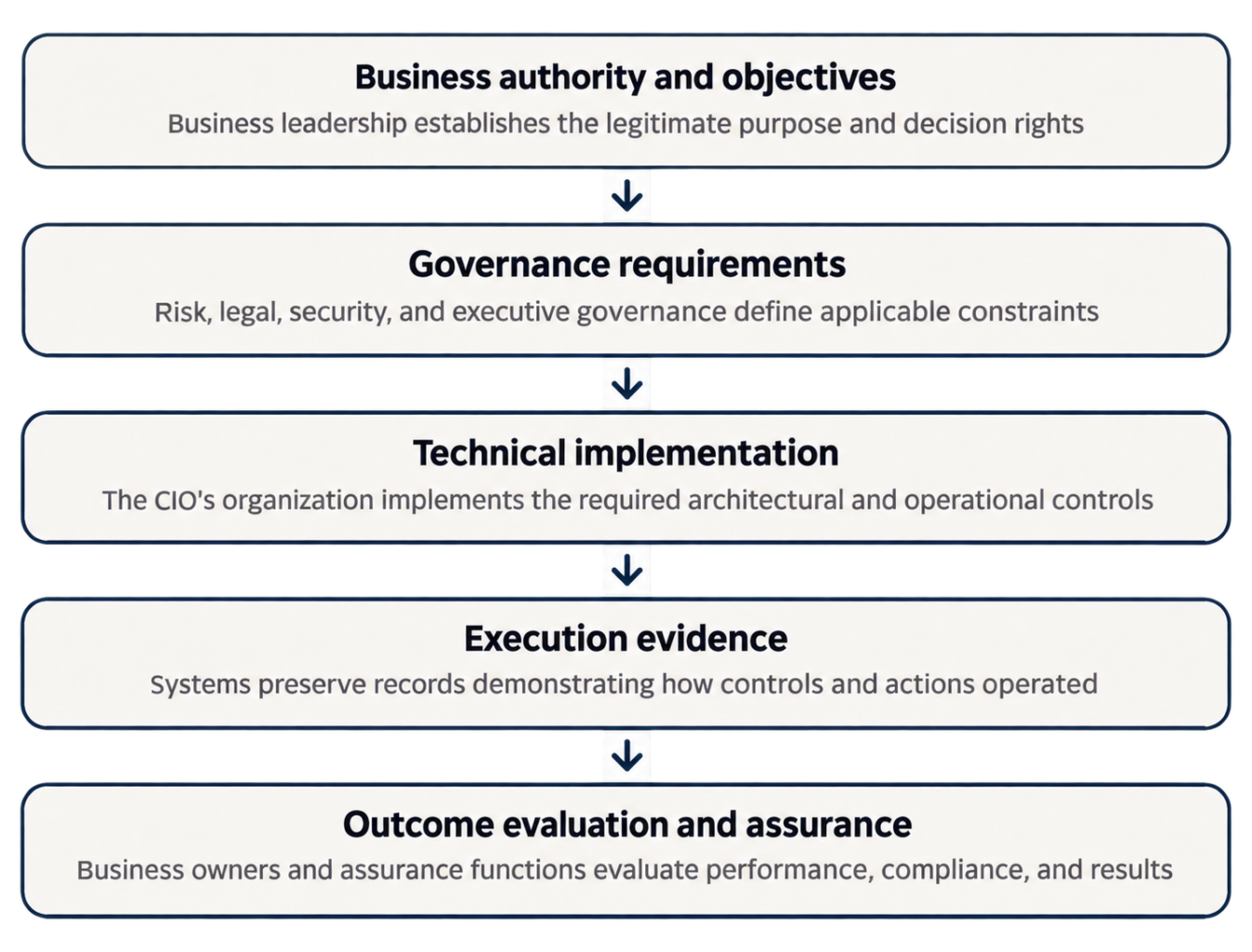
This chain connects governance decisions with operational evidence.
It also demonstrates why technical assurance must be coordinated with enterprise governance rather than substituted for it.
Within my Evidentiary Architecture™ framework, the objective is to preserve the relationship between authority, decisions, implementation, execution, and outcomes.
The CIO plays a critical role because technology systems generate much of the operational evidence needed to support that relationship.
But the CIO should not be the sole judge of whether the resulting business activity was appropriate.
That judgment belongs to the accountable business and governance authorities.
7. The CIO Should Own the Economics of the Technology Architecture
AI investment decisions are becoming increasingly complex.
The initial price of a model or platform rarely represents the full economic cost of operating an enterprise AI capability.
Organizations must consider inference consumption, licensing, infrastructure, data integration, retrieval services, monitoring, security controls, testing, operational support, vendor dependencies, and eventual replacement or retirement.
These costs may vary significantly with workload characteristics.
A pilot that appears inexpensive at limited volume may become costly when deployed across thousands of employees or integrated into high-frequency business processes.
The CIO should establish transparency into the economics of the technology architecture.
That includes understanding:
- The cost of individual AI services and shared platforms.
- Consumption patterns and unit economics.
- Infrastructure and integration dependencies.
- Vendor concentration and switching costs.
- Technical operating and maintenance costs.
- The economics of model selection and routing.
- Architectural duplication across departments.
- The cost of security, monitoring, and technical assurance.
- The lifecycle implications of retiring or replacing capabilities.
These responsibilities should be coordinated with the CFO and business investment owners.
The CIO can explain the technical cost of delivering a capability.
The CFO can evaluate its financial treatment, investment assumptions, and economic realization.
The business sponsor must demonstrate that the capability produces sufficient value to justify its continued operation.
Three Different Economic Questions
| Executive | Primary Economic Question |
|---|---|
| CIO | Can this AI capability be delivered and operated reliably at an economically sustainable technical cost? |
| CFO | Does the investment produce credible, measurable financial value relative to its full economic cost? |
| Business owner | Does the capability improve the business outcome for which this function is accountable? |
The questions overlap.
They are not interchangeable.
An AI capability can be technically efficient and financially unattractive.
It can be financially promising but operationally unreliable.
It can also be technically successful and economically beneficial while introducing unacceptable business risk.
The enterprise needs all three perspectives.
The CIO should not be made solely accountable for an investment’s business return simply because the investment uses artificial intelligence.
What the CIO Should Not Own Alone
Defining the CIO’s responsibilities is only half the governance problem.
Organizations must also identify responsibilities that should not be transferred to IT by default.
The following distinctions are particularly important.
| Responsibility | Primary Accountable Authority | CIO’s Role |
|---|---|---|
| Enterprise AI strategic priorities | CEO and executive leadership | Advise on feasibility, architecture, dependencies, and technical economics |
| Business process redesign | Accountable business executive | Enable integration and implementation |
| Business decision authority | Authorized business leadership | Enforce approved technical boundaries |
| Data meaning and permitted business use | Designated data owners and relevant governance authorities | Provide technical access and enforcement |
| Enterprise risk appetite | Board and executive risk governance | Implement and report on relevant technology controls |
| Legal and regulatory interpretation | Legal and compliance functions | Support implementation and evidence requirements |
| Financial value realization | Business sponsor with CFO oversight | Provide technology cost and performance evidence |
| Independent assurance | Authorized audit or independent assurance function | Supply technical evidence and remediation support |
| Workforce policy and organizational redesign | Business leadership and human resources | Support technology-related workforce changes |
| Enterprise AI architecture | CIO | Lead architectural standards, integration, and technology governance |
The objective is not to diminish the CIO’s role.
It is to establish a sustainable allocation of accountability.
An enterprise that assigns all AI responsibility to the CIO may appear to have simplified governance.
In reality, it may have obscured the distinction between technology management and legitimate business authority.
Centralizing technical accountability is useful. Centralizing every AI-related business decision in IT is not.
The CIO, CDO, CISO, and CAIO: Avoiding the Executive Ownership Collision
As AI adoption expands, organizations are introducing or redefining executive roles.
The Chief Data Officer may lead data governance and information strategy.
The Chief Information Security Officer may lead cybersecurity risk management and security assurance.
The Chief AI Officer may coordinate AI strategy, adoption, model governance, or AI capability development.
The CIO remains responsible for substantial portions of the technology environment on which these functions depend.
Without explicit boundaries, these roles can overlap in ways that slow decisions and weaken accountability.
The solution is not a universal organizational chart.
Different enterprises have different structures, regulatory requirements, and operating models.
The solution is a clear allocation of decision rights.
An Illustrative Executive Responsibility Model
| Executive Role | Principal Accountability |
|---|---|
| CEO and executive committee | Enterprise AI strategy, strategic priorities, and cross-functional accountability |
| CIO | Enterprise AI architecture, platforms, integration, technology operations, and technical control implementation |
| CDO | Enterprise data governance, data quality, information ownership structures, and data strategy |
| CISO | Cybersecurity policy, security risk assessment, security control requirements, and security assurance within the organization’s governance model |
| CAIO, where appointed | AI strategy coordination, AI capability standards, adoption oversight, or designated AI governance responsibilities |
| CFO | Financial governance, investment economics, and verification of financial value |
| Business executives | Authorized business decisions, process redesign, operational outcomes, and value realization |
| General Counsel and compliance leadership | Legal interpretation, contractual requirements, and regulatory compliance oversight |
| Internal audit | Independent evaluation of governance, risk management, and controls |
These are illustrative assignments, not universal reporting relationships.
In some organizations, the CISO reports to the CIO.
In others, the CISO reports independently to the CEO or another executive.
The CDO may report to the CIO or operate as a separate enterprise function.
A CAIO may own centralized AI delivery or may serve primarily as a strategic coordinator.
What matters is that the enterprise knows which executive has the authority to decide, which executive must be consulted, and which executive remains accountable.
Overlapping expertise is not inherently a problem.
Overlapping authority without explicit decision rights is.
The CIO Must Become an Architect of Decision Infrastructure
The most important long-term change may be conceptual.
Enterprise architecture has traditionally emphasized applications, information flows, technology platforms, and business capabilities.
In the AI enterprise, those elements increasingly support an additional architectural concern: decision infrastructure.
Decision infrastructure is the combination of information, authority, systems, controls, and evidence that allows enterprise decisions to be made and executed legitimately.
It includes more than analytics or automated workflows.
A decision-capable enterprise must establish:
- Which information is authoritative for a particular decision.
- Who or what is permitted to make that decision.
- Which conditions constrain the decision.
- How the decision becomes an operational action.
- How exceptions and interventions are handled.
- How the organization verifies the resulting outcome.
- How evidence and lessons are preserved for future decisions.
The CIO should lead the technical architecture supporting these capabilities.
Business and governance authorities must define their legitimate use.
This distinction is particularly important when organizations begin deploying multiple AI agents across business functions.
Without shared architectural standards, each agent may implement its own assumptions about identity, permissions, information access, exception handling, and evidence.
The enterprise can quickly accumulate a collection of locally intelligent systems without a coherent mechanism for governing their collective behavior.
The Enterprise Decision Infrastructure Model
| Architectural Layer | Essential Function | Primary Ownership |
|---|---|---|
| Business objectives | Define intended outcomes and constraints | Business leadership |
| Information authority | Establish trusted sources, meaning, and permitted uses | Data owners and governance functions |
| Decision authority | Define legitimate permissions, delegation, and escalation | Business and executive governance |
| AI capability | Generate analyses, recommendations, or authorized actions | Designated AI capability and system owners |
| Technical enforcement | Apply access controls, workflow gates, limits, and intervention mechanisms | CIO and relevant technology teams |
| Operational execution | Integrate decisions into business processes and systems | Business operations with CIO enablement |
| Evidence and observability | Preserve technical records and support reconstruction | CIO for technical evidence; business owners for decision and outcome evidence |
| Outcome assurance | Evaluate results, risk, and compliance against approved objectives | Business, risk, compliance, and independent assurance functions |
This model shifts the discussion from who owns the AI tool to who owns each part of the decision process.
That is a more useful foundation for enterprise accountability.
It also prepares the organization for a future in which AI capabilities may be replaced frequently while business authority and governance requirements remain relatively stable.
The enterprise should not have to redesign its entire accountability structure whenever it changes models.
Why the CIO Cannot Solve the AI Operating Model Alone
The previous articles in this series established several connected principles.
AI does not simply automate jobs. It reconstructs work.
AI agents require changes to operating models.
Traditional organizational structures were designed around human information flows.
The AI skills gap includes judgment, process understanding, data authority, and governance competence.
AI investments must demonstrate economic conversion rather than merely report productivity improvements.
And sustainable competitive advantage increasingly depends on organizational learning speed.
These principles converge on a single organizational reality.
The CIO can enable enterprise intelligence, but cannot independently make the enterprise intelligent.
A technically sophisticated AI platform cannot compensate for unclear business objectives.
Excellent integration cannot resolve conflicting organizational incentives.
Reliable automation cannot establish legitimate decision authority where none has been defined.
Detailed system logs cannot prove business value when outcomes have not been measured.
Faster model responses cannot overcome an executive approval process that takes weeks.
These are enterprise operating-model problems.
They require executive leadership beyond the technology function.
The CIO should be an essential architect and participant in their resolution.
But enterprise transformation must remain an enterprise responsibility.
The CIO’s AI Accountability Scorecard
A practical governance model should translate the CIO’s responsibilities into measurable performance.
Traditional IT metrics remain necessary, but they are insufficient to evaluate the CIO’s contribution to enterprise AI.
The scorecard should examine architectural coherence, operational control, reliability, technical assurance, and economic sustainability.
| Accountability Dimension | Illustrative Measures |
|---|---|
| Architectural coherence | Percentage of material AI systems conforming to approved architecture; documented exceptions; duplicated platform capabilities |
| Integration effectiveness | Integration reliability, supported interoperability standards, deployment lead time |
| Authority enforcement | Percentage of consequential AI actions subject to approved technical controls; unauthorized action attempts; revocation effectiveness |
| Information control | Provenance coverage, access-policy enforcement, authoritative-source integration, unauthorized data access incidents |
| Operational reliability | Availability, latency, failure rates, recovery performance, dependency incidents |
| Intervention capability | Time to suspend agent activity, time to revoke permissions, tested recovery effectiveness |
| Technical assurance | Control evidence completeness, evaluation coverage, unresolved technical exceptions, remediation time |
| Technology economics | Cost per transaction or workload, consumption variance, infrastructure efficiency, vendor concentration |
| Lifecycle discipline | Model and agent inventory coverage, change traceability, retirement completeness, unsupported dependencies |
These measures should not become an excuse to create another dashboard disconnected from executive decisions.
They should answer operational questions.
Can the enterprise identify its consequential AI systems?
Can it demonstrate which permissions those systems possess?
Can it enforce and revoke delegated authority?
Can it explain which information sources support AI-enabled actions?
Can it detect material changes in system behavior?
Can it suspend operations when required?
Can it demonstrate that technical controls are working?
Can it operate AI capabilities at sustainable cost?
These are appropriate CIO accountability questions.
They focus on the technological conditions necessary for responsible enterprise intelligence.
They do not confuse platform performance with business success.
A Practical CIO Agenda for the Next 12 Months
The CIO does not need to wait for the organization to complete a comprehensive AI transformation before strengthening its operating model.
A disciplined 12-month agenda can establish meaningful progress.
- First 90 days: Establish visibility and accountability: Inventory consequential AI systems and agents, identify owners, document critical integrations, assess existing permissions, and establish the current governance and architectural gaps.
- Days 91–180: Define the enterprise AI architecture: Establish platform standards, integration patterns, technical control requirements, monitoring expectations, and clear decision boundaries between technology and business leadership.
- Days 181–270: Operationalize authority and assurance: Implement or strengthen delegated-authority enforcement, intervention mechanisms, evaluation procedures, technical evidence capture, and operational recovery capabilities for priority AI workflows.
- Days 271–365: Measure, improve, and institutionalize: Evaluate architecture compliance, control effectiveness, operational performance, technical economics, and recurring failure patterns. Use the findings to improve standards and retire unnecessary duplication.
The sequence should be risk-based.
A highly autonomous agent connected to financial transactions may require immediate attention.
A low-risk internal drafting assistant may warrant a different level of control.
The objective is not to impose identical governance overhead on every AI application.
It is to ensure that technical safeguards are proportionate to the authority, exposure, and consequences of each capability.
The Boardroom Question
Boards should not ask the CIO only how many AI applications have been deployed, how many employees use them, or how much the organization has spent on AI infrastructure.
Those figures may be useful.
They do not establish whether the enterprise has a dependable foundation for intelligent operations.
A more consequential question is:
Can management demonstrate that our AI systems operate within approved business authority, use appropriately governed information, remain controllable under adverse conditions, and produce sufficient evidence for independent evaluation?
The CIO should be able to explain the architecture and technical controls that support those requirements.
Business leaders should be able to explain the decisions and outcomes for which they remain accountable.
Risk and assurance functions should be able to evaluate the resulting evidence.
If those responsibilities cannot be distinguished, the enterprise may have adopted AI faster than it has established the ability to govern it.
The Executive Imperative
The CIO’s role in the AI enterprise should be defined through explicit accountability rather than expanding expectations.
Executive leadership should take six actions.
1. Define CIO ownership of enterprise AI architecture and technology operations. Establish clear accountability for platforms, integrations, technical controls, reliability, and lifecycle management.
2. Separate business authority from technical execution. Require business owners to approve the decisions and actions delegated to AI systems.
3. Translate governance requirements into enforceable controls. Ensure that permissions, limits, exceptions, expiration, and intervention mechanisms are implemented through appropriate technology.
4. Establish shared responsibility for evidence. Assign the CIO ownership of technical evidence while preserving business and governance accountability for decision justification and outcomes.
5. Create an integrated executive operating model. Clarify the respective responsibilities of the CIO, CDO, CISO, CAIO where appointed, CFO, legal counsel, risk functions, and business executives.
6. Measure the CIO against the quality of enterprise AI infrastructure, not AI adoption alone. Evaluate architecture, controllability, assurance, reliability, and technology economics.
These actions provide a more durable foundation than assigning all AI-related activity to a single executive.
They recognize that intelligent enterprises require both technological coherence and legitimate organizational authority.
Conclusion: The CIO Must Own the Foundation, Not Every Decision
Artificial intelligence is expanding the influence of technology across the enterprise.
As AI systems move from providing information to participating in operational decisions, the CIO’s responsibilities become more consequential.
The CIO must ensure that intelligent capabilities can be integrated, controlled, monitored, evaluated, and sustained.
The CIO must establish architectural standards that prevent fragmentation.
The CIO must ensure that approved authority can be technically enforced.
The CIO must provide the operational infrastructure necessary to detect failures, intervene effectively, and preserve evidence.
And the CIO must understand the technology economics that determine whether enterprise AI can operate sustainably.
But the CIO should not become the default owner of every business decision influenced by artificial intelligence.
Business executives must retain responsibility for their decisions, operating processes, and outcomes.
Governance authorities must establish legitimate constraints.
Boards must oversee the resulting allocation of accountability.
The enterprise needs a CIO who can build the technological foundation for intelligent operations without allowing technology ownership to replace business authority.
That is the emerging mandate.
The CIO should not own all enterprise intelligence. The CIO should own the architecture that makes enterprise intelligence dependable, governable, and operationally useful.
References
Davenport, Thomas H., and Nitin Mittal. All-in on AI: How Smart Companies Win Big with Artificial Intelligence. Boston: Harvard Business Review Press, 2023.
International Organization for Standardization and International Electrotechnical Commission. ISO/IEC 42001:2023: Information Technology—Artificial Intelligence—Management System. Geneva: ISO, 2023.
ISACA. COBIT 2019 Framework: Governance and Management Objectives. Schaumburg, IL: ISACA, 2018.
National Institute of Standards and Technology. Artificial Intelligence Risk Management Framework (AI RMF 1.0). NIST AI 100-1. Gaithersburg, MD: NIST, 2023. https://doi.org/10.6028/NIST.AI.100-1.
National Institute of Standards and Technology. Artificial Intelligence Risk Management Framework: Generative Artificial Intelligence Profile. NIST AI 600-1. Gaithersburg, MD: NIST, 2024. https://doi.org/10.6028/NIST.AI.600-1.
The Open Group. The TOGAF Standard, 10th Edition. Reading, UK: The Open Group, 2022.
Weill, Peter, and Jeanne W. Ross. IT Governance: How Top Performers Manage IT Decision Rights for Superior Results. Boston: Harvard Business School Press, 2004.
Coming Next: Article 20 of 20
The AI-Native Enterprise Will Not Look Like Today’s Enterprise
The final installment brings the series together.
If AI changes how information is produced, decisions are made, work is organized, authority is delegated, and organizational learning occurs, then the enterprise itself must eventually change.
The concluding article will examine what an AI-native enterprise may look like, how its operating model differs from today’s organization, and which strategic choices leaders should begin making now.