Data Governance Series | Article 13 of 20
Governing the Information That Drives the Enterprise
Summary
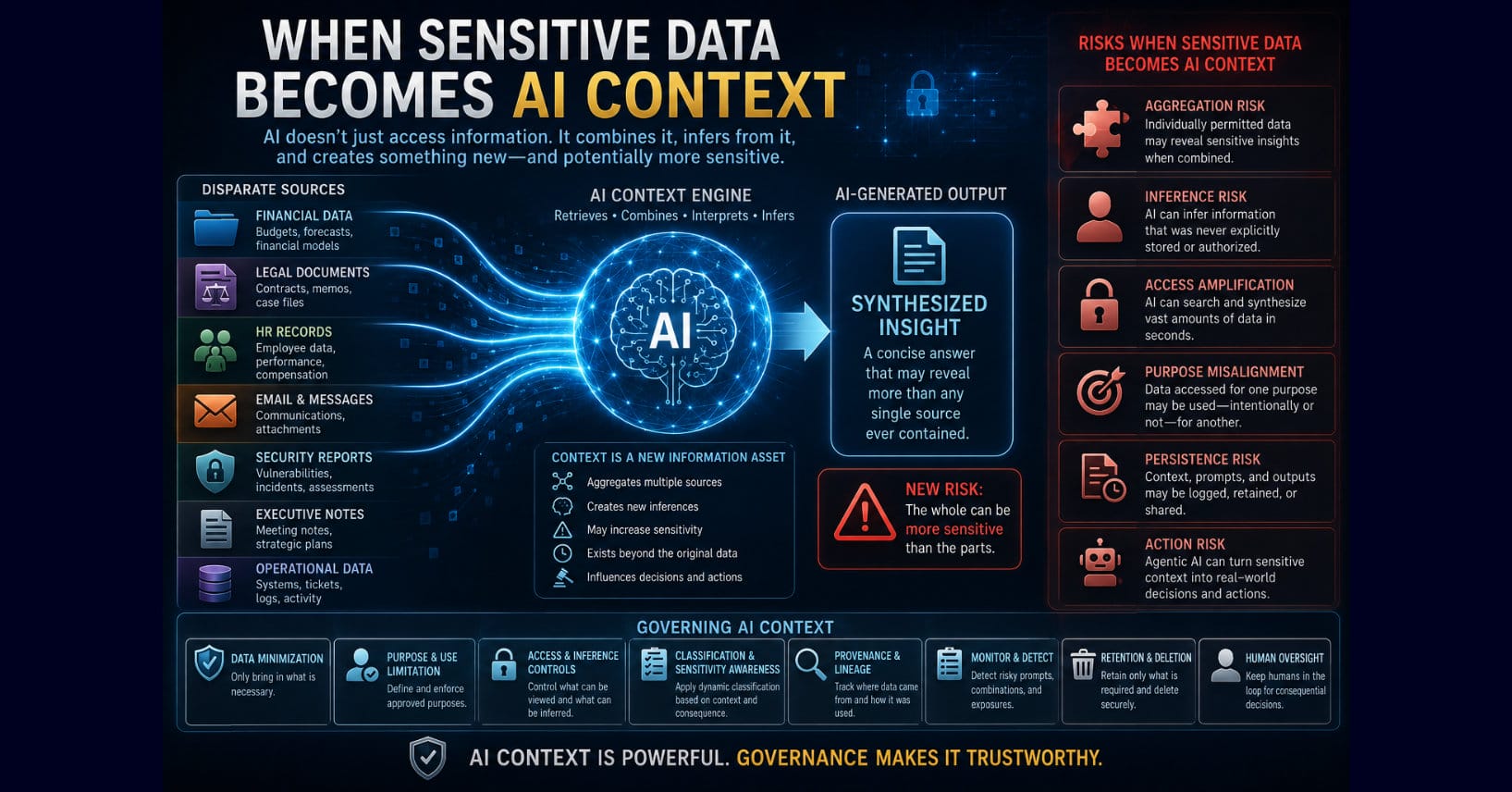
Enterprise AI does more than access sensitive information. It retrieves data across repositories, combines individually permitted sources, identifies relationships, generates inferences, and can create information more sensitive than any single source.
“When Sensitive Data Becomes AI Context” examines why traditional object-level access controls are necessary but increasingly insufficient for enterprise AI. The article explores aggregation risk, capability amplification, dynamic classification, purpose limitation, permission to infer, sensitive prompts, conversational memory, vector stores, context concentration, AI-generated outputs, logging, semantic data loss prevention, and agentic AI.
The central governance issue is that authorization to access information does not automatically imply authorization to combine it, infer from it, retain it, or act upon it. As enterprise AI becomes more capable, organizations will need to govern information not only where it is stored but also where it is dynamically assembled and used.
The article introduces context governance as an emerging discipline for controlling what information may enter AI context, how it may be combined, what inferences are permitted, how long context persists, what outputs require classification, and when human oversight is necessary.
An employee opens a confidential document.
The access is logged.
Permissions are checked.
The employee is authorized.
Nothing unusual happens.
Now consider a different interaction.
The employee asks an enterprise AI assistant:
“Summarize everything we know about the acquisition target, including financial concerns, personnel risks, legal issues, and anything executives have discussed privately.”
The AI searches across multiple repositories.
It retrieves financial models.
Legal memoranda.
Executive meeting notes.
Email.
HR information.
Risk assessments.
Due-diligence documents.
Perhaps every individual retrieval is technically permitted.
The AI combines the information.
Summarizes it.
Identifies relationships.
Infers patterns.
Produces a concise answer containing information that no single source ever contained.
Something important has changed.
The enterprise is no longer governing access merely to documents and records.
It is governing context.
And when sensitive data becomes AI context, traditional access controls may no longer be enough.
AI Changes What “Access” Means
For decades, information security has been built largely around objects.
Files.
Records.
Databases.
Applications.
Folders.
Messages.
Tables.
Users receive permissions to access those objects.
AI changes the interaction.
A user does not necessarily open the source.
The AI retrieves information on the user’s behalf.
It may retrieve fragments from many sources.
It may summarize them.
Compare them.
Translate them.
Infer from them.
Combine them with other information.
The user receives a generated answer rather than the original objects.
That means the governance question is no longer simply:
“Was the user authorized to access each source?”
It also becomes:
“Was the AI authorized to construct this context for this purpose and present this resulting information to this user?”
That is a different control problem.
Context Is a New Information Object
One useful way to think about enterprise AI is that every prompt creates a temporary information object.
The AI assembles context.
That context may contain:
retrieved document chunks;
database values;
system instructions;
conversation history;
user-supplied information;
tool outputs;
external information;
model-generated summaries;
and intermediate reasoning artifacts available within the system architecture.
The context may exist only briefly.
But while it exists, it represents a new aggregation of enterprise information.
That aggregation may have governance characteristics different from any individual source.
This leads to an important principle:
AI context should be treated as an information asset, even when it is temporary.
Temporary does not mean inconsequential.
Individually Permitted Data Can Become Collectively Sensitive
Consider three documents.
Document A contains a list of upcoming projects.
Document B contains employee assignments.
Document C contains projected restructuring costs.
Each document is classified Internal.
An AI system combines them.
The generated answer identifies which employees are likely to be affected by an upcoming restructuring.
That inference may be substantially more sensitive than any individual source.
The source controls worked.
The aggregation created new sensitivity.
This is not a new concept in information security. Aggregation risk has existed for decades.
AI industrializes it.
What previously required a person to locate, read, compare, and analyze several documents can now happen in seconds.
The cost of inference has collapsed.
Governance must account for that change.
Classification May Need to Be Dynamic
Traditional classification assumes that information has a relatively stable sensitivity.
Public.
Internal.
Confidential.
Restricted.
AI challenges that assumption.
The classification of generated output may depend upon:
which sources were combined;
what the user asked;
what inference was generated;
who the user is;
what purpose is involved;
and what other information the system already knows.
A generated answer may therefore require a higher classification than its individual inputs.
For example:
Internal + Internal + Internal ≠ necessarily Internal.
The combined result may be Confidential.
This suggests that AI-era information governance may need dynamic classification.
Classification may need to reflect not only source sensitivity but generated consequence.
Least Privilege Is Necessary but Incomplete
Least privilege remains foundational.
AI systems should operate under controlled identities and receive only the permissions necessary for their approved functions.
But AI introduces a complication.
A human employee may legitimately have broad access because their role requires it.
An AI assistant operating under that employee’s permissions can potentially search that entire access domain instantly.
The human technically could have found the same information.
But technical possibility is not the same as practical capability.
AI changes the economics of discovery.
A person might need hours to locate and synthesize information across dozens of repositories.
An AI assistant can do it in seconds.
That creates what might be called capability amplification.
The permission did not change.
The practical power of the permission did.
Governance models should recognize that difference.
“The User Could Already Access It” Is Not Enough
This argument appears frequently in enterprise AI discussions:
“The AI only shows users information they already have permission to access.”
That is important.
It is not sufficient.
Suppose an executive has legitimate access to:
employee records;
financial projections;
legal memoranda;
customer contracts;
security assessments;
and strategic plans.
The executive could manually review all of them.
An AI system can synthesize them into:
“Identify the ten employees whose departure would create the greatest operational risk during the planned restructuring.”
No source contains that answer.
The AI created it.
The relevant question is not merely whether the executive could access the inputs.
It is whether the enterprise intended those inputs to be combined for that purpose and whether the resulting inference requires additional governance.
AI turns access into analytical capability.
Purpose Limitation Becomes Critical
This is why purpose limitation becomes increasingly important.
A user may have legitimate access to information for one business purpose.
That does not automatically make every AI-enabled use appropriate.
Customer support employees may access customer histories to resolve service issues.
Should that information be used to infer customer financial vulnerability?
HR may access employee records for workforce administration.
Should an AI system combine them with collaboration activity to predict who is likely to resign?
Security teams may access system logs.
Should those logs be combined with employee communications to infer behavioral risk?
The technical access may exist.
The governance authorization may not.
AI forces organizations to distinguish permission to access from permission to infer.
Permission to Infer Is a New Governance Question
This distinction deserves explicit attention.
Traditional access control asks:
May this person see this data?
AI governance increasingly needs to ask:
May this system infer this conclusion from this data?
Those are different permissions.
A healthcare organization may legitimately possess extensive patient information.
That does not mean every inference from that information is appropriate.
A financial institution may possess detailed transaction histories.
That does not automatically authorize every predictive use.
An employer may possess workforce information.
That does not mean AI should infer sensitive employee characteristics.
An enterprise may therefore need governance controls around classes of inference, not merely classes of data.
This is a significant expansion of data governance.
Sensitive Context Can Leak Through Innocent Questions
Users do not always need to request sensitive information explicitly.
Consider:
“Which projects are most likely to be delayed next quarter?”
The AI might answer using:
staffing shortages;
employee leave;
vendor disputes;
legal holds;
budget reductions;
security incidents;
and confidential restructuring plans.
The question sounds ordinary.
The evidence needed to answer it may not be.
A system focused only on prompt classification could miss the problem.
Governance must consider the retrieved context and generated output.
Risk exists throughout the chain.
Prompts Can Become Sensitive Data
The prompt itself may also contain sensitive information.
Employees may paste:
customer records;
source code;
contracts;
legal questions;
medical information;
credentials;
incident details;
personnel concerns;
financial forecasts;
or confidential strategy
into AI systems.
The organization therefore needs to govern not only what AI retrieves but what users provide.
Questions include:
May this information be submitted to this model?
Where is the prompt processed?
Is it retained?
Is it logged?
Can the provider use it for training?
Who can review the conversation?
What retention applies?
Does a legal hold affect it?
Can the user delete it?
The prompt is data.
Conversation history is data.
AI governance must treat them accordingly.
Conversation Memory Extends the Context Boundary
AI systems increasingly preserve conversational context.
That can improve usefulness.
It can also create governance complexity.
A user discusses a confidential acquisition on Monday.
On Thursday, the same assistant uses information from that conversation while answering a different question.
Was that intended?
Does the original classification still apply?
Should sensitive context persist across sessions?
What happens when a user changes roles?
What happens when a project ends?
What happens when information becomes subject to a legal hold?
What happens when retention expires?
Persistent memory turns temporary context into stored enterprise information.
The governance model must change with it.
Sensitive Data Can Enter Context Indirectly
Not all sensitive context originates from direct retrieval.
An AI system may use:
tool outputs;
API responses;
agent messages;
cached results;
prior summaries;
model-generated classifications;
external search results;
or outputs from another AI system.
Sensitive information can therefore enter the context through multiple pathways.
A mature governance architecture needs to understand not merely source repositories but the entire context supply chain.
Where did each piece of context originate?
What classification applies?
What restrictions traveled with it?
Was it transformed?
Was it generated?
Can its provenance be established?
This is data lineage applied to AI runtime.
Vector Stores Deserve Classification
RAG architectures introduce another sensitive asset: the vector store.
Organizations may index confidential documents and create embeddings from them.
The resulting vector database can become one of the most strategically important information stores in the enterprise.
Yet it may be treated as an AI infrastructure component rather than a governed data repository.
That is risky.
Vector stores require decisions about:
classification;
access;
segmentation;
encryption;
retention;
backup;
geographic location;
tenant isolation;
monitoring;
deletion;
and incident response.
If sensitive enterprise knowledge is represented there, the vector environment belongs inside the organization’s data governance and security perimeter.
Context Windows Can Become Concentration Points
AI systems are increasingly capable of processing large amounts of context.
That creates productivity benefits.
It also creates concentration risk.
A context window may temporarily contain information from numerous sensitive sources.
From a security perspective, this can resemble assembling multiple protected datasets into one processing environment.
The larger the context, the more important questions become:
What entered it?
Why?
Under whose authority?
For what purpose?
What left it?
What was logged?
What persisted?
What can be reconstructed later?
Large context windows are not merely a model capability.
They are an information concentration capability.
External Models Change the Boundary
When enterprise information is sent to an externally hosted AI service, the governance boundary expands again.
Organizations need to understand:
what data leaves the enterprise;
whether it is encrypted;
where processing occurs;
whether prompts are retained;
whether outputs are retained;
whether provider personnel can access them;
whether information is used for training;
which subprocessors participate;
which jurisdictions apply;
how deletion works;
what incident obligations exist;
and what evidence the provider can supply.
“Enterprise-grade AI” is not itself a governance control.
The enterprise must understand the data handling architecture.
Sensitive Outputs Need Controls Too
Much attention is placed on protecting input data.
The output may be equally sensitive.
An AI system may generate:
a legal interpretation;
an employee risk assessment;
a fraud prediction;
a merger analysis;
a vulnerability summary;
a customer segmentation;
a strategic recommendation;
or an inferred relationship
that did not previously exist as a stored record.
The generated output may deserve classification.
It may require restricted distribution.
It may need human review.
It may need retention.
It may need provenance.
It may need to be prevented from entering another AI system.
AI output is not automatically less sensitive because a machine created it.
Sometimes the inference is more sensitive than the evidence.
Logging Creates Another Copy
Governance teams understandably want extensive AI logging.
Logs support:
security;
monitoring;
audit;
incident investigation;
model evaluation;
and decision reconstruction.
But logging sensitive context creates another information asset.
A log may contain:
prompts;
retrieved content;
source references;
generated answers;
user identities;
tool outputs;
decisions;
and actions.
That log can become more sensitive than the application database itself.
Governance therefore faces a tradeoff.
Capture enough evidence to support accountability.
Do not create unnecessary repositories of highly sensitive information.
Logging must itself be governed.
Redaction Is Useful but Not Sufficient
Organizations may attempt to protect sensitive information through redaction or masking.
Those controls can help.
But AI inference complicates them.
Remove a person’s salary.
The model may infer compensation from title, level, department, and budget.
Remove a medical diagnosis.
Other attributes may strongly imply it.
Remove a customer classification.
Transaction patterns may recreate it.
Data minimization remains essential.
But governance must recognize that AI can reconstruct sensitive characteristics from non-sensitive inputs.
The relevant question is not only:
“Did we remove the sensitive field?”
It is:
“Can the remaining context still produce the sensitive inference?”
Data Loss Prevention Must Evolve
Traditional data loss prevention systems often search for identifiable patterns.
Credit card numbers.
Social Security numbers.
Health information.
Classified terms.
Source code.
AI outputs may contain sensitive meaning without containing predictable patterns.
A generated strategic summary may be highly confidential even though no individual sentence triggers a traditional DLP rule.
This means AI-era DLP increasingly needs semantic awareness.
What does this output reveal?
What inference does it contain?
What combination of information produced it?
Where is it being sent?
The control problem moves from pattern detection toward contextual understanding.
Zero Trust Applies to AI Context
Zero Trust principles remain highly relevant.
Never trust implicitly.
Verify explicitly.
Use least privilege.
Assume breach.
But AI requires us to apply those principles to information flows, not merely identities and devices.
For each consequential AI interaction, the enterprise may need to evaluate:
the user;
the AI system;
the source;
the data classification;
the purpose;
the requested operation;
the generated inference;
the destination;
and the action.
The trust decision becomes multidimensional.
This is where identity governance, data governance, AI governance, and cybersecurity converge.
Agentic AI Makes Context Operational
With generative AI, sensitive context may produce a sensitive answer.
With agentic AI, sensitive context can produce an action.
An agent retrieves confidential financial information.
It interprets the information.
It decides a threshold has been exceeded.
It initiates a workflow.
Now the context has influenced enterprise behavior.
The chain becomes:
Sensitive Data → AI Context → Inference → Decision → Action
Every link requires governance.
Who authorized the data use?
Was the inference permitted?
Was the decision within scope?
Was the action authorized?
What evidence was preserved?
Agentic AI turns context governance into operational governance.
Context Needs Its Own Governance Model
Organizations may therefore need to begin thinking explicitly about context governance.
Context governance asks:
What information may enter an AI context?
Under what purpose?
From which sources?
With what classifications?
What combinations are permitted?
What inferences are prohibited?
How long may the context persist?
What may be logged?
What may leave the environment?
What outputs require classification?
When is human review required?
What evidence must be retained?
This is not a replacement for data governance.
It is data governance applied to the dynamic information environments AI creates at runtime.
Context Governance Should Be Proportional
Not every AI interaction requires elaborate controls.
An employee asking an AI assistant to improve the wording of a non-sensitive presentation is not equivalent to an AI system analyzing:
personnel decisions;
clinical information;
financial eligibility;
legal matters;
cybersecurity incidents;
merger activity;
regulated customer data;
or national security information.
Governance should follow consequence.
The higher the sensitivity and decision impact, the stronger the controls around context formation, inference, output, persistence, and action should become.
The objective is not to make AI unusable.
It is to make consequential AI governable.
Measure Sensitive Context Exposure
Organizations will also need new metrics.
Traditional security measures may tell leadership:
how many restricted files exist;
how many access violations occurred;
how many DLP events were detected.
AI governance may need additional measures:
percentage of AI systems permitted to process Restricted data;
number of high-sensitivity repositories connected to RAG;
percentage of sensitive indexed content with current ownership;
permission synchronization failures;
sensitive prompts submitted to unauthorized models;
high-risk inferences generated;
AI outputs requiring elevated classification;
cross-source aggregation events;
sensitive context retained in logs;
and agent actions based upon high-sensitivity information.
These measures help reveal where information risk is moving.
The Context Boundary Is the New Governance Boundary
Enterprise AI changes a fundamental assumption.
Historically, organizations governed information largely where it was stored.
Database.
Repository.
Application.
File system.
AI increasingly requires governance where information is assembled and used.
The same record may be low risk in one context and highly consequential in another.
The same user may be authorized for one purpose and not another.
The same data combination may create an entirely new sensitive inference.
The governance boundary therefore follows the context.
That is a substantial architectural change.
Boardroom Takeaway
Executives should not assume that existing access controls completely solve sensitive-data risk in enterprise AI.
AI changes what authorized access can accomplish.
It can retrieve information across repositories, combine individually permitted sources, infer new sensitive facts, preserve context across interactions, and translate information directly into automated action.
Leadership should ask:
“When sensitive enterprise information enters an AI context, do our controls govern only who could access the source—or also what the AI is permitted to combine, infer, generate, retain, and do with it?”
That distinction will become increasingly important as enterprise AI moves from search and summarization toward reasoning and action.
Because the most sensitive information an AI system produces may not exist in any database.
It may emerge only when the system puts the pieces together.
Coming Next
Article 14: AI-Generated Data Is Still Enterprise Data
AI systems are creating summaries, classifications, recommendations, scores, documents, predictions, and inferred relationships at unprecedented scale.
Some outputs disappear after the interaction.
Others are saved.
Once they enter a CRM, data warehouse, case system, knowledge repository, business workflow, or official record, they become part of the enterprise information environment.
The next article examines why machine-generated information needs ownership, provenance, classification, quality controls, retention, correction mechanisms, and lifecycle governance just like any other consequential enterprise data.