Enterprise Requirements Series—Article 1
This article explains why many software projects fail before developers write a single line of code. It argues that poor requirements, hidden assumptions, stakeholder misalignment, undocumented business rules, and premature solution design often create failure conditions long before implementation begins. Requirements engineering is presented as a discipline of risk management, decision clarification, and executive accountability.
Software developers have carried the blame for failed projects for decades.
Projects run over budget. Developers are blamed.
Projects miss deadlines. Developers are blamed.
The software doesn’t meet business expectations. Developers are blamed.
Yet post-project reviews repeatedly reveal a different story. Most failed software projects do not begin with bad code. They begin with bad requirements.
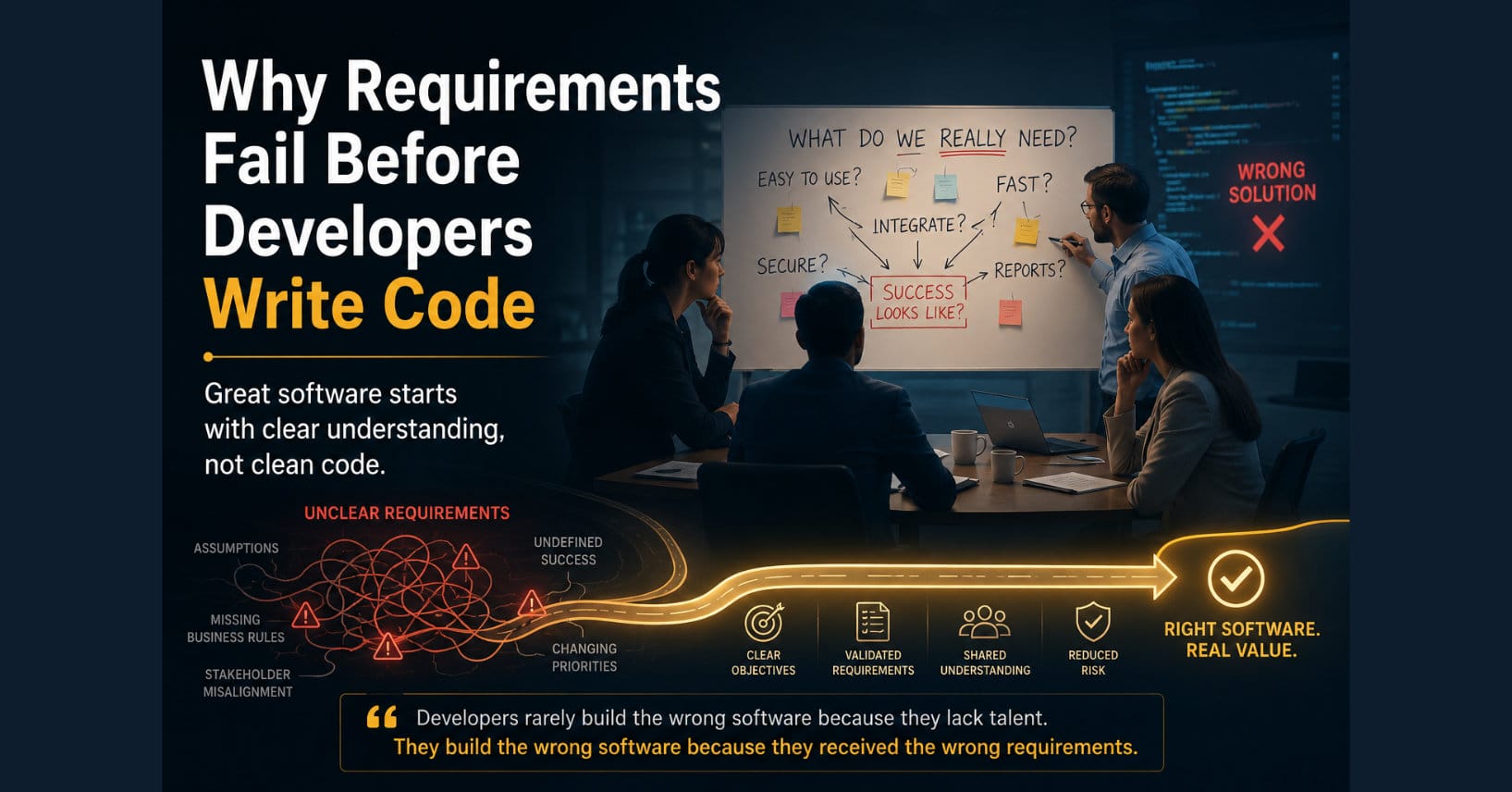
Developers rarely build the wrong software because they lack talent. They build the wrong software because they received the wrong requirements.
By the time the first line of code is written, many projects are already destined to deliver disappointing results.
The First Defect Is Usually a Conversation
Requirements engineering is often treated as documentation. It is not.
Requirements engineering is the disciplined process of discovering, validating, organizing, and communicating what a business actually needs before technical decisions are made.
The first defect in many software projects is not found during testing. It occurs during stakeholder meetings, where assumptions replace facts, opinions replace analysis, and undocumented expectations quietly become project requirements.
Every misunderstanding at this stage becomes exponentially more expensive as the project progresses.
Everyone Thinks They Agree
One of the most dangerous moments in any project is when everyone around the table nods in agreement.
Agreement without verification is not agreement.
Business leaders often describe outcomes.
Users describe daily tasks.
Managers describe policies.
Compliance officers describe regulations.
Architects think about systems.
Developers think about implementation.
Each participant believes they are discussing the same solution while silently interpreting the conversation through their own experience.
The result is not shared understanding. It is parallel assumptions.
Months later, everyone is surprised when the finished system does exactly what was requested—but not what anyone actually needed.
Requirements Are Not Features
Organizations frequently confuse features with requirements.
A feature describes what users can do.
A requirement explains why that capability exists, what business objective it supports, what constraints govern it, how success will be measured, and under what conditions it applies.
Consider these two statements:
The system shall allow managers to approve expenses.
That is a feature.
Now consider this:
Department managers may approve expense reports up to $5,000. Requests exceeding $5,000 require approval from the department director. All approvals must be completed within two business days and retained for seven years to satisfy corporate retention policy.
The second statement contains business rules, operational constraints, measurable expectations, and compliance requirements. It describes behavior rather than simply functionality.
The difference is profound.
One statement tells developers what to build.
The other tells the organization what problem the software must solve.
The Hidden Sources of Failed Requirements
Poor requirements rarely result from incompetence. They usually emerge from predictable organizational behaviors.
Stakeholders assume everyone understands the business process because they have worked together for years.
Subject matter experts skip details they consider obvious.
Leadership changes priorities without formally changing scope.
Technical teams begin designing solutions before business problems have been fully analyzed.
Compliance requirements are discovered halfway through development.
Business rules remain buried inside spreadsheets, email chains, policy manuals, or the minds of experienced employees.
None of these problems involve software development.
Every one of them affects software development.
Requirements Are Decisions
Every requirement represents a business decision.
Someone decided a process should work a certain way.
Someone established a policy.
Someone defined an approval threshold.
Someone determined acceptable risk.
Someone identified a regulatory obligation.
The software merely automates those decisions.
When organizations fail to identify or validate those decisions before development begins, developers are left making business decisions they were never authorized to make.
No programming language can compensate for missing governance.
The Cost of Starting Too Soon
Modern organizations often celebrate speed.
Development teams are encouraged to “just start building.”
Unfortunately, building the wrong solution quickly is still failure.
Projects that rush into design typically experience:
- Significant rework during development
- Increased change requests
- Schedule delays
- Budget overruns
- User dissatisfaction
- Reduced confidence in future technology initiatives
The irony is that organizations frequently interpret these symptoms as development problems when they are actually requirements problems.
The project simply exposed decisions that should have been made much earlier.
Requirements Engineering Is Risk Management
Good requirements reduce uncertainty.
They establish a shared understanding before resources are committed.
They define success before work begins.
They identify conflicts while changes are still inexpensive.
They expose missing business rules before developers invent them.
Most importantly, they provide a defensible foundation for every architectural, design, testing, and implementation decision that follows.
Requirements engineering is not administrative overhead.
It is one of the most effective forms of project risk management an organization can perform.
Looking Ahead
In future articles, we’ll examine why ambiguous requirements lead to expensive failures, why business rules are a form of architecture, why traceability is essential rather than bureaucratic, and how disciplined requirements engineering creates software that can evolve as organizations change.
Successful software projects rarely begin with exceptional programming.
They begin with exceptional thinking.
Developers build software.
Requirements engineering determines whether that software is worth building in the first place.
Requirements Reality: The most expensive software defect is the requirement that was never discovered.
Coming Next
Article 2—The Cost of Ambiguous Requirements
Ambiguous requirements rarely cause immediate problems—they create expensive ones later. Next, we’ll examine how vague language, undefined expectations, and multiple interpretations become some of the most costly defects in software engineering.