Data Governance Series | Article 11 of 20
Governing the Information That Drives the Enterprise
Summary
An enterprise can approve an AI use case, evaluate the model, establish human oversight, implement security controls, and monitor production performance—and still produce ungoverned outcomes if the information feeding the AI is poorly governed.
This article examines why AI governance must extend beyond the application and model into the enterprise information environment. AI can activate decades of accumulated governance debt by retrieving obsolete documents, conflicting definitions, poorly owned datasets, uncertain third-party information, and machine-generated inferences whose provenance has disappeared.
The article explores why AI-ready data requires more than technical availability, how RAG turns retrieval into a runtime governance event, and why classification, permissions, purpose restrictions, quality, provenance, and lifecycle status increasingly need to become machine-readable controls. As agentic AI connects information directly to decisions and automated actions, governed data becomes foundational infrastructure for governable intelligence.
An enterprise deploys an AI assistant.
The organization does everything that responsible AI governance appears to require.
The use case is approved.
The model is evaluated.
Security reviews the architecture.
Privacy reviews the processing.
Legal reviews the contract.
Human oversight is defined.
Logging is enabled.
Monitoring is established.
The application enters production.
Then an employee asks a question.
The AI retrieves an obsolete policy.
Another query retrieves a document whose owner left the organization three years ago.
A third combines two datasets that use different definitions of “customer.”
Another answer incorporates a machine-generated risk classification that nobody realizes originated as an AI inference.
The AI system was governed.
The information environment was not.
That distinction exposes one of the central problems enterprises will encounter as artificial intelligence becomes embedded in everyday operations.
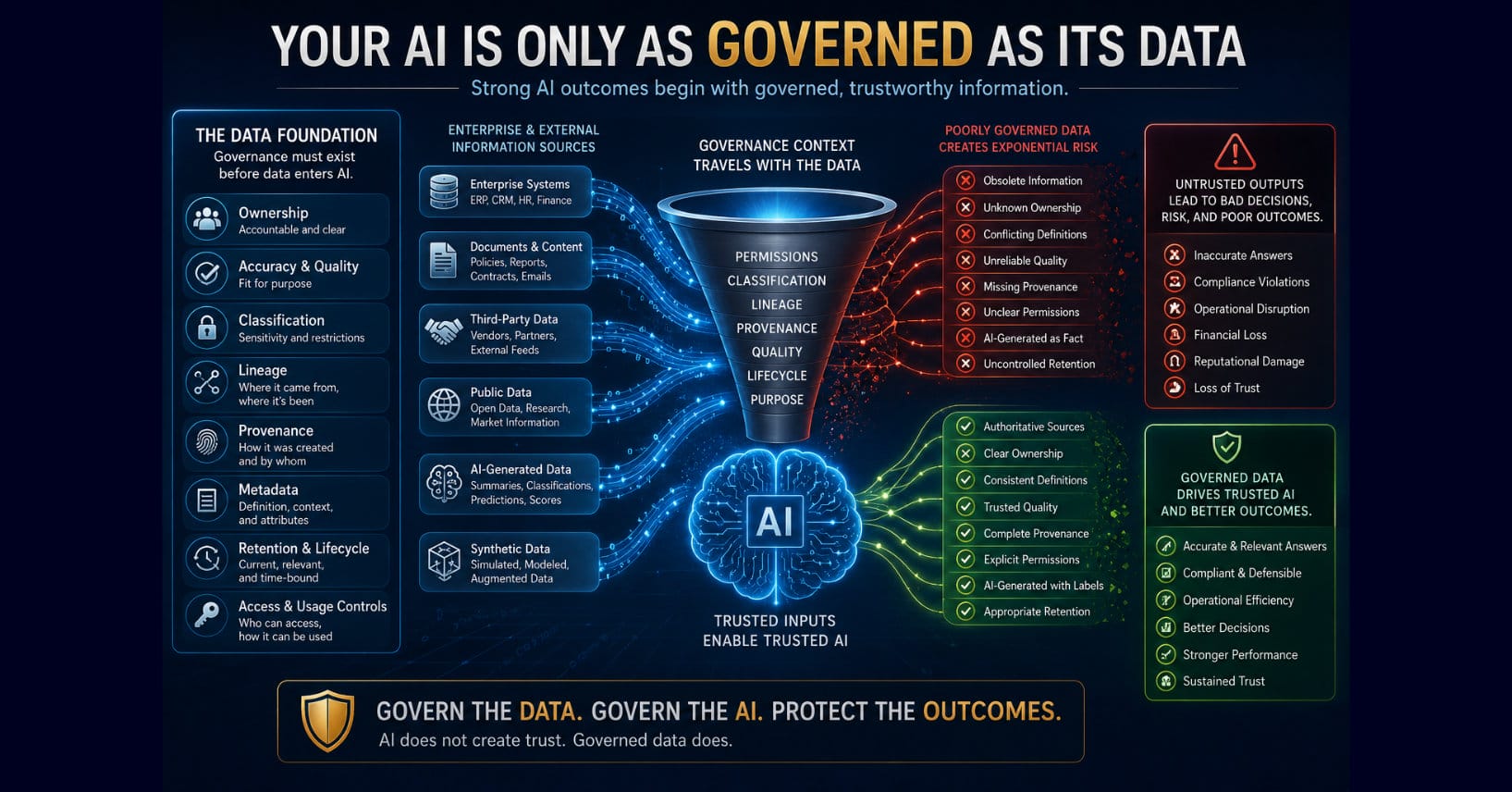
Your AI is only as governed as its data.
Governance Cannot Stop at the Application Boundary
Traditional technology governance often focuses on the system.
Who owns the application?
Who approved it?
What controls protect it?
What vendor provides it?
What risks were assessed?
What monitoring exists?
Those questions remain necessary.
AI changes the boundary.
An enterprise AI system may reach across dozens or hundreds of information repositories.
Documents.
Databases.
Email.
Collaboration platforms.
Knowledge bases.
Data warehouses.
APIs.
Customer records.
Third-party feeds.
Analytics products.
Vector stores.
Other AI systems.
The AI application may be one governed component sitting on top of an enormous information environment with inconsistent governance maturity.
The governance boundary therefore cannot stop at the application.
It must extend into the information the application can consume.
A Governed Model Can Produce an Ungoverned Answer
Imagine an organization deploys a carefully evaluated language model.
The model itself performs well.
It follows system instructions.
It respects technical access controls.
It generates citations.
It operates within approved infrastructure.
An employee asks:
“What is our policy for retaining customer records after account closure?”
The system retrieves three documents:
a current records-retention policy;
an obsolete departmental procedure;
and meeting notes discussing a proposed retention change.
The model synthesizes them.
The answer sounds reasonable.
It includes citations.
It may even accurately represent what the documents say.
But the answer is wrong.
Why?
Not because the model failed.
Because the information environment failed to communicate which source governed.
The AI system knew what was relevant.
It did not know what was authoritative.
That is a data governance failure expressed through AI.
AI Makes Old Governance Debt Visible
Organizations have accumulated information governance debt for decades.
Duplicate files.
Unknown owners.
Inconsistent definitions.
Obsolete documents.
Poor retention practices.
Unclassified information.
Uncontrolled spreadsheets.
Legacy datasets.
Broken lineage.
Incomplete metadata.
Shadow repositories.
Conflicting versions.
Historically, much of this debt remained relatively dormant.
Employees often knew which folders to ignore.
Experienced staff knew which spreadsheet was “the real one.”
Subject-matter experts knew that a particular policy had been replaced.
Institutional knowledge compensated for structural weakness.
AI changes that.
A retrieval system does not possess decades of organizational intuition unless that context has been represented somehow.
It sees information.
Suddenly, forgotten documents become searchable.
Old reports become retrievable.
Dormant datasets become accessible.
AI does not necessarily create the governance debt.
It activates it.
The Enterprise Has More Data Than Governed Data
Most organizations possess far more information than they have formally governed.
That was manageable when employees interacted with information selectively.
A person searching a document repository might review five or ten results.
An AI system can search thousands of documents, combine information across repositories, identify semantic relationships, and produce a synthesized answer in seconds.
That dramatically increases the surface area of information use.
The relevant governance question therefore changes from:
“Do we govern our critical data?”
to:
“What information can our AI systems actually reach, and how much of it carries enough governance context to be used safely?”
Those are very different questions.
Availability Is Not Readiness
Organizations sometimes equate data availability with AI readiness.
The information exists.
The system can connect to it.
Therefore, it is ready for AI.
That conclusion is dangerous.
AI-ready data requires more than technical accessibility.
Depending upon the use case, the organization may need to know:
who owns the information;
what it means;
whether it is authoritative;
whether it is current;
what quality limitations exist;
where it originated;
how it was transformed;
what classification applies;
what permissions govern it;
what contractual restrictions exist;
whether AI use is permitted;
whether it may be combined with other information;
whether it may leave a particular environment;
whether human review is required;
and whether the information itself was generated by AI.
A database connection establishes availability.
Governance establishes readiness.
Classification Needs to Become More Expressive
Traditional data classification is usually designed around confidentiality.
Public.
Internal.
Confidential.
Restricted.
Those categories remain important.
They are increasingly insufficient for AI.
Consider two datasets classified Internal.
The first may be approved for enterprise AI retrieval.
The second may contain licensed third-party information that cannot be used for model training.
Same confidentiality classification.
Different AI governance requirements.
Another dataset may be Public but have weak provenance and therefore be inappropriate for a consequential decision.
A Restricted dataset may be permitted for inference inside a controlled internal model but prohibited from external processing.
Governance metadata must therefore become more expressive.
AI systems may need attributes such as:
AI retrieval permitted.
AI training permitted.
External model prohibited.
Internal inference permitted.
Automated action prohibited.
Human review required.
High-consequence use restricted.
Machine-generated content.
Synthetic data.
Third-party restrictions apply.
The exact taxonomy will differ among enterprises.
The architectural principle is more important:
Governance rules must become machine-readable if machines are expected to obey them.
Permissions Are Only the Beginning
Access control is essential.
But access control alone cannot express every governance requirement.
An employee may legitimately access a legal memorandum.
That does not necessarily mean an AI assistant should summarize it into a broadly shared workspace.
An analyst may access customer records.
That does not automatically authorize combining them with external data for a new predictive use.
A manager may access employee information.
That does not necessarily permit AI-supported employment decisions.
An engineer may access proprietary source code.
That does not mean the code may be sent to an externally hosted model.
Identity answers:
Who are you?
Authorization answers:
What may you access?
AI governance increasingly needs another layer:
What may this system do with the information once accessed?
That is a usage-governance problem.
Purpose Becomes a Control
This leads to one of the most important concepts in AI-era data governance: purpose.
Traditional security often evaluates access based on identity, role, resource, and context.
AI systems make intended use increasingly important.
The same dataset may be appropriate for:
internal search;
summarization;
analytics;
fraud detection;
model training;
customer personalization;
or operational automation
under very different governance conditions.
A dataset approved for one purpose should not automatically become available for every AI purpose.
This is particularly important as organizations deploy general-purpose AI platforms capable of performing many tasks against the same information environment.
The enterprise may need to govern not merely who can access the data, but what purpose the data may serve.
RAG Is Where Data Governance Becomes Runtime Governance
Retrieval-augmented generation makes this problem tangible.
A RAG system retrieves enterprise information and supplies it to a model as context.
Every retrieval is therefore a governance event.
The system is effectively deciding:
This information is relevant.
This user may receive it.
This source may be used.
This document is sufficiently current.
This content may be combined with other retrieved content.
This information may influence the generated answer.
Those are governance decisions occurring at runtime.
If metadata, ownership, authority, classification, and lifecycle status are missing, the retrieval system has little governance context upon which to act.
It can optimize semantic similarity.
It cannot reliably optimize governance appropriateness.
That is why RAG architecture increasingly requires governance architecture.
Retrieval Needs Policy-Aware Filtering
The future of governed enterprise retrieval is unlikely to rely solely on similarity scores.
A governed retrieval process may need to evaluate:
semantic relevance;
user authorization;
source authority;
document status;
effective dates;
classification;
jurisdiction;
AI-use permissions;
quality status;
provenance;
purpose restrictions;
and decision consequence.
A highly relevant document might be excluded because it is superseded.
Another might be excluded because it is restricted from AI processing.
Another might be available for general search but not for a high-consequence workflow.
Another might require a warning because its provenance is uncertain.
This is substantially different from traditional enterprise search.
The retrieval layer becomes a policy enforcement point.
Data Quality Is Now Runtime Risk
Poor data quality has always created risk.
AI can accelerate the consequence.
A traditional analyst might notice that a field looks suspicious.
An automated AI process may consume it immediately.
An agent may act upon it.
The time between bad data and business consequence can shrink dramatically.
This means quality metadata may eventually need to influence runtime behavior.
Suppose a dataset falls below an approved completeness threshold.
Should an AI system continue using it?
Perhaps.
But maybe only for low-consequence tasks.
Perhaps the system should display a warning.
Perhaps automated action should be disabled.
Perhaps human review should become mandatory.
Perhaps retrieval should shift to an alternate source.
These are governance decisions that can increasingly be encoded into the information environment.
Quality stops being merely something reported on a dashboard.
It becomes an input to control.
Provenance Determines What the AI Actually Knows
AI systems can create the impression of knowledge.
But what does the system actually know?
Consider a customer attribute:
Fraud Risk: High
That could mean:
a fraud investigator confirmed suspicious activity;
a deterministic rule triggered;
a third-party vendor supplied the classification;
an analyst entered a judgment;
or an AI model inferred the risk.
The value is identical.
The evidentiary meaning is not.
If provenance disappears, the AI system consuming that field cannot distinguish those origins.
It may treat them as equally authoritative.
This is why provenance is not merely documentation for auditors.
It influences how information should be interpreted.
A governed AI system needs to understand not merely the value, but what kind of claim the value represents.
AI-Generated Data Needs Durable Labels
The problem becomes more difficult when AI creates information that persists.
An AI-generated summary is saved into a customer record.
A model-generated classification enters the warehouse.
An agent writes a recommended action into a ticket.
A generated document enters the knowledge base.
Months later, another AI system retrieves it.
Will that system know the information was machine-generated?
Will it know which model produced it?
Will it know whether a human reviewed it?
Will it know which sources informed it?
If not, generated content can gradually become indistinguishable from human-authored or observed information.
That creates the possibility of machine-generated information recursively influencing future machine-generated information.
Governance needs durable provenance.
A label that disappears after the first transaction is not enough.
The Feedback Loop Can Amplify Error
Consider the following chain:
Source Data → AI Inference → Stored Record → AI Retrieval → New Inference → Automated Action
Suppose the first inference contains a subtle error.
It is stored without provenance.
The second AI system treats it as factual source data.
The error influences a new inference.
That inference triggers an automated action.
Now the original mistake has propagated through the enterprise.
This resembles contamination in a data supply chain.
The farther the information travels, the harder the original defect becomes to identify.
Lineage and provenance provide the mechanisms for tracing the contamination backward.
Governance provides the controls for preventing inappropriate propagation forward.
Agents Turn Data Governance Into Action Governance
Agentic AI raises the consequence again.
A chatbot provides an answer.
An agent can do something.
Update a record.
Approve a workflow.
Send a communication.
Create a purchase order.
Open an incident.
Change a configuration.
Trigger another system.
Now the governance chain becomes:
Data → Interpretation → Decision → Action
If the data is poorly governed, the resulting action may be poorly governed even when the agent itself operates exactly as designed.
This is why organizations moving toward agentic AI need to think beyond model governance.
They need governed inputs.
Governed context.
Governed permissions.
Governed actions.
And evidence connecting them.
The AI agent’s authority should never exceed the governance quality of the information upon which its action depends.
The Governance Context Must Travel
One of the architectural challenges is preserving governance context as information moves.
A source system may know that a record is Restricted.
A data pipeline copies the record.
The classification disappears.
A warehouse knows that a dataset contains AI-generated fields.
An export strips the metadata.
A document platform knows that a policy is superseded.
A vector database stores the content without that status.
An AI system retrieves the information without the governance context that existed at the source.
The content moved.
The governance did not.
That is a serious architectural weakness.
In AI-enabled enterprises, critical governance attributes must either travel with the information or remain reliably linked to it throughout the processing chain.
Otherwise, every transformation creates an opportunity for governance loss.
Governance Needs an Information Control Plane
The emerging solution is an information control plane.
Not necessarily one product.
Not necessarily one database.
Rather, an architectural capability that allows systems to determine:
what information exists;
who owns it;
what it means;
where it came from;
how trustworthy it is;
what classification applies;
what purposes are permitted;
what AI restrictions exist;
what lifecycle state applies;
what controls are required;
and what evidence supports those determinations.
Metadata becomes part of this control plane.
So do catalogs.
Lineage.
Provenance.
Identity.
Policy engines.
Data quality.
Records management.
AI inventories.
Decision records.
The objective is not to centralize every governance function.
It is to make governance context available wherever information is being used.
AI Governance Becomes Policy Execution
This changes the nature of AI governance.
Policies remain necessary.
Committees remain necessary.
Risk assessments remain necessary.
Human judgment remains necessary.
But governance increasingly needs to become executable.
A policy saying:
“Restricted information must not be processed by unauthorized external AI systems”
has limited operational value unless systems can identify:
which information is Restricted;
which AI systems are external;
which are authorized;
which processing events are occurring;
and whether the policy applies.
Governance becomes real when policy affects system behavior.
That requires data governance.
The AI control cannot execute if the information does not carry the attributes needed to evaluate the rule.
Measure Governed Data Coverage
This suggests an important AI governance metric.
Organizations often measure:
number of AI systems inventoried;
number of use cases approved;
percentage of employees trained;
number of risk assessments completed;
model performance;
incidents;
and policy exceptions.
Those are useful.
But organizations should also consider measuring governed data coverage.
For consequential AI systems:
What percentage of consumed information has an accountable owner?
What percentage has authoritative status?
What percentage has appropriate classification?
What percentage has lineage?
What percentage has known provenance?
What percentage meets defined quality thresholds?
What percentage carries AI-use permissions?
What percentage has current lifecycle status?
What percentage of AI-generated persistent information retains provenance?
These measures expose the condition of the foundation underneath AI governance.
Not Everything Needs Maximum Governance
None of this means every piece of enterprise information requires exhaustive metadata, lineage, provenance, and approval.
That would be impractical.
Governance should remain proportionate to consequence.
An AI assistant helping an employee brainstorm meeting topics does not require the same information controls as an AI system supporting:
financial reporting;
clinical decisions;
employment actions;
credit decisions;
cybersecurity response;
regulatory compliance;
legal interpretation;
safety operations;
or autonomous transactions.
The governance question is not:
“Can we govern everything perfectly?”
It is:
“Do we know which information matters enough to require stronger governance?”
That is a much more achievable objective.
The Data Governance Program Becomes AI Infrastructure
This creates an important strategic implication.
Organizations with mature data governance have already built part of their AI governance infrastructure.
Data ownership.
Business glossaries.
Classification.
Metadata.
Lineage.
Quality controls.
Retention.
Authoritative-source management.
Access governance.
Provenance.
These capabilities may have been created for analytics, regulatory compliance, privacy, reporting, or operational efficiency.
They now become AI capabilities.
Conversely, organizations that neglected these disciplines may discover that AI exposes the accumulated debt.
The AI initiative becomes an unexpected audit of the enterprise information environment.
That may be uncomfortable.
It is also useful.
The Goal Is Governable Intelligence
The enterprise objective should not simply be artificial intelligence.
It should be governable intelligence.
Intelligence whose information sources can be understood.
Whose permissions can be enforced.
Whose provenance can be traced.
Whose quality can be evaluated.
Whose outputs can be distinguished from facts.
Whose decisions can be reconstructed.
Whose actions remain within defined authority.
And whose governance can be demonstrated with evidence.
That requires more than a responsible model.
It requires a governed information foundation.
Boardroom Takeaway
Executives should expect AI governance to expose weaknesses that have existed in enterprise information environments for years.
The organization may have excellent AI policies, carefully selected models, strong security controls, and rigorous approval processes.
But if AI systems consume information with unclear ownership, weak metadata, uncertain quality, missing provenance, obsolete lifecycle status, or ambiguous usage rights, the governance architecture remains incomplete.
Leadership should ask:
“How much of the information our most consequential AI systems consume is actually governed well enough for those systems to rely upon it?”
That question moves the discussion beyond AI policy.
It examines the foundation beneath AI behavior.
Because an AI system cannot consistently respect governance context that the enterprise never created.
It cannot reliably distinguish authority the enterprise never documented.
It cannot preserve provenance that was already lost.
It cannot compensate indefinitely for poor-quality information.
And it cannot make ungoverned data governed merely by processing it through a governed model.
Your AI is only as governed as its data.
Coming Next
Article 12: The Governance Problem Inside RAG
Retrieval-augmented generation is becoming one of the primary ways enterprises connect AI to proprietary information.
But every retrieval is also a governance decision.
Which information gets indexed? Which version is authoritative? What happens when a document is superseded? Which metadata survives chunking and embedding? How are permissions enforced? What happens when source access changes? And can the organization reconstruct exactly what evidence an AI system retrieved when it generated a consequential answer?
The next article examines why RAG is not merely an AI architecture.
It is a runtime data governance architecture.