AI Strategy Series | Article 5 of 20
Building the Intelligent Enterprise
Summary
Artificial intelligence does not eliminate an enterprise’s existing data problems. It inherits them—and can amplify their consequences as AI systems progress from generating insights to executing business decisions.
In Article 5 of the AI Strategy: Building the Intelligent Enterprise series, Victor M. Font Jr. examines why successful enterprise AI strategies depend on the quality, meaning, accessibility, provenance, and authority of underlying business information.
The article explores the relationship between data strategy and AI strategy, explaining why sophisticated foundation models cannot compensate for inconsistent business definitions, fragmented information architecture, or unreliable enterprise records.
It also addresses the growing importance of semantic consistency, authoritative information sources, and operational data governance as organizations deploy increasingly autonomous AI agents.
Five strategic questions help enterprise leaders evaluate whether their information assets can support planned AI investments.
The central argument is that sustainable AI value requires more than powerful models and ambitious implementation roadmaps. It requires an enterprise information foundation capable of supporting reliable decisions and effective action.
Artificial intelligence does not eliminate an enterprise’s data problems.
It inherits them.
And in many cases, it makes them more consequential.
Organizations are investing heavily in generative AI, intelligent automation, predictive analytics, and autonomous agents. They expect these technologies to accelerate decisions, improve operational efficiency, enhance customer experiences, and create competitive advantage.
Yet many of those same organizations continue to struggle with fragmented information, inconsistent definitions, unclear data ownership, incomplete records, and systems that cannot reliably exchange information.
The contradiction is becoming increasingly difficult to ignore.
An enterprise may deploy one of the most capable AI models available, connect it to corporate information, and discover that the resulting answers are inconsistent, incomplete, or simply wrong.
The immediate reaction is often to question the model.
Perhaps the prompt needs refinement.
Perhaps retrieval needs improvement.
Perhaps a different model would perform better.
Sometimes those assumptions are correct.
But frequently, the problem exists long before the AI system enters the picture.
The enterprise has never established a sufficiently reliable information foundation.
AI cannot consistently produce trustworthy business intelligence from information the organization itself does not understand, reconcile, or control.
That is why AI strategy cannot be developed independently of data strategy.
The enterprise’s ability to exploit artificial intelligence is constrained by the information capabilities it has already established.
The Data Problems AI Did Not Create
Enterprise data problems are not new.
Organizations have spent decades attempting to reconcile information distributed across enterprise resource planning systems, customer relationship management platforms, operational databases, document repositories, data warehouses, cloud applications, and departmental spreadsheets.
The challenges are familiar.
Different business units define the same terms differently.
Customer records are duplicated.
Product identifiers are inconsistent.
Historical information lacks sufficient context.
Ownership is unclear.
Data quality varies across systems.
Business rules are embedded in applications rather than documented as enterprise knowledge.
Critical information remains trapped in unstructured documents.
Traditional analytics platforms have struggled with these conditions for years.
Artificial intelligence does not make them disappear.
It changes how quickly and broadly their consequences can propagate.
Consider an enterprise with three different definitions of an active customer.
Sales defines an active customer as anyone with an open opportunity.
Finance defines an active customer as an organization with recognized revenue during the previous twelve months.
Customer service defines an active customer as anyone with an active support entitlement.
Each definition may be appropriate within its original business context.
But what happens when an AI assistant is asked:
“How many active customers do we have, and which ones are at risk of leaving?”
The answer depends on which definition the system uses.
If the enterprise has not established the relevant business context, the AI system may produce a confident response based on an inappropriate definition.
The model may be functioning exactly as designed.
The information architecture is not.
AI does not resolve conflicting business definitions merely by generating a fluent answer.
Data Quality Becomes Decision Quality
The consequences of poor data quality change when AI moves from supporting analysis to influencing or executing business decisions.
In traditional reporting environments, inconsistent information may produce inaccurate dashboards or require manual reconciliation.
Those problems are serious, but human analysts often have opportunities to identify discrepancies before acting.
AI can compress the distance between information retrieval and operational execution.
An AI assistant may summarize customer information and recommend an action.
An AI agent may use that information to modify an account, initiate a transaction, adjust inventory, or execute a workflow.
If the underlying information is incorrect, the resulting action may also be incorrect.
Consider a hypothetical distribution company using AI to optimize inventory allocation.
The system evaluates customer demand, available inventory, delivery commitments, and historical purchasing patterns.
But inventory records are not synchronized across warehouses.
Some customer priority classifications are outdated.
Contractual delivery obligations are stored in documents that the system cannot reliably interpret.
The AI system may generate an allocation plan that appears mathematically optimal.
Yet the plan may violate customer commitments, misallocate inventory, or create unnecessary operational costs.
The problem is not necessarily a failure of artificial intelligence.
It is a failure to provide authoritative, sufficiently complete, and contextually appropriate information.
As AI assumes greater operational responsibility, data quality becomes inseparable from decision quality.
And decision quality becomes inseparable from enterprise performance.
The Difference Between Having Data and Having Usable Information
Many enterprises assume that their extensive data holdings provide a natural advantage in artificial intelligence.
They have accumulated years of customer records, transactions, operational histories, product information, documents, and institutional knowledge.
That information may indeed be valuable.
But possession does not establish usability.
An organization may have enormous quantities of data without the ability to interpret, connect, or apply it consistently.
For AI purposes, enterprise information must satisfy several conditions.
Accessibility
The information must be available to authorized systems and users through reliable interfaces.
Data trapped in inaccessible applications or isolated repositories cannot readily support enterprise AI capabilities.
Accessibility does not mean unrestricted access.
It means information can be retrieved through appropriate architectural and authorization mechanisms.
Quality
Information must be sufficiently accurate, complete, timely, and consistent for its intended use.
Quality requirements vary by application.
An AI system summarizing historical meeting notes may tolerate certain imperfections.
An AI system supporting financial transactions may require substantially stronger assurances.
Meaning
The enterprise must understand what its information represents.
A field labeled “revenue” may refer to booked revenue, recognized revenue, recurring revenue, gross revenue, or another business measure.
Without semantic context, AI systems may combine information that appears similar but represents different concepts.
Provenance
The organization should be able to establish where relevant information originated, how it was transformed, and whether it remains appropriate for the intended purpose.
Provenance becomes especially important when AI-generated outputs influence consequential decisions.
Authority
The enterprise must identify which information sources are authoritative for particular business purposes.
Multiple systems may contain customer addresses, product prices, employee records, or contractual terms.
AI systems need a reliable basis for determining which source governs a particular decision.
Context
Information must be interpreted within the circumstances that give it meaning.
A customer discount may be valid only for a particular contract, product category, geographic region, or time period.
An isolated data value may be technically correct while being operationally misleading.
These characteristics determine whether enterprise data can support reliable AI applications.
The strategic asset is not simply the data the enterprise possesses. It is the information the enterprise can reliably interpret and use.
Why Better Models Cannot Fix Broken Information Architecture
Advances in foundation models are remarkable.
Modern AI systems can interpret natural language, analyze documents, generate software, recognize patterns, and synthesize information across complex inputs.
These capabilities can reduce the effort required to work with enterprise information.
But model sophistication does not eliminate the need for sound information architecture.
A model may recognize that two documents discuss similar concepts.
It cannot automatically determine which document represents the organization’s current approved policy.
It may identify contradictory statements.
It cannot necessarily establish which statement carries contractual authority.
It may infer relationships among customer records.
It cannot independently guarantee that those relationships are valid.
It may summarize a financial report accurately.
It cannot correct an underlying accounting classification without access to authoritative information and appropriate business rules.
The distinction is fundamental.
Artificial intelligence can improve how information is discovered, interpreted, and applied.
It cannot independently establish the organizational authority of information that the enterprise has never governed.
This is particularly important when organizations deploy retrieval-augmented generation, or RAG.
RAG can improve model responses by retrieving relevant information from external sources and supplying it as context.
But retrieval is not equivalent to information governance.
A retrieval system may return outdated policies, contradictory documents, incomplete records, or information lacking sufficient business context.
The model may then generate a coherent answer from unreliable source material.
The response may be fluent.
The underlying information may still be wrong.
Connecting AI to enterprise documents does not automatically create an authoritative enterprise knowledge system.
That requires deliberate information architecture, data governance, and operational controls.
AI Strategy Depends on Semantic Consistency
One of the most underestimated challenges in enterprise AI is semantic inconsistency.
Organizations frequently use identical terms to describe different concepts.
They also use different terms to describe the same concept.
These inconsistencies may be manageable when employees work within familiar departmental systems.
They become more problematic when AI systems operate across organizational boundaries.
Consider the term “customer.”
For sales, a customer may be a legal entity associated with an account.
For marketing, it may represent an individual contact.
For finance, it may be a billing relationship.
For operations, it may represent a service location.
For legal, it may refer to the contracting party.
An AI agent coordinating a customer onboarding process may need to understand all five interpretations.
If the underlying information architecture does not distinguish among them, the system may create incorrect relationships or execute actions against the wrong entity.
This is not simply a data cleansing problem.
It is a semantic architecture problem.
The enterprise must establish how business concepts are defined, related, and interpreted across systems.
That may involve business glossaries, canonical data models, metadata management, knowledge graphs, semantic layers, and other architectural capabilities.
No single technology solves the problem universally.
The objective is to establish sufficient consistency that information can be interpreted correctly across business processes.
As AI systems become more capable of coordinating work across applications, semantic consistency becomes increasingly important.
An enterprise cannot reliably automate decisions across business boundaries when the underlying business concepts change meaning at those boundaries.
Data Governance Is Becoming an AI Execution Dependency
Data governance has traditionally been associated with policies, stewardship, quality management, ownership, and regulatory compliance.
Those responsibilities remain important.
But AI introduces a more immediate operational requirement.
Governed information must be usable by systems that may retrieve, interpret, recommend, and act on it at machine speed.
That changes the practical significance of governance.
Consider a data governance policy stating that customer master records must be maintained by an authorized business function.
The policy establishes responsibility.
But an AI agent executing a customer service workflow needs more than a policy document.
It needs to know which customer record is authoritative.
It needs appropriate access to that record.
It needs to recognize when information is incomplete or contradictory.
It needs to understand which changes it is authorized to make.
And it needs to preserve sufficient evidence of consequential actions.
The governance requirement must therefore be translated into operational capabilities.
This does not mean every governance decision should be automated.
It means governance cannot remain disconnected from the systems that consume enterprise information.
The relationship is becoming increasingly direct:
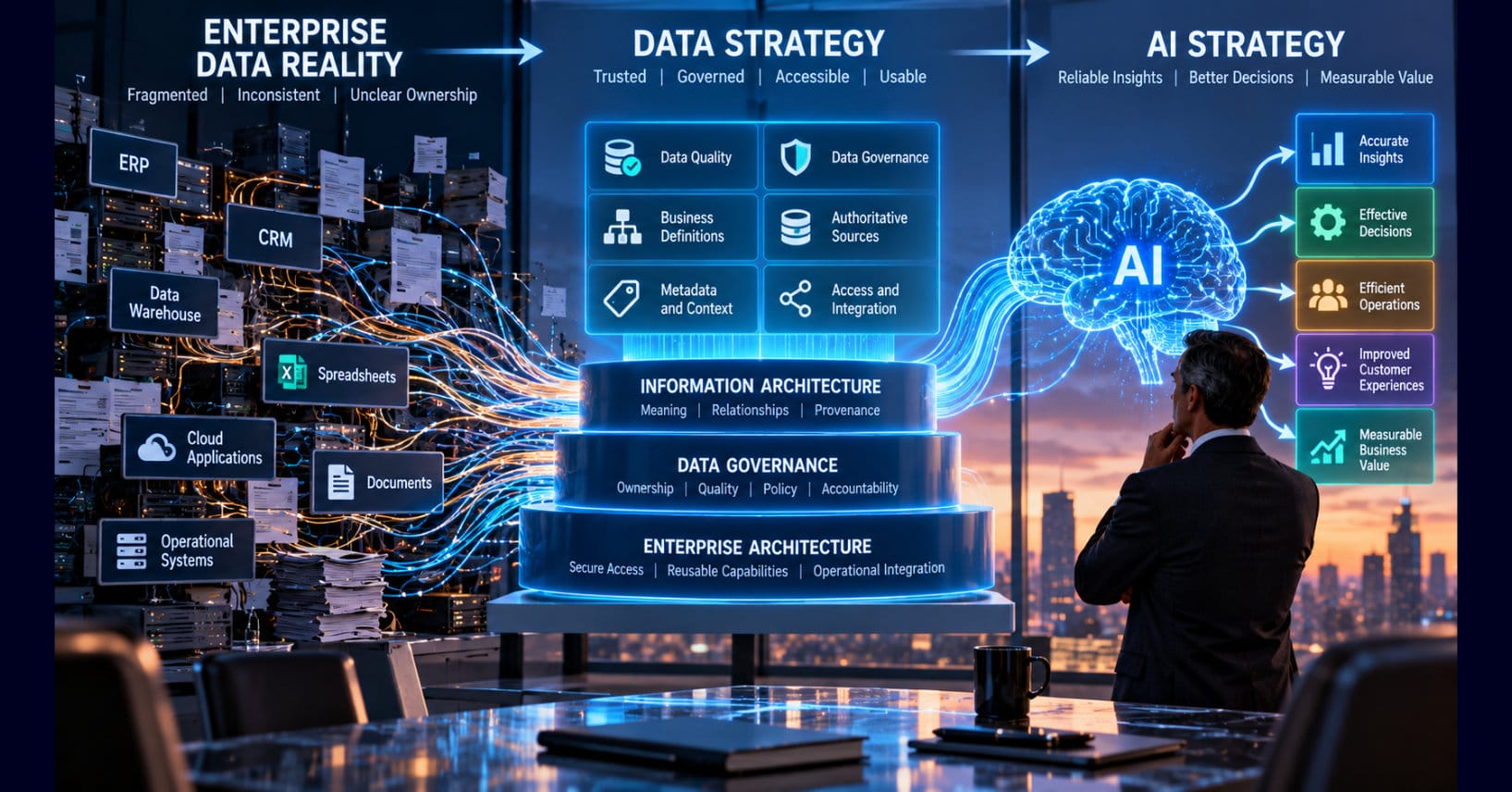
Data governance establishes information accountability. Information architecture establishes meaning and relationships. Enterprise architecture makes those capabilities available. AI systems consume them to support or execute business decisions.
If any part of that chain is weak, the reliability of the resulting AI capability may be compromised.
The Data Strategy Questions AI Leaders Must Ask
An enterprise AI strategy should not begin with the assumption that all relevant data is ready for use.
Leadership should evaluate the information foundation supporting its intended AI investments.
Five questions are particularly important.
1. Which Information Assets Are Strategically Important?
Not all enterprise data deserves equal investment.
The organization should identify the information assets required to support its most important AI-enabled business capabilities.
A financial institution may prioritize customer financial information, contractual obligations, risk classifications, and transaction histories.
A manufacturer may prioritize equipment telemetry, production schedules, quality records, and supplier information.
A healthcare organization may prioritize clinical records, scheduling information, operational capacity, and patient service workflows.
The specific priorities depend on enterprise strategy.
The objective is not to govern every information asset to the same standard.
It is to establish appropriate information capabilities where they matter most.
2. Do We Know Which Sources Are Authoritative?
Enterprises frequently maintain multiple representations of the same business information.
Leadership must determine whether authoritative sources have been established for strategically important data.
This includes understanding which system governs a particular attribute, under what circumstances, and for which business purpose.
Authority may vary by context.
A customer contact preference may be governed by one system, while contractual billing information is governed by another.
AI applications must be able to respect those distinctions.
3. Can We Establish Meaning and Provenance?
The organization should determine whether critical information can be interpreted consistently and traced to its origin.
This is especially important when AI outputs are used to support consequential decisions.
An executive receiving an AI-generated financial analysis should be able to determine which records and definitions informed the analysis.
An operational agent should not treat unverified information as authoritative merely because it was retrieved successfully.
4. Can Information Be Accessed Through Appropriate Architecture?
AI applications frequently require information distributed across multiple enterprise systems.
The organization should evaluate whether that information can be accessed through secure, reliable, and maintainable interfaces.
Point-to-point integrations may support individual pilots.
They may become difficult to manage as the number of AI applications increases.
Enterprise data services, APIs, event-driven integration, and shared information capabilities may provide more sustainable foundations.
The appropriate architecture depends on the organization’s requirements and existing technology environment.
5. Can We Measure Information Fitness for AI Use?
Traditional data quality metrics often focus on completeness, accuracy, consistency, and timeliness.
Those measures remain useful.
But AI applications also require evaluating whether information is fit for a particular task.
A dataset may satisfy general quality standards while remaining unsuitable for an AI application because it lacks context, contains unresolved ambiguity, or does not represent the population the system is expected to serve.
The enterprise should evaluate information quality in relation to the decisions and processes the AI system will support.
That connects data strategy directly to business outcomes.
The Hidden Cost of AI-Ready Data
Enterprise leaders sometimes underestimate the investment required to make information usable for AI.
The visible AI expenditure may involve model access, cloud infrastructure, software licenses, or application development.
The less visible work may involve:
- Reconciling inconsistent business definitions.
- Establishing authoritative data sources.
- Improving data quality.
- Modernizing integration interfaces.
- Classifying sensitive information.
- Resolving ownership and stewardship responsibilities.
- Developing metadata and semantic capabilities.
- Preparing unstructured information for retrieval.
- Establishing access controls.
- Implementing monitoring and evaluation mechanisms.
These activities can represent a substantial portion of the effort required to operationalize enterprise AI.
They also frequently create benefits beyond the original AI initiative.
Improved customer data may support better reporting, more effective service, and stronger operational coordination.
Modernized integration capabilities may reduce the cost of future application development.
Consistent business definitions may improve management decision-making independently of AI.
This creates an important investment consideration.
Some of the most valuable AI strategy investments may not involve AI models at all.
They may involve strengthening the information and architectural capabilities that make multiple AI applications possible.
An enterprise that funds AI applications while neglecting their information dependencies may be investing in visible capabilities while underfunding the foundations required to sustain them.
Why AI Readiness Cannot Be Reduced to a Data Quality Score
Organizations often attempt to assess AI readiness through maturity models and scoring exercises.
These assessments may evaluate data quality, governance, architecture, technology infrastructure, workforce capabilities, and organizational readiness.
Such assessments can provide useful information.
But a single enterprise-wide readiness score can conceal important differences.
An organization may have excellent financial data and poor customer data.
It may have mature analytics capabilities but fragmented operational integration.
It may maintain strong governance policies while lacking the technical mechanisms required to enforce them in AI workflows.
Readiness is therefore contextual.
The relevant question is not simply whether the enterprise is ready for AI.
It is whether the enterprise possesses the information, architecture, and operational capabilities required for a particular AI-enabled business outcome.
A manufacturer may be ready to deploy AI-assisted equipment maintenance while remaining unprepared for autonomous supply chain decisions.
A financial institution may have sufficient information quality for document summarization but not for automated credit decisions.
The distinction matters because readiness assessments should guide investment decisions rather than produce generalized declarations of organizational maturity.
AI readiness should be evaluated against the authority, consequences, and information requirements of the intended application.
AI Agents Raise the Stakes
The relationship between data strategy and AI strategy becomes more consequential as enterprises deploy autonomous agents.
Traditional AI applications frequently produce outputs for human review.
Agents may use those outputs to initiate additional actions.
An agent could retrieve customer information, interpret contractual terms, determine eligibility, update enterprise records, and initiate a financial transaction.
Each step depends on the quality and authority of the information available.
An error introduced early in the process may influence subsequent actions.
The agent may also generate new information that becomes part of the enterprise’s operational records.
This creates a feedback problem.
If AI-generated information is not appropriately identified, validated, and governed, future systems may treat it as authoritative source material.
Over time, the enterprise risks creating information environments in which machine-generated outputs are repeatedly consumed as though they were independently verified facts.
That possibility reinforces the importance of provenance and source authority.
It also creates a distinction between information used to inform an AI system and information the system is authorized to create or modify.
Those are different forms of access.
An agent permitted to read customer records should not automatically be authorized to change them.
An agent permitted to draft contractual language should not automatically be authorized to execute agreements.
An agent permitted to identify financial discrepancies should not automatically be authorized to modify accounting records.
These distinctions connect data strategy directly to the decision authority framework introduced in Article 4.
The more authority an AI system receives, the more consequential the quality, meaning, provenance, and accessibility of its information become.
From Data Projects to Enterprise Information Capabilities
A mature AI strategy should encourage organizations to move beyond treating data improvements as isolated remediation projects.
Instead, leadership should identify reusable enterprise information capabilities.
These may include authoritative customer information services, product knowledge platforms, semantic layers, governed document repositories, metadata services, and shared integration capabilities.
The distinction is important.
A project fixes a particular problem.
A capability enables the organization to address a class of problems repeatedly.
For example, an enterprise might improve product information quality to support one AI-powered customer service application.
That project could be valuable.
But if the organization establishes a reusable product information capability, the same investment might also support sales, procurement, logistics, product development, and additional AI applications.
The strategic value extends beyond the original use case.
This is where data strategy and enterprise architecture converge.
Information assets must be managed not merely as records stored in applications but as capabilities available to the enterprise.
AI can then consume those capabilities through consistent architectural mechanisms.
That approach reduces duplication and makes future AI investments easier to implement.
It also helps prevent the proliferation of disconnected AI applications, each attempting to reconstruct its own understanding of enterprise information.
The Boardroom Question That Should Come Before AI Investment
Imagine an executive presenting a proposal to deploy AI agents across customer service, procurement, and operations.
The projected benefits are substantial.
The implementation roadmap is detailed.
The vendor demonstrations are impressive.
A director asks:
“How do we know these systems will be acting on information the enterprise considers authoritative?”
That question may be more consequential than asking which foundation model the organization intends to use.
It requires management to explain whether the information environment can support the proposed operational authority.
It also exposes dependencies that may be absent from the financial model.
If the organization cannot establish authoritative sources, consistent definitions, reliable access, and appropriate provenance, the AI investment may require substantial foundational work before its projected benefits can be realized.
This is not an argument for delaying every AI initiative until the enterprise achieves perfect data quality.
Perfect data quality is neither realistic nor necessary.
It is an argument for matching information readiness to the requirements and consequences of the intended application.
Some AI capabilities can be deployed successfully with limited information dependencies.
Others require extensive enterprise information capabilities.
Leadership must understand the difference.
The Executive Imperative
Artificial intelligence creates extraordinary opportunities to improve how enterprises interpret information, make decisions, and execute work.
But those opportunities depend on the quality and usability of the information available.
A sophisticated model cannot compensate reliably for contradictory business definitions.
An autonomous agent cannot establish organizational authority that the enterprise has never defined.
A retrieval system cannot guarantee trustworthy answers when its sources are outdated, inconsistent, or inappropriate.
And an ambitious AI roadmap cannot eliminate the architectural consequences of fragmented enterprise information.
The strategic response is not to abandon AI initiatives until every data problem has been resolved.
It is to make information readiness an explicit component of AI investment decisions.
Enterprise leaders should identify which information assets matter most, establish authoritative sources, improve semantic consistency, strengthen integration capabilities, and evaluate information fitness for intended AI applications.
They should also recognize that investments in data architecture and governance may create greater long-term value than another isolated AI deployment.
The relationship is straightforward.
Enterprise strategy determines which capabilities matter. Data strategy establishes the information required to support them. Enterprise architecture makes that information usable. AI strategy determines how intelligence can transform the resulting business capabilities.
These disciplines are interconnected.
Treating them as independent initiatives creates unnecessary complexity and weakens execution.
The enterprises that derive sustained value from AI will not necessarily possess the largest datasets or the most sophisticated models.
They will possess the ability to turn authoritative information into reliable decisions and effective action.
Your AI strategy does not begin with the model you select. It begins with the information your enterprise can trust.
And whether leadership recognizes it or not, every AI investment inherits the consequences of the data strategy that came before it.
References
DAMA International. DAMA-DMBOK: Data Management Body of Knowledge. 2nd ed. Basking Ridge, NJ: Technics Publications, 2017.
International Organization for Standardization and International Electrotechnical Commission. ISO/IEC 25012:2008: Software Engineering—Software Product Quality Requirements and Evaluation (SQuaRE)—Data Quality Model. Geneva: ISO, 2008. https://www.iso.org/standard/35736.html.
International Organization for Standardization and International Electrotechnical Commission. ISO/IEC 42001:2023: Information Technology—Artificial Intelligence—Management System. Geneva: ISO, 2023. https://www.iso.org/standard/81230.html.
National Institute of Standards and Technology. Artificial Intelligence Risk Management Framework (AI RMF 1.0). NIST AI 100-1. Gaithersburg, MD: U.S. Department of Commerce, January 2023. https://doi.org/10.6028/NIST.AI.100-1.
National Institute of Standards and Technology. Artificial Intelligence Risk Management Framework: Generative Artificial Intelligence Profile. NIST AI 600-1. Gaithersburg, MD: U.S. Department of Commerce, July 2024. https://doi.org/10.6028/NIST.AI.600-1.
World Wide Web Consortium. PROV-O: The PROV Ontology. W3C Recommendation, April 30, 2013. https://www.w3.org/TR/prov-o/.
Coming Next
Article 6 — AI Readiness Is an Architecture Question
Organizations frequently assess AI readiness through employee skills, data quality, governance maturity, and technology adoption.
Those factors matter.
But enterprise AI cannot scale effectively when the underlying architecture cannot support reliable integration, secure access, reusable capabilities, operational monitoring, and coordinated execution across business systems.
In the next article, we examine why AI readiness is fundamentally an enterprise architecture challenge—and how architectural decisions determine whether AI remains a collection of isolated applications or becomes a sustainable enterprise capability.