AI Strategy Series | Article 17 of 20
Building the Intelligent Enterprise
Summary
Proprietary data is frequently described as the foundation of sustainable competitive advantage in artificial intelligence. As sophisticated AI models become increasingly accessible, organizations often assume that exclusive access to customer information, operational records, transaction histories, and institutional knowledge will distinguish them from competitors.
In Article 17 of the AI Strategy Series, Building the Intelligent Enterprise, Victor M. Font Jr. challenges that assumption and examines the conditions under which proprietary information becomes a genuine competitive moat.
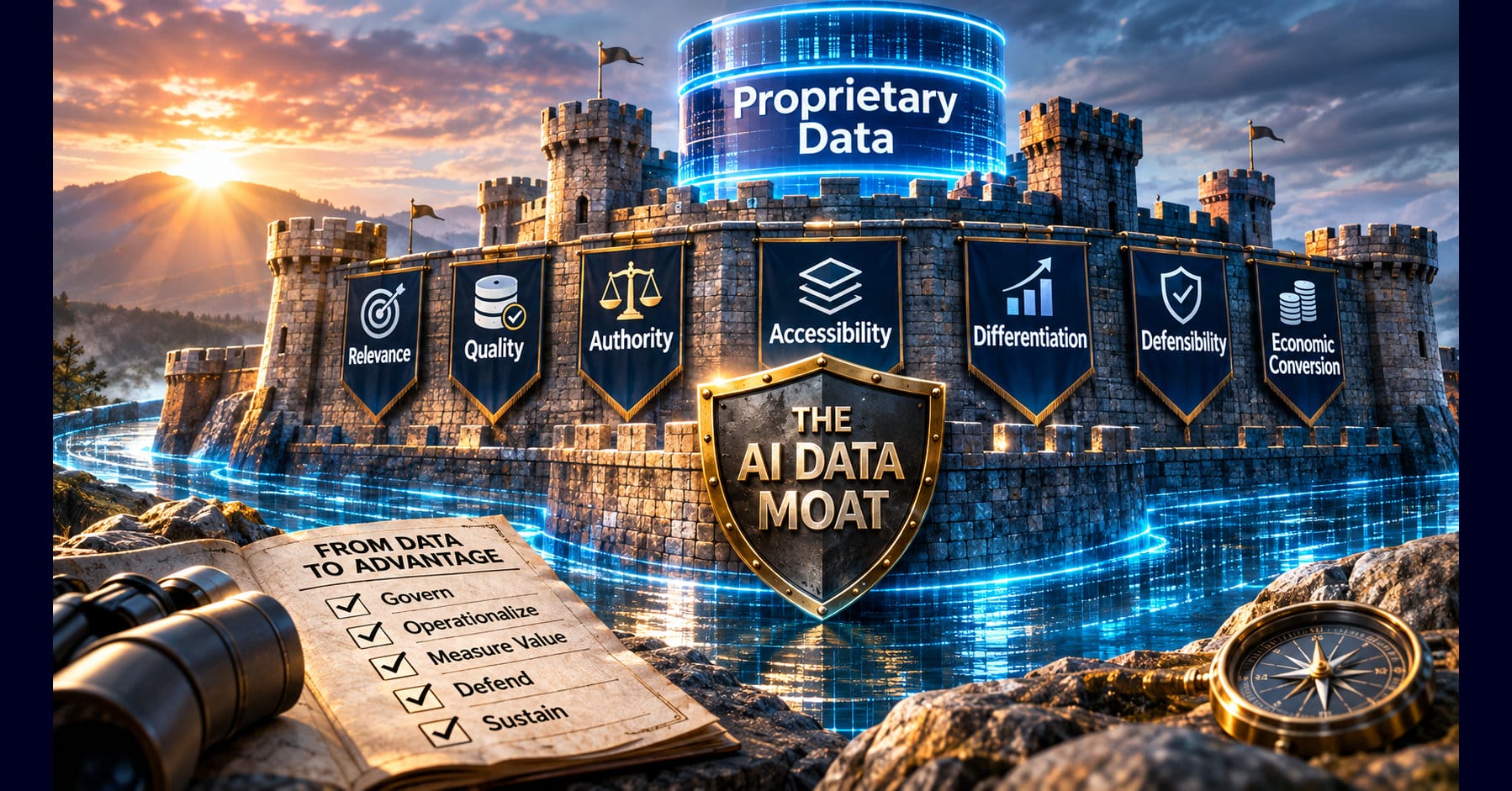
The article introduces the AI Data Moat Assessment Model, identifying seven essential conditions: relevance, quality, authority, accessibility, differentiation, defensibility, and economic conversion. Together, these conditions distinguish valuable information assets from capabilities that competitors cannot readily imitate or substitute.
Particular attention is given to the distinction between data possession and legitimate authority to use information. The article examines ownership, permitted purposes, access controls, processing restrictions, retention obligations, cross-border requirements, and evidentiary accountability.
An illustrative financial comparison demonstrates how proprietary information can improve AI forecasting accuracy, reduce inventory costs, and produce measurable economic benefits. However, the article emphasizes that operational improvements alone do not necessarily establish sustainable competitive differentiation.
The analysis also examines the complete economic cost of proprietary datasets, including acquisition, engineering, quality management, governance, security, lifecycle management, AI enablement, and ongoing maintenance.
A five-level Proprietary Data Advantage Maturity Model traces the progression from data possession through governed information, operational integration, demonstrated economic advantage, and defensible competitive differentiation.
For CEOs, CIOs, and boards of directors, the strategic imperative is to evaluate proprietary information as part of an integrated business capability rather than treating data ownership as an independent source of competitive advantage.
The central conclusion is that proprietary data is an input, not a moat. Sustainable differentiation emerges from the enterprise’s ability to govern, operationalize, and convert that information into defensible economic value.
Every organization seems to believe it possesses a secret weapon in the artificial intelligence economy.
Its proprietary data.
Executives describe decades of transaction histories, customer relationships, operational records, industry knowledge, and internal documentation as assets that competitors cannot easily reproduce.
The argument sounds compelling.
If increasingly sophisticated AI models are available to everyone, proprietary data must be what differentiates one enterprise from another.
Therefore, the reasoning continues, organizations with the largest collections of proprietary information should possess the strongest competitive advantages.
There is a problem with that conclusion.
Possessing proprietary data does not automatically create a competitive advantage.
An organization can accumulate enormous volumes of information without developing a meaningful ability to use it.
It can possess unique data that is inaccurate, obsolete, poorly governed, or irrelevant to consequential business decisions.
It can build sophisticated AI applications around information that competitors can approximate through alternative sources.
And it can invest millions of dollars in proprietary datasets without establishing how those investments produce superior business outcomes.
The economic value of data does not arise merely from its existence.
It emerges from the organization’s ability to transform information into capabilities that competitors cannot readily reproduce.
That distinction is becoming increasingly important as AI reduces the cost of accessing sophisticated analytical and generative capabilities.
In Article 16, When AI Makes Intelligence Cheap, What Becomes Valuable?, we examined how competitive advantage may shift from possessing intelligence toward the ability to exercise judgment, establish information authority, coordinate execution, and learn from results.
Article 17 extends that argument.
If proprietary data is to become a genuine competitive moat, what conditions must it satisfy?
And how can executives distinguish a strategically defensible information asset from an expensive collection of records?
The Proprietary Data Assumption
The conventional argument for proprietary data as an AI advantage follows a straightforward sequence.
An organization possesses information that competitors cannot access.
That information can be connected to an AI system.
The AI system produces more relevant or accurate outputs.
Those outputs improve business performance.
Therefore, the organization’s proprietary data creates a sustainable competitive advantage.
The problem is not that this sequence is impossible.
It is that each step contains assumptions that must be validated.
Consider a manufacturer with 30 years of maintenance records.
Those records may include equipment failures, repair histories, replacement parts, technician observations, environmental conditions, and operational interruptions.
Management concludes that this information constitutes a valuable proprietary dataset.
An AI system trained or grounded on those records might identify failure patterns that competitors cannot easily observe.
That is a plausible hypothesis.
But several questions remain unanswered.
Were the records captured consistently?
Do equipment identifiers remain stable across decades?
Were failure classifications standardized?
Can maintenance events be linked to production conditions?
Are technician observations reliable?
Have equipment designs changed enough to make older records less relevant?
Can the company connect predicted failures to operational decisions?
And can it demonstrate that the resulting interventions improve equipment availability or reduce maintenance costs?
Until these questions are answered, the organization possesses potentially valuable information.
It has not necessarily established a competitive moat.
Data ownership establishes control over an asset. Competitive advantage requires proof that the asset produces differentiated economic outcomes.
What Actually Makes a Competitive Moat?
A competitive moat is not simply something an organization owns.
It is a structural advantage that makes it difficult for competitors to reproduce the organization’s economic performance or competitive position.
Traditional sources of competitive advantage include economies of scale, network effects, switching costs, differentiated capabilities, intellectual property, brand strength, and privileged access to scarce resources.
Proprietary data can contribute to several of these advantages.
But the relevant question is whether it creates a meaningful barrier to imitation or substitution.
An organization may possess a unique dataset that competitors cannot obtain directly.
However, competitors may not need that exact dataset.
They may achieve similar outcomes through publicly available information, commercially licensed data, synthetic data, alternative analytical methods, or better operating processes.
A competitor may also use a more capable general-purpose model to achieve performance that previously required extensive domain-specific information.
The existence of proprietary data therefore does not establish that competitors face a meaningful disadvantage.
The strategic test is more demanding.
Does the information enable a valuable capability?
Does that capability produce measurable economic benefits?
Would those benefits decline materially without the proprietary information?
And would competitors face significant difficulty reproducing the capability through other means?
These questions distinguish data possession from defensible differentiation.
The Seven Conditions of a Genuine AI Data Moat
A proprietary dataset becomes strategically meaningful when it satisfies a combination of conditions.
No single condition is sufficient.
The advantage emerges from their interaction.
The AI Data Moat Assessment Model
| Condition | Strategic Question | Principal Risk |
|---|---|---|
| Relevance | Does the data improve a consequential business decision or capability? | Unique but economically irrelevant information |
| Quality | Is the information accurate, complete, consistent, and current enough for its intended use? | Unreliable outputs and operational errors |
| Authority | Does the enterprise have legitimate rights to use the data for the proposed AI purpose? | Legal, contractual, privacy, or governance exposure |
| Accessibility | Can authorized systems and users obtain the data in a usable form? | Valuable information trapped in disconnected systems |
| Differentiation | Does the data materially improve outcomes beyond available alternatives? | No meaningful performance advantage |
| Defensibility | Would competitors struggle to reproduce or substitute the resulting capability? | Rapid imitation or commoditization |
| Economic conversion | Can the advantage be translated into measurable financial or strategic value? | Technical improvement without realized returns |
These seven conditions provide a more rigorous basis for evaluating proprietary data investments.
They also reveal why many enterprise data initiatives fail to produce the strategic value originally anticipated.
The organization may satisfy one or two conditions while neglecting the others.
A dataset can be unique but unreliable.
It can be reliable but inaccessible.
It can be accessible but legally restricted.
It can improve model accuracy without improving business outcomes.
And it can produce meaningful business benefits without establishing a durable advantage over competitors.
The complete assessment matters.
1. Relevance: Unique Data Is Not Necessarily Useful Data
Organizations often equate the uniqueness of information with its strategic value.
But uniqueness and usefulness are different properties.
A company may possess millions of records describing internal activities that have little relationship to the decisions driving its financial performance.
Historical information may be interesting without being operationally consequential.
The first question should therefore be:
What specific business decision or capability will this data improve?
Consider a commercial insurer evaluating claims.
Historical claims information may help identify patterns associated with fraud, settlement costs, processing delays, or litigation outcomes.
But not every available data element contributes meaningfully to those objectives.
Some information may be redundant.
Some may reflect obsolete business practices.
Some may introduce noise.
Other information may create legal or fairness concerns without improving decision quality.
The strategic objective is not to maximize the amount of proprietary data supplied to AI.
It is to identify the information that improves consequential decisions.
That requires business ownership.
A data engineering team can determine how information is collected, transformed, and accessed.
It cannot independently determine whether a particular dataset improves underwriting profitability, customer retention, or claims performance.
Those judgments require accountable business leadership.
The value of proprietary data begins with the business decision it enables, not the volume of records it contains.
2. Quality: AI Cannot Reliably Repair an Untrustworthy Information Foundation
The second condition is information quality.
Enterprises frequently assume that AI can compensate for decades of inconsistent data management.
AI can assist with classification, deduplication, anomaly detection, entity resolution, and data quality remediation.
But these capabilities do not eliminate the need to establish reliable information foundations.
Consider a multinational enterprise with customer records distributed across regional business units.
The same customer may appear under different names.
Account hierarchies may be inconsistent.
Contractual relationships may not be represented accurately.
Some systems may contain outdated information.
Others may maintain conflicting definitions of revenue, customer status, or account ownership.
An AI system can generate a plausible customer profile from these sources.
But plausibility does not establish correctness.
If the system combines records incorrectly, it may produce recommendations based on relationships that do not exist.
If it uses outdated contract information, it may recommend commercially inappropriate actions.
If it relies on inconsistent revenue definitions, it may distort account profitability.
These failures become more consequential when AI systems move from analysis into operational execution.
An inaccurate recommendation may be corrected during review.
An autonomous action based on inaccurate information may create an immediate financial or contractual consequence.
Data quality must therefore be evaluated against intended use.
A dataset suitable for exploratory analysis may not be suitable for automated financial decisions.
Information quality is not a universal label attached to a database.
It is a determination about whether information is sufficiently reliable for a defined purpose.
That determination must be supported by measurable controls and evidence.
3. Authority: Possession Is Not Permission
The third condition is information authority.
This is one of the most overlooked dimensions of enterprise AI strategy.
Organizations frequently assume that because information exists within their systems, they may use it for any purpose.
That assumption can be incorrect.
Data may be subject to contractual restrictions, intellectual property rights, privacy obligations, confidentiality agreements, retention requirements, or jurisdiction-specific regulations.
An organization may have permission to store and process information for one business purpose without possessing authority to use it for another.
Consider customer information obtained through a service relationship.
The organization may have legitimate reasons to use that information to deliver the contracted service.
That does not automatically establish permission to incorporate the same information into model training, disclose it to an external AI provider, or use it for unrelated commercial purposes.
Similarly, an enterprise may license a valuable commercial dataset.
Its agreement may permit internal analytics while restricting redistribution, model training, derivative products, or use by affiliated entities.
These distinctions are not technical details.
They determine whether the proposed AI capability can be operated legitimately.
Data Authority Requirements
| Authority Dimension | Required Enterprise Determination |
|---|---|
| Ownership and control | Who owns, controls, or licenses the information? |
| Permitted purpose | For which business and AI uses is processing authorized? |
| Access authority | Which users, services, models, and agents may access it? |
| Processing restrictions | Are training, retrieval, transformation, or external processing restricted? |
| Retention and deletion | How long may information and derived artifacts be retained? |
| Cross-border use | Are geographic or jurisdictional restrictions applicable? |
| Evidence | Can the organization demonstrate the basis for authorized use? |
This is particularly important for retrieval-augmented generation, model customization, and agentic AI.
A retrieval system may technically access a document.
But technical accessibility does not establish that the requesting user or agent is authorized to receive its contents.
An AI agent may possess credentials allowing it to query a database.
But those credentials do not necessarily establish legitimate business authority to use the information in a particular decision.
The enterprise must distinguish among possession, access, permitted use, and delegated decision authority.
These are separate governance concerns.
A proprietary dataset becomes a liability when the organization cannot establish the authority under which it is used.
4. Accessibility: Data Trapped in Systems Is Not an Operational Advantage
The fourth condition is accessibility.
Many organizations possess valuable information that cannot be used effectively because it is fragmented across applications, databases, documents, and business units.
The information may be technically available somewhere within the enterprise.
But using it may require extensive manual extraction, reconciliation, transformation, and approval.
This creates an economic constraint.
An AI system cannot consistently produce valuable outcomes from information it cannot reliably access.
And an enterprise cannot scale an AI capability if each implementation requires a new collection of fragile integrations.
Accessibility does not mean unrestricted availability.
It means authorized information can be obtained in a usable form through appropriate architectural controls.
That requires attention to data models, metadata, interoperability, APIs, identity, authorization, and information lineage.
It also requires clarity about systems of record.
When several applications contain conflicting versions of the same business entity, the enterprise must establish which source is authoritative for a particular purpose.
Otherwise, AI applications may generate different answers depending on which system they consult.
The strategic opportunity lies in creating reusable information capabilities.
An enterprise that develops governed, interoperable information services can support multiple AI applications without repeatedly reconstructing the same data foundations.
This can reduce implementation costs and improve consistency.
But it requires enterprise architecture.
A collection of disconnected AI integrations is not an information strategy.
It is a growing maintenance obligation.
5. Differentiation: Does the Data Actually Improve the Outcome?
The fifth condition is differentiation.
This is where proprietary data claims must confront empirical evidence.
Management may believe that a unique dataset improves AI performance.
But that belief should be tested.
The relevant question is not whether the dataset changes the AI output.
It is whether the dataset produces a meaningful improvement in the business outcome.
Suppose a retailer develops an AI demand forecasting system.
A baseline model uses commonly available information, including seasonal patterns and historical sales.
An enhanced model incorporates proprietary customer behavior, local inventory conditions, promotional activity, and supplier performance.
The enhanced model produces more accurate forecasts.
That is encouraging.
But the evaluation should continue.
Does improved forecast accuracy reduce inventory carrying costs?
Does it decrease stockouts?
Does it improve product availability?
Does it reduce waste?
Does it increase contribution margin?
And are those improvements sufficiently large to justify the additional cost of collecting, governing, and maintaining the proprietary information?
Illustrative Data Differentiation Test
| Evaluation Dimension | Baseline Capability | Proprietary Data-Enhanced Capability |
|---|---|---|
| Forecast accuracy | 82% | 89% |
| Inventory carrying cost | $12 million annually | $10.8 million annually |
| Stockout rate | 6.0% | 4.5% |
| Incremental annual data and AI costs | Baseline operating cost | $350,000 additional |
| Estimated annual inventory cost reduction | Not applicable | $1.2 million |
| Illustrative net annual benefit | Not applicable | $850,000 before other effects |
All figures are hypothetical and provided solely to illustrate the evaluation method.
In this example, the proprietary data appears to create measurable value.
But even here, the organization must establish causality.
Were inventory improvements caused by the additional data?
Or did supplier changes, revised purchasing policies, demand conditions, or operational improvements contribute to the results?
A credible evaluation should use appropriate baselines, controlled comparisons where feasible, and evidence connecting the enhanced capability to realized outcomes.
The organization should also evaluate whether the improvement persists across locations, product categories, and changing market conditions.
A proprietary dataset that improves a laboratory benchmark but fails to improve production outcomes may have limited economic value.
The competitive value of data must be demonstrated through outcomes, not inferred from model performance alone.
6. Defensibility: Can Competitors Reproduce the Advantage?
The sixth condition is defensibility.
A dataset can create value without creating a durable competitive moat.
This distinction is central to enterprise strategy.
Suppose a company uses proprietary information to improve customer service response times.
The improvement reduces costs and increases customer satisfaction.
That is valuable.
But competitors may achieve similar results through better workflow design, commercially available customer service platforms, or alternative AI implementations.
The original company may realize a financial benefit without establishing a sustainable competitive advantage.
Defensibility requires a more demanding analysis.
How difficult would it be for competitors to reproduce the capability?
Would they need years of operational history?
Would they need privileged relationships or unique access rights?
Would they face substantial costs in collecting equivalent information?
Would they need to reproduce complex integrations, specialized processes, or institutional expertise?
Could they substitute another dataset or use a different technical approach?
And how quickly might the advantage erode as general-purpose AI capabilities improve?
Data Advantage Versus Data Moat
| Characteristic | Valuable Data Asset | Defensible Data Moat |
|---|---|---|
| Economic contribution | Improves business performance | Improves performance relative to competitors |
| Uniqueness | May contain proprietary information | Provides difficult-to-reproduce advantages |
| Substitutability | Alternatives may produce similar outcomes | Effective substitutes are limited or costly |
| Integration | Supports a business capability | Embedded in distinctive operating capabilities |
| Durability | Benefits may be temporary | Advantage persists despite competitive response |
| Strategic significance | Creates enterprise value | Helps sustain superior competitive positioning |
This distinction should influence capital allocation.
An organization may reasonably invest in data that produces operational benefits even when it does not create a moat.
Not every investment must establish sustainable competitive differentiation.
But management should avoid describing every valuable information asset as strategically defensible.
The investment thesis matters.
If the objective is cost reduction, evaluate the economics of cost reduction.
If the objective is competitive advantage, evaluate whether the advantage can withstand imitation and substitution.
Confusing these objectives produces weak strategy.
7. Economic Conversion: A Data Advantage Must Become Business Value
The seventh condition is economic conversion.
This connects directly to Article 15, The AI Business Case Is Usually Measuring the Wrong Thing.
Organizations frequently calculate the potential value of information using assumptions about improved productivity, faster analysis, or more accurate recommendations.
But potential value is not the same as realized financial benefit.
A proprietary dataset may improve the accuracy of an AI recommendation.
That improvement must still influence an operational decision.
The decision must produce a measurable business outcome.
And the outcome must be converted into an economic benefit that can be verified.
The conversion chain is straightforward in principle.
Proprietary Data → Improved AI Capability → Better Decision → Operational Change → Economic Benefit → Financial Realization
Each transition requires evidence.
If an AI system improves customer churn predictions, does the organization intervene with the appropriate customers?
Do those interventions improve retention?
Are retained customers profitable?
Does the incremental contribution margin exceed the cost of the retention program and supporting AI capability?
If the answers are unknown, management has not established the economic value of the data investment.
The same principle applies to predictive maintenance, fraud detection, supply chain optimization, and personalized customer experiences.
Data value is realized through business processes.
That means business process owners must be accountable for the conversion.
Technology teams can enable access, integration, analytics, and automation.
But they cannot independently guarantee that business operations will capture the resulting value.
Finance must validate the economic assumptions.
Business leadership must commit to the operational changes.
And governance must establish whether the capability operates within authorized boundaries.
The Hidden Cost of Maintaining a Proprietary Data Advantage
Data is often described as an asset that can be reused indefinitely at minimal cost.
That characterization overlooks important economic realities.
Enterprise data requires ongoing investment.
Information must be collected, stored, secured, classified, reconciled, governed, updated, and retained or deleted according to applicable requirements.
Its meaning must remain understandable.
Its lineage must be preserved.
Its permitted uses must be maintained.
Its quality must be monitored.
And its relevance must be reassessed as business conditions change.
A proprietary data advantage can therefore impose substantial recurring costs.
Total Economic Cost of a Proprietary AI Dataset
| Cost Category | Illustrative Components |
|---|---|
| Acquisition and collection | Data capture, licensing, instrumentation, ingestion |
| Engineering and integration | Pipelines, transformation, APIs, interoperability |
| Quality management | Validation, reconciliation, deduplication, remediation |
| Governance and assurance | Classification, ownership, access controls, audit evidence |
| Security and privacy | Protection, monitoring, incident response, privacy controls |
| Lifecycle management | Retention, deletion, archival, versioning, provenance |
| AI enablement | Retrieval infrastructure, embeddings, indexing, evaluation |
| Operational maintenance | Monitoring, updates, support, model and data drift management |
These costs should be included in the business case.
A dataset that produces $1 million in annual operational benefits but requires $900,000 in recurring maintenance may have a substantially different economic profile from one producing the same benefits at $200,000 in annual costs.
The analysis must also consider opportunity cost.
Capital allocated to preserving a proprietary dataset cannot simultaneously fund other investments.
The organization should therefore determine whether continued data investment produces returns superior to available alternatives.
This is especially important when external AI capabilities improve rapidly.
A dataset that once provided substantial differentiation may become less valuable as commercially available systems achieve comparable results.
The economic justification must be revisited.
Data Network Effects: The Strongest Argument—and Its Limitations
One of the most compelling arguments for proprietary data moats involves data network effects.
A data network effect occurs when additional usage or participation generates information that improves a product or service, potentially attracting more users and producing further useful information.
Consider a logistics platform.
More transactions may generate richer information about routes, delivery conditions, carrier performance, and operational constraints.
That information may improve optimization.
Better optimization may attract additional customers.
More customers may generate additional operational data.
The resulting cycle can reinforce the platform’s position.
But data accumulation does not automatically create a network effect.
Additional records must improve the capability.
The improvement must matter to users.
And the improved capability must contribute to additional adoption, usage, or economic value.
The relationship may also exhibit diminishing returns.
After a certain point, additional data may contribute little improvement.
Data quality may deteriorate as new sources introduce inconsistency.
Regulatory or contractual restrictions may limit reuse.
Competitors may achieve similar results through alternative approaches.
The enterprise must therefore distinguish among three different phenomena:
- Data accumulation: More information is collected.
- Data learning effect: Additional information improves a capability.
- Data network effect: Improved capability contributes to additional participation or usage that generates further valuable information.
These are not interchangeable.
Only the third describes a potentially self-reinforcing competitive mechanism, and even that mechanism does not guarantee durable market advantage.
The enterprise must demonstrate the feedback loop rather than assume it exists.
The Role of Data Provenance in Competitive Advantage
Provenance is frequently treated as a compliance or audit requirement.
In an AI-enabled enterprise, it can also influence the economic value of information.
Data provenance establishes where information originated, how it was transformed, and which processes or systems contributed to its current state.
This becomes essential when AI systems combine information from multiple sources.
An organization may possess a valuable proprietary dataset.
But if it cannot establish the origin, transformation history, and authority of its records, it may struggle to use that information in consequential decisions.
Consider a financial services enterprise using AI to evaluate commercial credit risk.
A recommendation may incorporate financial statements, transaction histories, market conditions, and internal relationship information.
The enterprise must understand which sources contributed to the recommendation.
It must distinguish authoritative financial records from estimates.
It must identify whether information was current at the time of evaluation.
And it must preserve sufficient evidence to explain the decision under applicable requirements.
Without provenance, the organization may possess information but lack the assurance necessary to use it confidently.
With reliable provenance, the same information may support more consequential and economically valuable applications.
This is one reason data governance and Evidentiary Architecture™ become strategically connected.
The objective is not merely to preserve technical logs.
It is to establish defensible relationships among information, authority, decisions, actions, and outcomes.
That capability supports trustworthy AI execution.
It also helps the enterprise learn which information actually contributes to superior decisions.
The Difference Between Data Governance and Data Monetization
Enterprise leaders sometimes assume that improving data governance will automatically create new revenue opportunities.
Governance is necessary for many valuable information uses.
But governance alone does not establish market demand.
A well-governed dataset may improve internal operations without being commercially valuable as a standalone product.
Conversely, an organization may identify commercial demand for information but lack the rights, quality, or controls necessary to monetize it responsibly.
The distinction matters.
Data governance establishes the conditions under which information can be trusted and used.
Data monetization requires an economic mechanism through which information creates value.
That mechanism may involve direct revenue from data products.
It may involve improved customer services.
It may involve lower operating costs.
It may involve better risk decisions.
Or it may involve enabling a differentiated product that competitors cannot readily reproduce.
The enterprise should identify the intended mechanism before investing in extensive data commercialization initiatives.
Otherwise, it risks building technically sophisticated information products without a credible market or internal business case.
When Synthetic Data and General-Purpose AI Weaken the Moat
The growing capabilities of general-purpose AI introduce another strategic consideration.
Some advantages previously attributed to proprietary data may become less defensible as models improve.
An organization may have relied on extensive labeled examples to support a specialized classification task.
A newer model may perform the task effectively with fewer examples.
A company may have invested in a large internal knowledge base to support routine customer questions.
A general-purpose model combined with a smaller authoritative information source may achieve comparable results.
Synthetic data may also support testing, simulation, and certain model development activities.
However, synthetic data is not a universal substitute for real-world information.
Its usefulness depends on how it is generated, validated, and applied.
It may reproduce biases or errors from its source data.
It may fail to capture rare events or complex operational relationships.
And it cannot automatically establish empirical facts that were never observed.
The strategic implication is not that proprietary data will become unnecessary.
It is that the amount and type of proprietary information required to produce differentiation may change.
Organizations should continuously test whether their proprietary datasets provide incremental value over improving baseline AI capabilities.
A moat that depends on competitors lacking access to yesterday’s analytical technology may not remain defensible tomorrow.
The Data Moat Can Become a Data Liability
Proprietary information can also create strategic exposure.
The more information an organization accumulates, the greater its responsibility to manage that information appropriately.
Large datasets can increase the consequences of security incidents.
They may contain obsolete records that should have been deleted.
They may include sensitive information whose permitted uses are poorly understood.
They may create contractual obligations that complicate model development or external processing.
They may also increase the cost of responding to litigation, regulatory inquiries, and data subject requests.
These concerns do not negate the value of proprietary data.
They demonstrate why value must be evaluated alongside obligations.
An enterprise should not retain information indefinitely merely because it might someday become useful for AI.
Retention decisions should consider legitimate business purposes, applicable requirements, security exposure, and lifecycle costs.
The goal is not to maximize data accumulation.
It is to maximize the value of information the enterprise can legitimately govern and use.
A dataset that cannot be responsibly managed is not a strategic advantage simply because competitors do not possess it.
The Data Moat Maturity Model
Organizations need a practical method for evaluating whether their information assets are progressing toward defensible competitive advantage.
A five-level maturity model provides one approach.
Proprietary Data Advantage Maturity
| Level | Maturity Stage | Enterprise Characteristics |
|---|---|---|
| 1 | Data Possession | Proprietary information exists, but quality, ownership, and business relevance are inconsistent |
| 2 | Governed Data | Ownership, quality controls, permitted uses, and provenance are established |
| 3 | Operational Data Capability | Information is integrated into repeatable AI-enabled business processes |
| 4 | Demonstrated Economic Advantage | Incremental outcomes and financial benefits are measured against credible baselines |
| 5 | Defensible Competitive Moat | The capability creates sustained differentiation that competitors cannot readily imitate or substitute |
The maturity model should not be interpreted as a mandatory linear implementation program.
An organization may possess highly valuable data in one business domain while remaining immature in others.
A small, carefully governed dataset may support a Level 4 capability even when the enterprise’s broader data estate remains fragmented.
The objective is to evaluate specific information assets in relation to specific business capabilities.
The model also distinguishes economic value from competitive defensibility.
Level 4 establishes that the data-enabled capability produces measurable economic benefits.
Level 5 requires evidence that those benefits contribute to a sustainable advantage relative to competitors.
That final distinction is often missing from enterprise AI strategies.
The Board’s Data Moat Questions
Boards should challenge broad claims that proprietary information constitutes an AI competitive advantage.
Management should be prepared to answer several questions.
What specific capability does the data enable?
The answer should identify a business decision, product, service, or operational process rather than merely describe a database.
How much does the proprietary information improve performance?
The answer should compare the enhanced capability with a credible alternative that does not use the proprietary data.
What economic benefit results from the improvement?
The answer should identify measurable business outcomes and verified financial effects.
What prevents competitors from reproducing the advantage?
The answer should address substitution, imitation costs, time requirements, exclusive access, and operating-model dependencies.
What are the ongoing costs and obligations?
The answer should include data governance, security, quality, integration, retention, and AI operations.
How durable is the advantage?
The answer should consider improving AI capabilities, changing market conditions, and potential erosion of the dataset’s relevance.
Who is accountable for maintaining the advantage?
The answer should identify the business owner responsible for economic outcomes, supported by technology, data governance, risk, and finance functions.
These questions move the discussion beyond the size of the enterprise’s information holdings.
They establish whether management has a credible strategy for converting proprietary data into defensible economic value.
The CIO’s Responsibility: Build Capabilities, Not Data Collections
The CIO has an important role in correcting the proprietary data narrative.
The enterprise does not need a technology strategy centered solely on accumulating information.
It needs an architecture that makes valuable information reliable, accessible, authorized, and operationally useful.
That requires coherent information models.
It requires authoritative systems of record.
It requires interoperability and reusable integration services.
It requires identity-aware access controls.
It requires data provenance and lifecycle governance.
It requires AI evaluation capabilities capable of measuring the incremental contribution of proprietary information.
And it requires operational evidence connecting AI outputs to decisions and business outcomes.
The CIO should also resist unnecessary architectural complexity.
Not every proprietary dataset requires a dedicated AI model.
Not every business process requires a specialized vector database.
Not every internal knowledge repository should become an autonomous agent’s information source.
Technology choices should follow business requirements.
The objective is to develop information capabilities that support measurable differentiation without creating unnecessary cost, duplication, or dependency.
The strongest AI data architecture is not necessarily the one containing the most information.
It is the one that delivers the right authoritative information to the right capability under the right conditions.
The CEO’s Responsibility: Identify the Real Source of Differentiation
The CEO must determine whether the enterprise’s competitive advantage actually depends on proprietary data.
Sometimes it does.
In other cases, the advantage comes from relationships, distribution, execution, specialized expertise, operational scale, or customer trust.
Data may strengthen those capabilities without being the primary source of differentiation.
Consider a healthcare organization with extensive patient information.
The existence of that information does not automatically make the organization better at delivering care.
Clinical outcomes depend on professional judgment, care coordination, operational processes, patient engagement, and numerous other factors.
Data can support those capabilities.
But its value depends on how it is used within an accountable care environment.
Similarly, a manufacturer may possess proprietary production information.
Its advantage may arise less from the records themselves than from the combination of engineering expertise, process discipline, equipment integration, and organizational learning.
A retailer may possess customer transaction histories.
Its differentiation may depend on merchandising decisions, fulfillment capabilities, supplier relationships, and customer experience.
The CEO must identify the complete system of capabilities that produces superior outcomes.
That system may be much harder for competitors to reproduce than the underlying dataset.
The most defensible AI advantage may be the enterprise capability built around proprietary data—not the data itself.
The Boardroom Question
If a competitor obtained access to equivalent information tomorrow, would our AI-enabled business capability still outperform theirs?
If the answer is no, the organization’s advantage may depend primarily on information exclusivity.
If the answer is yes, management should be able to explain which additional capabilities create the difference.
Those capabilities may include superior governance, information quality, proprietary processes, organizational expertise, integrated execution, customer relationships, or learning speed.
The board should understand which of these factors makes the advantage durable.
The Executive Imperative
Enterprise leaders should evaluate proprietary data through a disciplined investment and governance process.
First, inventory strategically relevant information assets. Focus on datasets connected to consequential business decisions, products, services, and operating capabilities.
Second, establish information authority. Determine ownership, permitted uses, access rights, provenance, retention obligations, and applicable restrictions.
Third, assess fitness for purpose. Evaluate whether data quality, completeness, timeliness, and consistency are sufficient for the intended AI application.
Fourth, test incremental differentiation. Compare AI-enabled outcomes with and without the proprietary information using credible baselines.
Fifth, establish the economic conversion mechanism. Identify how improved decisions or capabilities produce measurable financial or strategic benefits.
Sixth, evaluate defensibility. Determine whether competitors can imitate, substitute, or bypass the information advantage.
Seventh, calculate the complete economic cost. Include acquisition, integration, quality management, governance, security, lifecycle management, and AI operations.
Eighth, build the complementary operating capabilities. Integrate information into governed workflows, authorized decisions, and accountable execution.
Ninth, monitor advantage erosion. Reassess the dataset’s contribution as models, competitors, markets, and business conditions change.
Tenth, assign executive accountability. Establish ownership for economic outcomes rather than treating data strategy as an isolated technology initiative.
These actions transform proprietary data from an assumed strategic asset into an evaluated business capability.
Conclusion: The Moat Is What the Enterprise Can Do With the Data
Proprietary data can be an extraordinary source of enterprise value.
It can improve predictions, personalize services, strengthen operational decisions, reduce risk, and enable capabilities competitors cannot readily reproduce.
But none of these benefits arises automatically from ownership.
The data must be relevant.
It must be trustworthy.
Its use must be authorized.
It must be accessible.
It must improve outcomes.
The resulting capability must be difficult to imitate or substitute.
And the economic value must be demonstrable.
These conditions are becoming more important as AI reduces the scarcity of sophisticated analytical capabilities.
Organizations that rely solely on possessing unique information may discover that competitors can achieve similar results through alternative data, improving models, or superior execution.
Organizations that combine proprietary information with authoritative governance, integrated architecture, professional judgment, and rapid organizational learning may establish more durable advantages.
The distinction is fundamental.
Data is an input.
Competitive advantage is an outcome.
The enterprise must build the capabilities connecting the two.
Your proprietary data is not automatically an AI moat. The moat is the defensible business capability your enterprise builds with it.
References
Barney, Jay B. “Firm Resources and Sustained Competitive Advantage.” Journal of Management 17, no. 1 (1991): 99–120. https://doi.org/10.1177/014920639101700108.
Brynjolfsson, Erik, Daniel Rock, and Chad Syverson. “Artificial Intelligence and the Modern Productivity Paradox: A Clash of Expectations and Statistics.” In The Economics of Artificial Intelligence: An Agenda, edited by Ajay Agrawal, Joshua Gans, and Avi Goldfarb, 23–57. Chicago: University of Chicago Press, 2019.
Davenport, Thomas H., and Nitin Mittal. All-in on AI: How Smart Companies Win Big with Artificial Intelligence. Boston: Harvard Business Review Press, 2023.
International Organization for Standardization and International Electrotechnical Commission. ISO/IEC 42001:2023: Information Technology—Artificial Intelligence—Management System. Geneva: ISO, 2023.
National Institute of Standards and Technology. Artificial Intelligence Risk Management Framework (AI RMF 1.0). NIST AI 100-1. Gaithersburg, MD: NIST, 2023. https://doi.org/10.6028/NIST.AI.100-1.
Porter, Michael E. Competitive Advantage: Creating and Sustaining Superior Performance. New York: Free Press, 1985.
Teece, David J., Gary Pisano, and Amy Shuen. “Dynamic Capabilities and Strategic Management.” Strategic Management Journal 18, no. 7 (1997): 509–33.
Coming Next
Article 18: The AI Advantage Will Come From Learning Speed
As AI capabilities become more accessible, organizations will increasingly compete on how quickly they learn from decisions, actions, and outcomes.
The next article examines why organizational learning speed may become a defining competitive capability—and how enterprises can build feedback systems that continuously improve decisions, operating models, governance, and economic performance.