Enterprise Architecture Series—Article 2
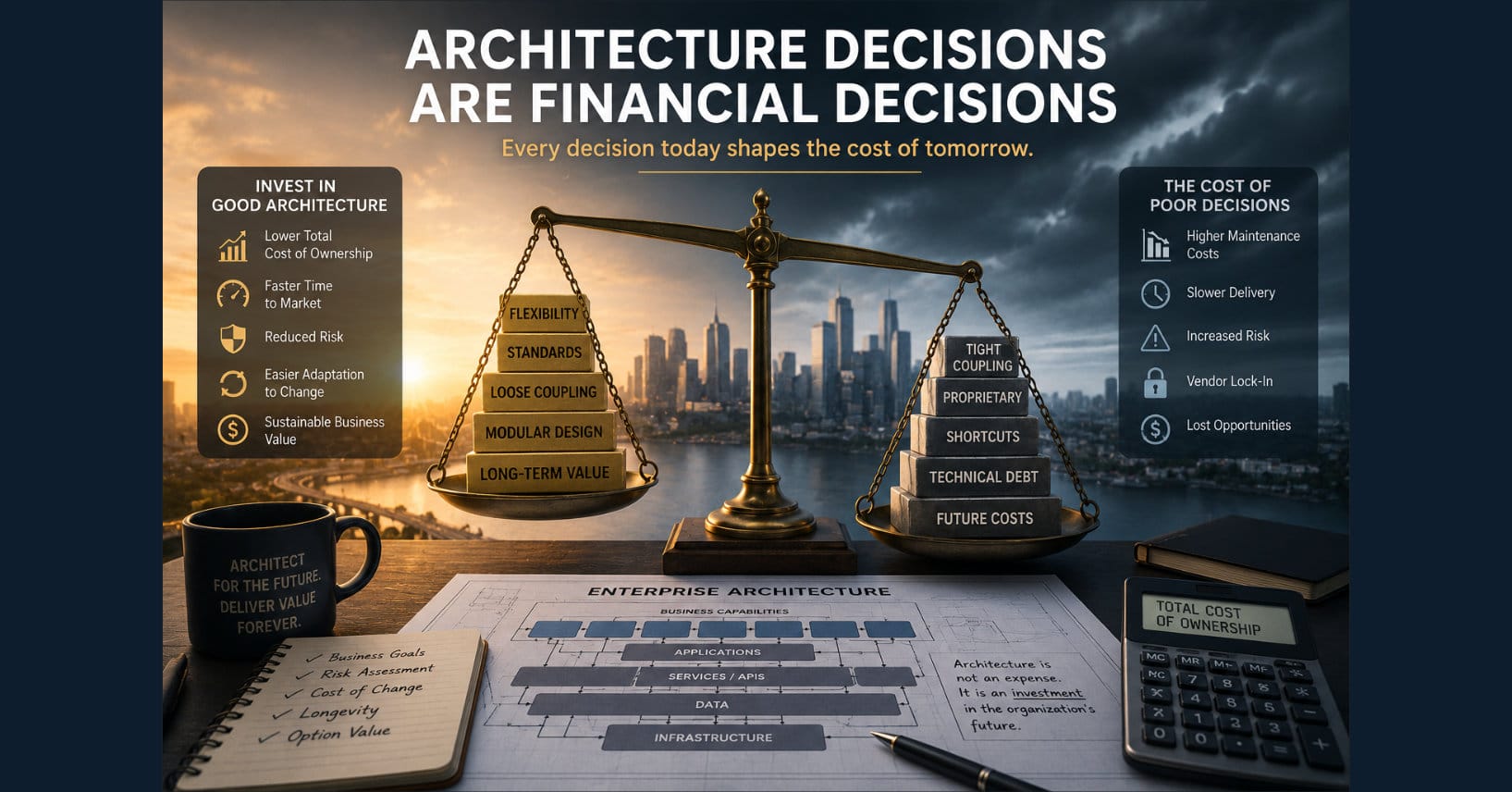
Every architectural decision creates a financial commitment that extends far beyond the initial implementation. This article explores how architecture shapes total cost of ownership, operational efficiency, vendor dependency, and an organization’s ability to adapt to future business needs. The best architectures are not simply technically elegant—they maximize long-term business value while minimizing the cost of change.
Executive Brief
Architecture is often viewed as a technical discipline, delegated to architects and engineering teams to determine frameworks, platforms, and system designs. Yet every architectural decision carries financial consequences that extend far beyond the IT department.
An architecture determines how quickly new products can be delivered, how expensive systems become to maintain, how resilient operations remain during disruption, and how effectively an organization responds to new business opportunities.
Whether leadership realizes it or not, architecture is an investment strategy. Every design choice either compounds organizational value or compounds future costs.
Good architecture is not simply good engineering—it is good financial stewardship.
The Business Problem
Organizations routinely scrutinize capital expenditures, operating budgets, and vendor contracts. Every dollar receives careful justification.
Ironically, some of the largest long-term financial commitments are made during architectural design sessions.
A decision to tightly couple systems may save development time today while adding years of increased maintenance costs.
Selecting a proprietary platform may accelerate implementation but create significant licensing and migration expenses later.
Ignoring scalability may reduce initial project costs while requiring a complete redesign after business growth.
Choosing convenience over maintainability often appears inexpensive because the financial consequences are deferred.
Unlike hardware purchases or software licenses, architectural debt rarely appears on a balance sheet.
Instead, it accumulates quietly until every enhancement becomes slower, every deployment becomes riskier, and every business initiative becomes more expensive.
Eventually, the organization discovers it has not merely built software.
It has purchased an expensive operating model.
The Architectural Principle
Every architectural decision should be evaluated as an investment.
Some investments produce immediate returns while preserving future flexibility.
Others provide short-term gains at the expense of long-term adaptability.
The objective is not always to choose the least expensive option.
The objective is to maximize long-term organizational value.
This requires architects to think beyond technical elegance.
They must evaluate:
- Implementation costs
- Operational costs
- Maintenance costs
- Scalability costs
- Integration costs
- Training costs
- Vendor dependency
- Opportunity costs
- Replacement costs
Viewed through this lens, architecture becomes an exercise in capital allocation rather than technical preference.
The most valuable architectures are those that continue generating returns long after the original project has been completed.
Enterprise Example
Consider an organization selecting a document management platform.
One solution offers rapid deployment through proprietary customization tools. The implementation is completed several months earlier than expected.
A competing solution requires additional upfront engineering but relies upon open standards, modular interfaces, and portable data formats.
Five years later, the proprietary vendor significantly increases licensing fees.
Integrating new business applications requires expensive consulting services.
Exporting data becomes difficult.
Replacing the platform would require rewriting dozens of custom integrations.
The organization remains locked into decisions made years earlier.
Meanwhile, the second organization upgrades components independently, negotiates with multiple vendors, and introduces new capabilities without replacing the entire platform.
The original implementation required a larger investment.
The lifetime cost of ownership proved substantially lower.
The architectural decision produced financial leverage.
Common Mistakes
Many organizations evaluate architecture exclusively through project budgets.
This perspective overlooks the majority of a system’s lifecycle costs.
Another common mistake is measuring success by delivery speed alone. Delivering quickly has value, but only if the resulting architecture remains economical to evolve.
Some teams over-optimize for theoretical future requirements, investing heavily in flexibility that the business may never need.
Others optimize exclusively for immediate delivery, creating architectures that become increasingly expensive with every enhancement.
Perhaps the most costly mistake is allowing technology preferences to replace financial analysis.
Architects should never ask only, “Is this technically superior?”
They should also ask, “What financial commitments does this decision create over the next decade?”
Architecture Insight
Technical debt is not merely a technical liability.
It is deferred financial debt.
Every shortcut taken today creates interest payments that future engineering teams—and future budgets—must eventually repay.
Questions Architects Should Ask
Before approving an architectural decision, consider:
- What is the expected total cost of ownership?
- Does this decision reduce or increase future operating expenses?
- How easily can this component be replaced?
- Are we creating unnecessary vendor dependency?
- Will this architecture reduce the cost of future business initiatives?
- What financial assumptions are embedded in this design?
Architect’s Checklist
Evaluate major architectural decisions against these criteria:
- Long-term maintenance costs have been considered.
- Vendor lock-in has been evaluated.
- Future scalability costs are understood.
- Integration costs are minimized.
- Replacement strategies exist.
- Business flexibility has financial value.
- The decision creates more options than constraints.
Conclusion
Architecture is frequently discussed in terms of technologies, frameworks, and design patterns.
Executives experience it differently.
They experience architecture through budgets.
Through project timelines.
Through acquisition costs.
Through maintenance contracts.
Through operational efficiency.
Through business agility.
Every architectural decision establishes financial commitments that often persist for years after the original implementation.
Organizations that recognize this treat architecture as a strategic investment rather than a technical exercise.
The most successful enterprise architectures are not simply the most elegant.
They are the ones that continuously deliver business value while reducing the cost of adapting to whatever comes next.