Enterprise Architecture Series—Article 1
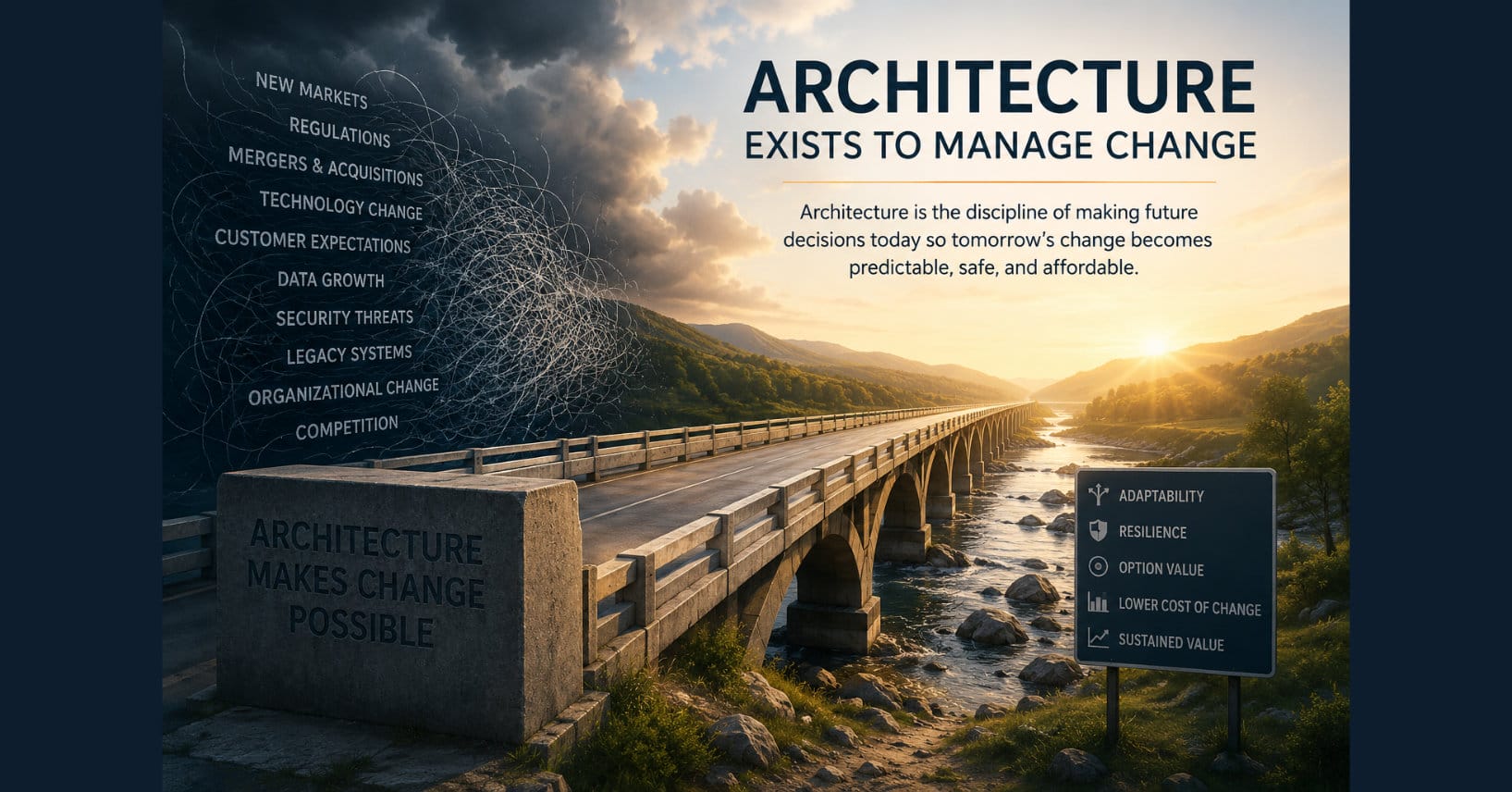
Enterprise architecture exists to manage change—not prevent it. This article explains why successful architectures are designed for adaptability rather than permanence, how architectural decisions influence an organization’s ability to evolve, and why future flexibility is one of the most valuable outcomes an architect can deliver.
Executive Brief
Many organizations believe enterprise architecture is about producing diagrams, defining standards, or selecting technologies. While those activities have value, they are not the purpose of architecture.
Enterprise architecture exists for one reason: to enable organizations to change predictably, safely, and economically.
Technology changes. Business priorities change. Regulations change. Markets change. Customer expectations change. The organizations that thrive are not necessarily those with the newest technology—they are those whose systems can adapt without creating instability.
Architecture is the discipline of making future decisions today so tomorrow’s change becomes an engineering exercise instead of an organizational crisis.
The Business Problem
Every software system begins with a specific business objective. Teams design applications to solve today’s problem using today’s assumptions.
The challenge is that assumptions rarely remain true.
A company enters a new market.
A merger introduces another technology stack.
Regulations require new reporting.
Artificial intelligence changes customer expectations.
An acquisition doubles transaction volume.
A product originally intended for fifty users now serves fifty thousand.
None of these events represent failures. They represent growth.
Unfortunately, many systems are designed only for their initial requirements. Every new business initiative requires increasing amounts of engineering effort because the architecture assumed the future would resemble the past.
Eventually, the organization reaches a point where every change becomes expensive, slow, and risky.
The software is not broken.
The architecture simply failed to anticipate that change is inevitable.
The Architectural Principle
Good architecture does not attempt to predict the future.
Instead, it prepares the organization to respond to an uncertain future.
That distinction changes everything.
Architects are not fortune tellers. They cannot know which technologies will dominate five years from now or what business opportunities leadership will pursue next quarter.
What they can do is reduce the cost of adapting when those events occur.
This requires designing systems around stable business capabilities rather than temporary implementation details.
It means minimizing unnecessary dependencies between components.
It means establishing clear interfaces that allow parts of the system to evolve independently.
It means separating policy from implementation, data from presentation, and business rules from infrastructure.
Architecture does not eliminate change.
Architecture makes change affordable.
Enterprise Example
Consider two organizations implementing a customer management platform.
The first organization tightly integrates customer data, billing, reporting, authentication, and marketing automation into a single application. Every feature shares the same database tables, business logic, and deployment process.
Initially, development moves quickly.
Three years later, marketing wants personalized customer experiences powered by artificial intelligence. Finance needs new reporting requirements. Sales requests CRM integration. Security mandates multi-factor authentication.
Each enhancement requires modifying the same interconnected application.
A small change in one area unexpectedly affects another.
Testing cycles grow longer.
Release schedules slow.
Technical debt accumulates.
The second organization approaches the problem differently.
Customer identity is treated as a business capability.
Billing remains independent.
Reporting consumes published interfaces instead of querying operational databases directly.
Authentication is abstracted behind a service boundary.
When new requirements emerge, individual capabilities evolve without destabilizing the rest of the platform.
Both organizations experienced change.
Only one architecture was prepared for it.
Common Mistakes
Organizations frequently misunderstand architecture because they focus on artifacts instead of outcomes.
One common mistake is equating architecture with documentation. Diagrams provide value only if they support better decisions. A perfectly documented system can still be impossible to evolve.
Another mistake is optimizing exclusively for current requirements. Every design decision assumes today’s needs are permanent, creating unnecessary rigidity when priorities inevitably change.
Some organizations pursue architectural perfection by designing for every conceivable future scenario. This often produces unnecessary complexity that delays delivery without improving adaptability.
Others ignore architecture entirely until systems become difficult to maintain. At that point, architectural work becomes significantly more expensive because existing constraints must first be untangled.
The objective is not to eliminate future uncertainty.
The objective is to reduce the cost of responding to it.
Architecture Insight
Successful architectures are measured less by how well they support today’s requirements than by how gracefully they accommodate tomorrow’s.
If your next major business initiative requires rewriting large portions of your existing platform, the architecture has become part of the problem instead of part of the solution.
Questions Architects Should Ask
Before approving any significant architectural decision, ask:
- Will this decision make future changes easier or harder?
- What assumptions are we making that may no longer be true in five years?
- Can individual components evolve independently?
- Are business capabilities isolated from implementation details?
- If this technology becomes obsolete, how difficult will replacement be?
- Have we optimized for adaptability instead of simply optimizing for delivery speed?
Architect’s Checklist
Evaluate your architecture against these principles:
- Change can occur without widespread system modification.
- Dependencies between components are intentional and limited.
- Business capabilities are clearly separated.
- Interfaces are stable and well-defined.
- Infrastructure decisions are replaceable.
- The cost of future change has been considered alongside the cost of initial implementation.
Conclusion
Every organization changes. Markets evolve, technologies mature, regulations emerge, and customer expectations continue to rise.
Software that cannot evolve eventually becomes an obstacle to the business it was built to support.
Enterprise architecture is not about producing impressive diagrams or documenting technology choices.
Its purpose is much simpler—and far more valuable.
Architecture exists to ensure that tomorrow’s business decisions are not constrained by yesterday’s technical decisions.
Organizations that understand this principle build systems capable of surviving far beyond their original requirements. Those that do not eventually discover that the greatest cost of software is rarely the initial implementation—it is the inability to change.